
制造业

Search documents
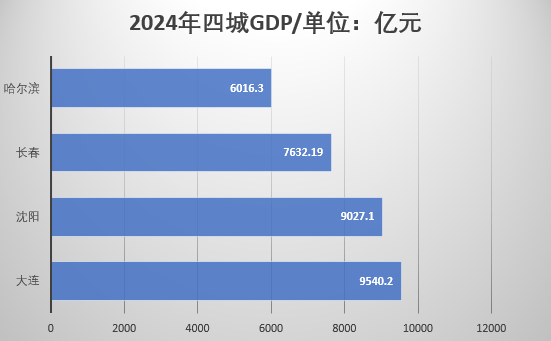
大连成东北首个“万亿城市”
Sou Hu Cai Jing· 2026-01-26 07:26
Core Viewpoint - Dalian has officially joined the trillion-yuan GDP club with a projected GDP of 1,000.21 billion yuan for 2025, marking a year-on-year growth of 5.7% at constant prices, highlighting its significant role in the industrial and port economy [1][2][6] Economic Performance - Dalian's GDP for 2024 is estimated at 954.02 billion yuan, making it a "quasi-trillion city" [2] - In the first three quarters of 2025, the city's GDP reached 724.82 billion yuan, reflecting a year-on-year growth of 6.0%, with the final annual GDP achieving the target of 1,000.21 billion yuan [2] - The city's industrial added value for 2025 is expected to grow by 11.7% year-on-year, an increase of 4.1 percentage points from the previous year, indicating robust industrial economic performance [2] Industrial Strengths - Dalian is recognized as a key traditional industrial base, with advantages in sectors such as equipment manufacturing, shipbuilding, and petrochemicals, which are crucial for its economic stability [2] - The port economy is a significant asset, with Dalian Port handling over 98% of Northeast China's foreign trade containers and more than 60% of crude oil transshipment [2] Investment and Development - The city has seen a notable increase in industrial investment, with manufacturing and industrial technological transformation investments growing by 2.8% and 14.5%, respectively [3] - In 2025, Dalian initiated 1,369 projects worth over 100 million yuan, a growth of 14.1%, including major projects like the Jinzhou Bay International Airport and the Changhai Cross-Sea Bridge [3] Future Challenges - Despite achieving a trillion-yuan GDP, Dalian faces challenges in areas such as technological innovation, with a lack of high-quality innovative enterprises and a low representation in national rankings [4][5] - The city must address structural imbalances in its economy, with heavy reliance on traditional industries and underdeveloped light industries and services [5] Regional Impact - Dalian's status as a trillion-yuan city is expected to enhance its regional influence, attracting more investment and talent to Northeast China, which is crucial for the region's overall revitalization [6][9] - The city aims to play a leading role in the revitalization of Liaoning and Northeast China, emphasizing the importance of its port in regional economic development [6][9]

前瞻:市场风暴眼美联储决议,如何为降息预期定调?
Sou Hu Cai Jing· 2026-01-26 07:20
Group 1 - The focus of the market is on the potential 100% tariffs imposed by President Trump on Canada if a trade agreement is reached with China, leading to a shift towards safe-haven assets [1] - The Federal Reserve's interest rate decision is a key point of interest this week, especially amid escalating global geopolitical tensions [1] - A series of important economic data releases this week will provide clearer insights into the global economic situation, which investors are closely monitoring [1] Group 2 - On Monday, the market will pay attention to Germany's IFO Business Climate Index, which is expected to show improvement, indicating a gradual recovery in the German economy [3] - The U.S. is set to release November durable goods orders, with expectations of a significant improvement to 3.7% month-on-month, up from -2.2% [3] Group 3 - On Tuesday, the U.S. will release the Conference Board Consumer Confidence Index, with expectations for a slight improvement above 90, reflecting consumer sentiment towards the economy [4] - The Richmond Fed Manufacturing Index is also expected to remain negative for the 11th consecutive month, but a slight improvement is anticipated, suggesting a gradual recovery in manufacturing [4] Group 4 - On Wednesday, Australia's CPI for December is expected to rise to 3.5% year-on-year, maintaining expectations for potential interest rate hikes by the Reserve Bank of Australia [6] - The Bank of Canada is expected to keep its interest rate unchanged at 2.25%, with most market participants anticipating stability unless trade negotiations with the U.S. falter [6] Group 5 - On Thursday, the Federal Reserve is expected to maintain its interest rate, with market participants looking for insights from Chairman Powell's press conference regarding future policy directions [7] - The market anticipates at least two rate cuts from the Federal Reserve this year, emphasizing a cautious stance amid geopolitical tensions [7] Group 6 - On Friday, Japan will release December employment data, while Germany and the Eurozone will report January unemployment rates, expected to remain at 6.3% [8] - The Eurozone's Q4 GDP is projected to slow from 1.4% to 1.3% year-on-year, with the ECB noting stronger-than-expected economic resilience driven by domestic demand [8]

江苏制造业:2026年贴息细则出台,已下达10.59亿贴息
Sou Hu Cai Jing· 2026-01-26 06:18
【1月26日江苏印发2026年制造业贷款财政贴息实施细则】1月26日消息,江苏省财政厅联合省发展改革 委、省工信厅印发2026年江苏省制造业贷款财政贴息实施细则。新增制造业新型政策性金融工具贴息等 扩围举措,为企业设备更新等提供财政支撑。 江苏自2024年起实施以"免申""直达""普惠"为导向的制造 业贷款财政贴息政策。对省内相关企业按设备购置贷款金额给予省市各1%贴息,先预拨、后清算,成 效显著。 截至2025年底,省市联动下达贴息资金10.59亿元。带动合作金融机构向1672个项目放贷超千 亿元,其中设备贷款725亿元,降低企业融资成本。 【免责声明】本文仅代表作者本人观点,与和讯网无关。和讯网站对文中陈述、观点判断保持中立,不 对所包含内容的准确性、可靠性或完整性提供任何明示或暗示的保证。请读者仅作参考,并请自行承担 全部责任。邮箱:news_center@staff.hexun.com 本文由 AI 算法生成,仅作参考,不涉投资建议,使用风险自担 ...
争夺全国第二个5万亿“工业之城”苏州有几张底牌?
Xin Lang Cai Jing· 2026-01-26 04:32
转自:中国经营报 中经记者方超张家振上海报道 在规上工业总产值2021年跨上4万亿元台阶后,有"最强地级市"之称的江苏省苏州市正全力冲刺新目 标。 日前,在苏州市新型工业化推进会议暨"AI+制造"创新发展大会上,当地明确提出了"2026年规上工业总 产值突破5万亿元"的目标。公开信息显示,2025年,苏州市规上工业总产值预计达4.89万亿元。 《中国经营报》记者注意到,在AI重塑经济社会发展模式的当下,苏州市正依托深厚的工业底蕴,打 出一套"AI+制造"组合拳,全力冲击5万亿"工业之城"。 根据苏州市提出的发展目标,2026年,苏州市规上工业总产值将突破5万亿元大关。这也意味着,苏州 市有望成为继广东省深圳市后,全国第二个规上工业总产值达5万亿元的城市。 苏州的目标显然并不止于此。2026年1月21日对外披露的《中共苏州市委关于制定苏州市国民经济和社 会发展第十五个五年规划的建议》(以下简称《苏州"十五五"规划建议》)明确提出,高水平建设制造 强市、质量强市,打造具有国际竞争力的"智能制造之城"。 剑指全球"智造之城" 借力人工智能热潮,苏州市正打响一场从"制造大市"向"智造之城"的攻坚战。 2026年1月4 ...
摩根士丹利2026年十大预测:AI能力分化加剧,科技巨头加速整合能源设施
Hua Er Jie Jian Wen· 2026-01-26 04:00
Core Insights - Morgan Stanley's 2026 market outlook highlights four major themes: AI technology diffusion, energy future, multipolar world, and social change, presenting ten key predictions for investors to understand the evolving market landscape driven by technology [1] Group 1: AI Technology Predictions - Prediction one indicates a bifurcated global AI development landscape, with the U.S. expected to achieve a leap in capabilities for frontier large models by the first half of 2026, while competitors in other regions will struggle to match this progress, creating a "two worlds" scenario in AI development [2] - Prediction two emphasizes that the demand for computing power will grow exponentially, outpacing supply growth, driven by the proliferation of AI applications and increasing complexity of use cases [3] Group 2: Policy and Economic Implications - Prediction three forecasts that the Trump administration will implement stronger policies than anticipated, focusing on ensuring domestic supply of critical minerals, supporting manufacturing return, increasing military spending, and lowering consumer costs [4] - Prediction four discusses the pressure for AI technology transfer and the pursuit of national self-sufficiency, which may affect trade dynamics as countries strive to enhance their domestic AI capabilities [5] Group 3: Energy and Infrastructure - Prediction five states that rising global energy costs will lead to a backlash against data center growth, prompting the introduction of low-cost energy support policies and encouraging data center projects to adopt off-grid power strategies [6] - Prediction six predicts that major AI companies will accelerate their integration with energy infrastructure to secure reliable and cost-effective energy sources, thereby enhancing energy and power efficiency through AI [7] Group 4: Manufacturing and Labor Market Changes - Prediction seven suggests that China will increase its share in the global manufacturing market in key tech-intensive sectors, while the U.S. manufacturing balance will tilt towards domestic production as technology diffusion diminishes the advantage of low-cost labor [8] - Prediction ten highlights that companies and governments will initiate extensive retraining programs to address employment changes driven by AI, with political sensitivity around perceived job losses leading to various policy interventions [10] Group 5: Economic Transformation - Prediction eight indicates that Latin America will enter a new investment cycle driven by policy shifts, geopolitical changes, and peak interest rates, with this bull market being investment-led rather than consumption-driven [9] - Prediction nine anticipates early signs of transformative AI leading to rapid price declines across multiple sectors by the second half of 2026, which may exacerbate wage inequality and increase capital expenditures, reshaping national competitiveness [11]

锐财经丨工业经济持续向优向新发展
Ren Min Ri Bao Hai Wai Ban· 2026-01-26 03:07
Group 1: Industrial Growth and Performance - In 2025, the industrial added value of large-scale industries increased by 5.9% compared to the previous year, showing a faster growth rate, up by 0.1 percentage points [2] - The mining, manufacturing, and electricity, heat, gas, and water production and supply industries saw added value growth of 5.6%, 6.4%, and 2.3% respectively [2] - Among 41 major industrial categories, 36 experienced growth, resulting in a growth coverage of 87.8% [2] Group 2: Export Performance - Large-scale industrial enterprises achieved an export delivery value of 15.8 trillion yuan, a 2.2% increase from the previous year, demonstrating strong resilience [2] - The equipment manufacturing sector showed significant export performance, with railway, shipbuilding, aerospace, and specialized equipment exports increasing by 24.2%, 10.2%, and 7.5% respectively [2] Group 3: Profit Structure Improvement - From January to November 2025, profits of large-scale industrial enterprises continued to grow, with the equipment manufacturing sector's profits increasing by 7.7%, contributing 2.8 percentage points to the overall profit growth of large-scale industrial enterprises [2] Group 4: High-tech Manufacturing Growth - In 2025, the added value of high-tech manufacturing increased by 9.4%, the highest growth rate since 2022, contributing 26.1% to the overall industrial growth [5] - Specific industries such as integrated circuit manufacturing, aircraft manufacturing, and biopharmaceuticals saw added value growth rates of 26.7%, 24.8%, and 12.1% respectively [5] Group 5: Digital Product Manufacturing - The added value of the digital product manufacturing industry grew by 9.3% in 2025, contributing 20.3% to the overall industrial growth [7] - Production of communication products like mobile communication base station equipment and 5G smartphones increased by 13.5% and 12.5% respectively [7] Group 6: Technological Innovation and Product Development - Companies are focusing on technological and industrial innovation, with examples like the AI-powered unmanned bulldozer deployed in complex mining environments [4] - New technologies such as perovskite materials and quantum computing are advancing rapidly, with successful prototypes being developed [4] Group 7: Consumer Supply and Market Trends - The industrial sector is adapting to new consumption trends, with a focus on optimizing product supply and enhancing brand development [8] - The integration of 5G, industrial internet, and other technologies into various sectors is expected to support the digital transformation of the economy [8]
大摩闭门会-消费-资本支出与财政政策如何驱动增长
2026-01-26 02:49
Summary of Key Points from Conference Call Industry and Economic Overview - **US Economy**: The US economy is expected to exhibit a K-shaped recovery in 2025, with stable consumption from high-income households, primarily driven by asset markets and housing prices. In 2026, inflation is projected to decline, and the peak effects of tariffs will fade, potentially enhancing purchasing power for middle- and low-income households, leading to a dual-driven consumption model [1][2] - **Eurozone Economy**: The Eurozone's economic performance is complex, with Germany showing significant potential for acceleration due to fiscal stimulus, while France and Italy are underperforming. Spain is strong but has a small share in the Eurozone. By the end of 2027, Eurozone growth is expected to exceed potential levels, accelerating from 0.1%-0.2% to around 0.35% [1][5] - **China's Macroeconomic Environment**: The macroeconomic environment in China remains challenging in 2026, with persistent deflationary pressures. However, advancements in advanced manufacturing are expected to improve global market share for exports. The People's Bank of China is unlikely to allow significant appreciation of the yuan to avoid exacerbating deflation, which could negatively impact corporate revenues, wage growth, and consumption [1][6] - **Asian Economies**: Other Asian economies are primarily driven by exports, with technology exports benefiting in 2025, while non-technology exports are expected to recover in 2026, leading to improved capital spending, employment, and consumption [1][3][7] Key Themes in Capital Expenditure - **Artificial Intelligence (AI) Investment**: In 2025, corporate spending will focus on AI, with non-AI related expenditures affected by policy uncertainties. AI investments are crucial for sustainable corporate spending, although a significant portion may not be reflected in GDP due to being intermediate or imported goods. If the recovery broadens, non-AI related spending may gain momentum, contributing to cyclical economic upturns [1][4] Risks and Considerations - **US Tariffs on Europe**: If the US imposes an additional 10% tariff on Europe, it could reduce GDP growth by 30-60 basis points. Retaliatory measures could further increase downside risks, indicating that new trade uncertainties could negatively impact Europe [1][3][9] - **Federal Reserve's Response to AI Adoption**: Rapid adoption of AI could significantly boost productivity growth, nearing 3%, similar to the tech boom of the 1990s. This may accelerate actual growth while inflation could decline, allowing the Federal Reserve to consider interest rate cuts, although timing will depend on balancing strong data with signs of falling inflation [1][8] Additional Insights - **Potential for Fiscal Stimulus in China**: A comprehensive demand-driven fiscal stimulus from Beijing is unlikely unless significant social stability challenges arise. In such cases, a shift towards consumer-focused policies, including increased social welfare spending, particularly for migrant workers, may be considered [1][10]
2025年浙江全社会用电量达7266.5亿千瓦时
Zhong Guo Dian Li Bao· 2026-01-26 01:57
Core Viewpoint - Zhejiang's electricity consumption is projected to reach 726.65 billion kWh by 2025, reflecting a year-on-year growth of 7.18%, indicating a positive economic development trend in the region [1] Group 1: Electricity Consumption by Sector - In 2022, the electricity consumption in Zhejiang's three major industries was 4.11 billion kWh, 476.81 billion kWh, and 133.2 billion kWh, with year-on-year growth rates of 12.14%, 5.60%, and 10.84% respectively [1] - The total electricity consumption for urban and rural residents reached 112.54 billion kWh, marking a growth of 9.65% [1] Group 2: Industrial and Service Sector Insights - As a major industrial and manufacturing province, Zhejiang aims to maintain stable industrial operations and optimize its structure, with industrial electricity consumption projected at 469.37 billion kWh in 2025, reflecting a year-on-year increase of 5.82% [1] - The electricity consumption in the information transmission, software, and IT services sector, which is closely related to the digital economy, reached 12.38 billion kWh, showing a growth of 14% [1] - The wholesale and retail sector, closely tied to the consumption economy, consumed 33.56 billion kWh, with a growth rate of 15.34%, while the electricity consumption for charging and swapping services surged to 7.77 billion kWh, an increase of 55.36% [1]
构建国企原始创新的长效驱动机制
Xin Lang Cai Jing· 2026-01-26 01:55
■ 马国维 《中共中央关于制定国民经济和社会发展第十五个五年规划的建议》提出,加强原始创新和关键核心技 术攻关。《中共中央关于进一步全面深化改革、推进中国式现代化的决定》对深化国资国企改革进行了 全方位部署,其中专门提出"健全国有企业推进原始创新制度安排"。在全球科技竞争白热化的当下,原 始创新能力在很大程度上决定着一个国家、一个民族的核心竞争力。当前,浙江省国资国企改革已进入 深水区,主要经济指标位居全国前列,但在原始创新领域仍存在短板。唯有以更大的改革勇气和历史耐 心,打破短期绩效的窠臼,构筑鼓励探索、宽容失败、激励长远的制度环境,才能点燃原始创新的引 擎,培育出属于浙江、影响世界的未来产业巨头,为在中国式现代化新征程上"勇当先行者、谱写新篇 章"注入强劲动能。 制约国企原始创新活力的现实挑战 国际领先制造业企业的发展轨迹揭示,原始创新并非偶然的灵光一现,而是长期战略定力、专业化组织 保障与适应性制度文化共同作用的结果。我省部分国企在技术创新与应用开发上成绩显著,但在系统 性、专注性的原始创新布局上,尚未形成与之规模匹配的战略纵深和专门队伍。这种差距,并非单纯由 企业发展历史长短决定,更关键的在于是否在制 ...
热烈祝贺市两会闭幕
Su Zhou Ri Bao· 2026-01-26 00:58
Group 1 - The core message emphasizes the successful conclusion of the municipal meetings, highlighting the unity and collective effort of representatives from various sectors to discuss development strategies for the city [1] - The meetings resulted in the approval of reports and resolutions that reflect the common will of the people, aiming to harness the collective strength of Suzhou for future progress [1] Group 2 - The "14th Five-Year Plan" has seen significant achievements, with the region's GDP and industrial output reaching historic highs, indicating a robust momentum for high-quality development [2] - The "15th Five-Year Plan" aims for a GDP growth of over 5% and an industrial output exceeding 5 trillion yuan, focusing on innovation and the establishment of a modern industrial system centered on advanced manufacturing [2] - The plan emphasizes the importance of maintaining a strong foundation in the real economy and fostering high-tech innovation to enhance Suzhou's competitiveness as a "smart manufacturing city" [2] Group 3 - The meetings stress the importance of cultural empowerment in building a strong socialist cultural city, balancing heritage preservation with urban renewal [3] - Initiatives will focus on enhancing the charm and cultural appeal of the ancient city while promoting the "Jiangnan culture" brand on the international stage [3] - The commitment to prioritizing the people's well-being includes addressing urgent needs in employment, education, healthcare, and housing, ensuring that development benefits are tangible for the community [3] Group 4 - The "15th Five-Year Plan" marks a new beginning, calling for unity and commitment to implement the central government's directives and advance the modernization of Suzhou [4] - There is a strong emphasis on confidence and continuous effort to achieve significant progress in the city's development, aligning with the broader goals of the nation [4]