医美

Search documents
港股异动 | 四环医药(00460)尾盘涨近9% 旗下渼颜空间“冻妍”获国家药监局批准上市
智通财经网· 2025-10-02 08:04
Core Viewpoint - Four Seasons Pharmaceutical (00460) experienced a nearly 9% increase in stock price, closing at 1.75 HKD, following the announcement of its product approval by the National Medical Products Administration of China [1] Group 1: Product Approval - The company’s subsidiary, Meiyan Space Biotechnology (Jilin) Co., Ltd., received a Class III medical device registration certificate for its self-developed injectable transparent sodium hyaluronate composite solution, branded as "Dongyan" [1] - "Dongyan" is the first approved compound solution in China that contains L-carnosine, designed for temporary improvement of skin dryness and dull complexion [1] Group 2: Strategic Product Matrix - The approval of "Dongyan" marks another milestone for Meiyan Space, following the earlier launches of "Tongyan Injection" and "Shaonian Injection" within the year [1] - The company is building a strategic product matrix that combines compliant regenerative materials (Tongyan and Shaonian injections) with skin quality management (water light needle) as dual engines [1] Group 3: Market Position - Meiyan Space has over thirty approved products, establishing a comprehensive product layout in the light medical beauty sector [1] - The company has achieved an integrated layout from skin quality improvement to contour modification, reinforcing its leading position in comprehensive anti-aging solutions [1]
四环医药自研复合溶液水光针“冻妍”破局,国产医美再添猛将
Ge Long Hui· 2025-09-30 11:59
Core Insights - The approval of "Dongyan," a hyaluronic acid compound solution, marks a significant breakthrough for the company in the medical aesthetics sector, being the first product in China to include L-carnosine for facial skin improvement [1][4][9] - The product's launch aligns with the rapid growth of the water light needle market, which is projected to reach $1.8 billion globally by 2025 and $4.5 billion in China by 2025, with a CAGR of 21.5% [4][14] Product Overview - "Dongyan" is designed to temporarily improve skin dryness and dullness, ensuring compliance and efficacy through a professional injection model [4][7] - The product features a composite formula that includes key ingredients such as hyaluronic acid, L-carnosine, vitamin B2, and essential amino acids, targeting comprehensive skin management [6][9] Market Positioning - The launch of "Dongyan" fills a gap in the market for compliant facial water light needles containing L-carnosine, which has been absent in China [5][9] - The product's positioning as a comprehensive skin improvement solution caters to the increasing demand for advanced skin health management, particularly among women over 30 [9][14] Strategic Development - The approval of "Dongyan" is part of the company's dual-engine strategy in the medical aesthetics field, complementing existing products like "Tongyan Needle" and "Shaonian Needle" [10][11] - The company has established a robust sales network covering over 6,800 medical aesthetic institutions across more than 370 cities in China, enhancing its market penetration capabilities [11][15] Financial Performance - The medical aesthetics division has shown significant growth, with a reported 85% year-on-year increase in revenue for the first half of 2025, surpassing traditional business revenue contributions [13][14] - The company is expected to continue its positive financial trajectory, supported by the launch of "Dongyan" and ongoing product development in the medical aesthetics sector [12][15]

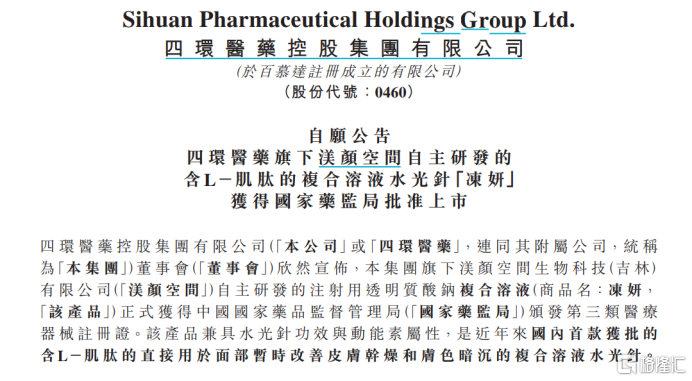
四环医药旗下渼颜空间自主研发的含L-肌肽的复合溶液水光针“冻妍”获国家药监局批准上市
Zhi Tong Cai Jing· 2025-09-30 08:41
Core Viewpoint - The approval of the injectable transparent sodium hyaluronate composite solution "Dongyan" marks a significant milestone for the company, enhancing its product portfolio in the aesthetic medicine sector [1][2] Group 1: Product Development - "Dongyan" is the first approved injectable solution containing L-carnosine in China, designed to temporarily improve skin dryness and dull complexion [1] - The product's key ingredients include sodium hyaluronate, L-carnosine, vitamin B2, glycine, alanine, and proline, which collectively support skin hydration, antioxidant properties, and collagen regeneration [1] Group 2: Strategic Positioning - The approval of "Dongyan" follows the earlier launches of "Tongyan" and "Shaonv" needles, further establishing a dual-engine strategic product matrix focused on compliant regenerative materials and skin quality management [2] - The company has over thirty approved products, creating a comprehensive product layout in the light medical beauty sector, from skin quality improvement to contour modification [2] Group 3: Future Plans - The company plans to increase investment in aesthetic medicine research and development, leveraging its nationwide sales network to promote "Dongyan" and enhance brand building [2] - The goal is to provide safer, more advanced, and personalized aesthetic services, leading the high-quality development of the Chinese aesthetic medicine industry [2]
四环医药(00460) - 自愿公告-四环医药旗下渼顏空间自主研发的含L-肌肽的复合溶液水光针「冻妍...
2025-09-30 08:30
香港交易及結算所有限公司及香港聯合交易所有限公司對本公告之內容概不 負 責,對 其 準 確 性 或 完 整 性 亦 不 發 表 任 何 聲 明,並 明 確 表 示,概 不 就 因 本 公 告 全部或任何部份內容而產生或因倚賴該等內容而引致之任何損失承擔任何責 任。 Sihuan Pharmaceutical Holdings Group Ltd. 四環醫藥控股集團有限公司 (於百慕達註冊成立的有限公司) (股份代號:0460) 自願公告 四環醫藥旗下渼顏空間自主研發的 含L-肌 肽 的 複 合 溶 液 水 光 針「凍 妍」 獲得國家藥監局批准上市 四 環 醫 藥 控 股 集 團 有 限 公 司(「本公司」或「四環醫藥」,連 同 其 附 屬 公 司,統 稱 為「本集團」)董 事 會(「董事會」)欣 然 宣 佈,本 集 團 旗 下 渼 顏 空 間 生 物 科 技(吉 林) 有 限 公 司(「渼顏空間」)自 主 研 發 的 注 射 用 透 明 質 酸 鈉 複合溶液(商 品 名:凍 妍, 「該產品」)正 式 獲 得 中 國 國 家 藥 品 監 督 管 理 局(「國家藥監局」)頒 發 第 三 類 醫 療 器 械 註 冊 ...
商贸零售行业周报:吉宏股份预告高增长,关注三季度高景气赛道公司-20250928
KAIYUAN SECURITIES· 2025-09-28 14:36
Investment Rating - The industry investment rating is "Positive" (maintained) [1] Core Views - The retail industry index decreased by 4.32% in the week of September 22-26, 2025, underperforming the Shanghai Composite Index, which increased by 0.21% [6][13] - The report highlights the strong performance of certain companies, such as Jihong Co., which is expected to achieve a net profit of 209-222 million yuan for Q3 2025, representing a year-on-year increase of 55-65% [4][26] - The report emphasizes the importance of emotional consumption themes and recommends focusing on high-quality companies in high-growth sectors [7][31] Summary by Sections Retail Market Review - The retail industry index closed at 2281.69 points, ranking 29th among 31 primary industries [6][13] - The brand cosmetics sector experienced the smallest decline of 1.31% during the week, while the watch and jewelry sector led with a year-to-date increase of 26.87% [18][20] Company Performance Highlights - Jihong Co. is expected to achieve a net profit of 209-222 million yuan for Q3 2025, driven by its dual business model of cross-border e-commerce and packaging [4][26] - Old Puhuang reported a revenue of 12.354 billion yuan for H1 2025, a year-on-year increase of 250.9%, with a net profit of 2.268 billion yuan, up 285.8% [36][37] - Chao Hong Ji achieved a revenue of 4.102 billion yuan in H1 2025, with a net profit increase of 44.3% [39] Investment Recommendations - Focus on high-quality companies in the gold and jewelry sector, such as Old Puhuang and Chao Hong Ji, which are expected to benefit from emotional consumption trends [7][31] - Emphasize the importance of offline retail companies that adapt to consumer trends, recommending companies like Yonghui Supermarket and Aiying Room [31][32] - Highlight the potential of domestic beauty brands, recommending companies like Mao Ge Ping and Po Lai Ya, which are positioned well in the high-end market [32][33]

行业点评报告:医美化妆品8月月报:锦波生物胶原蛋白冻干纤维获药用辅料登记,珀莱雅拟赴港上市-20250927
KAIYUAN SECURITIES· 2025-09-27 15:19
Investment Rating - The industry investment rating is "Positive" (maintained) [1] Core Viewpoints - The report highlights the strong performance of the retail and beauty sectors, with a focus on the growth potential of domestic brands in the beauty industry [6][44] - The medical beauty segment is expected to see new growth drivers from innovative products, while the cosmetics sector is benefiting from the rise of domestic brands and consumer trends towards self-care [6][44] Summary by Sections 1. Market Review - The beauty and personal care index rose by 6.84% in August 2025, ranking 15th among all primary industries, underperforming the broader market which saw a 7.97% increase [12][15] - In the medical beauty sector, notable stock performances in August included Meili Tianyuan Medical Health (+32.4%), Kedi (+31.7%), and Yisi Health (+22.7%) [16] - In the cosmetics sector, leading performers were Jiaheng Home (+55.4%), Shuiyang Co. (+36.3%), and Ruoyu Chen (+29.0%) [20] 2. Medical Beauty - Jinbo Biological's "Recombinant Type III Humanized Collagen Freeze-Dried Fiber" received drug auxiliary material registration, marking a significant advancement in the medical field [26] - Longzi Co. plans to acquire 67.5% of Chongqing Milan Baiyu for 92.475 million yuan, with performance commitments ensuring net profits of at least 9.29 million yuan, 9.89 million yuan, and 11.83 million yuan from 2025 to 2027 [28] 3. Cosmetics - Proya plans to list in Hong Kong, potentially becoming the first A+H share beauty company, which would enhance its international business development [32] - Proya's investment in Huazhi Xiao will strengthen its position in the makeup sector, leveraging Huazhi Xiao's content operations and overseas channels [35] - The launch of the NAN beauty brand by Shangmei Co. represents a strategic move to enhance its presence in the mid-to-high-end market [40] 4. Investment Recommendations - The report recommends focusing on leading domestic beauty brands that are continuously evolving and capitalizing on high-growth segments [44] - Key recommendations include Shangmei Co., Maogeping, Proya, and Runben Co., with an emphasis on their strong market positions and growth potential [48]


华熙生物:以科学为锚,共筑资本与产业发展的良性生态
Zhong Guo Zheng Quan Bao· 2025-09-26 11:06
Core Viewpoint - The ongoing discussion in the medical aesthetics industry regarding recombinant collagen and hyaluronic acid (HA) has been fueled by a recent article from Huaxi Biological, which challenges the one-sided views presented in some research reports about HA's efficacy and market value [1][2]. Industry Discussion - The debate began when a collagen company compared recombinant collagen and HA in its IPO prospectus, leading to a perception that recombinant collagen has advantages, which was echoed in various research reports [2]. - This perception has caused a misalignment in consumer understanding of HA's benefits and has impacted the market trust in HA, a sector where China holds a competitive edge [2]. - Huaxi Biological emphasizes that the scientific value and anti-aging properties of HA have been validated by numerous studies published in top journals, with a significant increase in research output since 2010 [2]. Research Report Critique - Industry experts note that while it is normal for research reports to focus on emerging technologies, they must be grounded in scientific analysis to avoid skewing perceptions and affecting industry development [3]. - Huaxi Biological's response to certain reports aims to uphold the scientific foundation of the industry and prevent speculative trading from disrupting technological advancements [3]. Challenges in Research Reports - The rapid evolution of capital market trends has led to challenges in the independence and professionalism of some research reports, which may deviate from objective principles [4]. - Some reports exhibit limitations in understanding the HA and collagen industries, lacking thorough analysis of core product mechanisms and scientific validation [4]. - There is a noticeable issue of content homogenization among reports, with many relying on mutual citations rather than original research, which undermines the credibility of their conclusions [4]. Market Influence on Research Independence - Research institutions play a crucial role in information dissemination, and their objectivity is vital, especially when market trends create hot concepts that may lead to superficial analyses [5]. - The balance between short-term market demands and long-term industry growth remains a challenge for research reports [5]. Collaborative Efforts for a Rational Capital Ecosystem - Huaxi Biological advocates for the improvement of research report quality to foster a rational discussion in the capital market and promote scientific rigor [6]. - Enhancing report quality requires collaborative efforts across the industry, emphasizing the need for in-depth field research and firsthand data collection [6]. - Reports should establish a comprehensive analytical framework that includes various data sources to avoid one-sided conclusions and provide investors with a holistic view [6]. Upholding Professional Independence - The core value of research reports lies in their ability to connect industry innovation with value investment through professional analysis [7]. - Reports must respect scientific principles and market dynamics, avoiding oversimplification of complex technologies and refraining from promoting short-term speculation [7].

SBC Medical Group Holdings (NasdaqGM:SBC) 2025 Conference Transcript
2025-09-25 14:07
SBC Medical Group Holdings Conference Summary Company Overview - SBC Medical Group Holdings Inc. trades on NASDAQ under the symbol SBC and is headquartered in Irvine, California, and Tokyo, Japan. The company provides management services and products to cosmetic treatment centers [4][5]. Core Business and Performance - SBC primarily offers comprehensive management support services to franchise clinics, focusing on aesthetic medicine. The company generates income through franchise fees and has diversified its offerings to include orthopedics, ophthalmology, health treatment, and infertility treatment [5][6]. - The total number of franchise clinics has increased to 259, with a net addition of 36 clinics since the previous year [6]. - Despite severe competition in Japan's aesthetic medicine industry, the number of customers has steadily increased, reaching 6.3 million annually [7]. Financial Performance - In February 2024, SBC began restructuring its business, which included revising franchise fees. This led to an 18% year-on-year decline in total revenue [8]. - Increased point redemption by customers reduced revenue, impacting management service revenues, while procurement and rental revenue rose due to higher purchases of medical materials [9]. - The company acquired MB carrier lounge, adding Zoom clinic to its network, which operates six clinics known for customizable laser treatments [9][10]. Strategic Initiatives - SBC launched NIO Skin Clinic in April, targeting expert-level customers with advanced global treatments, which has quickly gained popularity [12]. - The company is enhancing its medical tourism strategy, particularly focusing on Chinese tourists, by increasing its presence on social media and hosting promotional events [13]. - SBC is concentrating on high-growth areas such as orthopedics and AG treatment, responding to Japan's aging demographics [14]. Management and Global Expansion - The company has strengthened its management structure in the U.S. by hiring experienced professionals from various industries [15][16]. - SBC is committed to expanding its global business, including launching Japanese language services in Singapore [16]. Financial Strategy and Shareholder Returns - SBC maintains a robust financial base with sufficient cash on hand for domestic and global growth, including M&A opportunities [17]. - The company is considering new share issuance and partial sales by the founder to improve liquidity and accessibility for a broader investor base [18]. - SBC conducted its first share buyback program from May to July, which positively contributed to its share price and liquidity [18]. Future Outlook - The company aims to strengthen its core business in Japan while expanding into general medical areas and establishing a solid foundation in the U.S. and Southeast Asia [28]. - SBC plans to balance growth investment with shareholder returns, prioritizing funds for growth while ensuring support from a wider range of investors [25][26]. Key Takeaways - SBC Medical Group Holdings is focused on expanding its aesthetic medicine services while diversifying into other medical fields. - The company is undergoing strategic restructuring to position itself for future growth despite recent revenue declines. - There is significant growth potential in the aesthetic medicine market in Japan, with only about 10% of the population currently utilizing these services [22]. - SBC is actively working on enhancing its brand visibility and liquidity to attract more institutional investors [18].
医美“价格战”开打 新氧推出2999元“童颜针”
Mei Ri Jing Ji Xin Wen· 2025-09-25 13:18
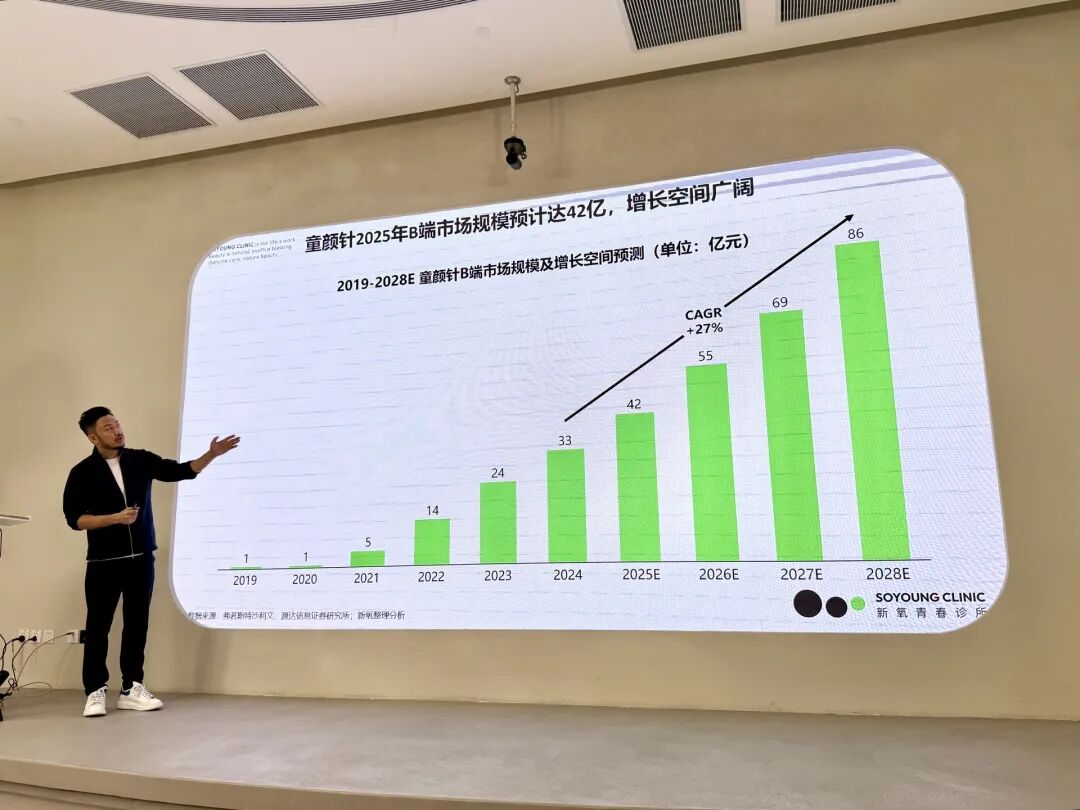
Core Insights - The article discusses the launch of a new low-priced product, "Miracle Youth 3.0," by the internet medical beauty platform New Oxygen, which has significantly reduced the price of the "youthful needle" to 2999 yuan, breaking the previous market average of over 10,000 yuan [1][2] - New Oxygen aims to disrupt the high-price cycle in the medical beauty industry and make compliant medical beauty services more accessible to consumers [1][6] - The company is facing performance pressures, with a reported 7% year-on-year decline in overall revenue and a net loss of 36 million yuan in Q2 2025 [1][4] Market Dynamics - The "youthful needle" market is rapidly expanding, with an expected B-end market size of 4.2 billion yuan by 2025, up from 500 million yuan in 2021 [2] - New Oxygen's strategy includes reducing customer acquisition costs and lowering unrelated treatment costs to maintain service quality while implementing low pricing [3][4] - The company has launched a new chain brand, "New Oxygen Youth Clinics," with 37 stores opened and plans to exceed 50 by the end of 2025 [3][4] Financial Performance - New Oxygen's offline business revenue surged by 426.1% year-on-year to 144 million yuan in Q2 2025, surpassing online business revenue for the first time [4] - Despite the growth in offline business, the overall revenue decline reflects the challenges of transitioning from traditional platform services to new business models [4][5] - The company is currently in a loss phase for its chain business but expects to reach profitability as it scales [4][5] Industry Challenges - The medical beauty industry is described as being in a "vicious cycle," where high upstream costs lead to inflated prices, pushing consumers towards unregulated options [6] - New Oxygen's CEO emphasizes the need for a shift towards lower prices to enhance consumer trust and increase market penetration [6][7] - The market is witnessing a shift towards "light medical beauty," which is expected to drive growth and lower consumer barriers [7] Competitive Landscape - Major internet companies are increasingly entering the medical beauty sector, intensifying competition [7] - New Oxygen welcomes the entry of more competitors, believing it will help develop and expand the new business model of medical beauty chains [7]

动辄上万元的“童颜针”,价格杀到2999元!医美平台CEO:此前也曾打到5000元以下,但遭厂商断货
Mei Ri Jing Ji Xin Wen· 2025-09-24 13:12
Core Viewpoint - The medical beauty market in China is experiencing a "price war," initiated by the internet medical beauty platform New Oxygen, which has significantly reduced the price of its "Miracle Youth 3.0" product to 2999 yuan, aiming to disrupt the high-price cycle in the industry [1][3]. Group 1: Market Dynamics - New Oxygen's price reduction strategy is intended to shift the medical beauty industry from a "seller's market" to a "mass consumer" market, making compliant medical beauty services more accessible to consumers [1][5]. - The market for "Youthful Needle" treatments is rapidly expanding, with projections indicating that the B-end market size will reach 4.2 billion yuan by 2025, up from 500 million yuan in 2021 [3][4]. - The medical beauty consumer demographic is evolving, with 90% of sales now coming from working and middle-class women, indicating a shift towards a broader consumer base [7]. Group 2: Company Strategy - New Oxygen's CEO, Jin Xing, emphasizes that the low-price strategy is crucial for eliminating "black medical beauty" practices by making compliant services affordable [1][6]. - The company has faced challenges with suppliers due to its aggressive pricing, leading to supply disruptions and demands from manufacturers to withdraw products from the market [4][5]. - New Oxygen's offline chain business has become a significant revenue driver, with a 426.1% year-on-year increase in revenue from this segment, surpassing online business for the first time [8]. Group 3: Financial Performance - In Q2, New Oxygen reported a 7% year-on-year decline in overall revenue to 379 million yuan, with a net loss of 36 million yuan, attributed to a decrease in the number of medical service providers on its subscription platform [1][8]. - The company's gross margin for its chain clinics was 24.3%, significantly lower than the industry average of over 50%, reflecting its low-margin strategy aimed at fostering a healthier operational model [5][6]. Group 4: Future Outlook - New Oxygen is actively working on supply chain integration by acquiring and representing key equipment and products, indicating a strategic move to gain control over its supply chain [9]. - The company plans to develop its own brand of medical beauty products, which will be used internally and sold to other institutions, further expanding its market presence [9].