航空航天

Search documents
5张图看懂“2026年全球视野·下注中国”十大核心ETF
Ge Long Hui· 2026-01-22 08:54
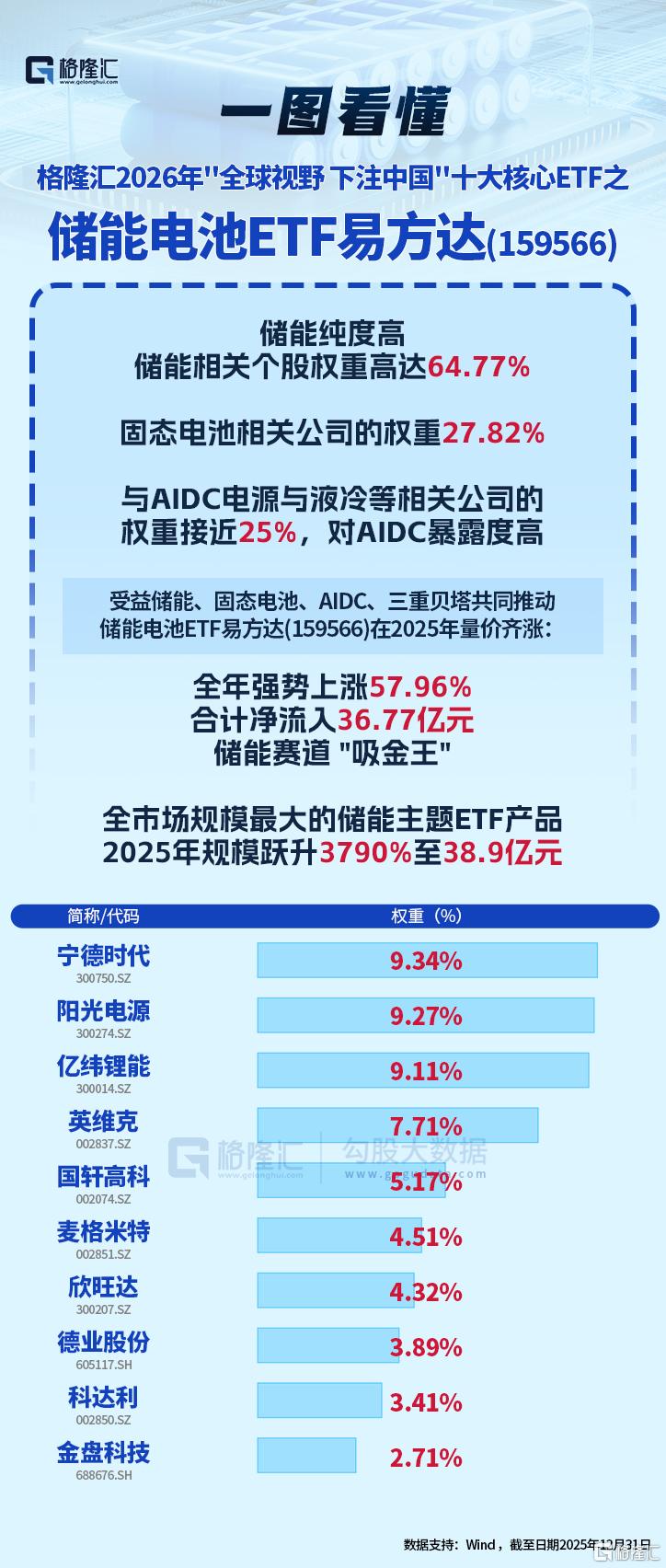
Group 1: Energy Storage Battery ETF - The Energy Storage Battery ETF by E Fund (159566) achieved a strong annual increase of 57.96% in 2025, with its scale rising from 100 million to 3.89 billion, marking a 3790% growth, making it the largest energy storage-related ETF in the market [1] - The ETF tracks the National Securities New Energy Battery Index, focusing on core stocks related to the energy storage battery industry, including leading companies like CATL, Sungrow, EVE Energy, and Inovance [1] - Key characteristics include a high purity of energy storage with 64.77% weight in energy storage-related stocks, benefiting from increased demand for energy storage due to rising data center electricity consumption [1] Group 2: Sci-Tech Chip ETF - The Sci-Tech Chip ETF (588200) tracks the Shanghai Stock Exchange Sci-Tech Board Chip Index, covering the entire chip industry chain, focusing on critical segments, with the top ten holdings accounting for 57% [3][4] - The index consists entirely of companies from the Sci-Tech Board, emphasizing R&D capabilities and technological innovation, representing the "elite force" of the chip industry [4] - The index shows significant growth indicators, with a 39% year-on-year revenue increase and a 94% net profit growth in the first three quarters of 2025 [4] Group 3: Aerospace ETF - The Aerospace ETF (159227) aligns closely with the "space and sky integration" strategy, focusing on military aerospace power, with a high weight of 98.2% in defense and military industries, making it the purest military index in the market [6][7] - The ETF has a significant overlap with commercial aerospace concepts, with a 70.19% correlation, and focuses on key national strategic areas such as military aircraft replacement and satellite internet [6][7] - It recorded a net inflow of 1.329 billion in the period, becoming the leading fund in the aerospace sector [7] Group 4: Hang Seng Technology ETF - The Hang Seng Technology ETF (513010) tracks the Hang Seng Technology Index, selecting 30 leading Hong Kong tech companies, covering sectors like internet platforms, semiconductors, and new energy vehicles [10] - The top ten holdings include major players like Meituan, SMIC, Tencent, and Alibaba, with AI-related companies making up over 60% of the portfolio [10] - The ETF saw a net inflow of 19.047 billion in 2025, with a low comprehensive fee rate of 0.25% per year [10] Group 5: Robotics ETF - The Robotics ETF (562500) focuses on the most competitive leading companies in the industry, with the top ten holdings accounting for 52% of the portfolio, showcasing significant leader effects [12][14] - It includes key component companies like Harmonic Drive and Mingzhi Electric, as well as system integrators like Inovance Technology and iFlytek, providing a balanced exposure to both industrial and humanoid robotics [12][14] - The ETF's latest scale is 26.169 billion, making it the only robotics-themed ETF in the market exceeding 20 billion [12]

《经济日报》整版报道 解码2025年中国制造的升级脉动
Jing Ji Ri Bao· 2026-01-22 06:41
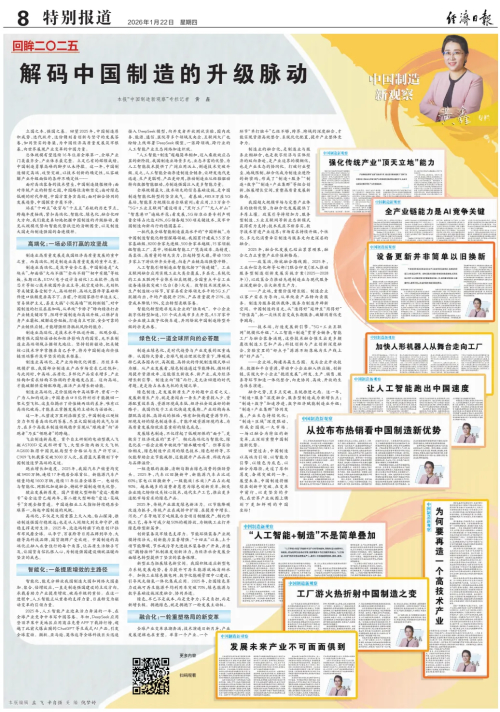
Core Viewpoint - The article emphasizes the significant advancements in China's manufacturing sector by 2025, highlighting its transition towards high-end, intelligent, green, and integrated manufacturing, which is crucial for the country's economic high-quality development [3][4]. High-end Manufacturing - High-end manufacturing is identified as a critical focus for achieving high-quality development in the manufacturing sector, addressing issues such as reliance on foreign technology and the need for a self-sufficient supply chain [5][6]. - The article notes that by 2025, China's automotive production and sales are expected to exceed 34 million units, maintaining its position as the world's largest automotive market for 17 consecutive years [6][7]. - The successful development of advanced technologies, such as the AS700D electric airship and AG600 amphibious firefighting aircraft, showcases China's progress in high-end manufacturing [6][7]. Intelligent Manufacturing - Intelligent manufacturing is positioned as a primary pathway for enhancing quality and efficiency, with artificial intelligence becoming a driving force for transformation [8][9]. - By 2025, China is expected to have over 1 million industrial devices connected through industrial internet platforms, significantly improving production efficiency and reducing operational costs [10]. - The integration of AI into manufacturing processes is leading to faster R&D cycles and smarter production methods, marking a shift from experience-driven to data-driven manufacturing [9][10]. Green Manufacturing - The article highlights the necessity of green manufacturing as a response to global climate challenges, emphasizing the importance of reducing carbon emissions and enhancing resource efficiency [11][12]. - By 2025, nearly 60% of new energy vehicles are projected to be part of vehicle replacement programs, indicating a strong consumer shift towards green products [12][13]. - The development of green technologies and equipment is expected to support traditional industries in reducing emissions and enhancing sustainability [12][13]. Integrated Manufacturing - Integrated manufacturing is described as a transformative approach that combines manufacturing with services and digital economies, enhancing overall competitiveness [14][15]. - Policies are being implemented to promote the deep integration of advanced manufacturing and modern services, fostering new growth drivers [15][16]. - The article notes that the integration of manufacturing with digital technologies and services is reshaping the value chain, moving from product sales to service-oriented models [15][16].
弘扬科学家精神|铸就应急救援的“生命方舟”
Ren Min Ri Bao· 2026-01-22 06:28
Core Viewpoint - The AG600 "Kunlong" amphibious aircraft is the world's largest civil amphibious aircraft, essential for national emergency rescue systems, and has faced numerous challenges since its inception in 2009 until its expected certification in 2025 [1][2]. Development Journey - The AG600 project was officially launched in 2009, with the first flight of the technology verification aircraft occurring in 2017. The aircraft is expected to receive its type certificate and production license by 2025 [1][2]. - The design team, led by chief designer Huang Lingcai, faced significant challenges due to a lack of existing technology and experience in amphibious aircraft design, with many team members being recent graduates [3][4]. Technical Innovations - The AG600 has overcome 110 key technologies for large amphibious aircraft, including 18 foundational and common technologies [4]. - The aircraft's hull is designed in a "V" shape to enhance stability on water, and it can achieve speeds exceeding 80 knots (approximately 148 km/h) while operating on water [4]. - The main flight control system is a significant advancement, being the first of its kind applied to a civil large aircraft in China, enhancing the industry's capabilities in complex software and hardware development [6]. Collaborative Efforts - The project involved collaboration among 296 enterprises and 16 universities, marking a significant achievement in China's civil aviation sector [5]. - Quality control was emphasized, with representatives from the company stationed at key suppliers to ensure traceability and reliability of components, which number over 200,000 [5]. Testing and Validation - The testing phase is critical and involves challenging conditions, with the team conducting extensive trials across various locations to ensure compliance with airworthiness requirements [7][8]. - The AG600 has been tested under extreme weather conditions, including temperatures as low as -40 degrees Celsius, to validate the performance of its hydraulic and fuel systems [7][8]. Future Aspirations - The aircraft has proven effective in emergency rescue operations, and the next goal is to enhance its durability and expand its usage across various applications [8].
业绩预增提振商业航天板块交投热度,航空航天ETF(563380)本周累计“吸金”近2.7亿元
Xin Lang Cai Jing· 2026-01-22 05:29
Core Viewpoint - The commercial aerospace sector is experiencing renewed activity, with significant inflows into the Aerospace ETF (563380), indicating strong market interest and potential growth in the industry [1][3][4]. Group 1: Market Activity - The Aerospace ETF (563380) attracted 267 million yuan in inflows this week (January 19-21), with an average daily trading volume rising to 266 million yuan, a 964% increase compared to the average daily trading volume of 25 million yuan in 2025 [1][3]. - The fund's total assets and shares reached new highs since its inception, amounting to 750 million yuan and 591 million shares, respectively [1][3]. Group 2: Industry Outlook - Despite recent market fluctuations, there is a strong consensus on the long-term trends in the aerospace industry, driven by national defense modernization and production iterations of core equipment [4]. - Several companies in the commercial aerospace supply chain have announced performance increases for 2025, indicating a shift from research and development to commercialization and scale effects, supported by policy and market demand [4]. Group 3: ETF Composition and Management - The underlying index of the Aerospace ETF focuses heavily on military aerospace capabilities, with aerospace military and aviation military sectors accounting for 44.0% and 32.5% of the index, respectively [4]. - The fund manager, Huatai-PB Fund, is one of the first ETF managers in China, with a strong presence in broad-based and dividend-themed indices [4].
3家商业航天企业IPO有新进展,航空航天ETF天弘(159241)换手率14.27%居同标的第一,近10日累计“吸金”超2.3亿元
2 1 Shi Ji Jing Ji Bao Dao· 2026-01-22 05:24
Group 1 - The A-share market showed strong performance on January 22, with all three major indices rising, and the commercial aerospace concept experienced a resurgence, with the National Aerospace and Aviation Industry Index increasing by nearly 3% [1] - The Tianhong Aerospace ETF (159241) recorded a trading volume of 119 million yuan and a turnover rate of 14.27%, the highest among its peers [1] - Over the past 10 trading days, the Tianhong Aerospace ETF has seen a net inflow of over 230 million yuan [2] Group 2 - The Tianhong Aerospace ETF closely tracks the National Aerospace and Aviation Industry Index, which covers sectors such as aerospace equipment, space technology, and military electronics, involving cutting-edge technology areas like satellite internet and low-altitude economy [2] - The National Defense and Military Industry sector accounts for 98.7% of the index's weight in the Shenwan first-level industry classification [2] - Recent updates on IPO guidance from three commercial aerospace companies indicate ongoing developments in the sector, with institutions like Huatai United Securities and CITIC Securities involved [2] Group 3 - Zhongyin Securities believes that the commercial aerospace theme is entering a "warming" phase, supported by improved top-level design and new policies that clarify the development blueprint for the industry [3] - The acceleration of low-orbit satellite network launches in China is expected to lead to a normalized and high-frequency launch phase, benefiting the upstream and downstream of the industry chain [3] - Dongxing Securities highlights that during the 14th Five-Year Plan period, commercial aerospace will be a key driver for new productive forces and high-quality technological development in China, with an expected increase in satellite launches by 2026 [3]
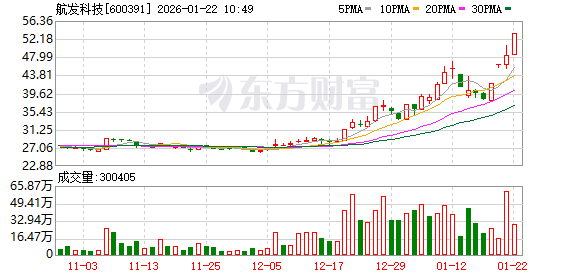
航发科技录得4天3板
Zheng Quan Shi Bao Wang· 2026-01-22 02:49
近日该股表现 | 日期 | 当日涨跌幅(%) | 换手率(%) | 主力资金净流入(万元) | | --- | --- | --- | --- | | 2026.01.21 | 4.95 | 18.53 | -13339.36 | | 2026.01.20 | 10.00 | 4.90 | 24902.72 | | 2026.01.19 | 10.00 | 7.96 | 15863.31 | | 2026.01.16 | -3.41 | 6.52 | -4403.39 | | 2026.01.15 | -1.91 | 9.31 | -7289.92 | | 2026.01.14 | -1.42 | 13.53 | -3003.15 | | 2026.01.13 | -9.99 | 5.55 | -2211.84 | | 2026.01.12 | 2.34 | 11.80 | -12898.51 | | 2026.01.09 | 6.40 | 14.26 | 8474.00 | | 2026.01.08 | 7.89 | 12.14 | -3859.64 | (文章来源:证券时报网) 证券时报·数据宝统计,两融 ...

一系列举措将出台 推动“十五五”实现良好开局
Jing Ji Wang· 2026-01-22 02:48
Group 1 - The core viewpoint emphasizes the importance of expanding domestic demand and optimizing supply to achieve a dynamic balance and virtuous cycle in the economy, with a focus on a new development model driven by domestic demand and consumption [2][3] - The National Development and Reform Commission (NDRC) plans to develop a strategic implementation plan for expanding domestic demand from 2026 to 2030, aligning with the trends of demand upgrading and the new technological revolution [2] - The NDRC aims to strengthen the real economy by fostering innovation, creating new supply, and generating new employment opportunities, while promoting a modern industrial system focused on intelligence, greenness, and integration [3] Group 2 - The construction of a unified national market is a significant strategic deployment by the central government, with positive progress already made and a commitment to deepen this initiative [4][5] - Key metrics indicate improvements in inter-provincial trade and reduced logistics costs, reflecting a favorable trend in resource allocation and market transaction costs [4] - Future efforts will focus on institutional development, high-quality growth, and addressing persistent issues that hinder market efficiency, such as low-price competition and local protectionism [5][6] Group 3 - The NDRC forecasts that by 2026, China's economic structure will continue to improve, with new growth drivers emerging from sectors like renewable energy, aerospace, and artificial intelligence [7][8] - The digital economy is expected to contribute significantly to GDP, with projections indicating it could reach 49 trillion yuan, accounting for approximately 35% of GDP by 2025 [8] - Regional innovation hubs, particularly in areas like the Greater Bay Area and the Yangtze River Delta, are set to enhance their roles in driving economic development and technological innovation [9]
中航高科20260121
2026-01-22 02:43
Summary of the Conference Call for AVIC High-Tech (中航高科) Industry Overview - **Composite Materials in Aviation**: Composite materials are increasingly used in aviation due to their lightweight and high-strength properties. The military sector has matured, and there is a growing expansion into the civilian sector. [2][3] - **Domestic Demand Forecast**: The demand for auxiliary materials in military aircraft is expected to reach 18,000 tons over the next decade, while the civilian aviation auxiliary materials market is projected to be significantly larger, with a forecasted demand of approximately 100,000 tons over the next 20 years. [2][7] Company Insights - **AVIC High-Tech's Role**: AVIC High-Tech is a key player in the production of prepreg materials, with its subsidiary AVIC Composites being a major supplier of resins and prepregs in China. The company holds about 70% of the prepreg market share. [2][13] - **Market Position**: The company is close to monopolizing the military-grade aviation prepreg market and is actively expanding into the civilian aviation sector, participating in projects like C919 and C929. [4][16] Demand Dynamics - **Civil vs. Military Aviation**: Military aviation has stringent performance requirements and higher prices, but the civilian aviation market is larger and more sustainable. Historical examples from companies like Hexcel and Toray show that commercial aviation demand has long-term advantages. [10] - **Future Demand Growth**: The demand for composite materials in civilian aviation is expected to grow significantly, driven by the C919 and CR929 projects, which will increase the usage of composites from 12% to 50%. [6][9] Strategic Developments - **Partnerships and New Ventures**: AVIC High-Tech has formed a joint venture with Commercial Aircraft Corporation of China (COMAC) to produce resin-based composite fan blades and casings for commercial aircraft engines, marking a strategic expansion into component manufacturing. [17] - **Production Capacity Expansion**: The company has invested in new production lines aimed at civilian aircraft composite applications, indicating a proactive approach to meet future demand. [16] Financial Performance - **Recent Financial Trends**: In the first three quarters of 2025, AVIC High-Tech experienced a slight revenue decline of about 1% and a decrease in net profit, attributed to fluctuations in military product delivery schedules. However, this is viewed as a temporary situation, with expectations for demand recovery. [18] - **Long-term Outlook**: The company is optimistic about its long-term growth potential, with expectations for improved profitability as civilian aircraft production scales up. The current valuation is considered to be at a historically low level, suggesting potential for future appreciation. [19] Key Challenges - **Barriers to Entry**: The prepreg and downstream auxiliary material sectors have high barriers to entry due to the need for customized resin development and extensive validation processes, making it difficult for new entrants to gain a competitive edge. [14] Conclusion - **Investment Consideration**: AVIC High-Tech is positioned to benefit significantly from the growth in both military and civilian aviation sectors, with a strong market presence in prepreg materials and strategic initiatives to expand its capabilities. The company remains a focal point for investors looking at the aviation materials market. [19]

智联招聘报告:算法工程师平均招聘薪资超2.5万元
Zheng Quan Shi Bao Wang· 2026-01-22 02:35
Group 1: Talent Demand in New Productive Forces - The demand for talent in the new productive forces sector is rapidly increasing, becoming a "growth pole" in the job market, driven by new technological waves and industrial upgrades [1] - In the new generation information technology sector, the number of algorithm engineer positions surged by 110.1% year-on-year, with an average monthly salary of 25,236 yuan, making it the most sought-after job in the field [1] - The demand for high-end equipment industry talent is also strong, with robot debugging engineers leading the field with a 64.1% year-on-year growth, and industrial robot engineers seeing a 60.6% increase [1] Group 2: Automotive and Aerospace Talent Demand - The automotive industry is transitioning from a "scale expansion phase" to a "technology competition phase," leading to diversified and deeper talent demand, with automotive structure engineers and automotive mechanical engineers seeing growth rates of 53.7% and 50.9% respectively [2] - The demand for materials process engineers in the new materials and aerospace sectors has also surged, with an 83.1% year-on-year increase, and drone engineers seeing a 59.4% rise [2] - The average monthly salary for navigation algorithm positions reached 26,219 yuan, indicating a strong market for specialized roles [2] Group 3: Integration of Industry and Education - The integration of industry and education is seen as a crucial path to resolving talent supply and demand contradictions, with initiatives like "Intelligent Connection of Hundreds of Schools, Empowering Thousands of Enterprises" in Shandong [3] - Local enterprises collaborating with universities have developed new electromechanical products, achieving a 10% improvement in energy efficiency and a 20% increase in service life [3] - The Ministry of Human Resources and Social Security aims to ensure stable employment by promoting a friendly employment development model and leveraging policies to support labor-intensive industries [3]
特朗普称可能给F-47战机改名:如果“我不满意”,我就要把“47”去掉
Huan Qiu Wang· 2026-01-22 01:34
Core Points - The U.S. President expressed dissatisfaction with the progress of the F-47 sixth-generation stealth fighter project and hinted at possibly renaming it if he remains unsatisfied [1] - The F-47 is touted as the most advanced aircraft in the U.S. military, with its name referencing the year the U.S. Air Force was established (1947) and honoring the President as the 45th and 47th President [3] - The F-47 is set to replace the F-22 as the U.S. Air Force's primary sixth-generation air superiority fighter, with the entire project valued at several hundred billion dollars and individual aircraft costs exceeding $300 million [5] Summary by Sections Project Overview - The F-47 project is expected to have a total value in the hundreds of billions, with development contracts exceeding $20 billion [5] - The aircraft is designed to replace the F-22, becoming the mainstay of the U.S. Air Force's sixth-generation capabilities [5] Naming and Significance - The name F-47 commemorates the establishment of the U.S. Air Force in 1947 and serves as a tribute to the P-47 Thunderbolt from World War II [3] - The President's remarks indicate a personal connection to the project, reflecting his branding concerns and potential influence on military projects [5] Challenges and Concerns - The F-47 project has faced significant cost issues, with reports indicating that its costs could be nearly three times that of the F-35, leading to project delays and concerns about its viability [5] - The former Secretary of the Air Force had previously suspended the project due to these escalating costs [5]