
芯片设计

Search documents
蔚来资本等入股自动驾驶芯片设计商新芯航途
Jing Ji Guan Cha Bao· 2025-08-21 08:29
Core Insights - New semiconductor company, Xinxin Hangtu (Suzhou) Technology Co., Ltd., has undergone a business change, adding new shareholders including Shenzhen Innovation Capital Investment Co., Ltd. and Hefei NIO Industrial Development Equity Investment Partnership (Limited Partnership) [1] - The registered capital of the company increased from approximately 12.269 million RMB to about 14.998 million RMB [1] - Established in December 2023, the company is involved in technology promotion and application services, software development, and integrated circuit chip design and services [1] Company Structure - Current shareholders include Suzhou Haowangjiao Xinxin Enterprise Management Partnership (Limited Partnership) and Suzhou Huanshi Lake Xincheng Industrial Investment Development Partnership (Limited Partnership), along with the newly added shareholders [1] - The legal representative of the company is Li Jun [1]

蔚来资本等入股新芯航途,后者为自动驾驶芯片设计商
Xin Lang Cai Jing· 2025-08-21 06:48
Group 1 - The core point of the article is the recent changes in the shareholder structure and registered capital of Xinxin Hangtu (Suzhou) Technology Co., Ltd, indicating potential growth and investment interest in the company [1] - The registered capital of Xinxin Hangtu has increased from approximately 12.269 million RMB to about 14.998 million RMB, reflecting a significant investment boost [1] - The company was established in December 2023 and focuses on technology promotion, software development, and integrated circuit chip design and services, positioning itself in the emerging autonomous driving chip design sector [1] Group 2 - New shareholders include Shenzhen Innovation Capital Investment Co., Ltd and Hefei NIO Industrial Development Equity Investment Partnership (Limited Partnership), suggesting a strategic partnership and financial backing [1] - The current shareholders also include Suzhou Haowangjiao Xinxin Enterprise Management Partnership (Limited Partnership) and Suzhou Huanxiuhu Xincheng Industrial Investment Development Partnership (Limited Partnership), indicating a diverse investment base [1] - The company is identified as an emerging player in the autonomous driving chip design industry, which is a rapidly growing sector with increasing demand for advanced technology solutions [1]
早盘消息面0821|公用事业价格改革、国产ASIC芯片大订单?
Xin Lang Cai Jing· 2025-08-21 01:53
Group 1: Public Utilities Price Reform - The core policy breakthrough is the implementation of the "Price Law Amendment Draft," which aims to eliminate the "loss-subsidy" cycle, leading to market-oriented pricing for gas and electricity, with significant adjustments expected by 2025 [1] - Beneficial pathways include residential gas price increases and expanded industrial demand for gas [2] - For electricity, compensation for coal power capacity and premium pricing for green energy are anticipated [3] Group 2: Semiconductor/Chip Industry - The chip design sector is experiencing a triple resonance of policy, demand, and supply [4] - Cambricon's core logic involves addressing safety concerns leading to a surge in domestic GPU orders, alongside advancements in process capacity and packaging solutions [4] - Chipone's collaboration with ByteDance on ASIC projects highlights the uniqueness of domestic ASIC customization, with a market value of hundreds of billions seen as just the starting point for order fulfillment and valuation shifts [4] Group 3: Servers and Networking - China Mobile's procurement validates the industry's prosperity [5] - ZTE has secured the largest share of China Mobile's procurement for 264,500 PC servers and 7,000 AI inference servers, dominating 70% of high-performance card packages, driven by the expansion of AI infrastructure and increased domestic production [5] - The Scale Up switching network is set to reach a significant milestone in 2026, with the domestic switching chip and switch market projected to be worth 21.4 billion and 66.9 billion respectively by 2028, indicating a clear market structure and simultaneous price and volume growth [5] Group 4: New Consumption - Pop Mart has raised its full-year revenue guidance to 30 billion, significantly up from the initial 20 billion, driven by confidence in overseas channel expansion, particularly in North America, and synchronized supply chain capacity growth [6] - Laopuhuang's luxury product strategy has resulted in a net profit of 2.35 billion in H1, a 291% increase, with price increase expectations materializing, supported by a 77% overlap with luxury consumer demographics and high store efficiency [7] Group 5: Chemical Industry - The Ministry of Industry and Information Technology's assessment of outdated production facilities over 20 years old is expected to accelerate the elimination of backward capacity, optimizing the competitive landscape [8] - Companies with advanced integrated facilities and significant cost advantages, as well as engineering service providers capable of upgrades, are likely to see a revaluation of their worth [9]
万通发展董事长突遭拘留,8.54亿元投资芯片公司再谋转型,股价又提前涨停被疑“老剧本”重演
Hua Xia Shi Bao· 2025-08-20 16:53
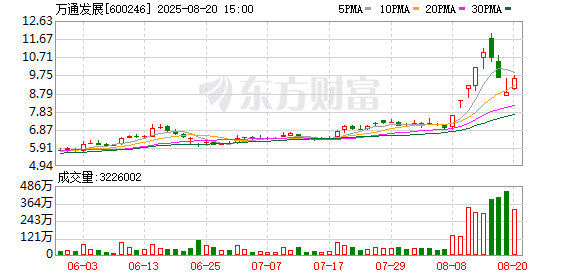
Core Viewpoint - The recent detention of Wang Yihui, the actual controller and chairman of Wantong Development, raises concerns about the company's ongoing transformation and investment strategies, particularly in light of its recent announcement to invest in a technology firm [2][3][4]. Group 1: Company Developments - On August 19, Wantong Development announced that its chairman Wang Yihui was detained by the Beijing police, with the investigation unrelated to the company's daily operations [2][3]. - Following the detention, the company appointed Qian Jinzhu, the CEO, to assume the responsibilities of the chairman and legal representative until Wang Yihui resumes his duties or a new appointment is made [3]. - The company maintains that its corporate governance structure and internal control systems are robust, ensuring that daily operations continue without significant disruption [4]. Group 2: Investment Activities - Wantong Development is in the process of investing 854 million yuan (approximately 8.54 billion) to acquire nearly 63% of Beijing Shuduo Information Technology Co., which specializes in PCIe high-speed switching chips [5][6]. - The investment in Shuduo Technology is part of Wantong's strategic shift towards technology, particularly in the AI and server sectors, where PCIe chips are critical [6][7]. - Despite the promising technology, Shuduo Technology is currently operating at a loss, with a projected net profit of -138 million yuan for 2024, although its revenue is expected to double to 32.38 million yuan [6][7]. Group 3: Market Reactions - Wantong Development's stock price has experienced significant volatility, rising from around 7 yuan to nearly 12 yuan before dropping to approximately 9 yuan following the chairman's detention [5]. - The company has faced scrutiny from regulators, similar to its previous failed acquisition of Solstice Optoelectronics, as it navigates the complexities of its new investment strategy [8][9]. - Investors are cautious, drawing parallels between the current situation and past events, as the stock price surged prior to the announcement of the investment in Shuduo Technology [9].



万通发展董事长突遭拘留 8.54亿元投资芯片公司再谋转型 股价又提前涨停被疑“老剧本”重演
Hua Xia Shi Bao· 2025-08-20 16:23
Core Viewpoint - The recent detention of Wang Yihui, the actual controller and chairman of Wantong Development, raises concerns about the company's ongoing transformation and investment strategy, particularly in light of its recent announcement to invest in a technology firm [2][3][4]. Group 1: Company Developments - On August 19, Wantong Development announced that its chairman Wang Yihui was detained by the Beijing Public Security Bureau, with the investigation unrelated to the company's daily operations [3]. - Following the detention, the company appointed Qian Jinzhu, a board member and CEO, to assume the responsibilities of the chairman until Wang Yihui resumes his duties or a new chairman is elected [3]. - The company maintains that its governance structure and internal control systems are robust, ensuring that daily operations will not be significantly affected by this incident [3]. Group 2: Investment Strategy - Wantong Development plans to invest 854 million yuan (approximately 8.54 billion yuan) to acquire approximately 63% of Beijing Shuduo Information Technology Co., Ltd., which specializes in PCIe high-speed switching chips [5][6]. - The investment in Shuduo Technology is seen as a strategic move to enter the high-tech sector, particularly in the AI and server markets, where PCIe chips are critical [5][6]. - Shuduo Technology is currently in a loss-making position, with a projected net profit of -138 million yuan for 2024, although its revenue is expected to double compared to 2023 [6]. Group 3: Market Reactions - Following the announcement of the chairman's detention, Wantong Development's stock price fluctuated significantly, rising from around 7 yuan to nearly 12 yuan before dropping back to approximately 9 yuan [4]. - The stock experienced a rebound on August 20, closing at 9.59 yuan, reflecting an increase of 8.36% [4]. - Investors have expressed concerns about the company's ability to execute its transformation strategy effectively, especially given the recent history of a failed acquisition attempt earlier in the year [7][8]. Group 4: Regulatory Scrutiny - The company received inquiries from the Shanghai Stock Exchange regarding the rationale behind the investment in Shuduo Technology, particularly concerning its ongoing losses and the potential impact on Wantong Development's operational capabilities [8][9]. - Similar scrutiny was faced during the earlier attempt to acquire Solstice Optoelectronics, which was ultimately terminated due to changes in the transaction environment and disagreements on commercial terms [7][8].
智通港股解盘 | 科技股这边风景独好 消费三剑客集体发力
Zhi Tong Cai Jing· 2025-08-20 12:58
【解剖大盘】 港股连续调整了多日,今天在A股的带动下终于出现反弹,收盘恒指涨0.17%。 美商务部周二正式宣布,将风力涡轮机等407类钢铁和铝衍生产品纳入关税清单。特朗普钢铝关税范围 陡然扩大,美国进口商措手不及。这很显然对美国经济形成反噬,美股又陷入被动,惯用的伎俩就是打 中国牌。据报道,美国财政部长贝森特当地时间19日在接受采访时称:"我们与中方进行了非常良好的 对话,我预计在11月前我们会再次会面。我认为当前工作开展得很顺利。" 再看老铺黄金(06181)业绩也超预期,股东应占利润22.68亿元,同比增加285%。今年上半年,老铺黄金 在单个商场平均销售业绩4.59亿元,已领先国际奢侈品一线巨头。据弗若斯特沙利文调研数据,老铺黄 金消费者与路易威登、爱马仕、卡地亚、宝格丽等国际五大奢侈品牌的消费者平均重合率接近八成,这 意味着国际奢侈品牌消费者越来越多转向老铺黄金,而中国品牌也首次成为高端消费的主流力量。如果 能达到国际奢侈品牌的认知度,那么海外这块增量就会较大,只是品牌的建立还需要时间和底蕴,今天 涨近9%。另外蜜雪集团(02097)、名创优品(09896)均涨幅超4%。 昨日板块聚焦提到的果链类持续 ...

今天,这个板块力挽狂澜
Mei Ri Jing Ji Xin Wen· 2025-08-20 10:45
隔夜,全球AI总龙头英伟达收盘下跌3.5%,软件公司Palantir和芯片设计公司Arm分别重挫9.4%和5%。 科技板块的下跌,带动纳指下跌了1.4%。 美股科技板块下跌的原因在于,麻省理工学院发布了一篇题为《生成式AI鸿沟:2025年商业AI现状》 的报告。 该报告指出,高达95%的企业从其生成式AI投资中获得的回报为零。OpenAI首席执行官Sam Altman近 期也敲响了AI投资警钟,他认为AI相关股票已出现泡沫迹象。两个消息共同刺激了投资者对美股科技 板块的谨慎态度。 尽管如此,也有不少对AI热潮持正面看法的观点出现。 即便是敲响AI投资警钟的Sam Altman,其动作却很诚实。Sam Altman准备让OpenAI投入数万亿美元建 设数据中心,还多方寻求算力合作。 对于AI是否有泡沫,达哥认为,真正的投资高手不是回避泡沫,而是看清它、利用它,并在大众狂欢 结束前悄然离场。 昨天,有一篇文章在投资圈流传。文章的主要意思是,在牛市中,下车了真正有价值的标的,就会很难 再上车,因为下车之后过一段时间会发现,卖出的个股继续上涨。 此时内心在想:便宜的时候我都卖了,现在再去买就下不了手。在错过有真正价值 ...
异动盘点0820|锂业股早盘走低;蔚来涨超4%,Viking Therapeutics跌超42%
贝塔投资智库· 2025-08-20 04:01
Group 1: Hong Kong Stocks - Chow Sang Sang (00116) surged over 18%, expecting a mid-term profit attributable to shareholders of approximately HKD 900 million to 920 million [1] - XPeng Motors (09868) rose over 4%, reporting a 125.3% year-on-year revenue growth in Q2, achieving a historical high for a single quarter [1] - Sunny Optical Technology (02382) increased over 6%, with a 52.56% year-on-year rise in mid-term profit attributable to shareholders for the six months ending June 30, 2025 [1] - China Gold International (02099) gained over 3%, reporting a turnaround to profitability in the first half of 2025, supported by a rich resource reserve and stable production [1] - Hansoh Pharmaceutical (03692) fell over 8%, announcing a 6.5% discount on a placement to raise nearly HKD 3.9 billion for innovative drug development [1] - Pop Mart (09992) rose over 6%, with adjusted net profit in the first half of 2025 increasing 3.6 times year-on-year [1] - Kunlun Energy (00135) dropped over 3%, reporting a 4.36% year-on-year decrease in mid-term profit attributable to shareholders for the first half of 2025 [1] Group 2: Other Stocks - Gilead Sciences (01672) fell over 8%, announcing a placement to raise a net amount of HKD 468 million, while its controlling shareholder cashed out nearly HKD 390 million [2] - Yixin Group (02858) rose over 1%, reporting a 28% year-on-year increase in adjusted net profit for the first half of 2025, with financial technology revenue soaring 124% [2] - Lithium stocks declined, with Ganfeng Lithium (01772) and Tianqi Lithium (09696) both dropping nearly 6%, amid inventory pressure in the lithium carbonate spot market [2] Group 3: US Stocks - Palo Alto Networks (PANW.US) rose 3.06%, exceeding expectations in Q4 earnings and providing optimistic guidance for future earnings [3] - BHP Group (BHP.US) increased 0.51%, reporting dividends exceeding expectations despite weak iron ore and coal prices [3] - NIO (NIO.US) rose 4.11%, with its L90 model delivering 6,400 units in 20 days since launch, with the factory operating at full capacity [3] - New Oriental (EDU.US) fell 2.79%, influenced by a drop in Oriental Selection's stock, while denying regulatory investigation rumors [3] - Viking Therapeutics (VKTX.US) plummeted 42.12% after reporting adverse side effects in its experimental obesity drug trials [4] - Arm (ARM.US) dropped 5.00%, as it hired Amazon's AI chip director to advance its chip development plans [4] - Home Depot (HD.US) rose 3.17%, reaching a new high since January, with Q2 net sales meeting market expectations [4] - Best Buy (BBY.US) increased 3.20%, launching a third-party online shopping platform to expand product variety [4] - Nexstar Media Group (NXST.US) rose 0.65%, announcing a $6.2 billion acquisition of Tegna [4] - Aurora Innovation (AUR.US) fell over 8%, closing down 7.14% after a short-seller report questioned its profit potential [5] - Boeing (BA.US) dropped 3.19%, with Airbus A320 deliveries expected to surpass Boeing's soon [5]





七旬董事长遭留置,万通发展又“变天”
阿尔法工场研究院· 2025-08-20 00:04
Core Viewpoint - The sudden detention of Wang Yihui, the chairman of Wantong Development, has created significant uncertainty for the company, which is currently undergoing a challenging transformation while facing regulatory scrutiny and financial losses [3][4][7]. Group 1: Company Background and Leadership Changes - Wantong Development, founded in 1991, is a significant player in China's real estate market, with its leadership historically linked to various sectors [9][10]. - Wang Yihui, who took control of the company in 2016, has been pivotal in its strategic shift from real estate to other sectors, including technology [11][12]. - Following Wang's detention on August 18, 2023, the board appointed Qian Jinzhu, the CEO, to assume the chairman's responsibilities, indicating a rapid response to the leadership crisis [4][8]. Group 2: Financial Performance and Transformation Efforts - Wantong Development has struggled financially, reporting losses of 330 million yuan in 2023 and an anticipated 498 million yuan in 2024, with further losses expected in the first half of 2025 [12][13]. - Despite attempts to diversify into sectors like tourism, new energy, and financial services, over 99% of the company's revenue still relies on real estate sales and rentals [13]. - The company announced a controversial acquisition of a 62.98% stake in the loss-making chip company Shudu Technology for 854 million yuan, raising questions about the rationale behind such a move amid ongoing losses [15][17]. Group 3: Market Reaction and Investor Sentiment - Following the announcement of the acquisition, Wantong Development's stock surged by 72% within days, but the news of the chairman's detention led to a dramatic drop, making it the only stock to hit the daily limit down on that day [19][20]. - The stock's volatility has left approximately 68,600 shareholders anxious, with significant capital outflows exceeding 8.4 billion yuan in just two trading days [20]. - The company has committed to continuing its transformation strategy despite the challenges posed by leadership changes and regulatory scrutiny [20][21].

景嘉微产品销量下降一年半亏2.53亿 拟2.2亿收购亏损公司溢价率3647%
Chang Jiang Shang Bao· 2025-08-19 23:26
Core Viewpoint - Jiangjiawei is facing significant operational pressure, leading the company to seek external acquisitions to enhance its overall strength amid declining performance metrics [1][3]. Financial Performance - In the first half of 2025, Jiangjiawei reported revenue of 193 million yuan, a year-on-year decrease of 44.78% [1][3]. - The net profit attributable to shareholders was a loss of 87.61 million yuan, a decline of 356.51% year-on-year [1][3]. - The net profit after deducting non-recurring gains and losses was a loss of 96.12 million yuan, down 550.44% year-on-year [1][3]. - Cumulatively, the company has incurred a total loss of 253 million yuan over the past year and a half [1][3]. Business Overview - Jiangjiawei specializes in the research, production, and sales of high-reliability electronic products, focusing on graphic display control, specialized radar, and chip sectors [2][3]. - The company experienced a significant decline in sales across its main product lines, with revenue from graphic display control, specialized radar, and chip sectors dropping by 62.91%, 18.84%, and 3.39% respectively in the first half of 2025 [3]. Strategic Initiatives - To counteract the operational challenges, Jiangjiawei is increasing its R&D investments and pursuing external acquisitions [4][5]. - The company plans to invest 220 million yuan in Wuxi Chengheng Microelectronics Co., Ltd., aiming to gain a controlling stake of 64.89% in the company [1][4]. - Jiangjiawei's R&D expenditure for the first half of 2025 was 153 million yuan, accounting for 79.40% of its revenue [5]. Acquisition Details - Chengheng Microelectronics focuses on edge AI chip design and has not yet achieved profitability, with a valuation of approximately 655 million yuan, reflecting a 3647% increase over its net asset value [6][7]. - The acquisition is expected to create a dual-driven development model combining GPU and edge AI chips, enhancing the company's competitive edge and shareholder returns [6].
