
银行理财

Search documents
突发!华夏人寿被吊销业务许可证,原董事长终身禁业!多家机构被罚→
Zhong Guo Jing Ji Wang· 2025-08-03 03:55
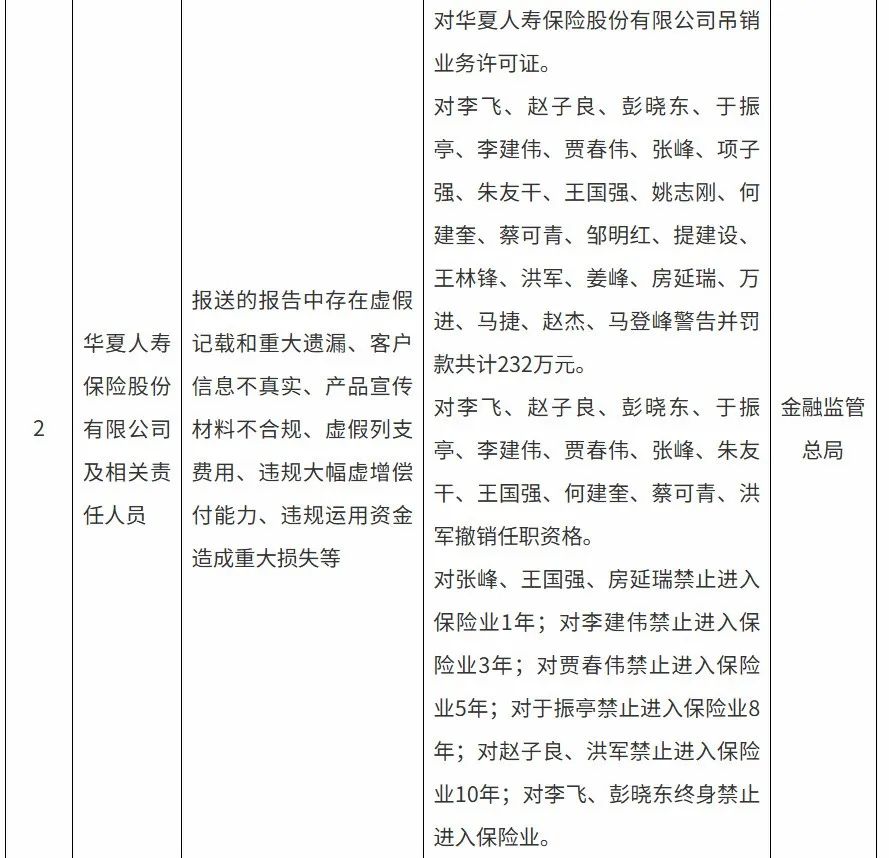
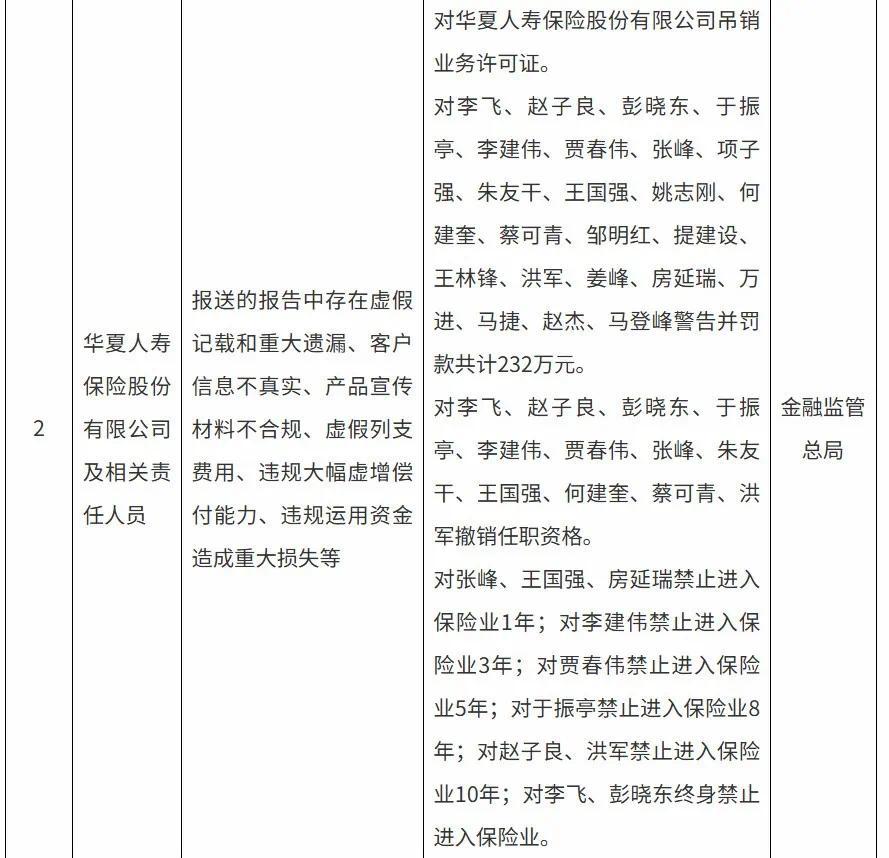
Summary of Key Points Core Viewpoint - The recent administrative penalties disclosed by the National Financial Supervision Administration highlight significant compliance issues across various financial institutions, including banks and insurance companies, leading to substantial fines and operational restrictions. Group 1: Bank Penalties - China Agricultural Development Bank was fined 10.2 million yuan for non-compliance in loan management and fund allocation [2] - Minsheng Bank's two branches were collectively fined 1.5 million yuan for inadequate loan management practices, with specific fines of 950,000 yuan and 550,000 yuan for its Haikou and Sanya branches respectively [2] - Guangyin Wealth Management was penalized with a total of 11.6 million yuan for irregular investment operations and data management issues [2] Group 2: Insurance Company Penalties - Huaxia Life Insurance was stripped of its business license due to serious violations including false reporting and mismanagement of client information, resulting in penalties against 23 responsible individuals totaling 2.32 million yuan [3][4] - China Dadi Property Insurance was fined 4.73 million yuan for inaccuracies in financial reporting and improper client information management [7] - Guoyuan Agricultural Insurance was fined 3.4 million yuan for similar reporting inaccuracies and failure to comply with regulatory requirements [8] Group 3: Individual Accountability - Multiple senior executives from Huaxia Life Insurance, including former chairman Li Fei and former general manager Zhao Ziliang, faced severe penalties including lifetime bans from the insurance industry [4][3] - Other insurance companies also saw penalties against their responsible personnel, with fines totaling 70,000 yuan for various violations [8]

投顾周刊:7月基金发行超900亿份
Wind万得· 2025-08-02 22:28
Group 1 - In July, over 90 billion units of funds were issued, with a notable increase in the issuance of innovative products like the Sci-Tech Bond ETF, indicating a recovery in the market [2] - The stock and bond markets are experiencing a "seesaw" effect, with funds flowing from bond funds to equity markets, prompting fund managers to adopt strategies to mitigate risks and manage liquidity [2] - 54 equity funds have doubled their performance over the past year, with GF Fund leading in the number of funds achieving this milestone [3] Group 2 - High dividend assets are in demand, leading to a surge in limit purchases for thematic funds, as defensive needs and a low-interest-rate environment attract market funds [3] - The Federal Reserve has maintained its interest rate target range at 4.25% to 4.5% for the fifth consecutive time, with Chairman Powell indicating that it is too early to predict a rate cut in September [4][18] - Ray Dalio has exited the board of Bridgewater Associates and sold his remaining shares, advocating for a 15% asset allocation to Bitcoin and gold to address U.S. debt concerns [6] Group 3 - In the week of July 28 to August 1, major global stock markets performed poorly, with significant declines in indices across China, the U.S., and Europe [7] - The bond market also saw a downturn, with yields on Chinese government bonds dropping by 1.01 basis points for 1-year bonds, 3.62 basis points for 5-year bonds, and 2.65 basis points for 10-year bonds [9][10] - The recent week also witnessed a mixed performance in the fund indices, with the Wande Bond Fund Index slightly increasing by 0.04% while stock and mixed fund indices declined [11] Group 4 - In the week of July 28 to August 1, the issuance of bank wealth management products was dominated by fixed-income plus funds, which accounted for 49.73% of the new products and 63.80% of the total scale [14] - The overall yield of wealth management products from Jianxin Wealth Management was notably high at 4.01%, reflecting a stable macroeconomic environment and strong bond market performance [15][16]

多家机构被罚,华夏人寿被吊销业务许可证
Zhong Guo Zheng Quan Bao· 2025-08-02 12:26
Summary of Key Points Core Viewpoint - The recent administrative penalties disclosed by the National Financial Supervision Administration highlight significant compliance issues across various financial institutions, including banks and insurance companies, leading to substantial fines and operational restrictions. Group 1: Bank Penalties - China Agricultural Development Bank was fined 10.2 million yuan for non-compliance in loan management and improper fund allocation [2] - Minsheng Bank's two branches were collectively fined 1.5 million yuan for inadequate loan management practices, with specific fines of 950,000 yuan and 550,000 yuan for its Haikou and Sanya branches respectively [2] - Guangyin Wealth Management was penalized with a total of 11.6 million yuan for irregular investment operations and data management issues [2] Group 2: Insurance Company Penalties - Huaxia Life Insurance was stripped of its business license due to serious violations including false reporting and mismanagement of client information [3] - China Dadi Property Insurance was fined 4.73 million yuan for failing to adhere to approved insurance terms and mismanagement of client data [6] - Guoyuan Agricultural Insurance was fined 3.4 million yuan for inaccuracies in reporting and failure to comply with regulatory requirements [7] Group 3: Individual Accountability - A total of 23 individuals associated with Huaxia Life Insurance faced penalties, including warnings and fines totaling 2.32 million yuan, with several being banned from the insurance industry for varying periods [4][5] - Specific individuals from China Dadi Property Insurance and Guoyuan Agricultural Insurance also received warnings and fines for their roles in the compliance failures [6][7]
多家机构被罚!华夏人寿被吊销业务许可证
Zhong Guo Zheng Quan Bao - Zhong Zheng Wang· 2025-08-02 11:12
Summary of Key Points Core Viewpoint - The recent administrative penalties disclosed by the National Financial Supervision Administration highlight significant compliance issues across various financial institutions, including banks, insurance companies, and wealth management firms, leading to substantial fines and operational restrictions. Group 1: Bank Penalties - China Agricultural Development Bank was fined 10.2 million yuan for non-compliance in loan management and improper fund allocation [2] - Minsheng Bank's two branches were collectively fined 1.5 million yuan for inadequate loan management practices, with specific fines of 950,000 yuan and 550,000 yuan for its Haikou and Sanya branches respectively [2] - Guangyin Wealth Management was penalized with a total of 11.6 million yuan for irregular investment operations and data management issues [2] Group 2: Insurance Company Penalties - Huaxia Life Insurance was stripped of its business license due to serious violations including false reporting and mismanagement of client information, leading to penalties against 23 responsible individuals totaling 2.32 million yuan [3][4] - China Dadi Property Insurance was fined 4.73 million yuan for inaccuracies in financial reporting and improper use of insurance terms [7] - Guoyuan Agricultural Insurance was fined 3.4 million yuan for submitting inaccurate reports and failing to comply with regulatory requirements [8] Group 3: Individual Accountability - Multiple senior executives from Huaxia Life Insurance faced severe penalties, including lifetime bans from the insurance industry for key figures such as former Chairman Li Fei and former General Manager Zhao Ziliang [4][5] - Other insurance companies also faced penalties with responsible individuals receiving warnings and fines, indicating a broader trend of accountability within the sector [6][8]
观察丨“低波”导向下,“戴枷锁”的银行理财猛配存款
券商中国· 2025-07-31 12:14
Core Viewpoint - The article highlights a significant shift in the asset allocation of wealth management products in China's banking sector, indicating a trend towards more conservative investment strategies due to regulatory pressures and market conditions [2][4][6]. Asset Allocation Changes - The proportion of cash and bank deposits in wealth management products increased from 23.9% (approximately 7.68 trillion yuan) at the end of 2024 to 24.8% (approximately 8.18 trillion yuan) by mid-2025 [2]. - Conversely, the allocation to bonds decreased from 43.5% to 41.8%, with the balance dropping from 18.6 trillion yuan to 18.33 trillion yuan [3]. - Equity assets also saw a decline, with the balance falling from 0.83 trillion yuan (2.58%) at the end of last year to 0.78 trillion yuan (2.38%) by mid-year [3]. Investment Style - The investment style of wealth management funds has become increasingly conservative, reflecting a heightened sensitivity to net asset value fluctuations among clients [4][6]. - The trend of short-term funding sources for wealth management products has raised concerns among industry professionals, as new products are being launched with shorter durations and low-risk profiles remain dominant [7]. Regulatory Impact - Since 2024, various technical methods for stabilizing net asset values have been prohibited, forcing wealth management funds to revert to conservative asset allocations [8]. - The regulatory environment has led to a reliance on low-volatility assets, despite attempts to diversify into equities [8]. Liquidity Risk Management - The significant allocation to interbank deposits, while meeting low-volatility requirements, poses potential liquidity risks [9]. - Current regulations limit the investment in illiquid assets to 15% of the net asset value for open-ended public wealth management products, yet many products exceed this limit through indirect investment channels [10][11]. Industry Practices - Some wealth management firms are reportedly circumventing liquidity restrictions by channeling investments through trust or insurance products, which allows them to bypass direct investment limits [10][12]. - This practice raises concerns about the actual liquidity of assets held within these products, as a high proportion may be tied up in illiquid investments [11][13]. Conclusion - The article suggests that the wealth management industry is constrained by a "low volatility" mandate, which may hinder the transition to a more dynamic and transparent investment approach [12][13].

银行理财周度跟踪(2025.7.21-2025.7.27):理财市场半年报出炉,债市调整致理财收益普降-20250731
HWABAO SECURITIES· 2025-07-31 10:15
Investment Rating - The report does not explicitly provide an investment rating for the banking wealth management industry Core Insights - The banking wealth management market has shown significant growth, with the total scale reaching 30.67 trillion yuan by the end of June 2025, a year-on-year increase of 7.53% [3][10] - The proportion of closed-end products with a duration of over one year has increased to 72.86%, indicating a trend towards longer-duration products [3][10] - Fixed-income products dominate the market, accounting for 97.20% of the total wealth management product scale, while cash management products are experiencing a contraction [3][11] - The proportion of wealth management products investing in public funds has risen to 4.2%, reflecting a shift in investment strategy [3][12] - The weight of credit bonds in wealth management products has decreased, with holdings at 312.79 billion yuan, representing 38.79% of total investment assets, down 2.34 percentage points year-on-year [3][12] Summary by Sections Regulatory and Industry Dynamics - The banking wealth management market has seen a notable increase in product scale, driven by factors such as the reduction in deposit rates and continuous innovation by wealth management companies [3][10] - The trend towards longer-duration products is aimed at enhancing yield and improving asset-liability matching [3][10] Yield Performance - For the week of July 21-27, 2025, cash management products recorded an annualized yield of 1.35%, down 2 basis points from the previous week [3][14] - The yield of fixed-income products has generally declined, influenced by market conditions and inflation expectations [3][15] Break-even Rate Tracking - The break-even rate for banking wealth management products rose to 2.02%, an increase of 1.23 percentage points week-on-week, indicating potential pressure on the products [3][23][25] - The expansion of credit spreads is correlated with the break-even rate, suggesting a need for close monitoring of credit market trends [3][23][24]
【银行理财】理财市场半年报出炉,债市调整致理财收益普降——银行理财周度跟踪(2025.7.21-2025.7.27)
华宝财富魔方· 2025-07-31 10:00
Core Viewpoint - The report highlights significant growth in the bank wealth management market, with a focus on the performance and trends of various financial products, particularly in the context of regulatory changes and market dynamics [2][6][7]. Regulatory and Industry Dynamics - As of June 2025, the total scale of the bank wealth management market reached 30.67 trillion yuan, a year-on-year increase of 7.53% [2][6]. - The scale of wealth management products from 32 companies was 27.48 trillion yuan, reflecting a year-on-year growth of 12.98% [2][6]. - There is a trend towards longer-duration products, with over 72.86% of closed-end products having a duration of more than one year, an increase of 4.99 percentage points year-on-year [2][6]. - Fixed-income products dominate the market, accounting for 97.20% of the total wealth management product scale, with cash management products experiencing a contraction [2][7]. - The proportion of wealth management products investing in public funds has risen to 4.2%, up 1.2 percentage points from the previous quarter [2][7]. Investment Trends - The investment in credit bonds has decreased, with holdings amounting to 312.79 trillion yuan, representing 38.79% of total investment assets, down 2.34 percentage points year-on-year [2][8]. - The recent market environment has led to a notable increase in the issuance of IPOs in Hong Kong, with a total of 42 IPOs raising 106.7 billion HKD in the first half of 2025, nearly eight times the amount from the same period last year [3][9]. Performance Metrics - The average annualized yield for cash management products was recorded at 1.35%, a decrease of 2 basis points week-on-week [10][13]. - The yield on 10-year government bonds rose by 7 basis points to 1.73%, indicating a significant upward trend in interest rates [13][14]. - The wealth management product net value ratio was 2.02%, an increase of 1.23 percentage points, with credit spreads widening by 4.06 basis points [4][17].

ESG产品月报(2025.8):权益类ESG产品业绩亮眼-20250731
Guoxin Securities· 2025-07-31 09:44
Core Insights - The ESG public fund products have shown significant performance, with a notable increase in the number of newly issued products peaking in November 2024, January 2025, and March 2025, while experiencing sharp declines in February and July 2025 [2][8] - The overall scale of ESG products has grown over the past two years, but with clear differentiation; ESG strategy funds and social responsibility theme funds have led in growth, while pure ESG and corporate governance themes have seen slower development [2][8] - The issuance of ESG bonds has been highly volatile, with a peak issuance amount of 190.155 billion yuan in April 2025, and a low of 37.844 billion yuan in January 2025 [2][13] - The number of ESG bank wealth management products has shown an "S-shaped" trend, with a steady increase in the number of products from 368 in June 2023 to 1,033 in June 2025 [2][17] ESG Product Overview - The monthly issuance of ESG public funds has fluctuated significantly, with the highest number of new products in November 2024 and January and March 2025, while February and July 2025 saw a sharp decline [8] - The total number and scale of ESG public funds have shown an upward trend from June 2023 to July 2025, with ESG strategy funds and social responsibility theme funds experiencing the most significant growth [8][9] ESG Bond Products - The monthly issuance amount of ESG bonds has shown considerable volatility, with peaks in April 2025 (190.155 billion yuan) and July 2025 (151.159 billion yuan) [13][2] - There are 13 ESG bonds rated A or above, with most having a term of 3 years and coupon rates above 2%, primarily classified as green bonds and sustainable development-linked bonds [13][2] ESG Bank Wealth Management Products - The number of ESG bank wealth management products has steadily increased, reaching 1,033 by July 2025, indicating strong market interest [17][2] - The growth in pure ESG theme products is steady, while social responsibility theme products have seen significant increases, although environmental protection themes have lagged [17][2] Public Fund Classification Tracking - For public equity and mixed equity funds, the pure ESG theme products have maintained a stable scale, with leading products like "Caitong Sustainable Development Theme" achieving a return of 16.31% in July 2025 [2][22] - The environmental protection theme funds have shown a declining trend in scale, with the "Penghua Carbon Neutral Theme C" product experiencing significant growth from 0.35 million yuan to 8.732 billion yuan [27][2] Representative Product Performance - The "Huatai-PB Quality Selection" fund achieved a return of 22.76% in July 2025, with a significant focus on information technology [61][2] - The "Huabao Core Advantage" fund recorded a return of 21.46% in July 2025, maintaining a high equity position [72][2]
股票型基金新发首次成主流,保险产品结构转型趋势初显
Huachuang Securities· 2025-07-31 07:18
Group 1: Report Summary - The report is a financial product tracking report from July 12 to July 25, 2025, covering bank wealth - management products, funds, and insurance products [1][7] - It also provides industry basic data, relative index performance, and related research report references [4][5][7] Group 2: Industry Investment Rating - No investment rating information is provided in the report Group 3: Core Views - In the bank wealth - management product market, the number of new products remained stable, with a 2.55% average performance benchmark. Fixed - income products dominated, and wealth - management companies had a high share [1][10] - The fund market witnessed a 62.83% increase in the total issuance scale, with stock - type funds becoming the new dominant type, indicating a shift in investors' risk preference [7] - The insurance product market saw a 50% reduction in new products, and there was a trend of transformation from traditional to dividend - type products due to interest rate policy adjustments [7][31] Group 4: Bank Wealth - Management Products New - Issue Overall Situation - From July 12 to July 25, 2025, 1290 new wealth - management products were issued, with an average performance benchmark of 2.55%. Fixed - income products accounted for 97.13%, and wealth - management companies issued 962 products, accounting for 74.57% [1][10] New - Issue Market Trend Summary - Product type feature: Fixed - income products, especially "fixed - income +", were popular, reflecting investors' conservative risk preference [16] - Term selection feature: Products with a 1 - 3 - year term had the highest proportion. Longer - term products allowed investors to lock in higher yields and helped institutions manage liquidity [19] Representative Product Analysis - Huaxia Wealth - Management Fixed - Income Enhanced Closed - end Wealth - Management Product No. 181: A "fixed - income +" product with a 3.40% - 5.40% performance benchmark, suitable for risk - averse investors seeking returns [20] - Puyin Wealth - Management Yizhen Closed - end Wealth - Management Product No. 18: A private "fixed - income +" product for high - net - worth individuals, with a 2.40% - 4.20% performance benchmark [21] Group 5: Fund Products New - Issue Overall Situation - From July 12 to July 25, 2025, 69 new public funds were established, with a total issuance scale of 4.9089 billion shares, a 62.83% increase from the previous period. Stock - type funds became the dominant type [7][22] New - Issue Rule Summary - Stock - type funds replaced bond - type funds as the dominant type, indicating an increase in market risk preference driven by factors such as policy support and a bullish stock market [24] - New - issue funds focused on high - growth sectors like "artificial intelligence", "STAR Market", and "Hong Kong Stock Connect Technology" [25][26] Representative Product Analysis - Huatai - PineBridge Stable Benefit 6 - Month Holding A (024582.OF): A hybrid bond - type primary fund with a 3.741 - billion - share issuance scale, using a "fixed - income +" strategy [27] - Huabao CSI 300 Free Cash Flow Linked A (024367.OF): A passive index fund tracking the CSI 300 Free Cash Flow Index, with a 2.697 - billion - share issuance scale [27] Group 6: Insurance Products Overall New - Issue Situation - From July 12 to July 25, 2025, 18 new insurance products were issued, a 50% decrease from the previous period. There was a transformation from traditional to dividend - type products [7][31] Life Insurance - Traditional life insurance new - issue decreased by 62.50%, while dividend - type life insurance increased by 16.67% [32] Annuity Insurance - The number of new annuity insurance products dropped from 19 to 6, with significant decreases in traditional and dividend - type products [33] Policy Impact - On July 25, the China Insurance Industry Association adjusted the expected interest rate, which led to the suspension of non - compliant products and promoted the development of dividend - type products [7][31]
有理财产品年内收益率超30%,啥情况?
Jing Ji Wang· 2025-07-31 06:32
Group 1 - The core viewpoint is that equity wealth management products have shown impressive returns, with 18 products yielding over 10% this year, and some exceeding 30% [1] - As of July 24, there are 46 publicly offered equity wealth management products, with 42 of them generating positive returns, indicating that 90% of these products are profitable [1] - The highest return among these products is 31.72% from the Huaxia Wealth Management Tian Gong Ri Kai 8 (precious metal index) [1] Group 2 - The performance of equity wealth management products is attributed to the short-term elasticity of equity assets and market mechanism arbitrage, particularly in sectors like new energy and AI [2] - Despite the strong performance, the number of equity products has not significantly increased, with the total scale of bank wealth management products at 30.67 trillion yuan, where equity products only account for 700 billion yuan [2] - The majority of bank wealth management clients prioritize capital safety, leading institutions to favor 'fixed income+' and mixed products over pure equity offerings [2] Group 3 - Banks are still developing their research and risk control capabilities in equity investments, with a current focus on fixed income assets [3] - The regulatory environment encourages banks to channel wealth management funds into equity markets to enrich long-term patient capital, although challenges remain in changing investor behavior [3] - Investors are advised to consider their risk tolerance and investment goals when selecting equity wealth management products, as higher returns come with higher risks [3] Group 4 - A comprehensive decision-making process should consider risk tolerance, liquidity needs, and market assessments, emphasizing a 'risk-return ratio' mindset for long-term asset allocation [4]