
高技术制造业

Search documents
10月制造业PMI回落至49% 三大重点行业保持扩张
Zheng Quan Shi Bao· 2025-10-31 05:27
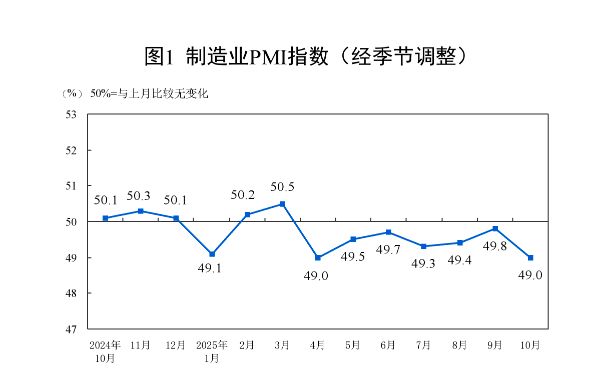
Core Viewpoint - In October, China's manufacturing Purchasing Managers' Index (PMI) fell to 49.0%, indicating a contraction in manufacturing activity, while the non-manufacturing business activity index rose slightly to 50.1%, suggesting stability in the overall economy [1][3]. Manufacturing Sector Analysis - The manufacturing PMI decreased by 0.8 percentage points from the previous month, ending a two-month upward trend, with all 13 sub-indices showing declines ranging from 0.1 to 2.6 percentage points [3]. - The manufacturing production index dropped to 49.7%, down 2.2 percentage points, indicating a shift from expansion to contraction, although it remains close to the neutral level of 50% [3]. - Factors contributing to the slowdown include pre-holiday demand release and increased international trade uncertainties, leading to cautious production intentions among manufacturers [3][4]. Demand and Export Trends - The new export orders index fell to 45.9%, a decrease of 1.9 percentage points, marking the second-lowest point this year, primarily due to global economic pressures and trade uncertainties [4]. - Key sectors such as equipment manufacturing, high-tech manufacturing, and consumer goods manufacturing, which are crucial for exports, experienced significant tightening in new orders, impacting overall market demand [4][6]. Key Industries Performance - Despite the challenges, the three key industries—high-tech manufacturing, equipment manufacturing, and consumer goods manufacturing—maintained PMIs above 50, indicating continued expansion [6][7]. - The production and new orders indices for these sectors hovered around 51%, reflecting stable growth supported by domestic market strength and effective policy measures [7]. Price Trends and Cost Pressures - In October, the purchasing and factory gate price indices for equipment manufacturing rose for three consecutive months, with the factory price index reaching a new high since June 2024 [7]. - The consumer goods manufacturing sector saw a decrease in the purchasing price index, indicating reduced cost pressures, which is beneficial for profitability in this sector [8]. Non-Manufacturing Sector Insights - The non-manufacturing business activity index increased to 50.1%, remaining above the neutral level, with significant contributions from sectors related to consumer spending during the holiday season [10]. - The construction sector showed signs of acceleration, with the civil engineering business activity index rising significantly, indicating a positive outlook for infrastructure investment in the fourth quarter [10].
10月制造业PMI回落至49% 三大重点行业保持扩张
证券时报· 2025-10-31 04:40
Core Viewpoint - In October, China's manufacturing PMI decreased to 49.0%, indicating a contraction in manufacturing activity, while the non-manufacturing business activity index slightly increased to 50.1%, suggesting stability in the overall economy [1][2]. Manufacturing Sector Analysis - The manufacturing PMI ended a two-month rising trend, with all 13 sub-indices declining, reflecting pressure on enterprises [4][5]. - The manufacturing production index fell to 49.7%, dropping 2.2 percentage points, indicating a slight slowdown in production activities [6]. - The new export orders index decreased to 45.9%, marking the second-lowest point this year, primarily due to global economic pressures and uncertainties in international trade [6][7]. - Key sectors such as equipment manufacturing, high-tech manufacturing, and consumer goods manufacturing maintained expansion, with PMIs of 50.5%, 50.2%, and 50.1% respectively [9][10]. Price Trends - Manufacturing prices showed positive changes, with the equipment manufacturing purchase price index and factory price index rising for three consecutive months, reaching a new high since June 2024 [11]. - The consumer goods manufacturing purchase price index decreased, indicating reduced cost pressures, which could benefit profit margins in the sector [12]. Non-Manufacturing Sector Insights - The non-manufacturing business activity index remained above 50%, reflecting ongoing expansion, with significant activity in sectors related to consumer travel and holiday spending [14][15]. - The civil engineering construction business activity index rose significantly, indicating a potential acceleration in infrastructure investment activities [16].


10月份我国制造业PMI为49.0%
Xin Hua Wang· 2025-10-31 04:15
Core Viewpoint - In October, the manufacturing Purchasing Managers' Index (PMI) decreased to 49.0%, reflecting a decline influenced by pre-holiday demand release and a complex international environment [1][2]. Group 1: PMI and Production Indices - The production index and new orders index for October were reported at 49.7% and 48.8%, respectively, showing declines of 2.2 and 0.9 percentage points from the previous month [1]. - The PMI for large, medium, and small enterprises was recorded at 49.9%, 48.7%, and 47.1%, indicating decreases of 1.1, 0.1, and 1.1 percentage points, respectively [1]. - Large enterprises maintained production and new orders indices at 50.9% and 50.1%, remaining in the expansion zone for six consecutive months [1]. Group 2: Industry Performance - Three key industries—high-tech manufacturing, equipment manufacturing, and consumer goods—sustained expansion with PMIs of 50.5%, 50.2%, and 50.1%, respectively [1]. - The production activity expectation index stood at 52.8%, indicating a continued optimistic outlook among most manufacturing enterprises [1]. Group 3: Market Dynamics - The construction of a unified national market is progressing, leading to positive changes in market prices, with the equipment manufacturing purchase and factory price indices rising for three consecutive months [2]. - Despite a slight slowdown in production activities in October, new growth drivers and consumer goods manufacturing showed steady growth, providing a solid foundation for macroeconomic stability [2].
制造业PMI回落至49%
第一财经· 2025-10-31 03:38
Core Viewpoint - The manufacturing PMI in October decreased to 49.0%, indicating a decline in manufacturing activity after two months of growth, influenced by pre-holiday demand release and a complex international environment [3][4]. Manufacturing Sector Analysis - The manufacturing PMI fell by 0.8 percentage points from the previous month, reflecting a contraction in manufacturing sentiment [3][4]. - The production index for manufacturing dropped to 49.7%, down 2.2 percentage points, indicating a slight slowdown in production activities [8]. - New export orders index decreased to 45.9%, marking a significant contraction in export demand, particularly in equipment manufacturing, high-tech manufacturing, and consumer goods manufacturing [9][10]. Supply and Demand Dynamics - Both supply and demand are experiencing a slowdown, with the procurement index falling to 49%, down 2.6 percentage points, indicating reduced purchasing activities among manufacturers [8]. - The overall market demand is weak, driven by external uncertainties and seasonal factors, leading to cautious production intentions among manufacturers [9]. Price Trends - Despite the slowdown, there are positive price changes in the manufacturing sector, with the purchasing price index and factory price index in equipment manufacturing rising for three consecutive months [12]. - The consumer goods manufacturing sector saw a decrease in purchasing price index by 2.5 percentage points, indicating reduced cost pressures, which may benefit profit margins [13]. Non-Manufacturing Sector Insights - The non-manufacturing business activity index rose to 50.1%, indicating expansion, driven by holiday effects and increased consumer activity in sectors like transportation and hospitality [16]. - The business activity expectation index remains high at 56.1%, suggesting strong confidence among service sector enterprises regarding future growth [16].
制造业PMI回落至49%,“反内卷”带动价格改善
Di Yi Cai Jing Zi Xun· 2025-10-31 03:10
Core Insights - The manufacturing PMI in October decreased to 49.0%, down 0.8 percentage points from the previous month, indicating a decline in manufacturing activity after two months of growth [1] - The non-manufacturing business activity index rose to 50.1%, up 0.1 percentage points, remaining in the expansion zone, driven by holiday effects [1] Manufacturing Sector - The manufacturing production index fell to 49.7%, a decrease of 2.2 percentage points, indicating a slight slowdown in production activities [4] - The new export orders index dropped to 45.9%, down 1.9 percentage points, marking the second-lowest point of the year, reflecting tightening export demand [5] - The procurement volume index decreased to 49%, down 2.6 percentage points, indicating a contraction in purchasing activities after two months of expansion [5] Business Performance by Company Size - Large enterprises' PMI fell to 49.9%, while medium-sized enterprises' PMI decreased to 48.7%, and small enterprises' PMI dropped to 47.1%, indicating pressure across all company sizes [6] - Despite the decline, large enterprises maintained stable supply and demand, while medium and small enterprises faced more significant challenges [6] Price Trends - The manufacturing sector experienced positive price changes, with the equipment manufacturing purchase price index and factory price index rising for three consecutive months [6] - The consumer goods manufacturing purchase price index fell to below 50%, while the factory price index increased, indicating reduced cost pressures and stabilized sales prices [7] Non-Manufacturing Sector - The non-manufacturing business activity index showed signs of recovery, with significant activity in sectors closely related to consumer travel, such as transportation and hospitality, driven by holiday effects [10] - The business activity expectation index remained high at 56.1%, indicating strong confidence among service sector enterprises regarding future development [10]
10月份制造业采购经理指数有所回落 非制造业商务活动指数略有回升
Guo Jia Tong Ji Ju· 2025-10-31 02:32
Group 1: Manufacturing PMI Insights - In October, the manufacturing PMI decreased to 49.0%, down 0.8 percentage points from the previous month, indicating a slowdown in production activities [1][2] - Both production index and new orders index fell to 49.7% and 48.8%, respectively, reflecting a decline in manufacturing production and market demand [2] - Large enterprises maintained a PMI above the critical point, with indices at 50.9% for production and 50.1% for new orders, indicating sustained demand in this segment [2][3] Group 2: Non-Manufacturing PMI Insights - The non-manufacturing business activity index rose to 50.1%, up 0.1 percentage points from the previous month, indicating a slight expansion in the sector [4] - The service industry business activity index increased to 50.2%, with significant growth in sectors closely related to consumer travel, such as rail and air transport, which saw indices above 60.0% [4] - The construction industry business activity index slightly decreased to 49.1%, but the business activity expectation index improved to 56.0%, suggesting a positive outlook for future market conditions [4] Group 3: Composite PMI Insights - The composite PMI output index stood at 50.0%, indicating overall stability in production and business activities across sectors [5] - The manufacturing production index and non-manufacturing business activity index were recorded at 49.7% and 50.1%, respectively, contributing to the composite index's position at the critical point [5]
广东总量居全国首位,5万亿俱乐部年底有望扩员
3 6 Ke· 2025-10-31 02:20
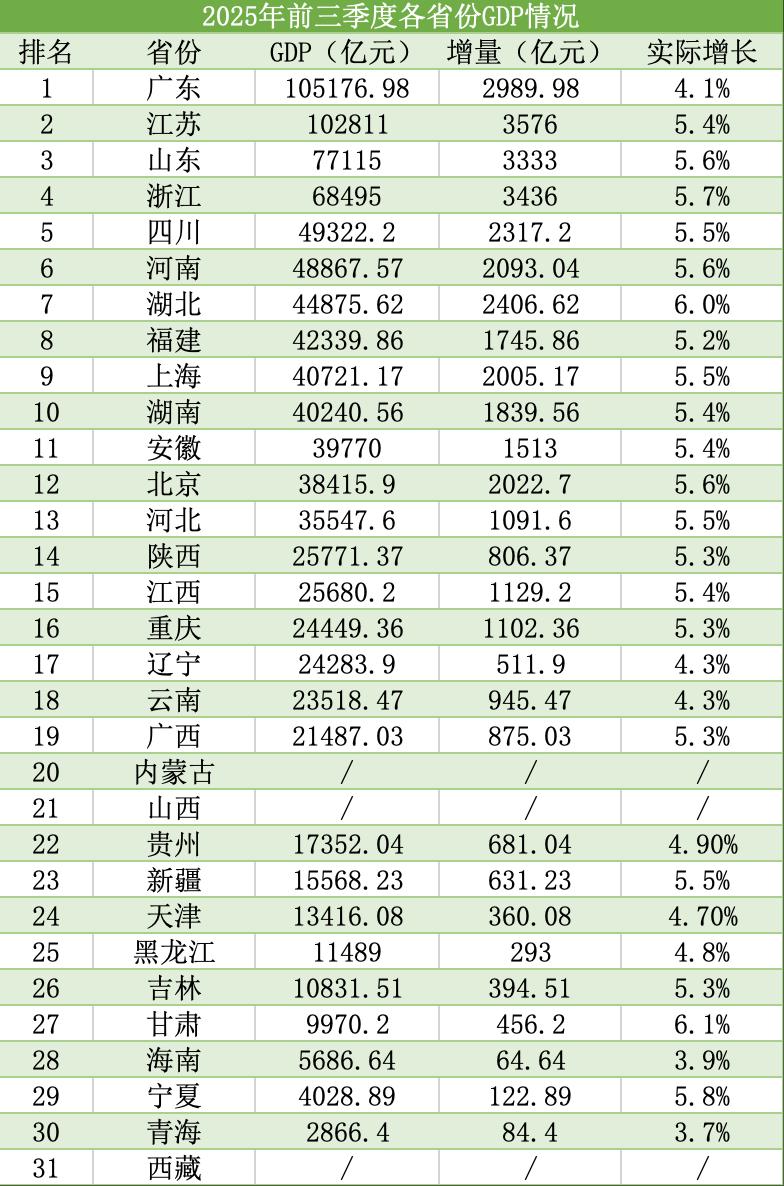
Core Insights - The GDP data for the first three quarters of 2025 has been released, with 28 provinces reporting their figures, showing a diverse economic performance across the country [1][4]. GDP Rankings and Growth - Guangdong leads with a GDP of 10,517.698 billion yuan, maintaining its position as the top province for 36 consecutive years, with a growth rate of 4.1% [4][5]. - Jiangsu follows closely with a GDP of 10,281.1 billion yuan and a growth rate of 5.4%, surpassing the 10 trillion yuan mark [2][7]. - Gansu has the highest growth rate at 6.1%, indicating strong economic performance [3]. Economic Performance by Province - 20 provinces outperformed or matched the national average growth rate of 5.2% [1]. - Shandong, with a GDP of 77,115 billion yuan and a growth rate of 5.6%, is on track to join the 10 trillion yuan club [10][11]. - Beijing is projected to reach a GDP of 49,843.1 billion yuan by the end of 2024, potentially entering the 5 trillion yuan club [12][13]. Sectoral Contributions - Guangdong's industrial output increased by 3.5%, with advanced manufacturing and high-tech sectors growing by 5.4% and 6.4%, respectively [5]. - In Jiangsu, the industrial output rose by 6.8%, with equipment manufacturing growing by 9.4% [8]. - Hubei showed robust growth in all three economic drivers, with fixed asset investment up by 6.5% and foreign trade reaching a record high [9]. Consumer Market Trends - In Guangdong, retail sales of cultural and office supplies, home appliances, and communication equipment grew significantly, with increases of 21.0%, 31.0%, and 16.5%, respectively [6]. - Shandong's retail sales also showed strong growth, with a total of 30,386.1 billion yuan, reflecting a 5.6% increase [11].
10月份制造业采购经理指数为49.0% 专家解读
Guo Jia Tong Ji Ju· 2025-10-31 02:03
Group 1: Manufacturing PMI Analysis - In October, the manufacturing PMI decreased to 49.0%, down 0.8 percentage points from the previous month, indicating a slowdown in production activities [1][2] - Both production index and new orders index fell to 49.7% and 48.8%, respectively, reflecting a decline in manufacturing production and market demand [2] - Large enterprises maintained a PMI above the critical point, with indices at 50.9% for production and 50.1% for new orders, indicating sustained demand in this segment [2] Group 2: Key Industry Performance - High-tech manufacturing, equipment manufacturing, and consumer goods industries continued to expand, with PMIs of 50.5%, 50.2%, and 50.1%, respectively, significantly above the overall manufacturing level [3] - Conversely, high-energy-consuming industries saw a PMI of 47.3%, indicating a decline in economic activity [3] - Market expectations remain optimistic, with a production and business activity expectation index of 52.8%, suggesting confidence among manufacturers [3] Group 3: Non-Manufacturing PMI Insights - The non-manufacturing business activity index rose to 50.1%, up 0.1 percentage points, indicating a slight recovery in this sector [4] - The service industry business activity index increased to 50.2%, with sectors like rail transport and accommodation showing strong activity levels due to holiday effects [4] - The construction industry business activity index fell to 49.1%, indicating a slight decline, but the business activity expectation index improved to 56.0%, reflecting better future outlooks [4] Group 4: Composite PMI Overview - The composite PMI output index stood at 50.0%, indicating overall stability in production and business activities across sectors [5] - The manufacturing production index and non-manufacturing business activity index were recorded at 49.7% and 50.1%, respectively, contributing to the composite index's position at the critical point [5]
10月份制造业采购经理指数有所回落 非制造业商务活动指数略有回升
Yang Shi Wang· 2025-10-31 02:01
Group 1: Manufacturing PMI Insights - In October, the manufacturing purchasing managers' index (PMI) decreased to 49.0%, down 0.8 percentage points from the previous month, indicating a slowdown in production activities [1][2] - Both production index and new orders index fell to 49.7% and 48.8%, respectively, reflecting a decline in manufacturing production and market demand [2] - Large enterprises maintained a PMI above the critical point, with indices at 50.9% for production and 50.1% for new orders, indicating sustained expansion in this segment [2][3] Group 2: Non-Manufacturing PMI Insights - The non-manufacturing business activity index rose to 50.1%, up 0.1 percentage points from the previous month, indicating a slight recovery in this sector [1][4] - The service industry business activity index increased to 50.2%, with sectors like railway transport and accommodation showing strong activity levels above 60.0% [4] - The construction industry business activity index slightly decreased to 49.1%, but the business activity expectation index improved to 56.0%, suggesting a more optimistic outlook [4] Group 3: Composite PMI Overview - The composite PMI output index stood at 50.0%, indicating overall stability in production and business activities across sectors [1][5] - The manufacturing production index and non-manufacturing business activity index were recorded at 49.7% and 50.1%, respectively, contributing to the composite index's position at the critical point [5]
国家统计局服务业调查中心首席统计师霍丽慧解读2025年10月中国采购经理指数
Guo Jia Tong Ji Ju· 2025-10-31 01:52
Group 1: Manufacturing PMI Insights - In October, the Manufacturing Purchasing Managers' Index (PMI) decreased to 49.0%, down 0.8 percentage points from the previous month, indicating a slowdown in manufacturing activity [2][3] - The production index and new orders index were reported at 49.7% and 48.8%, respectively, reflecting declines of 2.2 and 0.9 percentage points, suggesting weakened production and market demand [3] - Large enterprises maintained a PMI above the critical point, with large, medium, and small enterprises reporting PMIs of 49.9%, 48.7%, and 47.1%, respectively, indicating varying levels of economic activity [3] Group 2: Non-Manufacturing PMI Insights - The Non-Manufacturing Business Activity Index rose to 50.1%, an increase of 0.1 percentage points, indicating a slight expansion in the non-manufacturing sector [5] - The service sector's business activity index reached 50.2%, with significant growth in sectors closely related to consumer travel, such as rail and air transport, which exceeded 60.0% [5] - The construction sector's business activity index fell to 49.1%, down 0.2 percentage points, indicating a slight decline in construction activity, although the business activity expectation index improved to 56.0% [5] Group 3: Composite PMI Insights - The Composite PMI Output Index stood at 50.0%, indicating overall stability in production and business activities across sectors [7] - The manufacturing production index and non-manufacturing business activity index contributed to the composite index, reported at 49.7% and 50.1%, respectively [7]