
新消费

Search documents
国泰海通 · 晨报0618|策略、机械
国泰海通证券研究· 2025-06-17 15:09
Core Viewpoint - The article emphasizes the optimistic outlook for China's stock market, highlighting the emergence of new technology trends and business models, a decrease in opportunity costs for stock investments, and improved economic policies that favor investor returns. This creates a favorable environment for thematic investments, particularly in frontier technologies, advanced manufacturing, and structural improvements, with a focus on investment opportunities for the second half of 2025 [1][6][11]. Group 1: Frontier Technologies - Theme 1: AI and Embodied Intelligence - Artificial intelligence is expected to follow a path of "information infrastructure construction," "basic software deployment," "online application explosion," and "restructuring offline industries," with AI becoming a key catalyst for commercialization and increasing demand for computing power [2]. - The application of embodied intelligence is accelerating in fields such as research, education, and healthcare, with a focus on specific robotic products like quadrupedal and exoskeleton robots [2]. - Theme 2: Bioeconomy and Brain-Machine Interfaces - Biotechnology is rapidly advancing, enabling traditional industries to upgrade, with synthetic biology and information crossover technologies opening new spaces in the bioeconomy [3]. - The brain-machine interface industry is in the exploratory phase, with several tech companies attempting breakthroughs in hardware and applications [3]. - Theme 3: 6G Communication - 6G technology is set to revolutionize communication with significant improvements in speed and latency, with research expected to start in 2025 and commercial systems planned for 2030 [4]. Group 2: Advanced Manufacturing - Theme 4: Low-altitude Economy and Commercial Space - The low-altitude economy is entering a "manned era," with market size expected to exceed one trillion yuan by 2026, driven by the establishment of non-controlled airspace and operational certifications [7]. - The commercial space sector is anticipated to see significant growth due to the increasing demand for satellite launches and the development of satellite constellations [7]. - Theme 5: Deep-sea Technology - The government has prioritized deep-sea technology, with policies accelerating the industrialization process and a projected marine production value exceeding ten trillion yuan by 2024 [8]. - Theme 6: Self-sufficiency - The semiconductor sector is becoming a focal point in the technology competition, with policies promoting mergers and acquisitions to deepen domestic replacements [9]. Group 3: Structural Improvements - Theme 7: Smart Driving - The penetration of advanced smart driving technologies is accelerating, with significant cost reductions expected in related hardware due to scale effects from companies like BYD [10]. - Theme 8: New Consumption Brands - The consumption recovery is showing a "K-shaped" divergence, with traditional consumption under pressure while new consumption is thriving, driven by digital economy and infrastructure changes [12]. - Theme 9: Price Cycle Products - Some cyclical industries are beginning to reduce capacity, with expectations for improved supply-demand dynamics leading to price recoveries in related sectors [13]. - Theme 10: Regional Economy - There is an increasing urgency to address regional development imbalances, with accelerated investment in western infrastructure and supportive policies for local industries [14].


创新药行情催生年内首只“翻倍基”!
2 1 Shi Ji Jing Ji Bao Dao· 2025-06-17 14:16
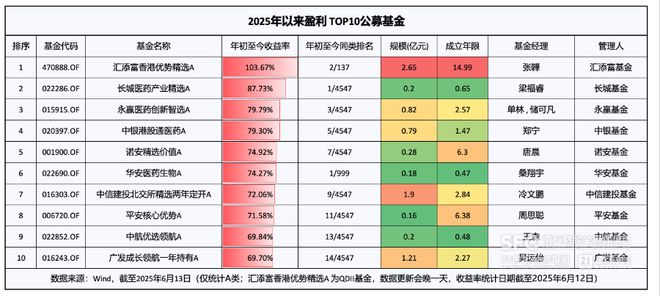
Group 1 - The first "doubling fund" in the public fund market for 2025 is the Huatai-PineBridge Hong Kong Advantage Selection A, which has achieved a 99.5% year-to-date return as of June 13, 2025, leading the entire market [1][2] - Among the top 10 funds for year-to-date returns in 2025, 8 are heavily invested in pharmaceutical companies, particularly in the innovative drug sector [1][2] - The innovative drug sector has seen significant growth, with the Wind Innovative Drug Concept Index rising over 25% and the Hang Seng Innovative Drug Index increasing over 53% since April 9, 2025 [2][3] Group 2 - Notable stocks in the innovative drug sector have experienced substantial price increases, with Shuyou Pharmaceutical leading at a 478.84% increase, followed by Sanofi Health at 129.81% [3][4] - The top-performing funds have a high concentration of investments in innovative drug companies, with the most frequently held stock being Kelong Biotechnology-B, which has also doubled in price [4][5] - Fund managers of the top-performing funds are predominantly new faces, with half of them having less than two years of investment experience [5][6] Group 3 - Zhang Wei, the manager of Huatai-PineBridge Hong Kong Advantage Selection A, has maintained a strong focus on the pharmaceutical sector, with the fund's top holdings consistently being in the biopharmaceutical industry [7][8] - The fund has shown resilience despite previous years of losses, with a significant recovery in 2025 attributed to the performance of its long-held innovative drug stocks [9][10] - Zhang Wei's investment strategy emphasizes long-term perspectives and stability in holdings, focusing on companies with global competitiveness and growth potential in the pharmaceutical and biotech sectors [10][11] Group 4 - The performance disparity among active equity funds in 2025 is notable, with 12 funds experiencing declines of over 20%, including several managed by Jin Zicai [13][14] - Jin Zicai's aggressive investment style has led to high turnover rates and concentrated positions, which can result in significant volatility [15][16] - The overall market sentiment towards innovative drugs remains positive, with expectations for continued growth driven by domestic medical demand recovery and supportive policies [10][11]


创新药、新消费调整,明天这些方向或接棒领涨!
Sou Hu Cai Jing· 2025-06-17 11:58
Market Overview - A-shares and Hong Kong stocks exhibited a narrow fluctuation pattern, with market sentiment remaining resilient amid sector rotation [1] - A-share indices showed slight declines, with the Shanghai Composite Index down 0.04% to 3387.4 points, while the Shenzhen Component and ChiNext Index fell by 0.12% and 0.36% respectively [1] - Hong Kong's Hang Seng Index decreased by 0.34% to 23980.30 points, with a total market turnover dropping to 202.1 billion HKD [1] Sector Performance - In the A-share market, sectors such as stablecoins, oil and gas, brain-computer interfaces, and solid-state batteries showed active performance, particularly the brain-computer interface concept which surged over 283% in related US stocks [2] - The stablecoin concept gained traction due to anticipated policy announcements in Hong Kong, while the solid-state battery sector was catalyzed by an upcoming industry forum [2] - Conversely, sectors like innovative drugs, IP economy, and pharmaceuticals faced notable adjustments, with the innovative drug sector reaching a historical high in trading congestion [2] - In the Hong Kong market, pharmaceutical and new consumption stocks experienced significant declines, with the pharmaceutical sector showing marked internal differentiation [2] Driving Factors - The structural market dynamics in A-shares are influenced by three main factors: external market sentiment, policy and event catalysts, and a shift in funds seeking opportunities in technology sectors [3] - A-share sectors such as coal, utilities, and oil and gas saw gains exceeding 0.5%, while pharmaceuticals and beauty care sectors dropped over 0.6% [3] - In the Hong Kong market, sectors like comprehensive enterprises and industrials showed positive performance, while healthcare and energy sectors faced notable declines [3] Future Outlook - The macroeconomic environment and policy developments are critical variables for market direction, with stable growth in industrial output and consumption providing fundamental support [4] - The market is expected to continue its oscillating trend, with high-position themes like innovative drugs and new consumption facing increased volatility [4] - Key areas for mid-term investment focus include AI computing power, solid-state batteries, and commercial aerospace, as these sectors are viewed as having significant potential [4] - The evolution of core issues such as Federal Reserve policy shifts and the stabilization of the domestic real estate market will play a crucial role in determining market direction [4]
提示一个风险,以及政策线索下的机会
Hu Xiu· 2025-06-17 11:49
2、政策引导去产能,有利于哪些行业? 今天的市场比较平淡,从新闻层面也没有透露出太多新的线索。所以时间紧张的朋友可以把今天的内容 跳过去。我们今天主要讲两方面:一是提示风险;二是沿着政策更深层次的脉络来梳理出一条线,可能 会预示着某个产业中的机会。 如有疑问请以音频内容为准,添加妙妙子微信huxiuvip302,入群有机会与董小姐进一步交流。 新闻解读评级说明:五星重磅,四星重要,三星级以下大家选择听。 1、又见炒作,脑机接口是风口,还是风险? 本篇评级为★★,主要围绕以下内容展开: 1、又见炒作,脑机接口是风口,还是风险? 首先,我们来聊一下风险。这两天,几个热点板块走势非常诡异,频繁出现高位大幅回撤的现象。这 种"你方唱罢我登场"的行情,非常不利于个人投资者获利。今天市场上出现了创新药板块的大幅下挫。 这并不是今天才出现的风险,而是一周前我们就跟大家提到过的。在这个行业内,包括行业圈子里的 人,甚至都有点看不懂这个赛道的表现。这种涨势可能已经透支了所有乐观的预期——也就是说,所有 正在研发的药物最终都能落地、获批、变成最终产品。只有这样乐观的预期,才可能打出这样的市场表 现。但显然,这是不太可能的。 在最 ...
读研报 | 当AH股溢价指数创下5年新低
中泰证券资管· 2025-06-17 10:02
Core Viewpoint - The article discusses the recent decline of the AH Premium Index, which has reached a five-year low, indicating a significant shift in the pricing dynamics between A-shares and H-shares [4][6]. Group 1: AH Premium Index Trends - The AH Premium Index dropped to 127.84 points, the lowest in five years, compared to over 160 points in February 2024, reflecting a 0.8% percentile position over the past five years [4]. - The financial sector (including banks, brokers, and insurance) has contributed significantly to the decline of the AH Premium Index, accounting for 64% of the decrease since 2025, 60% since April 7, and 76% since June [8]. - The top 25 stocks, primarily state-owned enterprises and resource stocks, have contributed to 79% of the decline since 2025, 71% since April 7, and 85% since June [8]. Group 2: Sector Contributions - The weighted AH premium rate for growth stocks has narrowed significantly, from 64.6% to 42.2% as of June 6, with non-bank financials, banks, and oil & gas sectors being the largest contributors to this decline [9]. - The contributions from sectors such as automotive and pharmaceuticals were also noted, with respective contributions of -0.9% and -0.6% [9]. Group 3: Market Sentiment and Future Outlook - The future trajectory of the AH premium rate remains uncertain, with varying opinions on whether it will continue to narrow or stabilize, depending on market sentiment and sector performance [9]. - Analysts suggest that the choice between A-shares and H-shares should not be oversimplified and should consider the specific investment strategies and profiles of different investors [11].

名家看市:张忆东战略性做多港股,刘煜辉认为港股下半年大概率迎来牛市
Mei Ri Jing Ji Xin Wen· 2025-06-17 09:46
Group 1 - The Hong Kong stock market is experiencing a bullish atmosphere, attracting global attention and positive forecasts from professionals and institutions for the second half of the year [1][4] - Zhang Yidong from Industrial Securities advocates for a strategic long position in Hong Kong stocks, citing a new era driven by the restructuring of international order and the revaluation of Chinese assets [2][5] - The market's underlying logic is shifting from being foreign capital-dominated to becoming a crucial international financial center for China, supported by favorable policies and resource allocation [2][5] Group 2 - The recovery of IPOs driven by technology and new consumption is expected to provide fundamental support for the revaluation of the Hong Kong stock market [2] - The market's valuation structure is increasingly dominated by new consumption, technology, and biomedicine, which now account for over half of the market's total market capitalization [2] - Zhang Yidong suggests focusing on growth assets such as military, technology, and new consumption as offensive strategies, while dividend assets like utilities and high-dividend stocks serve as defensive strategies [3] Group 3 - Liu Yuhui emphasizes that the Hong Kong Stock Exchange is the most popular financing market globally, predicting a bullish trend for the Hang Seng Index and Hang Seng Tech Index in the second half of the year [4] - There is a strategic push to move core Chinese assets to the offshore RMB market, potentially paving the way for the upcoming offshore RMB asset market [4] - Citic Securities also forecasts a potential index bull market for both Hong Kong and A-shares starting in Q4 2025, with a significant shift towards core assets [5][6]
暴涨、熔断!年内涨超50倍,股民直呼“我看不懂,大为震撼”泡泡玛特领跌,新消费三姐妹惨烈杀跌,是调整还是转折?
雪球· 2025-06-17 08:30
今日A股三大指数小幅下跌,截至收盘,沪指跌0.04%报3387点,深证成指跌0.12%,创业板指跌0.36%。 全天成交1.24万亿元,较前一交易日缩量 64亿元。 板块方面,脑机接口、油气、电池、核污染防治等板块涨幅居前,游戏、创新药、美容护理、IP经济等板块跌幅居前。 | < | 倍盗康 ··· Q | | --- | --- | | 870199 已收盘 06-17 15:34:55 北京 | | | 3125人加自选(一) > | | | 41.86 +9.66 +30.00% | CN 融 L1 | | 高 41.86 开 39.00 量 91575.00手 总市值 28.51亿 。 | | | . 低 38.50 换 24.62% 额 3.73亿 | 市盈TTM -- | 五日 分时 日K 月K 李K 年K 分钟 · 周K 均价:40.76 最新:41.86 +9.66 +30.00% | 86 | | 30.00% 卖5 | | | 0 | | --- | --- | --- | --- | --- | --- | | | | 英4 | | | 0 | | | | 卖3 | -- | | 0 | ...

港股收盘,恒指收跌0.34%,科指收跌0.15%,新消费概念股回调,泡泡玛特(09992.HK)跌6%,周大福(01929.HK)跌7.3%。
news flash· 2025-06-17 08:14
港股收盘,恒指收跌0.34%,科指收跌0.15%,新消费概念股回调,泡泡玛特(09992.HK)跌6%,周大福 (01929.HK)跌7.3%。 ...

刚刚!大跳水
中国基金报· 2025-06-17 08:04
Core Viewpoint - The market experienced slight fluctuations with all three major indices closing down, indicating a collective downturn in sectors such as innovative pharmaceuticals and new consumption [1][2][9]. Market Performance - On June 17, the market saw a narrow range of fluctuations, with the Shanghai Composite Index down by 0.04%, the Shenzhen Component down by 0.12%, and the ChiNext Index down by 0.36% [2]. - A total of 2,250 stocks rose, with 61 hitting the daily limit up, while 2,921 stocks fell [3][4]. - The total trading volume reached 12,371.36 billion, with a total of 100,014.4 million shares traded [4]. Sector Highlights - Brain-computer interface concept stocks showed strong performance, with companies like Aipeng Medical and Nanjing Panda hitting the daily limit up. A notable mention is a US-listed Chinese stock, which surged by 283%, reaching a market cap of 29.669 billion [5]. - Oil and gas stocks also saw significant gains, with companies like Tongyuan Petroleum and Shandong Molong achieving three consecutive limit ups. This was influenced by geopolitical tensions in the Strait of Hormuz, where three ships caught fire, impacting global oil prices [7]. Declines in Key Sectors - The innovative pharmaceutical sector and IP economy sector experienced a collective downturn, with several stocks showing significant declines [9][12]. - In the Hong Kong market, the innovative pharmaceutical sector also faced a sharp decline, with major companies like Heptares Therapeutics and Gilead Sciences dropping by over 10% [12][13]. Trading Conditions - The trading congestion in the innovative pharmaceutical sector reached a peak, accounting for nearly 4.8% of market trading volume, indicating a high level of investor interest [14]. - The new consumption sector also saw trading congestion levels above 7.2%, reflecting a similar trend of heightened trading activity [14]. - Analysts suggest that both the innovative pharmaceutical and new consumption sectors may have reached a phase of peak performance, driven by both strong fundamentals and investor sentiment [15].

野村证券:中国 A 股策略-2025年下半年展望
野村· 2025-06-17 06:17
策略 策略报告 [TABLE_COVER] 一致预期的长尾 2025 年下半年展望 [Table_first1] 中国 A 股策略 2025 年 06 月 06 日 [Table_first3] 分析师 策略研究团队 宋劲 jin.song@nomuraoi-sec.com SAC 执证编号:S1720519120002 傅尔 er.fu@nomuraoi-sec.com SAC 执证编号:S1720524010001 65413995/61850/20250610 16:55 在美国经济避免硬着陆的基准情形下,我们看好 AH 市场下半年相对和绝 对收益机会。全球宏观预期已被市场较长期计价,目前全球市场正再度迈 入一致预期的长尾期。面对美国经济强现实弱预期、中国经济弱现实强预 期的割裂,我们认为预期与现实间的错位将在下半年逐步被高频数据所验 证,当前投资者已再度站在十字路口。国际资金推动的"去美元化"叙事将 在交易层面叠加额外波动性。 从股权风险溢价(ERP)角度来看,我们认为沪深 300 仍具配置价值。鉴 于银行业在今年经营压力增加,我们预计金融行业净利率将小幅走低,同 时基于我们对当前宏观增速的预期,我们 ...