非金属矿物制品业

Search documents
中旗新材: 公司章程(2025年6月)
Zheng Quan Zhi Xing· 2025-06-19 15:15
广东中旗新材料股份有限公司章程 第一章 总则 第一条 为维护广东中旗新材料股份有限公司(以下简称"公司")、股东、职 工和债权人的合法权益,规范公司的组织和行为,根据《中华人民共和国公司法》 (以下简称《公司法》)、《中华人民共和国证券法》(以下简称《证券法》)、 《上市公司章程指引》《上市公司治理准则》和其他有关规定,制定本章程。 第二条 广东中旗新材料股份有限公司系依照《公司法》和其他有关规定成立 第六条 公司注册资本为人民币 182,874,555 元。 第七条 公司为永久存续的股份有限公司。 的股份有限公司(以下简称"公司")。 第八条 公司法定代表人为代表公司执行公司事务的董事。董事长为代表公司 公司以发起设立方式设立,由有限责任公司整体变更为股份有限公司。 公司在佛山市工商行政管理局登记注册,公司营业执照签发日期为本公司成 立日期,统一社会信用代码为:91440600564536724H。 第三条 公司于 2021 年 7 月 8 日经中国证券监督管理委员会(以下简称"中国 证监会")核准,首次向社会公众发行人民币普通股 2,267 万股,于 2021 年 8 月 23 日在深圳证券交易所(以下简 ...
联瑞新材: 联瑞新材募集资金管理制度
Zheng Quan Zhi Xing· 2025-06-13 12:23
江苏联瑞新材料股份有限公司 募集资金管理制度 第一章 总则 第一条 为了规范江苏联瑞新材料股份有限公司(以下简称"公司")募集 资金的管理和运用,保护投资者的权益,依照《中华人民共和国公司法》、《中 华人民共和国证券法》、中国证券监督管理委员会(以下简称"中国证监会") 颁布的《上市公司证券发行注册管理办法》、《上海证券交易所科创板股票上市 规则》(以下简称"《上市规则》")、《上市公司募集资金监管规则》以及《上 海证券交易所科创板上市公司自律监管指引第 1 号——规范运作》等法律、法规 的规定,结合公司实际情况,特制定本制度。 第二条 本制度适用于公司通过发行股票或者其他具有股权性质的证券,向 投资者募集并用于特定用途的资金监管,但不包括公司为实施股权激励计划募集 的资金监管。 本制度所称超募资金是指实际募集资金净额超过计划募集资金金额的部分。 第三条 公司的董事、高级管理人员应当勤勉尽责,督促公司规范使用募集 资金,自觉维护公司募集资金安全,不得参与、协助或纵容公司擅自或变相改变 募集资金用途。 第四条 公司控股股东、实际控制人不得直接或者间接占有或者挪用公司募 集资金,不得利用公司募集资金及募集资金投资 ...

5月广东CPI同比下降0.4% PPI环比降幅收窄
Sou Hu Cai Jing· 2025-06-11 11:13
Group 1: Consumer Price Index (CPI) Analysis - In May 2025, Guangdong's Consumer Price Index (CPI) decreased by 0.4% year-on-year, maintaining the same decline as the previous month, and a month-on-month decrease of 0.1% compared to a 0.3% increase in the previous month, resulting in a fluctuation of 0.4 percentage points [1] - The average CPI for January to May 2025 was down 0.4% compared to the same period last year [1] - Factors influencing the CPI included a 4.0% increase in fresh fruit prices due to the arrival of lychee season and increased demand from warmer weather, and a 2.3% increase in aquatic product prices due to reduced market supply during the fishing ban and increased demand during holidays, collectively contributing approximately 0.15 percentage points to the CPI increase [1] Group 2: Producer Price Index (PPI) Analysis - In May 2025, Guangdong's Producer Price Index (PPI) decreased by 1.8% year-on-year, with the decline widening by 0.4 percentage points compared to the previous month, and a month-on-month decrease of 0.2% [1] - The average PPI for January to May 2025 was down 1.3% year-on-year [1] - The Industrial Producer Purchase Price Index (IPI) also saw a year-on-year decrease of 3.1% and a month-on-month decrease of 0.4% [1] - The decline in PPI was influenced by falling international crude oil prices, overcapacity in certain industries, and insufficient downstream market demand [1][2] - In the PPI survey of 38 major industries, 6 industries saw price increases, 26 experienced price declines, and 6 remained stable, indicating an industry price increase rate of 15.8% [2] - Specific industries affected included a 3.6% decrease in oil and gas extraction prices, a 3.0% decrease in petroleum, coal, and other fuel processing prices, and a 4.1% decrease in black metal mining prices due to reduced demand in the construction and real estate sectors [2]
【招银研究|宏观点评】能源拖累——中国物价数据点评(2025年5月)
招商银行研究· 2025-06-10 12:25
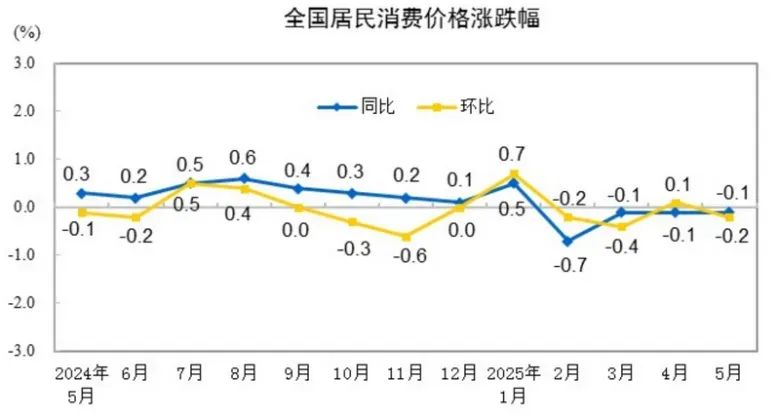
Core Viewpoint - The article discusses the inflation trends in May, highlighting a slight decrease in CPI and a more significant drop in PPI, with implications for future economic conditions and policy responses [1][10]. Group 1: CPI Inflation - May CPI inflation was reported at -0.1% year-on-year, matching the previous value and exceeding market expectations of -0.2% [1][2]. - Energy prices have significantly dragged down CPI inflation, while core CPI showed slight upward support [2][6]. - Food prices experienced a mild decline, with a 0.2% drop month-on-month, which is less than the average decline of 1.4% over the past five years [5]. - Core CPI inflation rose slightly by 0.1 percentage points to 0.6% year-on-year, although month-on-month momentum has weakened [6][7]. - Service prices remained resilient, with travel prices increasing by 0.8% month-on-month, surpassing the five-year average of 0.2% [6]. Group 2: PPI Inflation - May PPI inflation was reported at -3.3% year-on-year, a decrease of 0.6 percentage points from the previous month, and -0.4% month-on-month, which is weaker than the historical average since 2017 [10][12]. - The decline in PPI is attributed to weak oil prices affecting the entire industrial chain and a slowdown in the construction sector due to adverse weather conditions [10][12]. - Despite the overall decline, there are signs of recovery in prices related to exports and new growth sectors, with textile prices narrowing their decline and some electronic prices turning positive [12][15]. Group 3: Forward Outlook - Looking ahead, energy prices are expected to remain weak, with Brent crude oil projected to fluctuate between $60 and $70 [9]. - The overall pace of CPI recovery is anticipated to be slow, influenced by policies aimed at boosting domestic demand and consumption [16]. - For the second quarter, CPI inflation is expected to stabilize around 0%, while PPI inflation may drop to approximately -3.0% [16].

《特殊商品》日报-20250610
Guang Fa Qi Huo· 2025-06-10 03:51
知识图强, 求实奉献, 客户至上, 合作共赢 | 然橡胶产业期现日报 | | | | | | | --- | --- | --- | --- | --- | --- | | 投资咨询业务资格:证监许可【2011】1292号 2025年6月10日 | | | | 寇帝斯 | Z0021810 | | 现货价格及基差 | | | | | | | 品种 | 6月9日 | 6月6日 | 活快 | 涨跌幅 | 单位 | | 云南国营会到 胶(SCRWF):下海 | 13650 | 13750 | -100 | -0.73% | | | 全乳基差(切换至2509合约) | -75 | 100 | -175 | -175.00% | 元/吨 | | 泰标混合胶报价 | 13500 | 13600 | -100 | -0.74% | | | 非标价差 | -225 | -50 | -175 | -350.00% | | | 品种 | e a a fi | 6月6日 | 涨跌 | 涨跌幅 | 单位 | | 杯胶:国际市场:FOB中间价 | 45.20 | 44.90 | 0.30 | 0.67% | 泰铢/公斤 | | 胶水: ...
5月份PPI同比下降3.3%|快讯
Hua Xia Shi Bao· 2025-06-10 03:08
Group 1 - In May 2025, the Producer Price Index (PPI) for industrial producers decreased by 3.3% year-on-year and 0.4% month-on-month, while the purchasing price index fell by 3.6% year-on-year and 0.6% month-on-month [2] - The average PPI and purchasing prices from January to May 2025 both declined by 2.6% compared to the same period last year [2] - The decline in domestic prices is influenced by international factors, particularly the drop in international crude oil prices, which led to a 5.6% decrease in the oil and gas extraction industry and a 3.5% decrease in refined petroleum product manufacturing [2] Group 2 - The coal mining and washing industry saw a price drop of 3.0%, while coal processing prices fell by 1.1% due to seasonal demand and sufficient inventory [2] - The black metal smelting and rolling industry, along with the non-metallic mineral products industry, experienced a price decline of 1.0% due to ample supply of construction materials [2] - The year-on-year decline in PPI has widened by 0.6 percentage points compared to the previous month, but some industries are showing signs of price recovery due to improved supply-demand relationships [3] Group 3 - Consumer demand is recovering, leading to price increases in living materials, supported by policies aimed at boosting consumption [3] - The development of high-end equipment manufacturing is contributing to price increases in related industries, reflecting a trend towards high-tech product demand [3] - The transition towards high-end, intelligent, and green industries is progressing steadily, with some sectors experiencing year-on-year price increases [3]
5月份核心CPI同比涨幅扩大 经济韧性凸显
Zheng Quan Ri Bao· 2025-06-09 16:14
Group 1: CPI Analysis - In May, the Consumer Price Index (CPI) decreased by 0.2% month-on-month and 0.1% year-on-year, while the core CPI rose by 0.6% year-on-year, an increase of 0.1 percentage points from April [1][3] - The decline in CPI was primarily influenced by a 1.7% decrease in energy prices, which accounted for approximately 0.13 percentage points of the total CPI decline [2] - The hospitality and tourism sectors saw price increases of 4.6% and 0.8% respectively, indicating a recovery in consumer demand [2][3] Group 2: PPI Analysis - The Producer Price Index (PPI) fell by 0.4% month-on-month and 3.3% year-on-year, with the year-on-year decline widening by 0.6 percentage points compared to April [1][4] - The decrease in PPI was largely due to international factors, with significant price drops in the oil and gas extraction sector (5.6%) and refined petroleum products (3.5%) [4] - Domestic energy and raw material prices also saw a decline, particularly in the coal sector, which experienced a 3.0% drop due to seasonal demand [4][6] Group 3: Economic Outlook - The core CPI's mild recovery reflects improvements in supply and demand structures across various industries, supported by macroeconomic policies [3][6] - The overall economic resilience is expected to lead to a gradual recovery in CPI, with increased demand during the summer likely to boost service prices [3] - The PPI is anticipated to show marginal improvement, although it may take time to exit negative territory [6]
核心CPI稳中有升,消费品等领域价格边际向好
Di Yi Cai Jing· 2025-06-09 13:59
Group 1 - The core objective of macroeconomic policy in the second half of the year is to promote a reasonable recovery of price levels, which will create space for fiscal measures to boost consumption and investment, as well as for further interest rate cuts by the central bank [1][2][5] - In May, the Consumer Price Index (CPI) decreased by 0.1% year-on-year, marking the fourth consecutive month of negative growth, primarily due to falling energy prices and lower food prices [1][3][4] - The Producer Price Index (PPI) saw a year-on-year decline of 3.3% in May, with the drop in production material prices contributing significantly to this decline [1][6][10] Group 2 - The core CPI, which excludes volatile food and energy prices, rose by 0.6% year-on-year in May, indicating a slight improvement in underlying price levels [1][4][5] - The decline in food prices, particularly fresh vegetables and eggs, has been a major factor in the overall CPI decrease, with fresh vegetable prices dropping by 8.3% year-on-year [3][4][6] - The implementation of policies aimed at boosting consumption, such as the trade-in program for vehicles and appliances, has provided some support to prices in certain sectors [4][5][8] Group 3 - The analysis indicates that while the PPI is expected to show marginal improvement, it is likely to remain in negative territory for some time due to external and internal pressures [8][9][10] - The demand for high-tech products is increasing, leading to price increases in sectors such as integrated circuits and aircraft manufacturing [8] - The overall economic environment remains challenging, with low inflation levels exerting pressure on corporate operations and employment [5][6]
假日消费带动,5月核心CPI温和回升
2 1 Shi Ji Jing Ji Bao Dao· 2025-06-09 12:43
Group 1: CPI and PPI Overview - In May, the national CPI decreased by 0.1% year-on-year and 0.2% month-on-month, while the PPI fell by 3.3% year-on-year and 0.4% month-on-month [1][2] - The core CPI, excluding food and energy, increased by 0.6% year-on-year, indicating a slight improvement in domestic economic resilience [1][4] - The decline in CPI was influenced by seasonal factors and falling oil prices, while the core CPI's increase reflects a recovery in consumer demand [2][3] Group 2: Sector-Specific Price Changes - In May, food prices decreased by 0.4%, while non-food prices remained stable; consumer goods prices fell by 0.5%, and service prices rose by 0.5% [2][4] - The industrial producer prices showed a year-on-year decline of 3.3%, with significant contributions from the petroleum and coal industries, which saw price drops of 5.6% and 3% respectively [5][6] - The prices of durable consumer goods, such as gold jewelry and home textiles, increased by 40.1% and 1.9%, respectively, indicating a shift in consumer spending patterns [3][4] Group 3: Economic Outlook and Policy Recommendations - Future policies should focus on boosting consumption through active fiscal measures to stimulate domestic demand and support price recovery [2][4] - Analysts expect a moderate recovery in prices throughout the year, driven by macroeconomic policies and improvements in supply structure [6]
5月CPI环比由正转负,PPI同比降幅扩大
Cai Jing Wang· 2025-06-09 11:30
Group 1: CPI Analysis - In May, the Consumer Price Index (CPI) decreased by 0.1% year-on-year, marking three consecutive months of decline [1] - The month-on-month CPI turned negative, dropping by 0.2%, influenced primarily by a 1.7% decrease in energy prices, which accounted for approximately 70% of the total CPI decline [3][7] - Food prices fell by 0.2%, with seasonal vegetables seeing a 5.9% price drop, while some fresh fruits and fish experienced price increases due to supply constraints [7] Group 2: PPI Analysis - The Producer Price Index (PPI) saw a year-on-year decline of 3.3%, the largest drop since August 2023, with a month-on-month decrease of 0.4% [3] - The PPI decline was attributed to international input factors and domestic energy and raw material price decreases, with coal and steel industries facing overcapacity and intense competition [5][6] - The PPI's year-on-year decline was exacerbated by a high comparison base from the previous year, leading to a 0.6 percentage point increase in the decline rate [5] Group 3: Market Insights - The overall consumer market remains weak, with durable goods facing intense competition and limited price increases, while service consumption is recovering slowly [6] - Despite the challenges, there are signs of recovery in certain sectors, with core CPI rising by 0.6% year-on-year, driven by increased demand for specific consumer goods [8] - Future CPI trends are expected to stabilize and gradually rise, supported by seasonal agricultural production and ongoing government policies aimed at boosting consumption [8][9] Group 4: Policy Recommendations - To promote reasonable price recovery, it is essential to implement comprehensive measures, including enhancing consumer policies and improving social security systems [9] - The focus should be on stimulating demand in durable goods and service sectors, while also addressing income levels through industrial upgrades and job creation [9] Group 5: Future Outlook - The PPI may experience a slow recovery, influenced by global economic uncertainties and domestic structural adjustments, with high-end manufacturing and new energy sectors driving demand [12] - The resolution of overcapacity issues will take time, and the pace of PPI recovery may be gradual, affected by various external and internal factors [12]