
生猪养殖

Search documents
猪价“旺季不旺”全行业亏损,天邦食品按下投资“暂停键”
Di Yi Cai Jing· 2025-12-02 10:32
Core Viewpoint - The ongoing decline in pig prices and the industry's deep losses have led Tianbang Food to halt its capital expansion plans, reflecting a broader trend among listed pig companies to prioritize cash flow and survival strategies in a challenging market environment [1][2][4]. Company Summary - Tianbang Food announced the termination of its "Smart Pig Farm Upgrade Project," which was initially planned to invest 1.306 billion yuan, with only 146 million yuan (approximately 11% of the total) invested so far [1][2]. - The company is facing a tight cash flow situation, with a debt ratio of 70.27% as of September 30, 2025, and a significant short-term debt repayment gap exceeding 3 billion yuan [2][3]. - The company reported a 5.98% year-on-year decline in revenue to 6.719 billion yuan for the first three quarters of 2025, with a staggering 80.65% drop in net profit [3]. Industry Summary - The pig farming industry is experiencing severe challenges due to oversupply, with prices remaining low and the entire sector currently in a loss-making state [1][5]. - As of December 2, 2023, the average price of live pigs was reported at 11.47 yuan per kilogram, reflecting a year-on-year decrease of 30.32% and a month-on-month decrease of 7.95% [5]. - Analysts indicate that the supply-demand imbalance persists, with the overall market remaining loose, and there are no signs of a price turnaround in the near future [6][7].

【BOYAR监测】生猪市场每日简评【12.2】
Xin Lang Cai Jing· 2025-12-02 10:09
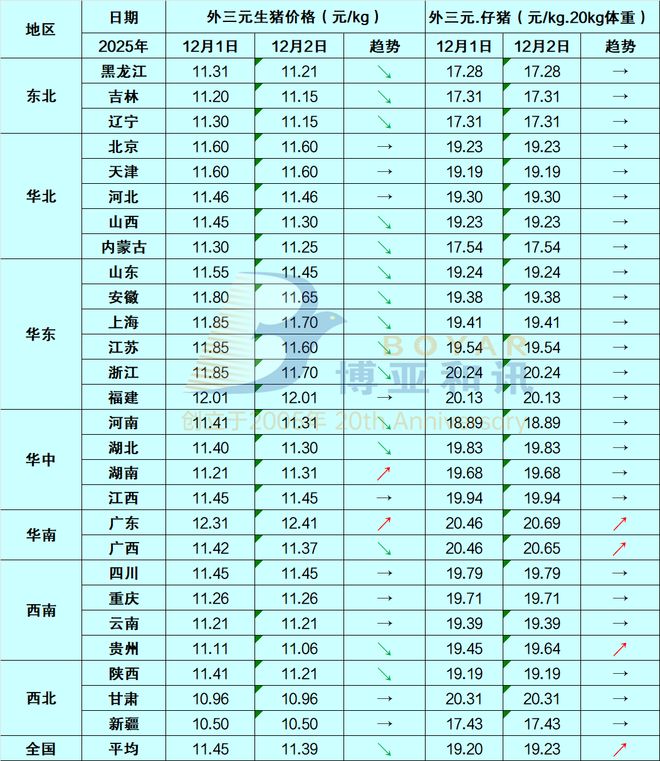
Group 1 - The average price of external three-yuan live pigs in China on December 2, 2025, is 11.39 yuan/kg, a decrease of 0.06 yuan/kg from the previous day [1] - The average price of piglets is 19.23 yuan/kg, an increase of 0.02 yuan/kg from the previous day [1] - The average price of white strip meat is 15.25 yuan/kg, a decrease of 0.07 yuan/kg from the previous day [1] Group 2 - The market sentiment is weak, particularly in the northern regions, leading to a decline in pig prices [2] - Despite attempts to raise prices at the beginning of the month, the market response has been limited, resulting in a lack of upward momentum in pig prices [2] - The supply side is experiencing a strong release, while demand remains weak, leading to a short-term market outlook of strong supply and weak demand [2][3] Group 3 - The price gap between northern and southern regions is widening, which may increase the volume of pig source transfers from the north [3] - The market sentiment is mixed, with expectations of a stable yet weak adjustment in pig prices in the coming days [3]

今日报纸头条 | 猪市“入冬”,何时“回暖”
Da Zhong Ri Bao· 2025-12-02 08:03
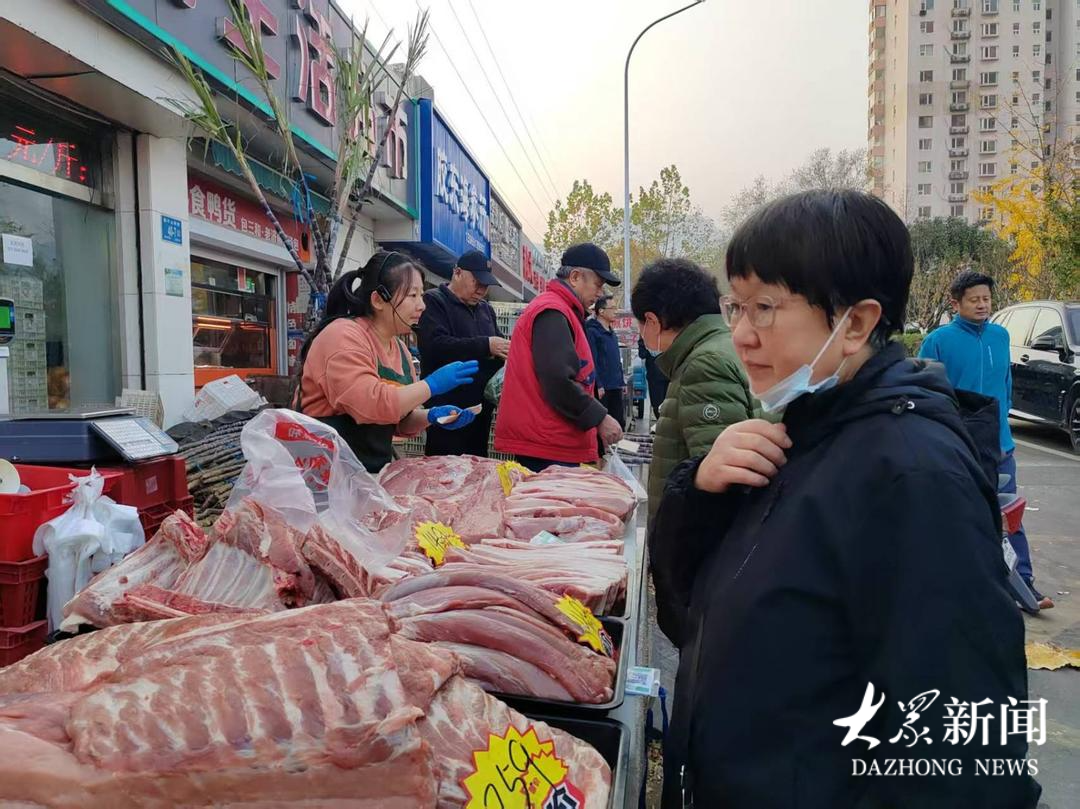
Core Insights - The Chinese pig market is experiencing a significant downturn, with prices continuing to decline despite the traditional peak consumption season in November [1][2][6] - The primary reason for the low prices is an oversupply in the market, driven by increased breeding and improved farming efficiency, leading to a supply-demand imbalance [6][9][15] Price Trends - The average price of pork in Shandong province dropped to 22.36 yuan per kilogram in mid-November, a decrease of 22.28% year-on-year and 0.40% month-on-month [1][3] - The average selling price for fat pigs fell to 12.11 yuan per kilogram, down 26.56% year-on-year and 1.06% month-on-month [1][3] Market Conditions - The supply of pork is currently abundant, with a notable increase in the number of breeding sows and improved production techniques contributing to the surplus [5][6] - The demand for pork has weakened, partly due to changing consumer preferences among younger generations who favor alternative meats and fast food options [6][7][9] Industry Challenges - Small and medium-sized pig farmers are facing severe financial difficulties, with many unable to cover their production costs, leading to a significant number exiting the market [3][6] - Larger farming operations are also struggling, with reports of losses exceeding 200 yuan per pig sold due to high production costs [3][6] Strategic Responses - Some farmers are adapting by shifting to niche markets, such as breeding specialty pigs, which can command higher prices despite longer growth periods [10][12] - Others are focusing on improving quality and efficiency through better feed management and diversifying their operations to mitigate risks [10][12][14] Government and Policy Actions - The Ministry of Agriculture and Rural Affairs is actively working on policies to stabilize pig production and improve market conditions, including comprehensive capacity regulation [15] - Recommendations include supporting small-scale farms, enhancing breeding quality, and promoting sustainable practices within the industry [14][15]
京基智农跌2.10%,成交额7764.40万元,主力资金净流出1549.55万元
Xin Lang Cai Jing· 2025-12-02 02:59
Core Viewpoint - The stock price of Jingji Zhino has experienced a significant decline this year, with a drop of 24.45% year-to-date and a recent 7.90% decrease over the past five trading days, indicating potential challenges in the company's performance and market perception [1][2]. Company Overview - Jingji Zhino, established on January 1, 1979, and listed on November 1, 1994, is located in Shenzhen, Guangdong Province. The company operates in modern agriculture and real estate, focusing on pig and chicken breeding, feed production, and real estate development [2]. - The revenue composition of Jingji Zhino includes: pig products (79.38%), feed products (11.67%), real estate (5.38%), rental income (1.36%), poultry products (1.29%), hotel business (0.83%), and other sources (0.07%) [2]. Financial Performance - For the period from January to September 2025, Jingji Zhino reported a revenue of 3.67 billion yuan, a year-on-year decrease of 20.12%, and a net profit attributable to shareholders of 298 million yuan, down 50.50% year-on-year [2]. - The company has distributed a total of 2.73 billion yuan in dividends since its A-share listing, with 1.10 billion yuan distributed over the past three years [3]. Shareholder Information - As of September 30, 2025, the number of shareholders for Jingji Zhino increased by 2.44% to 16,500, with an average of 31,879 circulating shares per person, a decrease of 2.38% [2]. - Among the top ten circulating shareholders, Hong Kong Central Clearing Limited holds 10.32 million shares, an increase of 6.33 million shares compared to the previous period [3].

农林牧渔行业报告(2025.11.21-2025.11.28):猪价呈二次探底之势,产能去化将持续
China Post Securities· 2025-12-02 02:58
Industry Investment Rating - The investment rating for the agriculture, forestry, animal husbandry, and fishery industry is "Outperform the Market" and is maintained [1]. Core Insights - The report indicates that the pig price is in a second bottoming trend, with ongoing capacity reduction expected. The average price of pigs as of November 28 is 11.09 yuan/kg, down 0.37 yuan/kg from the previous week, reflecting a continued supply surplus and weak demand [5][16]. - The report highlights that the October capacity reduction data for pigs exceeded expectations, leading to a notable increase in the pig farming sector, while the aquaculture sector experienced significant adjustments [14][16]. - The report emphasizes the importance of monitoring the situation regarding avian influenza in France, which has impacted the supply of breeding chickens [31][32]. Summary by Sections Market Overview - The agriculture sector performed well last week, with the agriculture, forestry, animal husbandry, and fishery index rising by 1.57%, ranking 21st among 31 primary industries [11][14]. Livestock Industry Chain Tracking Pigs - The average price of pigs is currently in a downward adjustment phase, primarily due to oversupply and weak demand. The industry is experiencing significant losses, with self-breeding pigs losing an average of 158 yuan per head as of November 28 [16][17]. - The Ministry of Agriculture reported that the number of breeding sows decreased to 39.9 million in October, achieving half of the target reduction of 1 million sows [18][19]. Broilers - The price of broiler chicks remains stable at 3.7 yuan/chick, with an average profit of approximately 0.8 yuan per chick. However, the terminal consumption remains weak, limiting price increases [31][32]. Planting Industry Chain Tracking - Sugar prices continue to decline, with the national average price at 5,493 yuan/ton, down 18 yuan/ton from the previous week. In contrast, soybean prices have shown some rebound, with Brazilian soybeans at 3,851 yuan/ton, down 0.9% [35][36].
正邦科技跌2.18%,成交额3.78亿元,主力资金净流出4984.06万元
Xin Lang Cai Jing· 2025-12-02 02:51
Core Viewpoint - Zhengbang Technology's stock price has shown fluctuations, with a recent decline of 2.18%, while the company has experienced a year-to-date increase of 7.53% in stock price [1][2]. Financial Performance - For the period from January to September 2025, Zhengbang Technology achieved a revenue of 10.658 billion yuan, representing a year-on-year growth of 82.58%. However, the net profit attributable to shareholders decreased by 97.25% to 8.2656 million yuan [2]. - The company has cumulatively distributed 2.864 billion yuan in dividends since its A-share listing, with no dividends distributed in the past three years [3]. Stock Market Activity - As of December 2, Zhengbang Technology's stock was trading at 3.14 yuan per share, with a total market capitalization of 29.046 billion yuan. The trading volume reached 378 million yuan, with a turnover rate of 1.64% [1]. - The net outflow of main funds was 49.8406 million yuan, with large orders accounting for 20.58% of purchases and 26.53% of sales [1]. Shareholder Information - As of November 20, the number of shareholders for Zhengbang Technology was 156,200, a decrease of 5.45% from the previous period. The average number of circulating shares per person increased by 6.76% to 46,233 shares [2]. Business Overview - Zhengbang Technology, established on September 26, 1996, and listed on August 17, 2007, is primarily engaged in feed production and sales, pig farming and sales, and veterinary drug production and sales. The main business revenue composition includes pig farming (59.63%), complete feed (38.31%), veterinary drugs (0.92%), concentrated feed (0.62%), and others [1]. - The company is classified under the agricultural, forestry, animal husbandry, and fishery industry, specifically in pig farming, and is associated with concepts such as rural revitalization and ecological agriculture [1].

中原证券晨会聚焦-20251202
Zhongyuan Securities· 2025-12-02 02:12
Core Insights - The report highlights a gradual recovery in various industries, with a focus on investment opportunities arising from supply and demand dynamics [6][14][16] - The AI sector is experiencing rapid growth, with significant advancements in technology and applications, particularly in China [16][17] - The chemical industry is expected to see a marginal recovery in profitability due to improved demand and reduced investment pressures [13][14] Domestic Market Performance - The A-share market has shown a slight upward trend, with the Shanghai Composite Index closing at 3,914.01, reflecting a 0.65% increase [3] - The average P/E ratios for the Shanghai Composite and ChiNext indices are 15.95 and 48.16, respectively, indicating a favorable long-term investment environment [8][9] International Market Performance - Major international indices, such as the Dow Jones and S&P 500, experienced slight declines, with the Dow Jones closing at 30,772.79, down 0.67% [4] Industry Strategies - The chemical industry is entering a phase of improved stability, with a focus on supply-side constraints and demand recovery, particularly in agricultural chemicals and fluorochemicals [13][14] - The AI industry is projected to benefit from increased domestic demand and government support, with a focus on integrated circuits and software [16][17] - The food and beverage sector is facing challenges with declining revenue growth, but opportunities exist in the snack and beverage markets, which are expected to grow significantly [20][21] Investment Recommendations - The report suggests focusing on leading companies in the chemical sector, such as Wanhua Chemical and Satellite Chemical, as well as opportunities in the AI and semiconductor industries [15][16] - In the food and beverage sector, companies like Baoli Food and Dongpeng Beverage are recommended due to their growth potential in the snack and soft drink markets [21] Key Data Updates - The semiconductor industry continues to show strong growth, with global sales reaching $69.47 billion, a 25.1% year-on-year increase [36] - The photovoltaic industry is experiencing a supply-demand imbalance, with a focus on capacity reduction and optimization of the competitive landscape [25][23]
建信期货生猪日报-20251202
Jian Xin Qi Huo· 2025-12-02 01:32
行业 生猪日报 日期 2025 年 12 月 02 日 021-60635740 期货从业资格号:F3055047 021-60635732 yulanlan@ccb.ccbfutures.com 期货从业资格号:F0301101 农业产品研究团队 研究员:林贞磊 linzhenlei@ccb.ccbfutures.com 研究员:余兰兰 研究员:王海峰 wanghaifeng@ccb.ccbfutures.com 研究员:刘悠然 请阅读正文后的声明 #summary# 每日报告 一、行情回顾与操作建议 021-60635727 期货从业资格号:F0230741 研究员:洪辰亮 021-60635572 hongchenliang@ccb.ccbfutures.co m 期货从业资格号:F3076808 021-60635570 liuyouran@ccb.ccbfutures.com 期货从业资格号:F03094925 数据来源:涌益,建信期货研究中心 生猪行情: 期货方面,1日生猪主力2603合约小幅高开后震荡走跌,尾盘收阴,最高11320 元/吨,最低 11175 元/吨,收盘报 11205 元/吨,较 ...
人形机器人板块持续反弹 布局窗口开启
Mei Ri Jing Ji Xin Wen· 2025-12-02 00:45
Group 1 - The humanoid robot sector is experiencing a significant rebound, with a clear inflow of funds and the overall sector entering an upward channel [1] - The core driving factors include the nearing end of sector adjustments, sufficient risk release, and a more rational and unified industry outlook [1] - By 2026, humanoid robots are expected to enter mass production, with major companies getting involved and policy support and subsidies likely to materialize [1] Group 2 - Space computing is transitioning from concept to reality, with major overseas tech companies actively investing in this area [2] - The energy supply for space computing will heavily rely on photovoltaic technology, with perovskite emerging as a promising next-generation solar technology due to its high efficiency and low cost [2] - Since 2025, the industrialization of perovskite has accelerated, with multiple GW-level production lines being launched, presenting investment opportunities in the perovskite sector [2] Group 3 - In October, the de-stocking of breeding sows accelerated, maintaining a loose supply situation in the industry [3] - Short-term pig prices are under pressure due to fluctuations, but continued de-capacity is expected to support the cyclical prosperity post-2026 H2 [3] - Recommendations include leading companies with strong cash flow and dividend capabilities, cost-leading firms, and companies pursuing mergers and acquisitions for growth [3]

预重整延期叠加猪价低迷 天邦食品拟终止13亿元数智化猪场升级项目
Mei Ri Jing Ji Xin Wen· 2025-12-02 00:28
Core Viewpoint - Tianbang Food has decided to terminate the "Smart Pig Farm Upgrade Project" due to slow progress and unfavorable market conditions in the pig farming industry, which has led to financial strain and a strategic shift in company operations [1][3]. Group 1: Project Termination - The company announced the termination of the project that had a total committed investment of 1.306 billion yuan, with only 146 million yuan invested as of November 24, representing a mere 11.19% of the planned investment [1][2]. - The remaining raised funds will be kept in a dedicated account and temporarily used to supplement working capital [1][2]. Group 2: Financial Strain and Industry Conditions - The pig farming industry has been facing overcapacity and low prices, resulting in widespread losses, with Tianbang Food's net profit for Q3 showing a loss of 92.49 million yuan, a year-on-year decline of 118.48% [4][5]. - The average price of market pigs has decreased from 14.60 yuan/kg in July to 11.34 yuan/kg in October, indicating a downward trend in pricing [5]. - The company is currently in a pre-restructuring phase, with a high debt ratio of 70.27% and current liabilities significantly exceeding current assets [4]. Group 3: Future Plans and Adjustments - Tianbang Food plans to adjust its funding usage as needed and will continue to upgrade necessary pig farms through self-funding or supplier financing [3]. - The company has no new project plans until the end of 2025, focusing on stabilizing its current operations [3].