
医疗

Search documents
【有本好书送给你】诺奖得主聊“匹配”:择校、肾脏移植…社会资源的分配,从来不是“价高者得”
重阳投资· 2025-10-22 07:33
Core Viewpoint - The article emphasizes the importance of understanding "matching mechanisms" in various markets, highlighting that resource allocation is not solely determined by price but also by a set of rules and systems that govern interactions in society [24][25]. Summary by Sections Introduction to Reading and Learning - The article begins with a quote from Charlie Munger, stressing that wisdom cannot be achieved without reading, and encourages continuous reading as a path to growth [2][3]. Book Recommendation - The featured book is "Matching: Who Gets What and Why" by Alvin E. Roth, which explores the concept of matching mechanisms in various sectors such as education, healthcare, and employment [8][9]. Market Design and Matching Mechanisms - The article discusses how traditional markets often fail to operate efficiently due to the absence of price mechanisms, leading to mismatches in resource allocation [10][24]. - It provides examples from education, such as college admissions and high school placements, illustrating how complex systems can lead to chaos and inefficiency [10][18]. Case Studies in Market Design - The article highlights successful market design examples, particularly in kidney transplantation, where a matching system has been implemented to allocate scarce resources effectively [20][21]. - It explains how the kidney exchange program operates, creating a larger pool of donors and recipients, thus increasing the chances of successful matches [23]. Conclusion on Market Mechanisms - The article concludes that understanding and designing effective matching mechanisms can lead to fairer and more efficient resource distribution, emphasizing that markets are not naturally occurring but are designed [24][25].


AI接下来将在哪个领域掀起革命?
3 6 Ke· 2025-10-22 02:04
Group 1 - Reid Hoffman, co-founder of LinkedIn, highlights a "blind spot" in Silicon Valley's obsession with software, suggesting that overlooked areas may be the starting point for the next AI revolution [1] - Hoffman emphasizes that the belief that "everything should be done with software" has become a limitation, potentially causing innovators to miss new opportunities [1] - He identifies biology as a complex and regulated field where the next generation of AI companies may emerge, focusing on enhancing human living standards [1] Group 2 - In the healthcare sector, AI is rapidly advancing, with Cathie Wood of Ark Investment noting that a true AI revolution is occurring in hospitals and laboratories [2] - Wood suggests that combining AI with advancements in gene sequencing and CRISPR technology could lead to a medical transformation [2] - Major tech companies are competing to establish a presence in the healthcare AI space, with Microsoft integrating AI into its cloud solutions for hospital operations [3] - NVIDIA is also making strides in healthcare, focusing on medical imaging as a key entry point and forming partnerships to enhance its AI platform [3]
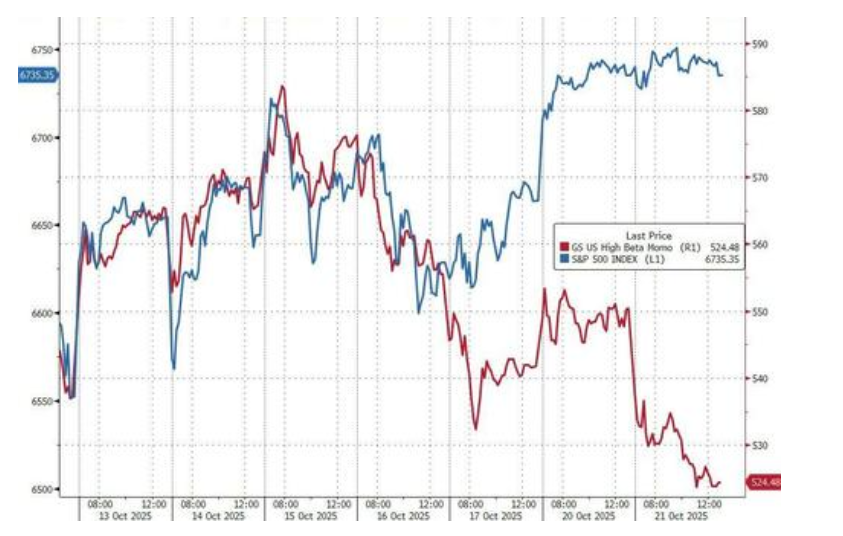
动量股暴跌!高盛交易员:美股“最热股票”遭遇“最大抛售”
Hua Er Jie Jian Wen· 2025-10-22 00:57
Core Viewpoint - Momentum stocks that have led the rise in the U.S. stock market this year are experiencing a significant sell-off, indicating a shift in market dynamics and investor sentiment towards quality stocks [1][3]. Group 1: Market Dynamics - The market is undergoing a notable rotation, with significant outflows from momentum stock portfolios based on performance over the past 3, 6, and 12 months [3]. - The sell-off is particularly pronounced in speculative sectors, including heavily shorted stocks, quantum computing concepts, and unprofitable tech companies [1][3]. - Historical data suggests that the momentum factor typically underperforms from November to January, indicating that the current downtrend may not be over [5][7]. Group 2: Performance Data - High Beta 12M Winners have a year-to-date return of 60%, while Global Rare Earths have surged by 258% [4]. - Non-profitable tech stocks have seen an 83% increase, but the overall trend indicates a shift towards quality stocks as speculative assets lead the market decline [4][11]. Group 3: Investor Behavior - Investors are moving from chasing high growth to seeking certainty in fundamentals, reflecting a clear change in risk appetite amid rising market uncertainties [4][11]. - Hedge funds maintain a high exposure to momentum stocks, positioned at the 90th and 94th percentiles over the past year and five years, respectively, which could trigger a cascading sell-off if positions are unwound [7][11]. Group 4: Sector Exposure - Current momentum stocks are heavily concentrated in information technology and industrial sectors, while being short on healthcare and consumer sectors, making them vulnerable to market shifts [11][12]. - The correlation between momentum stocks and gold has increased, suggesting that macroeconomic factors influencing both asset classes may be changing [12][14]. Group 5: Market Breadth - The performance of the S&P 500 has outpaced the "X7 index" (excluding seven major tech giants) in 13 out of the last 15 years, with a 6% annualized performance difference since January 2020 [14].
前三季度财政支出半数投向民生
Sou Hu Cai Jing· 2025-10-21 23:39
Core Insights - Beijing's fiscal revenue for the first three quarters of 2023 reached 503.99 billion yuan, marking a 3.6% increase, with corporate income tax maintaining a double-digit growth rate [1][2] - Total public budget expenditure amounted to 634.01 billion yuan, reflecting a 1.3% growth, with over 50% allocated to social welfare sectors [1][3] Revenue Summary - The city's general public budget revenue completed 503.99 billion yuan, achieving 76% of the annual budget [1] - Local tax revenue reached 432.74 billion yuan, growing by 5.5%, with tax revenue accounting for 85.9% of total revenue, maintaining the highest quality nationwide [1][2] - Major tax categories contributed 348.23 billion yuan, up 8.0%, representing 69.1% of total revenue [2] - Value-added tax generated 153.68 billion yuan, increasing by 4.4% [2] - Corporate income tax totaled 133.27 billion yuan, with a growth of 12.5% [2] - Personal income tax reached 61.28 billion yuan, growing by 8.0% [2] Expenditure Summary - Total public budget expenditure was 634.01 billion yuan, achieving 75% of the annual budget [2] - Key expenditure areas included: - Technology spending of 45.49 billion yuan, up 8.0%, focusing on international innovation center development [3] - Education expenditure of 94.04 billion yuan, increasing by 3.3%, aimed at promoting balanced educational development [3] - Health expenditure of 53.6 billion yuan, growing by 5.3%, to support public medical institutions and healthcare initiatives [3] - Social security and employment spending of 101.5 billion yuan, up 4.8%, to enhance the social security system [3] - Community spending of 74.29 billion yuan, increasing by 0.9%, supporting urban infrastructure projects [3]
大湖股份(600257)披露拟变更公司全称为“大湖健康产业股份有限公司”,10月21日股价上涨3.08%
Sou Hu Cai Jing· 2025-10-21 14:48
Core Viewpoint - Dahu Aquaculture Co., Ltd. plans to change its name to "Dahu Health Industry Co., Ltd." to better reflect its current business structure and development strategy focused on health products and healthcare services [1] Group 1: Company Name Change - The company intends to change its full name to align with its evolving business focus, as the revenue from its aquaculture business has decreased to 14.72% in 2024, while income from healthcare and aquatic product processing has increased [1] - The name change has been approved by the board and will be submitted for review at the upcoming third extraordinary general meeting of shareholders [1] Group 2: Business Scope Adjustment - The company will remove beverage production from its business scope and add services related to nursing institutions, health maintenance, and artificial intelligence application software development [1] - The final changes will be subject to approval by the Hunan Provincial Market Supervision Administration, indicating potential uncertainty [1]

美股前瞻 | 三大股指期货涨跌不一 通用汽车(GM.US)绩后大涨 奈飞(NFLX.US)盘后公布财报
智通财经网· 2025-10-21 11:49
Market Overview - US stock index futures showed mixed movements with Dow futures up 0.08% and S&P 500 futures up 0.03%, while Nasdaq futures fell 0.05% [1] - European indices also experienced gains, with Germany's DAX up 0.17%, UK's FTSE 100 up 0.30%, France's CAC40 up 0.55%, and the Euro Stoxx 50 up 0.26% [2][3] - WTI crude oil rose by 0.79% to $57.47 per barrel, and Brent crude oil increased by 0.67% to $61.42 per barrel [3][4] Market Sentiment - The recent rebound in US stocks is attributed to short covering rather than genuine investor confidence, indicating a potential "false prosperity" [5] - Concerns about the US credit market tightening could lead to forced selling by pension funds, which may trigger a significant market downturn [5] - Allianz's chief economist noted that the current AI investment boom is a "rational bubble" that could help the US outperform global markets [5] Federal Reserve Insights - Wall Street analysts predict that the Federal Reserve may announce the end of its balance sheet reduction plan in the upcoming meeting, which could stabilize monetary policy [6] - Recent market fluctuations have led to increased use of the Fed's repurchase agreement tool, indicating liquidity concerns [6] Individual Company Performance - General Motors (GM) reported Q3 revenue of $48.59 billion, exceeding expectations of $45.26 billion, and raised its full-year EPS guidance to $9.75-$10.50 [7][8] - Coca-Cola (KO) posted Q3 revenue of $12.46 billion, surpassing the expected $12.41 billion, and reaffirmed its 2025 guidance [8] - GE Aerospace's Q3 revenue increased by 24% to $12.18 billion, driven by strong performance in its commercial engine business [8] - Zion Bank's Q3 profit exceeded expectations, with revenue of $872 million, indicating that credit pressure in regional banks may be isolated incidents [8] - DocGo's stock surged nearly 27% following its acquisition of virtual healthcare platform SteadyMD [8] Upcoming Earnings Reports - Notable earnings reports expected include Netflix, Texas Instruments, and Alliance West Bank on Wednesday morning, and Barclays, Teck Resources, and AT&T before market open [10]



华邦健康:目前公司业务范围涵盖医药、医疗、农化、新材料、旅游等五大领域
Zheng Quan Ri Bao Zhi Sheng· 2025-10-21 11:41
Core Insights - Huabang Health, established in 1992, is a leading enterprise in the field of clinical skin medications and skin health in China [1] - The company has developed a diversified business model focusing on the health industry, with independent operations in agricultural chemicals, new materials, and tourism [1] - Huabang Health's business scope includes five major areas: pharmaceuticals, medical services, agricultural chemicals, new materials, and tourism [1] Business Structure - The company controls three listed subsidiaries: Yingtai Biotechnology (920819.BJ), Kaisheng New Materials (301069.SZ), and Lijiang Co. (002033.SZ) [1] - It also holds a controlling stake in a New Third Board enterprise, Qinling Tourism (870256.NQ), and has a stake in another New Third Board company, Purikin (874090.NQ) [1] Future Strategy - The company plans to adhere to its development strategy in pharmaceuticals and medical health, continuously improving its full industry chain model that integrates raw materials, formulations, functional skincare products, comprehensive skin health management, and medical services [1] - Huabang Health aims to maintain the independent and stable operation of its three listed companies while leveraging its role as a controlling shareholder in governance [1]



第一上海美股宏观策略周报:政治周期:美国国内政治转向与全球外交格局变化-20251021
First Shanghai Securities· 2025-10-21 10:30
Political Landscape - The U.S. is undergoing a "rightward shift" politically, reversing trends from the post-Cold War era, with significant ideological debates emerging domestically[3] - The upcoming midterm elections in November 2026 pose a risk for Trump, especially if economic downturns or conflicts arise before then[4] Economic Outlook - Inflation is currently manageable, with the Federal Reserve expected to lower interest rates two more times in 2025, following a recent cut[8] - The U.S. economy shows resilience, with corporate investments increasing as tariff uncertainties diminish, potentially supporting GDP growth over the next three years[9] Trade Relations - The U.S. has reached tariff framework agreements with most countries, with China being a notable exception; a key negotiation window is the APEC summit on October 1, 2025[7] - Recent U.S. sanctions on Chinese companies have escalated trade tensions, with China retaliating by halting soybean purchases from the U.S.[5] Investment Strategies - Investors are advised to diversify portfolios, favoring broad-based ETFs to mitigate risks associated with individual stocks[10] - The recommended asset allocation is 60% in stocks and 40% in bonds, with specific ETFs suggested for exposure to various sectors[10] Sector Analysis - The S&P 500's static P/E ratio is 28, above the historical average of 18, but excluding the M7 tech stocks reveals a more reasonable P/E of 19 for the remaining companies[11] - Financial and healthcare sectors are highlighted as undervalued, with P/E ratios of approximately 17 and 16, respectively, presenting investment opportunities[12] Emerging Trends - The AI sector is poised for significant growth, with major players like OpenAI and Google leading the charge; OpenAI's valuation has surged from under $100 billion to over $500 billion in two years[16] - The demand for gold is expected to rise due to geopolitical tensions, with recommendations for a 10%-20% allocation in investment portfolios[13]




未来学家凯文·凯利:“酷中国”将引领趋势
Guo Ji Jin Rong Bao· 2025-10-21 10:18
Core Insights - The core viewpoint emphasizes that AI's value lies in empowerment rather than replacement, with human-AI collaboration becoming the central mode of future society [1][4]. AI Uncertainty - There are three key uncertainties in the AI field: the feasibility of achieving general artificial intelligence, the trend of centralized versus decentralized computing deployment, and the impact of AI on employment [3]. - The possibility of general artificial intelligence remains uncertain, with a likelihood of a combination of specialized weak AIs rather than a single general intelligence system [3]. - Future AI computing resources are expected to be more distributed across edge or local devices rather than centralized in cloud computing centers [3]. Employment Impact - Data indicates that AI has not led to job losses; instead, it primarily empowers workers, with productivity increasing by an average of 25% [4]. - The collaboration between humans and AI, especially in knowledge-intensive sectors like healthcare and education, will become the norm [4]. Frontline Development Directions - Four key development directions for AI in the next five to ten years include: 1. Symbolic reasoning, combining top-down reasoning with bottom-up neural networks for complex cognitive tasks [6]. 2. Spatial intelligence, enabling AI to understand and operate in the physical world [6]. 3. Emotional intelligence, allowing AI to recognize and interact with human emotions [6]. 4. Autonomous agents that can complete tasks independently and form complex ecosystems [6]. "Protopia" Concept - The "Protopia" concept suggests a focus on continuous improvement and long-term optimism, advocating for gradual innovations rather than striving for an unattainable utopia [7]. Gradual AI Adoption - The adoption of AI is a gradual process requiring adjustments in organizational structures and workflows, with early beneficiaries being roles like programmers and customer service [8]. - The "three tries rule" suggests that initial attempts at AI application may be costly and prone to failure, but subsequent attempts can lead to success and optimization [8]. "Cool China" Vision - The concept of "Cool China" suggests that China can lead trends and become an attractive nation through soft power accumulation [10]. - Key paths to achieving "Cool China" include creating excellent products, enhancing cultural output, and developing attractive urban environments [11]. - The vision includes an AI-empowered society characterized by efficiency, fairness, and integrity, with China positioned to build a data-driven decision-making model [11].
希玛医疗(03309)10月21日斥资38.13万港元回购20万股
智通财经网· 2025-10-21 10:03
智通财经APP讯,希玛医疗(03309)发布公告,于2025年10月21日,该公司斥资38.13万港元回购20万股 股份,每股回购价格为1.89-1.92港元。 ...