
半导体制造

Search documents
华虹半导体(01347.HK)绩后低开近4%
Mei Ri Jing Ji Xin Wen· 2025-11-07 01:47
Group 1 - Hua Hong Semiconductor (01347.HK) experienced a nearly 4% decline after its earnings report, with a current drop of 3.87%, trading at 77 HKD [1] - The trading volume reached 16.83 million HKD at the time of reporting [1]
eNVM,发展现状
半导体行业观察· 2025-11-07 01:00
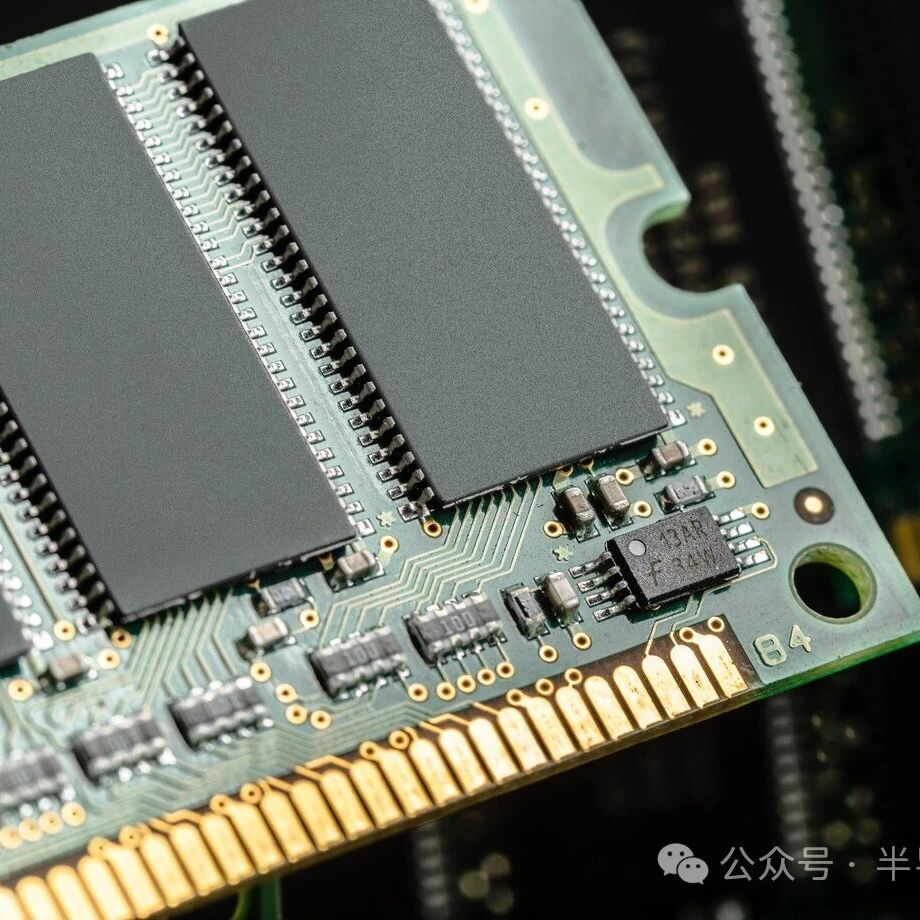
Core Insights - The article emphasizes that we are in the era of artificial intelligence, where data is crucial for innovation, and embedded non-volatile memory (eNVM) is a foundational technology that retains information without power [2][6] - By November 2025, the eNVM market is expected to grow rapidly, driven by the surge in edge data and the increasing application of AI functionalities in microcontrollers (MCUs) and system-on-chips (SoCs) [2][6] Market Growth and Projections - The embedded emerging NVM market, including MRAM, RRAM, and PCM, is projected to exceed $3 billion by 2030, indicating strong demand as eFlash becomes less applicable in certain areas [2][3] - The automotive industry remains a core market for eNVM, with significant growth expected in secure integrated circuits (ICs) and industrial MCUs by 2025 [4] Technological Advancements - Advanced nodes are pushing MRAM, ReRAM, and embedded PCM to the forefront, with manufacturers expanding embedded solutions from 28/22 nm to 10-12 nm platforms [3][4] - Companies like TSMC, Samsung, and STMicroelectronics are actively developing and mass-producing these technologies, with TSMC preparing for 12 nm FinFET ReRAM/MRAM by 2025 [3][4] Applications and Use Cases - eNVM is being recognized as a practical alternative to EEPROM/OTP in analog, power management, and mixed-signal designs, especially where cost, durability, and data retention are critical [4] - The role of eNVM is expanding from mere storage to being part of computing architectures, particularly in low-power edge AI inference applications [5][6] Challenges and Solutions - Challenges include integrating eNVM at advanced logic nodes while balancing durability and data retention to meet automotive reliability standards [5] - The availability of PDK/IP is improving, and production capacity is gradually increasing, addressing these challenges [5]

罗姆总裁:台积电退出是重大打击
半导体行业观察· 2025-11-07 01:00
Core Insights - TSMC's decision to exit the GaN foundry business by July 2027 has significantly impacted ROHM, as stated by ROHM's president, who described it as a "huge blow" [2][3] - ROHM is currently in discussions with Vanguard International Semiconductor (VIS), a subsidiary of TSMC, and is exploring various options for future development, including in-house and collaborative approaches [2][3] Group 1 - TSMC's exit from the GaN foundry business is attributed to market dynamics and long-term business strategy, with increasing price pressure from Chinese GaN wafer manufacturers being a contributing factor [2] - Navitas Semiconductor announced a strategic partnership with Power Integrations following TSMC's decision, with plans for mass production of 100V products starting in the first half of 2026 [2] - ROHM plans to maintain and deepen its collaboration with partners while exploring future production structures post-2027 [3] Group 2 - ROHM's president emphasized the importance of TSMC's technology integration with their own, highlighting the ongoing discussions with VIS for 8-inch model production [3] - The company is considering various possibilities for future operations, including the potential transition of processes back in-house and seeking new partners [3]

事关安世半导体、稀土、中美经贸磋商 商务部最新发声→
Guo Ji Jin Rong Bao· 2025-11-06 15:43
Group 1: ASML Semiconductor Issue - The Chinese Ministry of Commerce criticized the Dutch government's interference in ASML Semiconductor's internal affairs, claiming it has caused turmoil in the global semiconductor supply chain [2] - China has approved export license applications from Chinese exporters related to ASML, aiming to stabilize supply and promote the resumption of ASML Semiconductor (China) operations [2] - China urges the Netherlands to adopt a responsible attitude and cease interference in corporate matters to find constructive solutions to the ASML issue [2] Group 2: Rare Earth Export Control - The Ministry of Commerce stated that rare earths have dual-use properties, and China conducts licensing reviews in accordance with laws and regulations [3] - China emphasizes its willingness to enhance communication and cooperation with all parties to optimize the licensing process and ensure compliance in trade of controlled items [3] Group 3: China-US Economic Cooperation - The Ministry of Commerce announced recent outcomes from China-US economic consultations, covering topics such as fentanyl tariffs, agricultural trade, and maritime logistics [4] - China expresses its willingness to work with the US to implement the agreements reached during the consultations and the meeting between the two countries' leaders [4] Group 4: China-EU Cooperation - The Ministry of Commerce noted the EU's efforts to diversify export markets through free trade agreements and highlighted China's commitment to high-level opening-up [5] - China is open to deepening mutually beneficial cooperation with the EU and exploring various economic agreements, including investment agreements, to enhance trade and investment facilitation [5]
A股晚间热点 | 小米突发!外资做空规模一周激增53%
智通财经网· 2025-11-06 14:30
Group 1 - Xi Jinping emphasized the high-standard construction of Hainan Free Trade Port to promote high-quality development and support the national new development pattern [1] - The focus is on creating a modern industrial system with Hainan characteristics, optimizing leading industries, and integrating technological and industrial innovation [1] Group 2 - Hedge funds have significantly increased their short positions on Xiaomi by 53% in the past week, indicating a shift in investor sentiment ahead of the Q3 earnings report on November 18 [2] - The current issue for Xiaomi is not a collapse in performance but an "expectation imbalance," where the narrative has been overly optimistic with a long realization cycle [2] Group 3 - The Ministry of Commerce responded to the semiconductor supply chain disruption caused by Dutch interference, stating that China has approved relevant export licenses to restore supply [3] - The Ministry also highlighted the dual-use nature of rare earths and related items, conducting licensing reviews in accordance with regulations [3] Group 4 - Kweichow Moutai reported a decline in Q3 performance due to cyclical adjustments in the liquor industry, with increased inventory pressure and a slowdown in growth [4] - The company is transitioning from high-speed growth to high-quality development, focusing on a multi-faceted value management system to enhance shareholder benefits [4] Group 5 - Cambrian Technology's stock price surpassed Kweichow Moutai, nearing a historical high, with a market capitalization of 624.1 billion yuan, making it the second-largest in the electronics sector [6] Group 6 - The UK central bank maintained interest rates at 4.0% but indicated a potential shift towards supporting rate cuts following the upcoming government budget announcement [7] Group 7 - In October, U.S. companies announced a record 153,074 layoffs, a 175.3% increase year-on-year, reflecting significant changes in the labor market due to AI and cost-cutting measures [8] Group 8 - The Ministry of Commerce plans to promote the silver economy through four key areas, including expanding the elderly care service sector and enhancing domestic service support [10] - The silver economy in China is projected to grow at an annual rate of over 12%, with market size expected to reach 30 trillion yuan by 2035, accounting for 10% of GDP [10] Group 9 - Positive announcements include the completion of the acquisition of Woven Material by Zhiyuan Robotics and the resumption of military procurement qualifications by Xingwang Yuda [17] - Negative announcements include significant share reductions by shareholders in companies like Xintonglian and Weiao Co., indicating potential market volatility [17]


安世半导体风波仍在持续 闻泰科技重要股东突然宣布减持:最高价值超16亿元!
Mei Ri Jing Ji Xin Wen· 2025-11-06 14:21
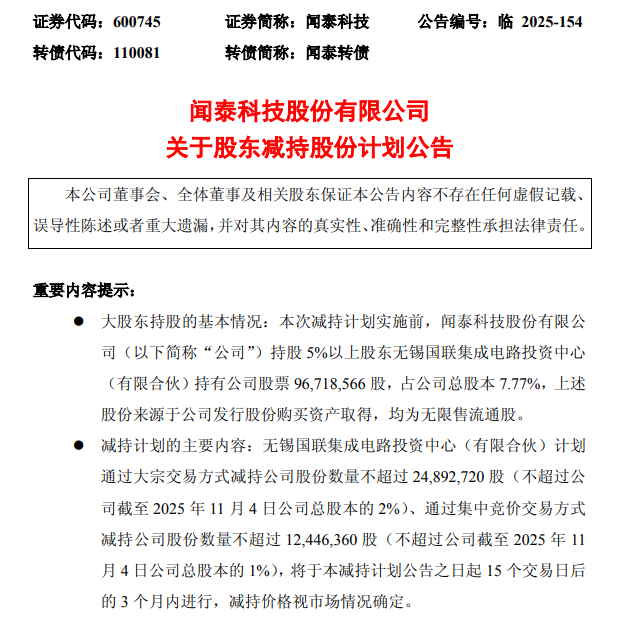
Core Viewpoint - Wentech Technology (600745.SH) is facing significant shareholder reductions amid the "Nexperia" semiconductor turmoil, with the second-largest shareholder planning to reduce holdings by up to 3% of the total share capital, despite the stock price increasing over 24% in the past month and a half [1][2][8]. Shareholder Reduction - On November 5, Wentech Technology announced that its major shareholder, Wuxi Guolian Integrated Circuit Investment Center (Limited Partnership), plans to reduce its holdings by up to 24,892,700 shares (2% of total share capital) through block trading and up to 12,446,400 shares (1% of total share capital) through centralized bidding, totaling a maximum reduction of 37,339,100 shares (3% of total share capital), valued at approximately 1.608 billion yuan based on the closing price of 43.08 yuan on November 5 [2][3][5]. - As of the end of Q3, Wuxi Guolian Integrated Circuit Investment Center held 7.77% of Wentech Technology's shares, making it the second-largest shareholder, with this planned reduction accounting for nearly 40% of its total holdings [5]. Financial Performance - In Q3, Wentech Technology reported a significant increase in net profit by 279.29%, amounting to 1.04 billion yuan, despite a 77.38% decline in revenue to 4.43 billion yuan [10][11]. - The semiconductor business, particularly Nexperia, has become the main revenue source for Wentech Technology, contributing 14.715 billion yuan in revenue and 2.297 billion yuan in net profit in 2024 [12]. Nexperia Situation - The ongoing turmoil surrounding Nexperia has raised concerns about the stability of Wentech Technology's semiconductor business, with potential risks to revenue, profit, and cash flow if control is not restored by the end of 2025 [12][16]. - Nexperia has faced significant operational disruptions due to political interference, leading to a warning from the European Automobile Manufacturers Association about potential production halts for car manufacturers [10][12].

事关稀土出口、安世半导体问题 商务部最新回应
Zhong Jin Zai Xian· 2025-11-06 14:01
Group 1: Anshi Semiconductor Issues - The Chinese government criticizes the Netherlands for interfering in Anshi Semiconductor's internal affairs, causing global semiconductor supply chain disruptions [2] - China emphasizes its commitment to stabilizing the semiconductor supply chain and has approved export licenses for relevant Chinese exporters to help Anshi Semiconductor resume supply [2] Group 2: China's CPTPP Membership - The Chinese government is actively pursuing membership in the Comprehensive and Progressive Agreement for Trans-Pacific Partnership (CPTPP), which could enhance multilateralism and free trade amid rising unilateralism and protectionism [3][4] - Research indicates that China's accession to CPTPP could lead to GDP growth for member countries ranging from 0.2% to 1.1% and export growth between 2.5% and 11.8% [4] - China's participation is expected to significantly increase the global influence of CPTPP and create new growth opportunities in various sectors, including oil, agriculture, and education services [4] Group 3: China-EU Cooperation - China expresses willingness to deepen mutually beneficial cooperation with the EU and explore various trade agreements, including investment agreements, to enhance trade and investment facilitation [5] Group 4: Export Licensing for Rare Earths - The Chinese government is conducting licensing reviews for rare earth elements, emphasizing compliance with regulations while optimizing the licensing process to facilitate compliant trade [6] Group 5: US-China Trade Relations - The Chinese Ministry of Commerce is open to discussions regarding the lifting of bans on US companies and is committed to implementing the outcomes of recent trade negotiations with the US [7]
荷兰安世:中国安世拒付货款,继续断供!
国芯网· 2025-11-06 13:11
Core Viewpoint - The article highlights the ongoing supply chain issues faced by the semiconductor industry, particularly due to the actions of Nexperia, a Dutch company, which has suspended wafer supplies to its Chinese factory over payment disputes. This situation is expected to impact various automotive manufacturers, including Nissan and Volkswagen, leading to production cuts. Group 1: Company Actions - Nexperia has suspended wafer supplies to its Chinese factory due to the refusal of its Chinese subsidiary to pay for shipments, indicating that this is not an isolated incident [3] - The company accused its Chinese subsidiary of unauthorized use of company seals, opening unapproved bank accounts, and sending misleading communications to clients and suppliers [3] - Nexperia expressed relief over the U.S. authorities' decision to pause the implementation of the "related party rules," which previously expanded export controls [3] Group 2: Industry Impact - Nissan plans to reduce production of its popular Rogue SUV by approximately 900 units due to a shortage of chips supplied by Nexperia, starting from the week of November 10 [3] - Other automakers, including Volkswagen, are also expected to face similar production challenges if the sanctions against Nexperia do not improve [4] - Approximately 70% of Nexperia's products are packaged in China, indicating a potential urgent shortage of packaging capacity in the European market unless a diplomatic resolution is reached [5]
【财闻联播】不降息,英国央行宣布!上纬新材要约收购交割完成
券商中国· 2025-11-06 12:35
Macro Dynamics - The Ministry of Commerce held a roundtable meeting for foreign enterprises in Shanghai during the China International Import Expo, with over 30 foreign companies and associations participating [2] - The National Medical Insurance Administration announced a pilot program for intelligent review of medical insurance processes, aiming to enhance efficiency and security in fund management [3] Financial Institutions - Former chief analyst at Tianfeng Securities, Kong Rong, is set to become the deputy director of Guolian Minsheng Securities Research Institute, indicating a consolidation of research operations [7] - Li Shengye, deputy director of the Xinjiang branch of the Export-Import Bank of China, is under investigation for serious violations of discipline and law [8] Market Data - The Shanghai Composite Index rose nearly 1% to surpass 4000 points, with significant trading volume and a broad market rally, particularly in the chemical and aluminum sectors [9] - As of November 5, the financing balance on the Shanghai Stock Exchange was reported at 1,254.887 billion yuan, showing a slight increase, while the Shenzhen Stock Exchange's balance decreased [10] - The Hong Kong Hang Seng Index increased by 2.12%, with notable gains in the semiconductor and technology sectors [11] Company Dynamics - Fushun Special Steel is supplying key structural materials, including GH3535 alloy, for China's first thorium-based molten salt reactor project, positioning itself as a core materials supplier [13] - BGI Genomics reported a net profit of 1.139 billion yuan for the first three quarters of 2025, driven by strong sales of its proprietary products [15] - Hwa Hong Semiconductor achieved a record sales revenue of 635.2 million USD in Q3, marking a 20.7% year-on-year increase [19] - Chow Tai Fook closed over 900 stores in the past year, reflecting challenges in the retail environment despite rising gold prices [20]
事关安世半导体、稀土、中美经贸磋商,商务部最新发声→
Guo Ji Jin Rong Bao· 2025-11-06 12:34
Group 1: ASML Semiconductor Issue - The Chinese Ministry of Commerce criticized the Netherlands for interfering in ASML's internal affairs, which has led to disruptions in the global semiconductor supply chain [2] - China has approved export license applications for relevant exporters to help ASML (China) resume supply, emphasizing a responsible approach to global semiconductor stability [2] - China urges the Netherlands to adopt a constructive attitude and stop interfering in corporate matters to find a solution for the ASML issue [2] Group 2: Rare Earth Export Control - The Ministry of Commerce stated that rare earths have dual-use properties, and China conducts license reviews in accordance with laws and regulations [3] - China is committed to optimizing the licensing process to promote compliant trade of controlled items and ensure the stability of global supply chains [3] Group 3: China-US Economic Cooperation - The Ministry of Commerce announced recent outcomes from China-US economic consultations, covering topics such as fentanyl tariffs, agricultural trade, and maritime logistics [4] - China expresses willingness to work with the US to implement the agreements reached during the consultations and the meeting between the two heads of state [4] Group 4: China-EU Cooperation - The Ministry of Commerce noted the EU's efforts to diversify export markets through free trade agreements [5] - China is advancing high-level opening-up and aims to deepen mutually beneficial cooperation with the EU, exploring various economic agreements including investment accords [5]