
塑料

Search documents
【图】2025年1-5月湖南省初级形态的塑料产量统计分析
Chan Ye Diao Yan Wang· 2025-09-18 01:05
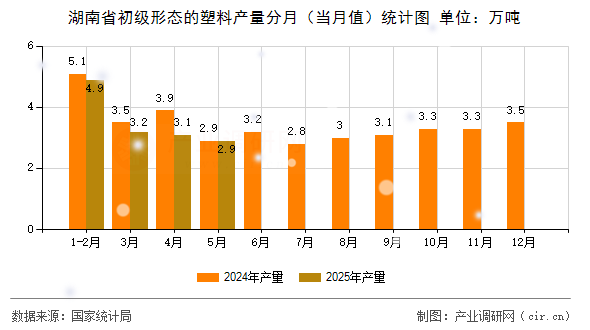
2025年5月初级形态的塑料产量统计: 摘要:【图】2025年1-5月湖南省初级形态的塑料产量统计分析 初级形态的塑料产量:2.9 万吨 同比增长:-2.3% 据统计,2025年1-5月,湖南省规模以上工业企业初级形态的塑料产量与上年同期相比下降了9.4%, 达14.2万吨,增速较上一年同期低13.2个百分点,增速较同期全国低19.5个百分点,约占同期全国规模 以上企业初级形态的塑料产量5809.8万吨的比重为0.2%。详见下图: 图2:湖南省初级形态的塑料产量分月(累计值)统计图 增速较上一年同期变化:高4.6个百分点 据统计,2025年5月湖南省规模以上工业企业初级形态的塑料产量与上年同期相比下降了2.3%,达2.9万 吨,增速较上一年同期高4.6个百分点,增速较同期全国低12.5个百分点,约占同期全国规模以上企业初 级形态的塑料产量1190万吨的比重为0.2%。 详见下图: 图1:湖南省初级形态的塑料产量分月(当月值)统计图 2025年1-5月初级形态的塑料产量统计: 初级形态的塑料产量:14.2 万吨 同比增长:-9.4% 增速较上一年同期变化:低13.2个百分点 注:初级形态的塑料2004年及以前名 ...

PEEK材料产业热度不减 商业化成本难题待解
Zheng Quan Shi Bao· 2025-09-17 18:54
Industry Overview - PEEK materials are recognized as one of the best thermoplastic engineering plastics globally, widely used in transportation, aerospace, electronics, energy, and healthcare sectors [1][2] - The PEEK industry is transitioning from "import reliance" to "domestic substitution + technological breakthroughs," with an expected increase in the proportion of high-end products [2][3] Market Performance - On September 17, the PEEK industry index rose by 1.74%, reaching a historical high, with a year-to-date increase of approximately 76.5% [1] - The global PEEK market is projected to exceed 13.1 billion yuan by 2031, with the Chinese market expected to reach 5 billion yuan by the same year [4] Production Capacity and Key Players - The global PEEK production landscape is dominated by a few key players, with Victrex being the largest producer, holding 60% of the global capacity [3] - Chinese companies like Zhongyan Co., Watte Co., and Shandong Junhao have made significant technological advancements and capacity expansions in the PEEK sector [3][4] Applications in Robotics - PEEK materials are increasingly being utilized in robotics, particularly in precision components, with companies like Watte Co. and Hechuan Technology actively developing applications [5][6] - PEEK's properties, such as lightweight and high strength, make it ideal for critical components in humanoid robots [6][7] Cost and Market Challenges - The high cost of PEEK materials, which can be ten times higher than other specialty materials, limits its application in cost-sensitive areas [7][8] - The industry faces challenges in expanding the application scale of PEEK due to its high price, which is a common issue for companies [8][9] Future Outlook - The PEEK market is expected to grow at a compound annual growth rate (CAGR) of 14.4% from 2025 to 2031, with significant contributions from low-altitude economy, new energy vehicles, and robotics [4] - Companies are focusing on cost reduction strategies and brand building to enhance competitiveness and market share [8][9]

PEEK材料产业热度不减商业化成本难题待解
Zheng Quan Shi Bao· 2025-09-17 18:05
Group 1 - PEEK materials are recognized as one of the best thermoplastic engineering plastics globally, widely used in various high-end manufacturing sectors such as transportation, aerospace, electronics, energy, and healthcare [1][3] - The PEEK industry is transitioning from "import reliance" to "domestic substitution + technological breakthroughs," with expectations for an increase in the proportion of high-end products [1][2] - The global PEEK market is projected to exceed 13.1 billion yuan by 2031, with a compound annual growth rate (CAGR) of 14.4% from 2025 to 2031 in China [3][4] Group 2 - The global PEEK production landscape is dominated by a few key players, with Victrex being the largest producer, holding 60% of the market share [2] - Chinese companies like Zhongyan Co. and Water Co. have made significant advancements in PEEK technology and capacity expansion, breaking the monopoly of international giants [2][3] - Water Co. has established a full-chain layout in the PEEK field, with a production capacity of 1,000 tons of PAEK resin materials [2][4] Group 3 - PEEK materials are increasingly being applied in robotics, with companies like Water Co. conducting tests for PEEK materials in various robotic components [4][5] - The unique properties of PEEK, such as lightweight and high strength, make it an ideal material for critical components in humanoid robots [5][6] - Despite the high cost of PEEK materials limiting their use in some applications, there is potential for cost reduction through domestic production and capacity expansion [6][7] Group 4 - The high price of PEEK materials has been a common challenge for the industry, restricting the expansion of downstream applications [7][8] - Domestic manufacturers are focusing on brand building and enhancing technical service capabilities to compete with established foreign brands [8][9] - The industry anticipates that if PEEK raw material costs drop below 400 yuan per kilogram, it could lead to broader adoption across various applications [7][8]
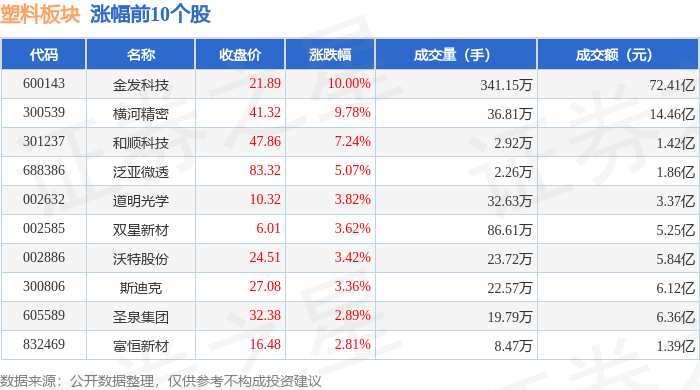
塑料板块9月17日涨1.19%,金发科技领涨,主力资金净流入7.03亿元
Zheng Xing Xing Ye Ri Bao· 2025-09-17 08:42
| 代码 | 名称 | 主力净流入(元) | 主力净占比 游资净流入 (元) | | 游资净占比 散户净流入(元) | | 散户净占比 | | --- | --- | --- | --- | --- | --- | --- | --- | | 600143 | 金发科技 | 7.95 Z | 10.97% | -4.31 Z | -5.95% | -3.63 Z | -5.02% | | 300539 横河精密 | | 1.93 乙 | 13.37% | 1966.42万 | 1.36% | -2.13 Z- | -14.73% | | 688716 中研股份 | | 5968.35万 | 9.06% | -735.69万 | -1.12% | -5232.66万 | -7.94% | | 300806 | 斯迪克 | 5382.87万 | 8.79% | -1951.57万 | -3.19% | -3431.31万 | -5.61% | | 605589 圣泉集团 | | 2924.31万 | 4.60% | -3861.45万 | -6.07% | 937.14万 | 1.47% | | 002585 双 ...

塑料震荡企稳
Bao Cheng Qi Huo· 2025-09-17 05:25
1. Report Industry Investment Rating - No information provided in the given content 2. Core View of the Report - The plastic futures 2601 contract is expected to maintain a volatile and stable trend, driven by the cost support from stable crude oil prices, reduced polyethylene supply due to plant maintenance, and improved downstream demand during the peak season [2][5] 3. Summary by Related Catalogs 3.1 Crude Oil Price and Cost Support - The trading logic in the crude oil futures market comes from three aspects: macro - factor drive with a "tight - to - loose" macro - environment, increased supply as OPEC+ continues to expand production, and rising geopolitical premiums in the oil market. After the game between supply increase and enhanced geopolitical risks, the domestic and international crude oil prices are expected to be volatile and stable, providing cost support for plastic futures [3] 3.2 Domestic Polyethylene Supply - Since September, the weekly output of domestic polyethylene has declined slightly due to the maintenance of devices such as Yulong Petrochemical, Liaoyang Petrochemical, and Yangzi Petrochemical. As of the week of September 12, 2025, the domestic polyethylene enterprise maintenance loss was 14.62 tons, a week - on - week increase of 2.28 tons. However, considering the planned restarts and new maintenance in the second half of the month, the supply decline momentum is expected to weaken, and the weekly output may stabilize and rebound [4] 3.3 Downstream Demand - With the arrival of the "Golden September" peak season, the profits of films and packaging films have improved. As of the week of September 12, 2025, the domestic film profit rose to - 220 yuan/ton, a year - on - year increase of 24.14%, and the packaging film profit was 148 yuan/ton, a year - on - year increase of 39.62%. The overall operating rate of downstream polyethylene industries reached 42.17%, a week - on - week increase of 1.11%. The demand side is expected to continue growing [5]
聚烯烃日报:宏观支撑,聚烯烃小幅反弹-20250917
Hua Tai Qi Huo· 2025-09-17 03:52
Report Industry Investment Rating - Unilateral: Neutral; Inter - period: 01 - 05 reverse arbitrage; Cross - variety: Long L - P [3] Core Viewpoints - Macro support has strengthened, black - series commodities led the rise, driving a slight rebound in polyolefins. Some upstream petrochemical plants are under maintenance, with capacity utilization slightly decreasing. New capacity is expected to be put into production, and supply is expected to remain at a high level, with large inventory pressure in the upstream and mid - stream. Downstream demand is in the seasonal improvement stage of "Golden September", with the overall downstream factory operating rate rising slightly. The international oil price has rebounded, and the propane price has continued to rise, strengthening the cost - side support [2] Summary According to the Directory I. Polyolefin Basis Structure - It includes the trend of the plastic futures main contract, the basis between LL East China and the main contract, the trend of the polypropylene futures main contract, and the basis between PP East China and the main contract [8][11] II. Production Profit and Operating Rate - It involves the production profit of LL (crude oil - based), PE operating rate, PE weekly output, PE maintenance loss, PP production profit (crude oil - based), PP production profit (PDH - based), PP operating rate, PP weekly output, PP maintenance loss, and PDH - based PP capacity utilization [18][20][21] III. Polyolefin Non - standard Price Spread - It includes the price spreads of HD injection - LL East China, HD blow - molding - LL East China, HD film - LL East China, LD East China - LL, PP low - melt copolymer - drawn East China, and PP homopolymer injection - drawn East China [27][34][35] IV. Polyolefin Import and Export Profit - It covers the import profit of LL, the price difference between LL FOB US Gulf and China CFR, the price difference between LL Southeast Asia CFR and China CFR, the price difference between LL Europe FD and China CFR, the import profit of PP, the export profit of PP (to Southeast Asia), the price difference between PP homopolymer injection FOB US Gulf and China CFR, the price difference between PP homopolymer injection Southeast Asia CFR and China CFR, the price difference between PP homopolymer injection Northwest Europe FOB and China CFR, and the export profit of LL [41][45][52] V. Polyolefin Downstream Operating Rate and Downstream Profit - It includes the operating rates of PE downstream agricultural film, packaging film, and winding film, and the operating rates of PP downstream woven bags, BOPP film, injection molding, as well as the production profits of PP downstream woven bags and BOPP film [61][62][72] VI. Polyolefin Inventory - It involves the inventories of PE oil - based enterprises, PE coal - chemical enterprises, PE traders, PE ports, PP oil - based enterprises, PP coal - chemical enterprises, PP traders, and PP ports [74][77][88]
《能源化工》日报-20250917
Guang Fa Qi Huo· 2025-09-17 02:01
Report Industry Investment Rating No relevant content provided. Core Views Chlor - Alkali Industry - The caustic soda futures market is stabilizing, with overall commodity sentiment positive. Supply may decline due to planned maintenance, and demand from the alumina industry is weakening, while non - alumina demand is improving but with limited price support. Spot prices may stabilize, and the downside of futures prices is limited [27]. - The PVC futures market is rebounding, driven by macro - sentiment. Supply is expected to decrease due to more maintenance this week, and demand from downstream products is slightly increasing. The cost side is providing bottom support, and it is expected to stop falling in the peak season from September to October [27]. Polyester Industry Chain - For PX, supply is increasing to a relatively high level, and short - term demand has some support, but the upside is limited. It is expected to fluctuate between 6600 - 6900 in the short term [30]. - PTA's spot market liquidity is good, and the medium - term supply - demand is weak. It is expected to fluctuate between 4600 - 4800 in the short term, and TA1 - 5 should be rolled in a reverse spread [30]. - Ethylene glycol's supply - demand pattern is strong in the near - term and weak in the long - term. It is expected to reduce inventory in September but increase inventory in the fourth quarter. It is recommended to wait and see on the single - side and use EG1 - 5 reverse spread [30]. - Short - fiber's short - term supply - demand is weak, and it mainly follows raw material fluctuations. The single - side strategy is the same as PTA, and the processing fee is expected to fluctuate between 800 - 1100 [30]. - Bottle - chip's supply increases slightly, and demand may decline. It mainly follows cost fluctuations, and the processing fee is expected to fluctuate between 350 - 500 yuan/ton [30]. Pure Benzene - Styrene Industry - Pure benzene's supply is at a relatively high level, and demand is weak. It is expected to be supported by the strong oil price and good macro - atmosphere, and BZ2603 should follow styrene to fluctuate strongly [35]. - Styrene's price is strongly supported but the upside is limited by high port inventory. EB10 should be bought at low prices, and the EB11 - BZ11 spread should be widened at low levels [35]. Urea Industry - Urea futures have rebounded in the past two days, driven by supply - side maintenance expectations. Demand is mainly supported by export and industrial needs, and the futures increase is mainly due to short - covering and expectation differences [39][40]. Methanol Industry - Methanol's supply in the inland is at a high level, and demand is weak due to the traditional off - season. The inventory pattern is relatively healthy, and the overall valuation is neutral. The market is swinging between high - inventory reality and overseas gas - restriction expectations, and the inventory inflection point should be monitored [42]. LLDPE - PP Industry - PP's PDH and propylene - purchasing profits are suppressed, with more unplanned maintenance and falling inventory, but the basis is still weak. PE's maintenance is at a relatively high level, with short - term low supply pressure, rising basis, and inventory reduction. Demand for new orders is poor, and the market is in a state of "decreasing supply and increasing demand" [45]. Crude Oil Industry - Overnight oil prices rose due to geopolitical conflicts, which increased concerns about supply disruptions of Russian refined oil and crude oil. The market's focus has shifted to immediate supply risks, and the oil price is likely to run along the upper edge of the shock range in the short term. It is recommended to wait and see on the single - side, and look for opportunities to widen spreads on the options side after volatility increases [48] Summary by Directory Chlor - Alkali Industry - **PVC, Caustic Soda Spot & Futures**: On September 16, Shandong 32% liquid caustic soda's price decreased by 3.0%, and Shandong 50% liquid caustic soda's price decreased by 4.4%. The prices of East - China PVC increased, and the prices of related futures contracts also changed slightly [27]. - **Supply**: The overall PVC start - up rate increased by 4.2% to 79.4%, while the profit of externally - purchased calcium carbide PVC decreased by 12.8% [27]. - **Demand**: The start - up rates of alumina, viscose staple fiber, and printing and dyeing industries all increased slightly, and the start - up rates of downstream PVC products also increased [27]. - **Inventory**: The inventory of liquid caustic soda in Shandong increased by 17.0%, and the total social inventory of PVC decreased slightly by 0.3% [27]. Polyester Industry Chain - **Downstream Polyester Product Prices and Cash Flows**: On September 16, the prices of most downstream polyester products increased slightly, and the cash flows of some products changed [30]. - **PX - Related Prices and Spreads**: CFR China PX price decreased by 0.2%, and PX - naphtha spread increased by 0.9% [30]. - **PTA - Related Prices and Spreads**: PTA's spot price increased by 0.2%, and the processing fee of PTA's spot increased by 19.6% [30]. - **MEG - Related Prices and Spreads**: MEG's spot price increased by 0.2%, and the basis of EG01 increased [30]. - **Polyester Industry Chain Start - up Rate Changes**: The start - up rates of Asian PX, Chinese PX, and PTA all increased, while the start - up rate of pure - polyester yarn decreased [30]. Pure Benzene - Styrene Industry - **Upstream Prices and Spreads**: On September 16, the prices of Brent and WTI crude oil increased, and the price of CFR China pure benzene increased by 0.3% [35]. - **Styrene - Related Prices and Spreads**: The price of styrene's East - China spot increased by 0.8%, and the cash flows of non - integrated and integrated styrene improved [35]. - **Pure Benzene and Styrene Downstream Cash Flows**: The cash flows of some downstream products of pure benzene and styrene changed, with some increasing and some decreasing [35]. - **Pure Benzene and Styrene Inventory**: The inventories of pure benzene and styrene in Jiangsu ports decreased [35]. - **Pure Benzene and Styrene Industry Chain Start - up Rate Changes**: The start - up rates of some products in the pure benzene and styrene industry chain decreased, while the start - up rates of downstream PS and EPS increased [35]. Urea Industry - **Futures Closing Prices**: On September 16, the prices of urea futures contracts increased slightly, and the price of methanol futures decreased [39]. - **Upstream Raw Materials**: The prices of most upstream raw materials of urea remained stable, and the estimated production costs of fixed - bed and water - coal - slurry remained unchanged [40]. - **Spot Market Prices**: The prices of urea in different regions changed slightly, with some increasing and some decreasing [40]. - **Supply - Demand Overview**: The daily and weekly production of domestic urea increased slightly, and the factory inventory increased by 3.44%, while the port inventory decreased by 11.52% [40]. Methanol Industry - **Methanol Prices and Spreads**: On September 16, the prices of methanol futures contracts decreased, and the basis and regional spreads changed [42]. - **Methanol Inventory**: The enterprise, port, and social inventories of methanol increased [42]. - **Methanol Upstream - Downstream Start - up Rates**: The start - up rates of upstream domestic enterprises and overseas exchanges decreased, while the start - up rates of some downstream products increased [42]. LLDPE - PP Industry - **Product Prices and Spreads**: On September 16, the prices of LLDPE and PP futures contracts increased slightly, and the spreads between different contracts and the basis changed [45]. - **Inventory**: The enterprise and social inventories of PE and PP increased [45]. - **Upstream - Downstream Start - up Rates**: The start - up rates of PE and PP devices decreased, while the start - up rates of some downstream products increased [45]. Crude Oil Industry - **Crude Oil Prices and Spreads**: On September 17, the prices of Brent, WTI, and SC crude oil increased, and the spreads between different contracts and different types of crude oil changed [48]. - **Refined Oil Prices and Spreads**: The prices of NYM RBOB, NYM ULSD, and ICE Gasoil increased, and the spreads between different contracts of refined oil changed [48]. - **Refined Oil Crack Spreads**: The crack spreads of gasoline, diesel, and jet fuel in different regions changed, with some increasing and some decreasing [48].
供需基本面改善 塑料震荡企稳
Qi Huo Ri Bao· 2025-09-17 01:01
Group 1: Oil Market Dynamics - The escalation of the Russia-Ukraine conflict has increased geopolitical tensions, leading to a stabilization and slight rebound in domestic and international crude oil futures prices [1][2] - Current trading logic in the crude oil market is driven by macroeconomic factors, increased supply surplus expectations, and geopolitical risk premiums [2] - OPEC+ has decided to continue increasing production in October, contributing to expectations of a supply surplus in the fourth quarter [2] Group 2: Polyethylene Production and Demand - Domestic polyethylene weekly production has slightly decreased due to maintenance at several petrochemical facilities, resulting in a significant increase in maintenance loss [3] - As of September 12, maintenance losses for domestic polyethylene reached 146,200 tons, with a weekly increase of 22,800 tons [3] - The upcoming restart of several polyethylene facilities is expected to stabilize production levels, despite some facilities entering maintenance [3] Group 3: Seasonal Demand Trends - The traditional consumption peak season of "Golden September and Silver October" is approaching, leading to a gradual recovery in the plastic end-user demand market [4] - Profit margins in the film and packaging film sectors have improved, with the domestic film industry showing a significant year-on-year improvement in profitability [4] - The overall operating rate of downstream polyethylene industries has increased, indicating a positive trend in production activity [4]
化工行业整体稳健 机构调研聚焦业绩增长点
Zhong Guo Zheng Quan Bao· 2025-09-16 22:17
Core Insights - The chemical industry in China is experiencing mixed performance, with overall revenue and net profit growth of 2.35% and 3.92% respectively in the first half of 2025 compared to the previous year [1] - A total of 237 out of 436 listed chemical companies reported year-on-year net profit growth, with 124 companies exceeding 30% growth [4] Industry Performance - Non-metal materials, plastics, agricultural chemicals, and chemical products showed significant net profit growth, with increases of 21.1%, 19.77%, 14.66%, and 3.08% respectively [1] - Conversely, chemical fibers, rubber, and chemical raw materials faced declines in net profit, with decreases of -18.5%, -15.59%, and -2.73% respectively [1] - In the plastics sector, synthetic resins and modified plastics had notable net profit increases of 34.17% and 23.08% [2] - The agricultural chemicals sector saw exceptional growth in pesticides, potassium fertilizers, and compound fertilizers, with net profit increases of 120.54%, 40.1%, and 13.25% respectively [2] - The chemical products sector also performed well, particularly in fluorine chemicals and food additives, with net profit growth of 89.53% and 37.98% [2] - The chemical raw materials sector had strong performers like other chemical raw materials and chlor-alkali, with net profit increases of 36.18% and 26.75% [3] Company Highlights - Notable companies such as Xinda Co., Su Li Co., and Lianhua Technology reported net profit growth exceeding 1000% in the first half of 2025 [4] - New and Cheng achieved a revenue of 11.1 billion yuan, a 12.76% increase, and a net profit of 3.6 billion yuan, a 63.46% increase [5] - Juhua Co. reported total revenue of 13.33 billion yuan, a 10.36% increase, and a net profit of 2.05 billion yuan, a 146.97% increase [5] Institutional Research Focus - Institutional research is concentrated on identifying growth drivers for the second half of the year, R&D investment directions, sources of performance growth, overseas business development, and market value management [6][7] - Companies like New and Cheng are focusing on nutrition, flavoring, and new materials to enhance revenue [7] - Huami New Materials reported a 16.20% increase in R&D investment, focusing on automotive and aerospace sectors [7] - Companies are actively expanding overseas markets, with efforts in rail transit and rubber tape projects in Europe [8]


化工行业整体稳健机构调研聚焦业绩增长点
Zhong Guo Zheng Quan Bao· 2025-09-16 20:20
Core Insights - The chemical industry in China is experiencing mixed performance, with overall revenue and net profit growth of 2.35% and 3.92% respectively in the first half of 2025 compared to the previous year [1] - Certain sub-sectors such as non-metallic materials, plastics, agricultural chemicals, and chemical products have shown significant net profit growth, while others like chemical fibers, rubber, and chemical raw materials have faced declines [1][2] Industry Performance - Non-metallic materials, plastics, agricultural chemicals, and chemical products saw net profit increases of 21.1%, 19.77%, 14.66%, and 3.08% respectively [1] - The plastics sector, particularly synthetic resins and modified plastics, reported net profit growth of 34.17% and 23.08% [1] - The agricultural chemicals sector, including pesticides and potassium fertilizers, experienced remarkable growth with net profit increases of 120.54% and 40.1% [1][2] - Conversely, the chemical fibers sector faced challenges, with net profit declines of -18.5% for chemical fibers and -15.59% for rubber [1][2] Company Performance - Among 436 listed companies in the chemical industry, 237 reported year-on-year net profit growth in the first half of 2025, with 124 companies exceeding 30% growth and 52 companies exceeding 100% growth [3] - Notable companies such as Xinda Co., Su Li Co., and Lianhua Technology achieved net profit growth exceeding 1000% due to low base effects from the previous year [3] - Major companies like Baofeng Energy and New Chemical achieved significant revenue and net profit growth, with New Chemical reporting revenues of 11.1 billion yuan, a 12.76% increase, and net profits of 3.6 billion yuan, a 63.46% increase [3][4] Research and Development Focus - Companies are increasingly focusing on R&D investments, with Huami New Materials reporting a 16.20% increase in R&D spending, primarily in automotive, high-speed rail, and aerospace sectors [5] - The company aims to enhance revenue through cost control and effective management of R&D expenditures [5][6] Market Expansion and Management - Companies like Sanwei Co. are actively expanding overseas markets, particularly in rail transit and rubber tape sectors in Europe [6] - Cangzhou Mingzhu emphasizes the importance of market management and sustainable development to enhance intrinsic value [6]