
信息传输

Search documents
刘奕:促进生产性服务业扩能提质
Jing Ji Ri Bao· 2026-01-21 00:01
Core Viewpoint - The development of the productive service industry is essential for enhancing production efficiency and supporting the modernization of the industrial system, as outlined in the "14th Five-Year Plan" [1][4]. Group 1: Integration and Development Trends - The productive service industry is increasingly integrated with other sectors, driven by advancements in information technology and the deepening of economic services, leading to the emergence of new industrial forms [2]. - The integration of productive services with manufacturing, agriculture, and other service industries is a dynamic process that can stimulate significant changes in industrial functions, forms, and business models [2]. Group 2: Support for Manufacturing Transformation - In 2023, the revenue of large-scale productive service enterprises in China reached 119 trillion yuan, with an average annual growth rate of 12.1% from 2020 to 2023, significantly outpacing GDP growth [4]. - Productive services provide comprehensive technical support to manufacturing, helping to overcome core technological bottlenecks and significantly reduce product development cycles and improve production efficiency [4]. - Services such as supply chain finance and smart logistics help manufacturing reduce overall costs and enhance supply chain stability [5]. Group 3: Expanding Development Space - International logistics and compliance consulting services assist manufacturing enterprises in integrating into the global value chain, thereby reducing costs associated with entering overseas markets [6]. - The relationship between the development of productive services and maintaining a reasonable proportion of manufacturing is complementary, with both sectors driving each other's growth [6]. Group 4: Optimizing the Development Environment - Despite progress, challenges remain in the depth of integration, the strength of operating entities, and the availability of high-end supply [7]. - Recommendations include accelerating the application of digital technologies, cultivating diverse entities, and optimizing policy support to enhance the capacity and quality of productive services [7][8]. - Expanding financial incentives and tax benefits for high-end productive services, while lowering market entry barriers, is crucial for promoting the free flow and optimal allocation of resources [8].
促进生产性服务业扩能提质
Jing Ji Ri Bao· 2026-01-20 22:12
Core Insights - The production service industry is crucial for enhancing production efficiency and supporting agricultural and industrial activities, as highlighted in the "14th Five-Year Plan" which emphasizes the need for specialization and high-end value chain extension [2][4] Group 1: Industry Development - The production service industry has seen significant growth, with revenue from large-scale enterprises reaching 119 trillion yuan in 2023, reflecting an average annual growth rate of 12.1% from 2020 to 2023, surpassing GDP growth during the same period [5] - The integration of production services with advanced manufacturing is essential for driving the transformation and upgrading of the manufacturing sector, fostering a dual cycle of service support for manufacturing and vice versa [6][7] Group 2: Technological Integration - The application of technologies such as artificial intelligence, big data, and industrial internet is enhancing the efficiency and value of production services, facilitating a more intelligent and digitalized manufacturing process [5][8] - The promotion of smart technologies and the establishment of platforms for technology transfer are critical for accelerating the transition from laboratory innovations to production applications [6][8] Group 3: Policy Recommendations - To optimize the development environment for the production service industry, it is recommended to promote the application of digital technologies, cultivate diverse service providers, and enhance policy support mechanisms [8][9] - Expanding financial incentives and tax benefits for high-end production services, while lowering market entry barriers, is essential for fostering a competitive and efficient production service sector [9]

10万亿度电!中国用电量不仅超美两倍,更远超欧俄印日四国之和
Sou Hu Cai Jing· 2026-01-20 18:39
Core Insights - In 2025, China's total electricity consumption is projected to exceed 10.4 trillion kilowatt-hours, marking a historic milestone as the first single country to surpass this threshold [1] - China's electricity demand is more than double that of the United States and greater than the combined total of the EU, Russia, India, and Japan [1] Group 1: Electricity Consumption Breakdown - The primary sector consumed 149.4 billion kilowatt-hours, with a growth rate of 9.9%, reflecting advancements in modern agriculture such as greenhouse farming and smart irrigation [4] - The secondary sector accounted for 6,636.6 billion kilowatt-hours, representing 64% of total consumption, with a stable growth rate of 3.7%, indicating a solid industrial production base [4] - The tertiary sector consumed 1,994.2 billion kilowatt-hours, and urban and rural residential electricity usage was 1,588 billion kilowatt-hours, together contributing to half of the overall growth rate [4][5] Group 2: Emerging Sectors - The charging and swapping service industry saw an impressive electricity consumption growth rate of 48.8%, correlating with the rising number of new energy vehicles [8] - The information transmission and software industry experienced a 17% growth in electricity consumption, highlighting the significant energy demands of digital activities such as online shopping and video streaming [8] Group 3: Infrastructure and Technological Advancements - China's electricity consumption per capita is 7,400 kilowatt-hours, compared to the U.S. at 12,000 kilowatt-hours, but has shown significant improvement over the past decade [10] - The State Grid's recent "14th Five-Year Plan" involves a 4 trillion yuan investment not for building power plants but for upgrading the entire grid system [12] - The integration of ultra-high voltage transmission networks, virtual power plants, and intelligent scheduling systems enables efficient electricity distribution across vast distances [12][14] Group 4: Global Positioning and Future Outlook - China has built a unified national grid system, allowing for efficient electricity transfer across regions, unlike fragmented systems in the U.S. and EU [14] - In 2022, China accounted for over half of the world's new wind and solar power installations, showcasing its leadership in renewable energy [16] - The ability to self-manufacture critical components for ultra-high voltage and flexible direct current equipment enhances China's energy technology confidence [18] - The 4 trillion yuan investment aims to address weaknesses in rural electricity infrastructure while expanding energy capabilities, reflecting a comprehensive approach to energy security [18][20] Group 5: Economic Implications - The 10 trillion kilowatt-hours of electricity consumed is not just a statistic but represents the backbone of China's economic transformation, shifting from traditional coal-based energy to a diversified energy structure [20] - Electricity has become a stabilizer for economic growth and an accelerator for technological advancement, underpinning various modern activities [20] - China's advancements in energy management and infrastructure position it as a leader in the global energy landscape, challenging perceptions of its developmental status [20]
“四连跳”背后的韧性与活力
Jin Rong Shi Bao· 2026-01-20 02:08
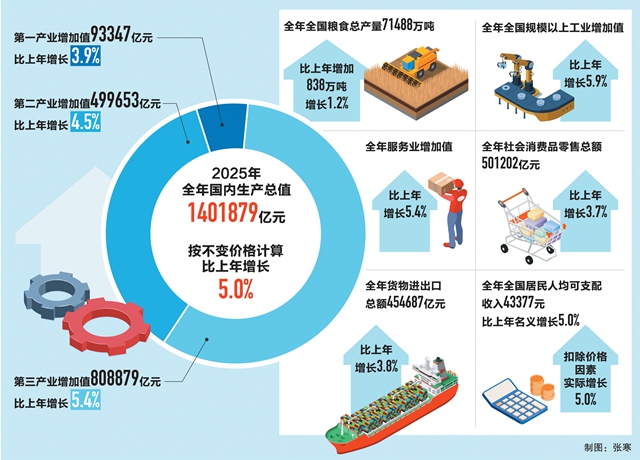
2025年,我国国内生产总值突破140万亿元,按不变价格计算,比上年增长5.0%;全国城镇调查失业率 平均值为5.2%;货物贸易再创新高,外汇储备余额超过3.3万亿美元……1月19日,国家统计局公布了 2025年国民经济运行成绩单。 从110万亿元到140万亿元,"十四五"时期,我国经济总量实现"四连跳"。这背后,不是数字的简单叠 加,而是结构之变、动能之新、底气之足的生动诠释,更是中国经济向新向优、行稳致远的有力印证。 站在"十五五"规划开局的新起点,中国经济发展更具底气。尽管外部环境复杂多变,国内挑战依然存 在,但中国经济长期向好的基本面没有改变,高质量发展的大势没有改变。我们将持续以新质生产力培 育新优势,以深化改革破解新挑战,以扩大开放拓展新空间,中国经济必将在新的征程上,续写更多跨 越式奇迹,在中国式现代化道路上书写更为精彩的发展篇章。 没有一蹴而就的跨越,只有久久为功的积淀。中国经济5年实现"四连跳",是传统产业转型升级的坚 守,是新兴产业加速崛起的奋进,是改革开放持续深化的红利,更是14亿人携手前行、共促发展的磅礴 合力。 高质量发展的成色,在结构优化中愈发鲜亮。告别粗放增长的旧路径,中国经济迈 ...
2025年主要发展目标任务顺利实现——来之不易成绩单彰显经济韧性活力
Ren Min Ri Bao· 2026-01-20 01:58
Economic Resilience and Growth - In 2025, China's economy is expected to continue its strong resilience and vitality, achieving major goals set for social and economic development during the "14th Five-Year Plan" [1] - The national economy is projected to maintain a steady growth trajectory, with a focus on innovation-driven development, industrial quality improvement, digital empowerment, and green transformation [2] Innovation and Industrial Upgrading - China has become the first country to possess over 5 million valid domestic invention patents, with R&D expenditure reaching 39,262 billion yuan, ranking second globally [2] - The added value of high-tech manufacturing and equipment manufacturing accounted for 17.1% and 36.8% of the total industrial added value, respectively [2] - The production of civil drones and industrial robots increased by 37.3% and 28% year-on-year [2] Green Energy Development - Clean energy generation from hydropower, nuclear power, wind, and solar sources grew by 8.8%, with non-fossil energy consumption rising by approximately 2 percentage points compared to 2024 [3] - The annual production and sales of new energy vehicles exceeded 16 million units [3] - Industrial added value reached 41.7 trillion yuan, growing by 5.8% year-on-year, contributing 35% to economic growth [3] Consumer Market Expansion - The total retail sales of consumer goods surpassed 50 trillion yuan, marking a 3.7% increase from 2024, with final consumption contributing 52% to economic growth [4] - Service retail sales grew by 5.5%, outpacing goods retail sales, indicating a shift towards balanced consumption between goods and services [4] - Online retail sales increased by 8.6%, driven by e-commerce and digital technologies [4] Policy Implementation and Economic Stability - Macro policies are being actively implemented to support high-quality economic development, including measures to stabilize employment and promote investment [7] - The policy of replacing old products with new ones has led to a 4.1% increase in retail sales of related goods, contributing to overall retail growth [7] - By the end of 2025, the number of cars per hundred households is expected to reach 52.9, an increase of 1.7 from 2024 [7] Technological and Industrial Integration - The added value of smart unmanned aerial vehicle manufacturing and smart vehicle equipment manufacturing grew by 57% and 26.2%, respectively [8] - The development of artificial intelligence and quantum technology is fostering new business opportunities and enhancing economic productivity [8] Positive Economic Outlook - Major international organizations have raised their growth forecasts for China's economy, reflecting a positive outlook for future development [10] - The focus on innovation, reform, and domestic circulation is expected to drive qualitative improvements and reasonable growth in the economy [10]
国家统计局发布2025年四季度和全年国内生产总值初步核算结果
Guo Jia Tong Ji Ju· 2026-01-20 01:49
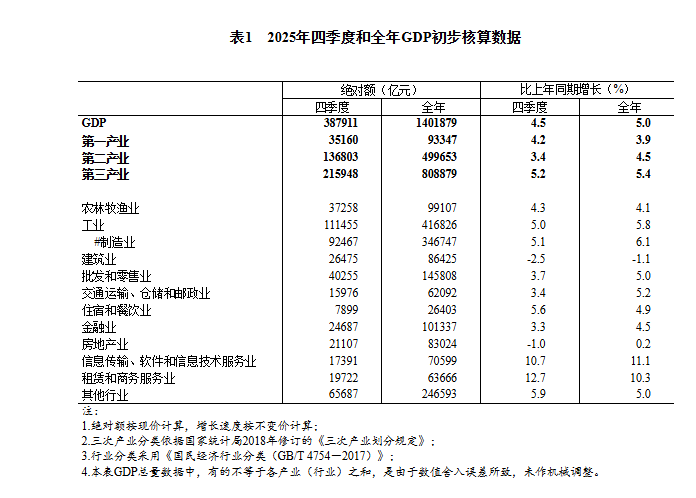
Core Viewpoint - The National Bureau of Statistics released preliminary GDP accounting results for the fourth quarter and the entire year of 2025, indicating a growth trend in various sectors of the economy [1]. Group 1: GDP Overview - The GDP for the fourth quarter of 2025 is reported at 38,791.1 billion yuan, with an annual total of 1,401,879 billion yuan, reflecting a year-on-year growth of 4.5% for the fourth quarter and 5.0% for the entire year [2]. - The primary industry contributed 35,160 billion yuan in the fourth quarter, growing by 4.2% year-on-year, while the secondary industry accounted for 136,803 billion yuan, with a growth rate of 3.4% [2]. - The tertiary industry showed a robust performance with a GDP of 215,948 billion yuan in the fourth quarter, marking a growth of 5.2% [2]. Group 2: Sector Performance - The construction industry experienced a decline, with a GDP of 26,475 billion yuan in the fourth quarter, down by 2.5% year-on-year [2]. - The wholesale and retail trade sector reported a GDP of 40,255 billion yuan, growing by 3.7% compared to the previous year [2]. - The information transmission, software, and IT services sector exhibited strong growth, with a GDP of 17,391 billion yuan, increasing by 10.7% year-on-year [2]. Group 3: Quarterly Growth Trends - The GDP growth rates for the past quarters show fluctuations, with 2025 projected to have quarterly growth rates of 1.2% in Q1, 1.0% in Q2, 1.1% in Q3, and 1.2% in Q4 [6]. - The growth trend indicates a gradual recovery and stabilization in the economy, with the fourth quarter of 2025 expected to maintain a steady growth rate [6].
深度关注丨中国经济向新向优
Zhong Yang Ji Wei Guo Jia Jian Wei Wang Zhan· 2026-01-20 00:37
中央纪委国家监委网站 柴雅欣 1月19日,2025年中国经济成绩单公布:初步核算,全年国内生产总值1401879亿元,按不变价格计算, 比上年增长5.0%。 2025年是"十四五"规划收官之年。在以习近平同志为核心的党中央坚强领导下,中国经济航船无惧风 雨,顶住多重压力,保持稳中有进发展态势,高质量发展取得新成效。但也要看到,外部环境变化影响 加深,国内供强需弱矛盾突出,经济发展中老问题、新挑战仍然不少。翻开这份成绩单,我们应如何看 待经济数据背后的发展成色?面对新的风高浪急,中国经济航船如何继续乘风破浪、勇毅前行? 稳中有进:在风浪中稳住了发展底盘、巩固了发展根基 "稳"是2025年中国经济的突出特点。面对外部环境急剧变化,国内困难挑战增多的复杂严峻形势,我国 实施更加积极有为的宏观政策,不仅有效化解外部环境变化的不利影响,更在风浪中稳住了发展的底 盘、巩固了发展的根基。 "全年社会消费品零售总额突破50万亿元,比上年增长3.7%,比2024年加快0.2个百分点,规模居全球零 售市场前列。"康义说。 "中国经济又一次在爬坡过坎中实现全年5%的增长,完成了年初确定的目标。特别是2025年国内生产总 值首次站上 ...
财信宏观 | 2025顺利收官,2026向新而行——2025年宏观数据点评
Xin Lang Cai Jing· 2026-01-20 00:36
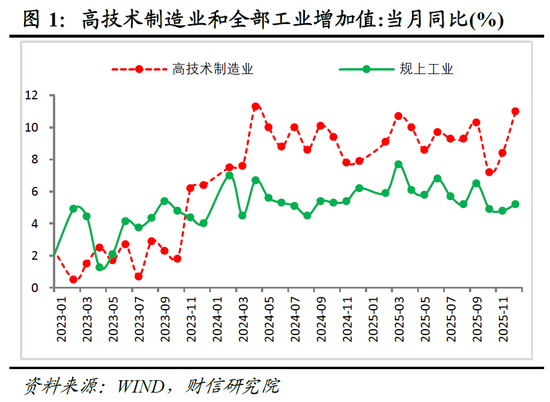
Economic Outlook for 2025 - The GDP growth for 2025 is projected at 5.0%, with a quarterly growth of 4.5% in Q4, characterized by a "strong supply, weak demand" scenario and low inflation pressure [1][4][54] - The macroeconomic policy is expected to strengthen, but the efficiency of transmission and marginal effectiveness needs improvement [1][5][54] - The transition from old to new economic drivers is accelerating, with significant structural optimization [1][7][54] Economic Forecast for 2026 - GDP growth for Q1 2026 is anticipated at 4.9%, with an annual growth of around 4.8% [1][54] - Despite the continuation of the "strong supply, weak demand" pattern, the contribution from high-tech manufacturing and modern services is expected to increase, enhancing internal growth resilience [1][54] December Economic Performance - The economy in December continued to show a "production recovery, consumption and investment under pressure" structural characteristic, with industrial value-added and service production indices both improving [2][55] - Social retail sales grew by only 0.9%, with high base effects and weak consumption from low-income groups being major drag factors [2][55] - Investment saw a cumulative decline, with manufacturing, infrastructure, and real estate investment growth rates all accelerating downward [2][55] Inflation Trends - Inflation is expected to continue its upward trend in 2026, following a weak inflation environment in 2025, where the GDP deflator index decreased by 1.0% [2][4][54] - By the end of 2025, signs of improvement were noted, with CPI rising for four consecutive months and PPI showing positive month-on-month growth for three months [2][4][54] Financial Data Insights - The growth rate of social financing continued to slow, with a significant reliance on government bonds, which contributed 76% of the annual increase in social financing [3][57] - In December, social financing and M1 growth rates continued to decline, but there were signs of improvement in corporate credit [3][57] - The overall credit growth is expected to stabilize gradually, although social financing still faces downward pressure [3][57]
经济总量实现新跨越
Jing Ji Ri Bao· 2026-01-19 22:18
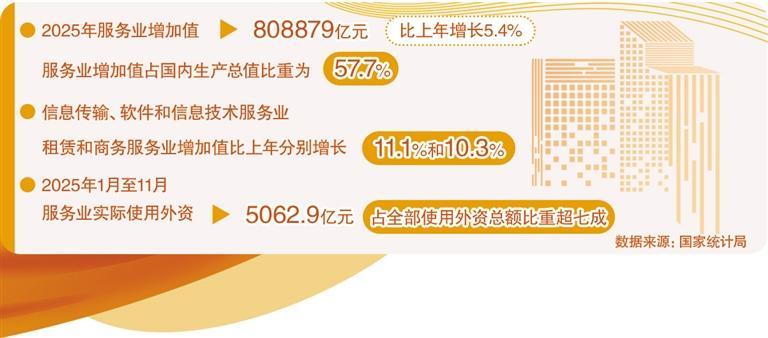
2025年是"十四五"规划收官之年,我国经济运行总体平稳,经济发展向新向优。 一、经济总量再上新台阶,全年增长目标圆满实现 初步核算,2025年,我国国内生产总值(GDP)首次突破140万亿元,达到1401879亿元,按不变价格计 算,比上年增长5.0%。 四季度,我国GDP为387911亿元,按不变价格计算,同比增长4.5%。 三、国内需求不断释放,外贸韧性持续彰显 消费需求平稳增长。2025年,最终消费支出对经济增长贡献率为52.0%。其中,四季度最终消费支出对 经济增长贡献率为52.9%。 投资结构持续优化。2025年,资本形成总额对经济增长贡献率为15.3%。其中,四季度资本形成总额对 经济增长贡献率为16.0%。 净出口彰显较强韧性。2025年,货物和服务净出口对经济增长贡献率为32.7%。其中,四季度货物和服 务净出口对经济增长贡献率为31.1%。 四、新质生产力成长壮大,高质量发展扎实推进 数字经济发展动能强劲。2025年1月至11月,规模以上信息传输、软件和信息技术服务业企业营业收入 同比增长11.9%,高于规模以上服务业企业4.1个百分点。2025年,实物商品网上零售额比上年增长 5.2%, ...
“稳、进、新、韧” ——四个关键字透视2025年中国经济
Zhong Guo Zheng Quan Bao· 2026-01-19 21:53
Core Viewpoint - In 2025, China's GDP reached 140.19 trillion yuan, marking a 5.0% increase from the previous year, reflecting a stable and progressive economic environment despite various challenges [1][2]. Economic Stability - The GDP growth of 5.0% in 2025 is significant for a large economy like China, which also maintained an average urban unemployment rate of 5.2% and achieved record high trade volumes with foreign exchange reserves exceeding 3.3 trillion USD [2]. - The total retail sales of consumer goods surpassed 50 trillion yuan, growing by 3.7%, indicating a strong consumer market supported by various policy measures [2]. - Industrial production contributed significantly to economic stability, with the industrial added value reaching 41.7 trillion yuan, a 5.8% increase, contributing 35% to economic growth [2]. Economic Progress - Despite complex internal and external environments, China accelerated the transformation of old and new growth drivers, with high-tech manufacturing's added value rising to 17.1% of total industrial output [4]. - The contribution of final consumption expenditure to economic growth exceeded 50%, showcasing a shift towards a consumption-driven economy [4]. - The total import and export volume grew by 3.8%, reflecting a robust trade environment [4]. Innovation and New Growth Drivers - In 2025, R&D expenditure intensity reached 2.8%, surpassing the OECD average for the first time, with total R&D spending at 39.26 billion yuan [6]. - China became the first country with over 5 million valid invention patents, and its PCT international patent applications ranked first globally for six consecutive years [6]. - The manufacturing sector saw significant growth in digital products, with a 9.3% increase in output, and the information technology services sector grew by 11.1% [7]. Resilience - Despite global economic challenges, China's economy demonstrated resilience, achieving a growth rate of 5.0% and contributing approximately 30% to global economic growth [8]. - The diversification of foreign trade has accelerated, with China becoming a major trading partner for over 150 countries, focusing on high-tech and high-value-added exports [8]. - The foundation laid during the 14th Five-Year Plan is expected to support continued high-quality development into the 15th Five-Year Plan [9].