
制造业

Search documents
固定收益点评:关注结构和持续性
GOLDEN SUN SECURITIES· 2026-03-17 01:02
1. Report Industry Investment Rating No information provided in the content. 2. Core Viewpoints of the Report - The economic data at the beginning of 2026 is strong, but its sustainability needs further observation. The economic structure shows a pattern of strong supply and weak demand, and the price related to domestic demand may still be under pressure. The bond market fluctuates in the short - term, and there is a repair opportunity after the quarter - end [1][5][9]. 3. Section - by - Section Summaries 3.1 Economic Overview - The economic data from January to February 2026 is strong, with a pattern of strong supply and weak demand. The growth of the supply side is affected by the Spring Festival factor, and its sustainability needs to be observed. The industrial added value from January to February increased by 6.3% year - on - year, and the service industry production index increased by 5.2% year - on - year, while the fixed - asset investment increased by 1.8% and social retail sales increased by 2.8% [1][9]. 3.2 Industrial Output - External demand and the Spring Festival factor jointly drive industrial output. The industrial added value from January to February 2026 increased by 1.1 percentage points to 6.3%, and the service industry GDP increased by 5.2% year - on - year. The export growth rate drove the export delivery value growth rate to increase by 3.1 percentage points to 6.3%. New economy maintains a high growth rate, with the added value of equipment manufacturing and high - tech manufacturing growing by 9.3% and 13.1% respectively [2][10]. 3.3 Consumption - The consumption growth rate has rebounded but remains at a low level, indicating weak consumption demand. In January - February 2026, social retail sales increased by 2.8% year - on - year, up 1.9 percentage points from December last year. The growth is related to residents' income pressure and low consumption willingness. Some basic and upgraded consumer goods sales have improved, and the retail sales of some industries have increased significantly due to the Spring Festival [3][14]. 3.4 Investment - The investment growth rate has turned positive but is still at a low level. In January - February 2026, the national fixed - asset investment (excluding rural households) increased by 1.8% year - on - year, up 17.0 percentage points from the previous value. Infrastructure and manufacturing investment achieved positive growth, at 9.8% and 3.1% respectively, offsetting the decline in real estate investment (-11.1%) [3][17]. 3.5 Real Estate - Real estate investment continues to operate at the bottom, and the construction and sales ends are still under pressure. From January to February, real estate investment was -11.1% year - on - year, with a narrowing decline. The construction end data is deteriorating, and the sales end has improved slightly under the influence of policies, but developers' confidence is still insufficient [4][19]. 3.6 Bond Market - The bond market fluctuates in the short - term. The long - end fluctuates greatly due to low participation of allocation - type institutions, while the short - end declines due to loose liquidity and falling inter - bank deposit rates. The long - end adjustment may not be sustainable, and the market is expected to repair after the quarter - end. It is recommended to increase leverage in the short - term and choose a suitable riding position [5][26].
经济开门红——全面解读1-2月经济数据
泽平宏观· 2026-03-16 16:06
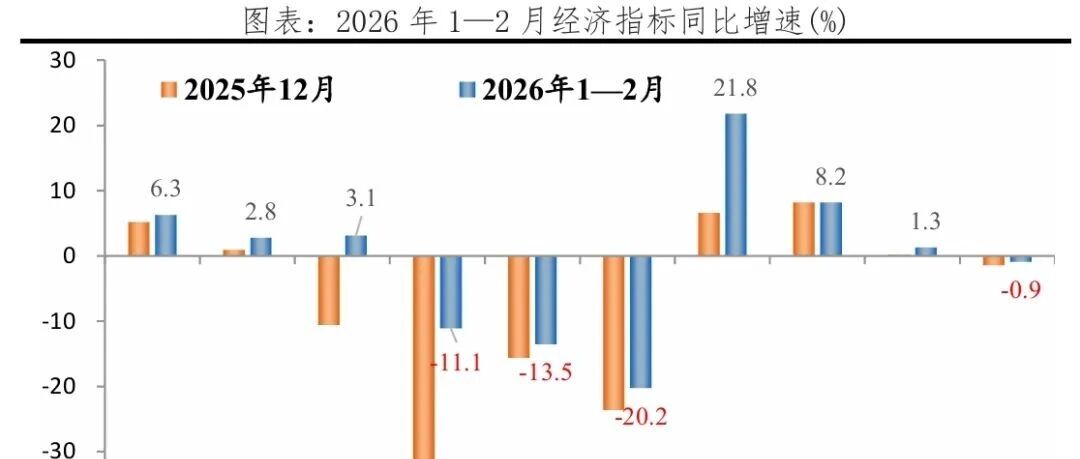
Economic Overview - The national economy showed a "new strong, old weak, external strong, internal stable" trend in the first two months of 2026, with high-tech manufacturing and equipment manufacturing leading the growth [2][3] - Industrial production accelerated, with a year-on-year increase of 6.3% in industrial added value, up 1.1 percentage points from December [2][8] - Fixed asset investment turned positive, growing by 1.8% year-on-year, a significant recovery of 16.9 percentage points from December [2][12] Industrial Production - High-tech manufacturing and equipment manufacturing sectors experienced significant growth, with high-tech manufacturing value-added increasing by 13.1% year-on-year [6][9] - The production of upstream raw materials improved due to rising international oil prices, while midstream machinery and equipment sectors benefited from policy effects [9][10] Investment Trends - Fixed asset investment (excluding rural households) showed a year-on-year increase of 1.8%, with high-tech industry investment growing by 5.1% [12][20] - Infrastructure investment surged by 11.4% year-on-year, driven by the acceleration of major projects and statistical adjustments [17][18] Real Estate Market - The decline in real estate investment narrowed, with sales area and sales amount decreasing by 13.5% and 20.2% respectively, but showing improvement from December [15][16] - Real estate companies are still cautious in land acquisition, with a significant drop in land transaction volume [16] Export Performance - Exports exceeded expectations, with a year-on-year growth of 21.8%, driven by global manufacturing recovery and enhanced competitiveness [25][26] - Exports to countries along the Belt and Road increased by 28.5%, accounting for over 50% of total exports [25][26] Consumer Spending - Social retail sales increased by 2.8% year-on-year, with service consumption performing well due to the long Spring Festival holiday [23][24] - Traditional consumer goods saw a significant demand boost during the holiday period, with restaurant income rising by 4.8% [23] Financial Data - Social financing maintained a stable growth rate of 8.2%, supported by government bonds and bank loans [28][29] - M2 growth remained at 9.0%, while M1 increased by 5.9%, indicating a shift in deposit trends towards non-bank institutions [29] Price Trends - CPI rose by 1.3% year-on-year, the highest in nearly three years, influenced by the timing of the Spring Festival [31][32] - PPI decline narrowed, reflecting input inflation and strong demand in certain technology sectors [31][32]

数据点评 | 经济开门红的“预期差”(申万宏观·赵伟团队)
赵伟宏观探索· 2026-03-16 16:02
Core Viewpoints - Domestic demand shows a significant "expectation difference" compared to external demand, driven by factors such as the extended Spring Festival holiday, government subsidy policies, and improved consumer confidence [2][10][88] Consumption - In January-February, the total retail sales of consumer goods increased by 2.8% year-on-year, exceeding expectations of 2.4%, with a notable rebound of 1.9 percentage points from the previous month [9][88] - The growth in consumption was primarily influenced by the long Spring Festival holiday, which boosted demand for essential goods like tobacco, alcohol, and food, with respective year-on-year growth rates of 19.1% and 10.2% [10][88] - The new round of "old-for-new" subsidy policies led to significant increases in the sales of home appliances and furniture, with year-on-year growth rates of 22.0% and 11.0% respectively [10][88] - Service consumption also improved, with restaurant revenue growth rising by 2.6 percentage points to 4.8% [10][88] Investment - Fixed asset investment showed a remarkable rebound, with a year-on-year increase of 1.8%, up 16.9 percentage points from the previous month, marking a historically rare recovery [2][13][91] - Infrastructure investment improved significantly, with a year-on-year increase of 10.8%, driven by a decrease in the proportion of special refinancing bonds [13][91] - Manufacturing investment also saw a notable rise, with a year-on-year increase of 3.1%, while real estate investment's year-on-year decline narrowed to -11.1% [13][91] Real Estate - Although sales, new construction, and completion rates remain low, real estate investment showed a significant rebound, with a year-on-year increase of 24.7 percentage points to -11.1% [3][24][63] - The sales area of commercial housing improved slightly, with a year-on-year decline of 13.5%, up 2.1 percentage points from the previous month [3][24][63] - However, new construction and completion rates still face uncertainties, with respective year-on-year declines of 23.1% and 27.9% [3][24][63] Production - Industrial value-added growth rebounded significantly, with a year-on-year increase of 6.3%, up 1.1 percentage points from December 2025, reflecting the combined effects of the Spring Festival timing and improved demand [5][32][90] - Labor-intensive industries, such as food manufacturing and beverages, showed substantial production increases, driven by improved consumer spending [32][90] - The production of intermediate and capital goods also improved, likely due to stronger exports and investment recovery [32][90] Summary - The easing of pressures from debt and real estate markets has led to a notable improvement in domestic demand, which may represent the largest expectation difference for the economy this year [4][90][41]
数据点评 | 经济开门红的“预期差”(申万宏观·赵伟团队)
申万宏源宏观· 2026-03-16 15:17
Core Viewpoints - The improvement in domestic demand is more significant than external demand, with a notable "expectation gap" observed in early 2026 [2][10][90] Consumption - The retail sales growth rate for January-February increased by 1.9 percentage points year-on-year to 2.8%, driven by a longer Spring Festival holiday and government subsidy policies [2][10][88] - Key categories such as tobacco, alcohol, and staple foods saw significant improvements, with year-on-year growth rates rising to 19.1% and 10.2% respectively [10][88] - Service consumption also showed positive recovery, with restaurant income growth rising to 4.8% [2][10][88] Investment - Fixed asset investment rebounded significantly, with a year-on-year increase of 1.8%, up 16.9 percentage points from the previous month, marking a historically rare rebound [2][10][13] - Infrastructure investment improved notably, with a year-on-year increase of 11.4%, while manufacturing investment rose to 3.1% [7][52][57] - The decline in real estate investment narrowed to -11.1%, reflecting improvements in corporate cash flow and a reduction in the issuance of special refinancing bonds [2][10][13] Real Estate - Despite low levels of sales, new construction, and completions, real estate investment showed a significant rebound, with sales area and amount improving slightly [3][24][89] - The credit financing growth rate for real estate companies increased, contributing to the rebound in investment [3][24][89] - However, new construction and completion growth rates remain low, indicating uncertainty in future investment recovery [3][24][89] Production - Industrial value-added growth for January-February rose to 6.3%, reflecting the combined effects of the Spring Festival timing and improved demand [2][10][32] - Labor-intensive industries, such as food manufacturing, saw significant production increases, indicating a recovery in consumer demand [32][90] - The production of intermediate and capital goods also improved, likely due to stronger exports and investment recovery [32][90] Summary - The easing of pressures from debt and real estate is expected to lead to significant improvements in domestic demand, which may represent the largest expectation gap for the economy in 2026 [4][90][41]
开年经济的温度
HUAXI Securities· 2026-03-16 12:25
Economic Performance - Industrial added value increased by 6.3% year-on-year in January-February, exceeding the expected 5.0%[1] - Fixed asset investment rose by 1.8% year-on-year, against an expected decline of 4.2%[1] - Retail sales of consumer goods grew by 2.8% year-on-year, surpassing the expected 2.1%[1] Supply and Demand Dynamics - The weighted year-on-year growth of industrial and service production indicators was 5.6%, rebounding by 0.5 percentage points from December[1] - The gap between supply and demand narrowed from 9.6 percentage points to 2.5 percentage points[1] External Demand and Exports - Industrial export delivery value surged by 6.3%, the highest growth rate since April of the previous year, contributing 0.7 percentage points to industrial added value[2] - The expected annual export growth rate has been revised upward from 3-5% to around 6%[2] Consumer Spending Trends - Retail sales growth for services reached 5.6%, significantly higher than the 2.5% growth for goods[2] - Automobile sales negatively impacted retail performance, contributing a drag effect of 2.2 percentage points on retail sales[3] Infrastructure and Investment - Fixed asset investment increased by 1.8%, with infrastructure investment growing at 11.4%, outperforming manufacturing and real estate investments[4] - State-owned investment rose by 7.7% year-on-year, significantly higher than the previous year's decline of 2.5%[4] Real Estate Market Insights - Real estate sales area and sales value showed better-than-seasonal performance, with sales area declining by only 1.1% month-on-month[5] - New home prices in first-tier cities saw a reduced decline of 0.1% month-on-month, indicating a stabilization trend[5] Overall Economic Outlook - The economic data indicates improvements in consumption and investment, particularly in infrastructure, driven by state-owned enterprises[6] - The real estate sector shows signs of recovery, although challenges remain due to previous weak sales and limited land acquisition by developers[6]
宏观经济月报:经济回升的地基仍待夯实-20260316
Guoxin Securities· 2026-03-16 11:49
Economic Growth - Monthly GDP growth rate reached 5.2%, up 0.5 percentage points from December 2025, indicating sustained economic momentum[1] - Industrial production increased by 6.3% year-on-year, accelerating by 1.1 percentage points from December 2025, with high-tech manufacturing outperforming traditional industries[1] - Fixed asset investment rebounded to a year-on-year growth of 1.8%, shifting from negative to positive[1] Demand Recovery - Social retail sales grew by 2.8% year-on-year, with a record high in month-on-month growth over the past decade[1] - Exports surged by 19.2% year-on-year, significantly above last year's average growth rate, driven by global AI investment and rising commodity prices[1] - Consumer confidence remains fragile, as evidenced by weak household loan demand and a decline in service consumption growth compared to December 2025[2] Policy and Future Outlook - Government spending is expected to maintain significant momentum in March, supported by a relatively ample fiscal surplus and the rollout of 800 billion yuan in policy financial tools[2] - The urbanization rate for permanent residents reached 67.9%, but the registered urbanization rate remains below 50%, highlighting the need for improved public services for migrant workers[2] - Risks include potential weakening of policy stimulus and uncertainties in overseas economic policies[2]
内需市场“开门稳”,政策组合拳护航开局
Lian He Zi Xin· 2026-03-16 11:27
Group 1: Domestic Demand Overview - In January-February 2026, China's domestic demand market showed a stable start, with retail sales of consumer goods reaching 8.61 trillion yuan, a year-on-year growth of 2.8%, accelerating by 1.9 percentage points from December 2025[4] - Fixed asset investment (excluding rural households) grew by 1.8% year-on-year, marking a turnaround from a decline of 3.8% in the previous year[8] - The growth in infrastructure investment was significant at 11.4%, serving as a stabilizing force for overall investment[8] Group 2: Policy Support and Economic Strategy - The government has introduced a policy package including 250 billion yuan in special long-term bonds to support the replacement of consumer goods and an additional 100 billion yuan in financial collaboration funds to boost domestic demand[10] - The focus of policies is shifting from "investment in objects" to "investment in people," aiming to enhance consumer confidence and reduce precautionary savings[11] - The emphasis on effective investment is reflected in the "14th Five-Year Plan," which includes 109 major projects to drive new productive forces and modern infrastructure[11] Group 3: Consumer Behavior and Market Trends - Service consumption has accelerated, with restaurant revenue growing by 4.8%, outpacing the 2.5% growth in goods retail[4] - Upgraded goods showed strong recovery, with communication equipment sales increasing by 17.8% and gold and jewelry sales rising by 13.0%[6] - Despite positive trends, automotive retail sales fell by 7.3% year-on-year, and real estate investment saw a significant decline of 11.1%, indicating that the recovery of domestic demand still requires consolidation[10][12]
2026年1-2月宏观经济数据
Guan Tong Qi Huo· 2026-03-16 11:11
Report Summary 1. Report Industry Investment Rating No information provided. 2. Core Viewpoint In January - February 2026, major economic indicators showed a significant rebound, and the national economy got off to a good start. However, the impact of changes in the external environment has deepened, geopolitical risks have continued to rise, and there are still many old problems and new challenges in domestic economic development and transformation, with some enterprises facing operational difficulties [3]. 3. Summary by Relevant Catalogs Industrial Production - From January - February, the added value of industrial enterprises above designated size increased by 6.3% year - on - year, 1.1 percentage points faster than in December of the previous year. Equipment manufacturing and high - tech manufacturing had good growth momentum, with their added values increasing by 9.3% and 13.1% respectively, 3.0 and 6.8 percentage points faster than the overall industrial added value. The output of products such as 3D printing equipment, lithium - ion batteries, and industrial robots increased significantly [3]. - In February, the manufacturing PMI was 49.0%, and the enterprise production and operation activity expectation index was 53.2%, up 0.6 percentage points from the previous month [3]. Service Industry - From January - February, the national service industry production index increased by 5.2% year - on - year, 0.2 percentage points faster than in December of the previous year. Industries such as information transmission, software and information technology services, leasing and business services, and finance had relatively fast growth [4]. - In February, the service industry business activity index was 49.7%, up 0.2 percentage points from the previous month; the service industry business activity expectation index was 55.8%. Industries such as accommodation, catering, and culture, sports and entertainment were in a high - level boom range [4]. Market Sales - From January - February, the total retail sales of consumer goods reached 8607.9 billion yuan, a year - on - year increase of 2.8%, 1.9 percentage points faster than in December of the previous year. Service retail sales increased by 5.6% year - on - year, 0.1 percentage points faster than the whole of the previous year. Online retail sales of goods and services reached 3254.6 billion yuan, a year - on - year increase of 9.2% [5]. Fixed - Asset Investment - From January - February, national fixed - asset investment (excluding rural households) was 5272.1 billion yuan, a year - on - year increase of 1.8%, compared with a decline of 3.8% for the whole of the previous year. Infrastructure investment increased by 11.4% year - on - year, while real estate development investment decreased by 11.1% [6]. Goods Import and Export - From January - February, the total volume of goods import and export was 7732.1 billion yuan, a year - on - year increase of 18.3%, 13.4 percentage points faster than in December of the previous year. Exports were 4617.8 billion yuan, an increase of 19.2%; imports were 3114.3 billion yuan, an increase of 17.1% [7]. Employment - From January - February, the average urban surveyed unemployment rate was 5.3%, the same as the same period of the previous year. In February, the urban surveyed unemployment rate was 5.3%, up 0.1 percentage points from the previous month [8]. Price - From January - February, the national consumer price index (CPI) increased by 0.8% year - on - year. The industrial producer price index (PPI) decreased by 1.2% year - on - year, with the decline narrowing [9].
2026年1-2月经济数据点评:开局平稳向好
Tebon Securities· 2026-03-16 10:43
Economic Overview - The macroeconomic data for January-February 2026 shows a positive start, with industrial added value increasing by 6.3% year-on-year, accelerating by 1.1 percentage points from December 2025[1] - Total import and export value grew by 18.3% year-on-year, with exports rising by 19.2%[1] - Retail sales of consumer goods increased by 2.8% year-on-year, with catering revenue up by 4.8%[1] Production Sector - Industrial production saw a significant increase, with the industrial added value growing by 6.3% year-on-year, up from 5.2% in December 2025[2] - The manufacturing PMI for February was 49.0%, indicating a slight contraction, but large enterprises maintained a PMI of 51.5%, suggesting resilience in industrial production[2] Service Sector - The service production index recorded a year-on-year growth of 5.2%, up from 5.0% in December 2025[3] - Key sectors such as information technology services and financial services grew by 10.1% and 7.0% respectively, indicating strong internal momentum in the service industry[3] Demand Side - Retail sales reached 860.79 billion yuan, with a year-on-year growth of 2.8%, significantly up from 0.9% in December 2025[4] - The government has initiated measures to boost consumption, including a special bond issuance of 250 billion yuan to support consumer goods[5] Investment Trends - Fixed asset investment (excluding rural households) grew by 1.8% year-on-year, reversing a decline of 3.8% in 2025[6] - Infrastructure investment surged by 11.4% year-on-year, driven by local special bond issuance and project acceleration[6] Foreign Trade - The total value of goods trade reached 7.73 trillion yuan, with exports increasing by 19.2% and imports by 17.1% year-on-year[7] - Private enterprises' imports and exports grew by 22.8%, indicating enhanced vitality in foreign trade[7] Risks - Potential risks include intensified US-China tensions, geopolitical uncertainties, and challenges in policy implementation[8]
1-2月经济数据点评:经济数据取得开门红
Bank of China Securities· 2026-03-16 09:43
Economic Performance - Industrial added value in January-February increased by 6.3% year-on-year, exceeding the market expectation of 5.23%[4] - Retail sales of consumer goods grew by 2.8% year-on-year, with non-automobile retail sales increasing by 3.7%[22] - Fixed asset investment rose by 1.8% year-on-year, with infrastructure investment up by 11.4%[33] Sector Analysis - High-tech industries saw a significant growth of 13.1% in industrial added value[2] - Mining industry added value increased by 6.1%, while manufacturing grew by 6.6%[2] - Real estate investment fell by 11.1%, with residential investment down by 10.7%[44] Consumer Behavior - Service consumption increased by 5.6% year-on-year, indicating a recovery in consumer spending[28] - Online retail sales grew by 9.2%, with physical goods online retail up by 10.3%[27] - The sales area of commercial housing decreased by 13.5%, and sales revenue dropped by 20.2%[48] Economic Outlook - The economic growth target for 2026 is set at 4.5%-5.0%, with a consumer price increase of around 2.0%[51] - The government aims to maintain policy flexibility to counteract external uncertainties, including potential global inflation and geopolitical tensions[51] - Risks include a potential second wave of global inflation and unexpected downturns in the European and American economies[51]