
新能源产业

Search documents
港股异动 | 协鑫新能源(00451)高开近7% 拟向Pharos发行1.865亿股认购股份 协同加速Web3与新能源产业融合
智通财经网· 2026-01-08 01:33
Core Viewpoint - GCL-Poly Energy (00451) has seen a significant stock price increase of nearly 7%, currently trading at 1.38 HKD, following the announcement of a subscription and investment agreement with Pharos [1] Group 1: Investment Agreement - The company plans to issue 186.5 million subscription shares at a price of 1.033 HKD per share to the subscriber, Pharos [1] - This investment is expected to leverage Pharos's advanced technology and the company's resource advantages to accelerate the integration of Web3 and the renewable energy industry, creating synergistic value for all parties involved [1] Group 2: Strategic Implications - The investment allows the company to explore the potential of blockchain technology in innovating the renewable energy sector and aims to create sustainable value for shareholders [1] - The board believes that the subscription represents a good opportunity for the company to expand its capital and shareholder base [1]
刘振中:立足战略考量打造新兴支柱产业
Jing Ji Ri Bao· 2026-01-08 00:06
Core Viewpoint - The article emphasizes the importance of developing emerging pillar industries as a crucial task for building a modern industrial system in China, highlighting the strategic significance of this initiative in the context of global changes and the transition to high-quality economic development [1][2]. Group 1: Importance of Emerging Pillar Industries - Developing emerging pillar industries is a systematic project that balances development and security, addressing both immediate and long-term needs [2]. - The urgency stems from the need to transition economic growth drivers, as traditional industries are losing their effectiveness in stimulating economic growth [2]. - Emerging pillar industries are seen as innovation-driven sectors that can enhance the effectiveness of the national innovation system and lead to breakthroughs in core technologies [2]. Group 2: Criteria for Identifying Potential Emerging Pillar Industries - A potential emerging pillar industry should possess several characteristics: strategic necessity, growth traction, innovation leadership, ecological dominance, and development maturity [4]. - Strategic necessity relates to industries that are critical for national security and long-term competitiveness [4]. - Growth traction refers to industries with significant market potential and the ability to generate substantial investment and output multiplier effects [4]. - Innovation leadership is characterized by high R&D intensity and the capacity to produce disruptive innovations [4]. - Ecological dominance involves the potential to form or lead global industrial ecosystems [4]. - Development maturity indicates that the technology and business models have been validated in the market and are on the verge of rapid growth [4]. Group 3: Examples of Emerging Pillar Industries - Several emerging pillar industries are identified, including artificial intelligence, which is projected to exceed 900 billion yuan in core industry scale by 2024, and the biopharmaceutical industry, which has surpassed the 100 billion yuan mark in innovative drug markets [5]. - The renewable energy sector, particularly lithium battery storage technology, is highlighted as a key driver of green growth [5]. Group 4: Strategies for Developing Emerging Pillar Industries - To develop emerging pillar industries, a comprehensive support system must be established, focusing on innovation, industrial upgrading, scenario empowerment, institutional guarantees, and global layout [5][6][7]. - Strengthening innovation sources involves building integrated research systems and focusing on original innovations in foundational technologies [5]. - Promoting industrial upgrading requires enhancing the leadership of "chain master" enterprises and fostering collaboration across the supply chain [6]. - Scenario empowerment aims to unleash domestic market potential by creating opportunities and establishing benchmark projects [7]. - Institutional guarantees involve creating a regulatory environment that supports the unique development patterns of emerging industries [7]. - Global layout emphasizes the need for companies to establish a global presence and participate in international standard-setting [7].
协鑫新能源(00451.HK)与Pharos订立认购及投资协议
Ge Long Hui· 2026-01-07 22:49
Core Viewpoint - GCL-Poly Energy (00451.HK) has entered into a subscription and investment agreement with Pharos Network Technology Limited, aiming to enhance the integration of Web3 and the renewable energy sector through blockchain technology [1] Group 1: Investment Agreement Details - The company will issue 186.5 million new shares, representing approximately 12% of the existing share capital as of the announcement date, and about 10.71% of the enlarged share capital post-issuance [1] - The subscription will be conducted under general authorization, with the payment for the new shares being made in cash [1] Group 2: Strategic Implications - The investment is expected to leverage Pharos's advanced technology and the company's resources to accelerate the synergy between Web3 and the renewable energy industry, creating collaborative value for all parties involved [1] - The board believes that the subscription presents a good opportunity for the company to expand its capital and shareholder base [1]
立足战略考量打造新兴支柱产业
Xin Lang Cai Jing· 2026-01-07 21:21
Core Viewpoint - The focus on developing emerging pillar industries is a strategic choice for building a modern industrial system in China, emphasizing the need for innovation and adaptation in the face of global changes and economic transformation [1][2]. Group 1: Importance of Emerging Pillar Industries - Developing emerging pillar industries is essential for transitioning economic growth drivers, addressing the slowdown of traditional industries, and ensuring a smooth shift from old to new growth engines [2]. - Emerging pillar industries are innovation-driven, requiring significant R&D investment and breakthroughs in core technologies, which can enhance the effectiveness of the national innovation system [2]. - The development of these industries is a strategic decision to create new advantages in international competition, aiming to convert China's industrial and market advantages into technological and ecological advantages [2]. Group 2: Criteria for Identifying Potential Emerging Pillar Industries - Potential emerging pillar industries should possess strategic necessity, contributing to national security and long-term competitiveness [4]. - They must demonstrate growth traction, with significant market potential and the ability to generate substantial investment and output multiplier effects [4]. - Innovation leadership is crucial, with industries at the global technology forefront capable of producing disruptive innovations that can benefit other sectors [4]. - Ecological dominance is important, with the potential to form or lead global industrial ecosystems [4]. - Development maturity is necessary, indicating that the technology and business models have been validated and are on the verge of scaling [4]. Group 3: Examples of Emerging Pillar Industries - The artificial intelligence industry is projected to exceed 900 billion yuan in 2024, significantly impacting various sectors [5]. - The biopharmaceutical industry has a vast market space, with the innovative drug market surpassing 100 billion yuan [5]. - The renewable energy sector, particularly lithium battery storage technology, continues to lead globally and is crucial for promoting green growth [5]. Group 4: Strategies for Developing Emerging Pillar Industries - Strengthening innovation sources by establishing integrated research systems and focusing on original innovations in foundational technologies [6]. - Promoting industrial upgrades by enhancing collaboration among leading enterprises and fostering world-class industrial clusters [6]. - Deepening scenario empowerment to unlock domestic market potential and accelerate the penetration of new products [7]. - Establishing institutional guarantees to create a conducive environment for the development of emerging pillar industries [7]. - Advancing global layouts to secure a competitive position in international markets and participate in the formulation of international standards [7].
宏润建设(002062):首次覆盖报告:基建底盘稳固,新兴业务打开第二成长曲线
EBSCN· 2026-01-07 12:23
Investment Rating - The report gives the company an "Accumulate" rating for the first time [5]. Core Viewpoints - The company is one of the earliest private enterprises to enter shield tunneling construction in China, with over 300 kilometers of cumulative tunneling and a strong presence in key cities like Shanghai, Hangzhou, and Ningbo. The company is expanding its business from traditional infrastructure to include photovoltaic energy storage, distributed energy, and intelligent construction, creating a more balanced growth structure [1][14]. - The company's new energy business is entering a high-growth phase, projected to grow by 298% year-on-year in 2024 and 94% in the first half of 2025, contributing significantly to profit. This shift from "construction contracting" to "engineering + energy" is beginning to show results [1][3]. - The construction industry is under pressure, with new contracts declining for two consecutive years. However, policies aimed at improving cash flow are expected to gradually enhance the financial environment for the industry [2][38]. Summary by Sections Company Overview - The company has evolved from a focus on rail transit construction to becoming a leading integrated construction group in urban infrastructure and new energy. It has a strong foothold in the Yangtze River Delta region and has diversified its business to include various sectors such as municipal engineering and renewable energy [14][16]. Industry Analysis - The construction industry is currently facing a contraction due to a downturn in the real estate sector and tightening local finances. New contract amounts have decreased significantly, but ongoing debt resolution policies are expected to improve cash flow conditions [2][38]. Business Transformation - The company is actively seeking new growth avenues in response to the pressures on traditional construction. It is focusing on new energy and intelligent construction, with significant investments in these areas. The new energy business is expected to provide a second growth curve, while the AI robotics sector is also being developed through strategic partnerships [54][65]. Financial Projections - The company forecasts a decline in revenue for 2024, with a projected revenue of 5.923 billion yuan, down 7.82% year-on-year. However, net profit is expected to stabilize and grow in subsequent years, with predictions of 287 million yuan in 2025 and 350 million yuan in 2027 [4][3].

多部门发声,2026年要做这些事
财联社· 2025-12-29 11:43
Core Viewpoint - The article outlines the key tasks and changes planned for 2026 in various sectors, including finance, employment, consumption, investment, urban development, and technological innovation, as part of China's strategic planning for economic growth and stability. Group 1: Fiscal Policy - In 2026, a more proactive fiscal policy will be implemented, focusing on expanding fiscal expenditure, optimizing government bond tools, enhancing transfer payment efficiency, and improving expenditure structure [2][3] - The fiscal policy aims to promote resident employment and income growth by coordinating various funds to support job stability and entrepreneurship [3] Group 2: Consumption and Investment - The government will support consumption through initiatives like the "old for new" program, optimizing subsidy standards, and promoting service consumption [4] - Measures will be taken to stabilize investment, including increasing central budget investments and utilizing various government investment funds to enhance investment efficiency [5] Group 3: Urban Development - High-quality urban renewal will be prioritized, focusing on community improvements, public space enhancements, and safety projects [6] Group 4: Industry and Technology - There will be an emphasis on enhancing industrial technological innovation capabilities, addressing core technologies, and developing a national manufacturing trial service network [9] - The government plans to cultivate emerging and future industries, including AI, integrated circuits, and biotechnology, while supporting innovation in sectors like 6G technology [10] Group 5: Infrastructure and Energy - The construction of cross-regional and cross-basin transportation corridors will be advanced to support national strategic goals [11] - The energy sector will see an increase in renewable energy supply, with significant additions in wind and solar power capacity, and a focus on future energy industries like hydrogen and nuclear energy [12] Group 6: Social Welfare - The implementation of direct disbursement of maternity benefits to insured individuals will be pursued, along with expanding coverage for flexible employment and migrant workers [13] - The real estate market will be stabilized by utilizing existing housing stock for affordable housing and other social needs [14]


坚决扛牢经济大区挑大梁的使命担当 在奋力谱写中国式现代化沈阳篇章中走在前、作表率
Xin Lang Cai Jing· 2025-12-27 18:42
Group 1 - The core message emphasizes the commitment of the Tiexi District to implement the spirit of the municipal economic work meeting, aiming to be a key player in building Shenyang as an international center in Northeast Asia [1] - The district plans to sign 400 projects, start and resume work on 500 projects, and complete 150 projects by the end of the year, focusing on large and impactful projects to boost economic growth [1][2] - There is a strong focus on expanding domestic demand and exploring new consumption models, particularly in the automotive sector and through the development of vibrant commercial areas [1][2] Group 2 - The strategy includes fostering new industrial growth by enhancing the industrial structure and promoting technological innovation, particularly in emerging sectors like biomedicine and renewable energy [2] - The district aims to create a first-class business environment by prioritizing service optimization and addressing the needs of enterprises, thereby enhancing the overall development climate [2] - Continuous reform and opening-up efforts are highlighted to stimulate internal growth, with a focus on strengthening state-owned enterprises and supporting businesses in accessing international markets [2] Group 3 - The district is committed to meeting the new expectations of the public by improving services related to employment, education, and social welfare, thereby enhancing the overall quality of life for residents [3]
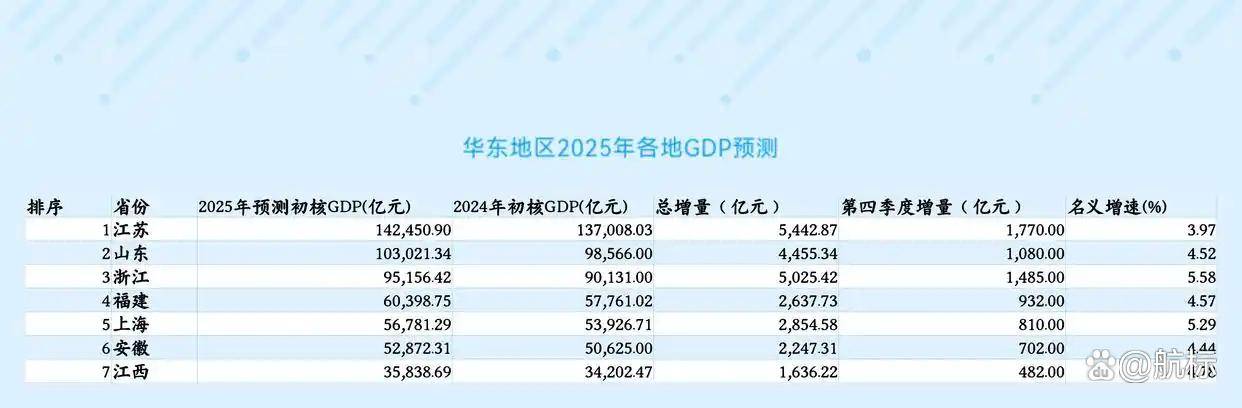
华东6省1市2025年GDP预测:江苏增速不到4%,浙江约10万亿,福建任超上海!
Sou Hu Cai Jing· 2025-12-26 19:03
Group 1 - The core viewpoint of the article highlights the economic competition in the East China region, with Jiangsu, Zhejiang, and Fujian showcasing their GDP forecasts for 2025, revealing underlying development dynamics [1] - Jiangsu is projected to have a GDP of 14.25 trillion, maintaining its leading position, but its growth rate has decreased to 3.97% [1][5] - Zhejiang's GDP is forecasted at 9.52 trillion, nearing the 10 trillion mark, driven by its digital economy and strong private sector [1][4] Group 2 - Fujian's GDP is expected to reach 6.04 trillion, surpassing Shanghai, supported by its strategic position in cross-strait cooperation and marine economy [1][6] - The article emphasizes the interplay between national strategies and local characteristics, questioning the sustainability of Fujian's growth, Zhejiang's potential to break the 10 trillion barrier, and Jiangsu's need for transformation amid slowing growth [1][6]
精准谋划,激活发展新动能
Qi Lu Wan Bao· 2025-12-26 09:33
Group 1 - The meeting focused on strategic planning for key projects in 2026, involving various local government departments and investment teams to enhance collaboration and project execution [1][2] - Key areas of discussion included 11 major projects in real estate, park operations, new energy, commercial ventures, and equity investment, along with 6 fund cooperation projects and 15 urban commercial and livelihood improvement projects [1] - The meeting emphasized the importance of precise planning and resource sharing to support the successful implementation of projects, aiming for high-quality development in the region [2] Group 2 - The meeting established a clear project planning approach, highlighting the need for a structured management system to accelerate project readiness and transformation [2] - A focus on high-quality project construction is intended to ensure a strong foundation for the region's economic and social development during the 14th and 15th Five-Year Plans [2]
广西东兴产业园区建设热潮涌动
Guang Xi Ri Bao· 2025-12-24 04:05
今年,广西东兴国家重点开发开放试验区和东兴市持续深化"三个突破年"行动,提速推进广西东兴 产业园区和重大项目建设各项工作,以精准服务破难题、以协同发力促提升,集中精力抓项目、强产 业、谋发展,以实干实效为东兴市经济社会高质量发展蓄势赋能。 12月22日,在广西东兴产业园区的电子信息产业示范园内,大型机械设备轰鸣作响,工程机械往来 穿梭,工人们紧张作业,展现出一派繁忙的建设景象。 重大项目是扩投资、稳增长的重要引擎和有力抓手。2024年以来,广西东兴产业园区通过争取专项 债券、边境转移支付资金、中央预算内资金等各类上级资金约13.23亿元,带动社会资本58.51亿元,完 成园区道路建设21.68公里,标准化厂房建设18.01万平方米,成功引进神州天玑5.0新能源产业园、3C数 码智能制造产业园等一批标杆"园中园"项目。 截至目前,广西东兴产业园区今年新签约产业项目达21个,协议总投资额140.23亿元,其中超10亿 元项目5个,初步形成"优势互补、要素联动、成果共享"的区域协同发展格局。"2024年,园区规上工业 总产值达36.93亿元,同比增长28.15%,较国家批准设立东兴产业园区之初增长近2倍;2025年 ...