
旅游酒店

Search documents
A股午评:创业板指涨0.85% 贵金属概念、芯片产业链集体爆发
2 1 Shi Ji Jing Ji Bao Dao· 2026-01-21 04:38
Market Overview - The A-share market experienced a morning rally, with the ChiNext Index rising over 1% at one point. By the close, the Shanghai Composite Index increased by 0.16%, the Shenzhen Component Index rose by 0.76%, and the ChiNext Index finished up by 0.85% [1] - The total trading volume in the Shanghai and Shenzhen markets reached 1.63 trillion yuan, a decrease of 216.9 billion yuan compared to the previous trading day [1] Sector Performance - Precious metals concept stocks saw significant gains, with Hunan Silver achieving two consecutive trading limits [1] - The semiconductor industry chain expanded its upward momentum, with over ten stocks including Huada Technology, Longxin Technology, and Zhizheng Shares hitting the daily limit [1] - Lithium mining stocks experienced a rebound, with Shengxin Lithium Energy and Dazhong Mining both reaching the daily limit [1] - Conversely, the consumer sector weakened, particularly in the liquor and tourism hotel segments, which led the decline [1] - The coal sector faced a downturn, with Dayou Energy dropping over 8% [1]

A股午评:创业板指涨0.85%,贵金属概念持续爆发
2 1 Shi Ji Jing Ji Bao Dao· 2026-01-21 04:00
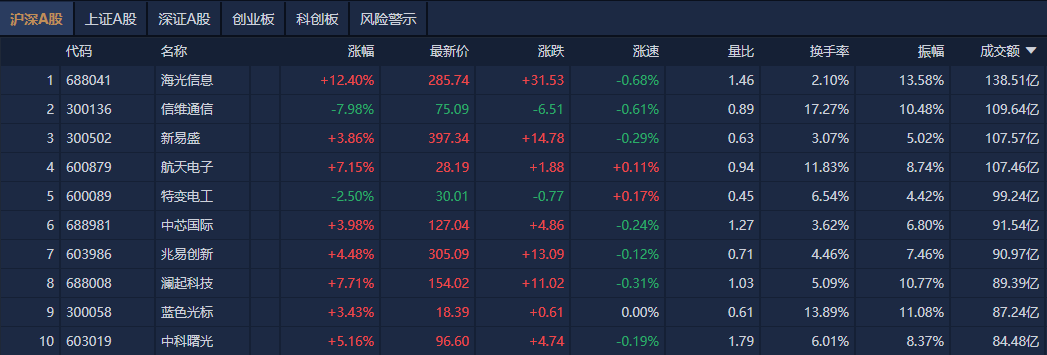
Market Overview - The market experienced fluctuations in the early session, with the ChiNext index rising over 1% at one point. By the end of the morning session, the Shanghai Composite Index increased by 0.16%, the Shenzhen Component Index rose by 0.76%, and the ChiNext index gained 0.85%. Over 2,900 stocks in the market saw an increase [1]. Sector Performance - Precious metals continued to surge, with Hunan Silver achieving two consecutive trading limits. The chip industry chain saw expanded gains, with companies like Huada Technology, Longxin Zhongke, and Zhizheng Co., Ltd. hitting the daily limit. The lithium mining sector also rebounded, with Shengxin Lithium Energy and Dazhong Mining both reaching the daily limit [2]. - Conversely, the consumer sector weakened collectively, with the liquor and tourism hotel sectors leading the decline. The coal sector also fell, with Dayou Energy dropping nearly 8% [3]. Trading Volume - The total trading volume in the Shanghai and Shenzhen markets reached 1.63 trillion yuan, a decrease of 216.9 billion yuan compared to the previous trading day. Notably, Haiguang Information led individual stock trading with a volume exceeding 13.8 billion yuan, followed by Xinwei Communication, Xinyi Sheng, and Aerospace Electronics [4]. Individual Stock Highlights - Haiguang Information saw a significant increase of 12.40%, closing at 285.74 yuan, with a trading volume of 138.51 billion yuan [5]. - Xinwei Communication experienced a decline of 7.98%, closing at 75.09 yuan, with a trading volume of 109.64 billion yuan [5]. - New Yi Sheng increased by 3.86%, closing at 397.34 yuan, with a trading volume of 107.57 billion yuan [5]. - Aerospace Electronics rose by 7.15%, closing at 28.19 yuan, with a trading volume of 107.46 billion yuan [5].


市场早盘震荡拉升,中证A500指数上涨0.56%,2只中证A500相关ETF成交额超84亿元
Sou Hu Cai Jing· 2026-01-21 03:57
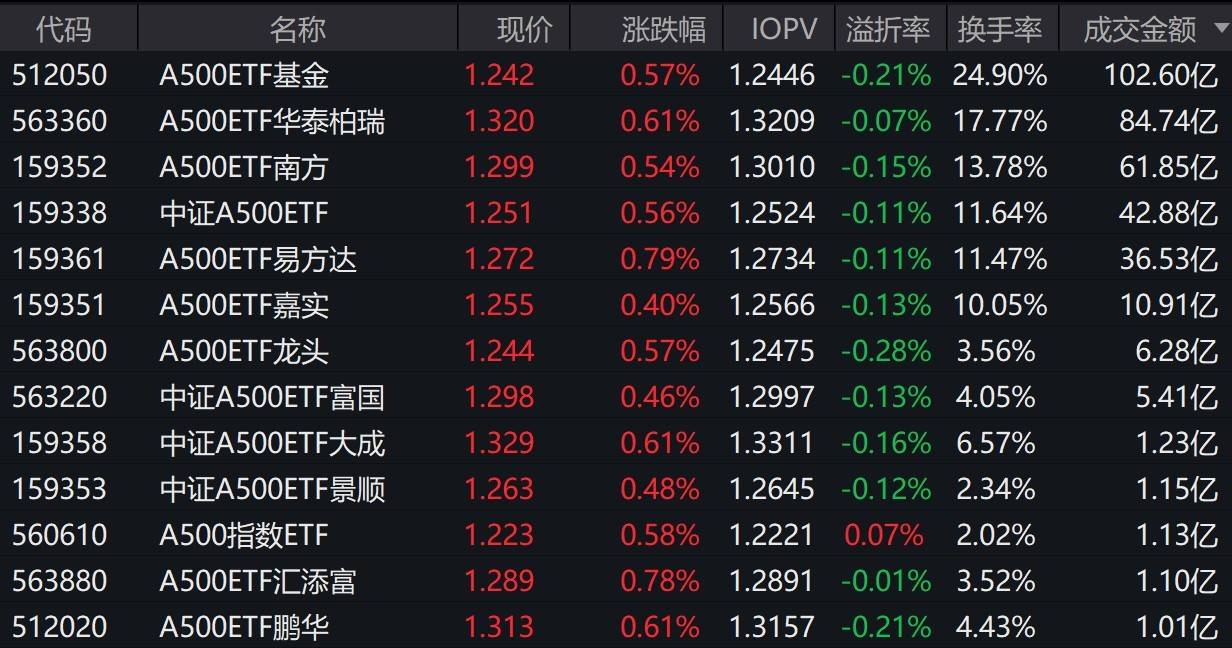
Group 1 - The market experienced fluctuations in early trading, with the ChiNext Index initially opening low but rising over 1%, while the CSI A500 Index increased by 0.56% [1] - The precious metals sector continued to surge, the chip industry chain saw expanded gains, and lithium mining concepts rebounded, while the consumer sector collectively weakened, particularly in the liquor and tourism hotel sectors [1] - As of the morning close, ETFs tracking the CSI A500 Index saw slight increases, with 13 related ETFs having transaction volumes exceeding 100 million yuan, and 2 surpassing 8.4 billion yuan [1] Group 2 - Specific ETFs related to the CSI A500 Index showed varying performance, with A500 ETF Fund at 1.242 yuan (up 0.57%) and A500 ETF Huatai-PB at 1.320 yuan (up 0.61%) [2] - Other notable ETFs included A500 ETF Southern at 1.299 yuan (up 0.54%) and A500 ETF E Fund at 1.272 yuan (up 0.79%) [2] - The trading rates for these ETFs varied, with A500 ETF Fund showing a liquidity rate of 24.90% and A500 ETF Huatai-PB at 17.77% [2]
市场震荡拉升,创业板指半日涨0.85%,贵金属、芯片产业链方向爆发
Feng Huang Wang Cai Jing· 2026-01-21 03:43
Market Overview - The market experienced a volatile upward trend in early trading, with the ChiNext Index rising over 1% at one point. By midday, the Shanghai Composite Index increased by 0.16%, the Shenzhen Component Index by 0.76%, and the ChiNext Index by 0.85% [1] - The total trading volume in the Shanghai and Shenzhen markets reached 1.63 trillion yuan, a decrease of 216.9 billion yuan compared to the previous trading day [1][6] Index Performance - Shanghai Composite Index: 4120.10, up 0.16%, with 1205 stocks rising and 1048 falling [2] - Shenzhen Component Index: 14263.20, up 0.76%, with 1626 stocks rising and 1170 falling [2] - ChiNext Index: 3306.00, up 0.85%, with 871 stocks rising and 479 falling [2] Sector Performance - The precious metals sector continued to surge, with Hunan Silver achieving two consecutive trading limits [2] - The semiconductor industry saw significant gains, with multiple stocks such as Huada Technology and Longxin Zhongke hitting trading limits [2] - The lithium mining sector rebounded, with companies like Shengxin Lithium Energy and Dazhong Mining also reaching trading limits [2] Declining Sectors - The consumer sector collectively weakened, particularly in the liquor and tourism hotel segments [3] - The coal sector faced declines, with Dayou Energy dropping over 8% [3] Market Sentiment - 71.21% of users are bullish on the market [4] - The market showed a high limit-up rate of 76% and a profit rate of 59% for stocks that hit trading limits yesterday [7]

未知机构:光仔收盘观察系列中国中免收盘价AH股创下202311以来-20260121
未知机构· 2026-01-21 02:20
Summary of Key Points from the Conference Call Industry Overview - The conference call highlights significant stock price increases in various companies within the tourism and hospitality sectors, indicating a positive market trend. - The focus is on a K-shaped recovery, cyclical reversal, silver economy, and strong innovation and operational leaders as key investment themes for 2026. Company Highlights - **China Duty Free Group (中国中免)**: - Achieved a new high in A/H share prices since November 2023, indicating strong market performance and investor confidence [1]. - **ShouLai Hotel (首旅酒店)**: - Recorded a new high in stock price since September 2023, reflecting positive developments in the hospitality sector [2]. - **Three Gorges Tourism (三峡旅游)**: - Stock price reached a new high since January 2016, suggesting a robust recovery in tourism-related activities [3]. - **Jiuhua Tourism (九华旅游)**: - Achieved a new high in stock price since July 2016, indicating a resurgence in interest and investment in this segment [4]. - **Gu Ming (古茗)**: - The stock price reached a new high since its IPO, showcasing strong market performance and growth potential [5]. Investment Themes - The call emphasizes the following investment directions for 2026: - K-shaped recovery, indicating that some sectors are recovering faster than others. - Cyclical reversal, suggesting a shift in market dynamics that could benefit certain industries. - Silver economy, focusing on the growing market for products and services catering to the aging population. - Strong innovation and operational leaders, highlighting companies that excel in these areas as prime investment opportunities [6]. Conclusion - The conference call presents a positive outlook for the tourism and hospitality sectors, with several companies achieving significant stock price milestones. The identified investment themes for 2026 suggest a strategic focus on recovery trends and demographic shifts that could drive future growth.
收评:创指高开低走跌1.79% 贵金属、化工板块领涨
Xin Lang Cai Jing· 2026-01-20 07:08
Market Overview - The three major stock indices experienced fluctuations throughout the day, with the ChiNext Index leading the decline, dropping nearly 2% [1] - The Shanghai Composite Index closed at 4113.65 points, down 0.01%; the Shenzhen Component Index closed at 14155.63 points, down 0.97%; and the ChiNext Index closed at 3277.98 points, down 1.79% [1] Sector Performance - The precious metals sector continued to strengthen, with Hunan Silver and Zhaojin Gold both hitting the daily limit [1] - The chemical sector also showed robust performance, with China Chemical and Hongqiang Co. among several stocks reaching the daily limit [1] - The real estate sector was active throughout the day, with stocks like Dayue City and Hefei Urban Construction hitting the daily limit [1] - The tourism and hotel concept stocks gained strength, with Dalian Shengya and Jiuhua Tourism reaching the daily limit [1] - Conversely, the CPO sector saw a collective adjustment, with Tongyu Communication hitting the daily limit down [1] - The commercial aerospace sector experienced significant declines, with Chaojie Co. dropping over 10% [1] Overall Market Sentiment - Overall, there were more declining stocks than advancing ones, with over 3100 stocks declining across the two markets [1] - The leading gainers included the epoxy propylene, precious metals, and glyphosate sectors, while military electronics, military information technology, and terahertz sectors faced the largest declines [1]
主力资金流入前20:中国电建流入6.90亿元、上海电力流入6.24亿元
Jin Rong Jie· 2026-01-20 06:26
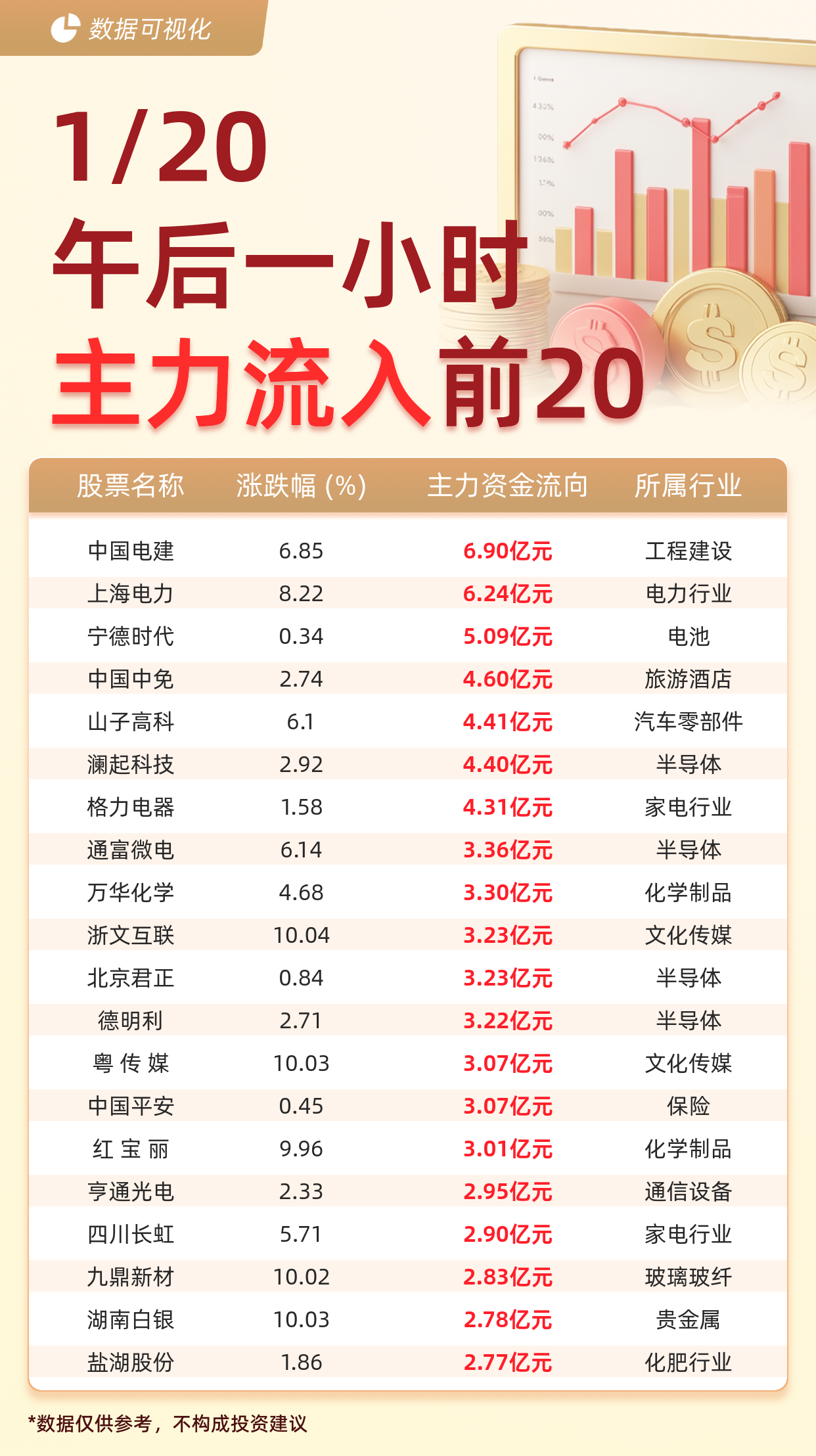
Core Insights - The main focus of the news is on the significant inflow of capital into various stocks, highlighting the top 20 stocks with the highest capital inflow as of January 20, with specific amounts listed for each company [1][2][3] Group 1: Stock Performance - China Power Construction saw a capital inflow of 690 million yuan with a price increase of 6.85% [2] - Shanghai Electric experienced a capital inflow of 624 million yuan and a price increase of 8.22% [2] - Contemporary Amperex Technology reported a capital inflow of 509 million yuan with a modest price increase of 0.34% [2] - China Duty Free Group had a capital inflow of 460 million yuan and a price increase of 2.74% [2] - Sanzi Gaoke recorded a capital inflow of 441 million yuan with a price increase of 6.1% [2] Group 2: Industry Insights - The engineering sector, represented by China Power Construction, is showing strong investor interest with significant capital inflow [2] - The electric power industry, highlighted by Shanghai Electric, is also attracting substantial investments [2] - The battery industry, represented by Contemporary Amperex Technology, is experiencing steady capital inflow despite a small price increase [2] - The tourism and liquor sector, represented by China Duty Free Group, is seeing positive capital movement [2] - The automotive parts sector, represented by Sanzi Gaoke, is gaining traction with notable capital inflow [2]





英大证券晨会纪要-20260120
British Securities· 2026-01-20 06:10
Market Overview - The A-share market is expected to maintain a volatile adjustment phase in the short term, following a rapid rise and subsequent consolidation [1][10] - On Monday, the three major indices of the A-share market showed mixed performance, with the Shanghai Composite Index closing in the green while the ChiNext Index fell after a brief rise [1][10] - The market structure is characterized by more stocks rising than falling, with notable strength in sectors such as precious metals, electric grid equipment, and aerospace, while the AI application sector continues to adjust [1][10] Short-term Market Dynamics - The trading volume has decreased, with the total turnover dropping to 2.7 trillion yuan, increasing the probability of adjustment [1][8] - Escalating trade tensions between the US and Europe have heightened global market risk aversion [1][8] - The upcoming peak of annual report forecasts in January is creating a battleground between performance expectations and fundamental verification, particularly for some popular themes in technology [1][8] Mid-term Market Outlook - The mid-term positive trend remains unchanged, with the global interest rate cut cycle entering its second half, leading to a macro liquidity environment of both internal and external easing [2][9] - There is a clear trend of reallocating household wealth towards the stock market, providing solid support for continued market entry of mid-to-long-term funds [2][9] - The current market is not in a trend decline but rather in a structural optimization phase during consolidation, offering entry points for quality stocks as valuations are repaired [2][9] Sector Analysis - The precious metals sector has shown strong performance, driven by factors such as the onset of the Federal Reserve's interest rate cut cycle, increased geopolitical tensions, and strong demand for gold as an inflation hedge [6][7] - The aerospace and military sectors have also seen significant gains, supported by stable growth in defense budgets and ongoing geopolitical conflicts that may catalyze further investment [7][8] - The report suggests focusing on segments like aerospace, military technology, and defense information systems, which are expected to benefit from policy support and emerging growth points [7][8]
券商晨会精华 | 人形机器人多重因素共振 关注结构性边际变化
智通财经网· 2026-01-20 00:38
Market Overview - The three major indices showed mixed performance, with the Shanghai Composite Index rising by 0.29% and the ChiNext Index falling by 0.7% [1] - The total trading volume in the Shanghai and Shenzhen markets was 2.71 trillion yuan, a decrease of 317.9 billion yuan compared to the previous trading day [1] - Over 3,500 stocks in the market experienced gains, with notable performances in sectors such as electric grid equipment, robotics, precious metals, and tourism [1] Sector Highlights - The electric grid equipment sector saw significant gains, with multiple stocks hitting the daily limit, including Baobian Electric and China West Electric [1] - The robotics sector experienced fluctuations, with stocks like Wuzhou New Spring and Riyi Electronics reaching the daily limit [1] - The precious metals sector also performed well, with Sichuan Gold and Zhaojin Mining hitting the daily limit [1] - The tourism and hotel sector strengthened, with stocks such as Dalian Shengya and Jiuhua Tourism reaching the daily limit [1] - The commercial aerospace sector was active, with stocks like Jinding New Materials and Yuexiu Capital hitting the daily limit, while Chaojie Co. rose over 15% [1] - Conversely, the CPO sector faced declines, with stocks like Cambridge Technology hitting the daily limit down [1] Investment Insights - Galaxy Securities highlighted the potential of humanoid robots, noting that multiple factors are converging, and emphasized the importance of structural marginal changes [2] - Tesla's Gen3 is expected to launch in Q1, with a projected production of 1 million units by 2030, indicating a significant growth opportunity in the humanoid robot market [2] - The application scenarios for humanoid robots are diversifying, with early adoption in industrial logistics, elderly care, special environments, agriculture, and consumer-facing robots [2] Consumer Sector Analysis - According to招商证券, the frequent consumer stimulus policies and stable demand for leisure activities present opportunities in the travel chain layout [3] - Hainan's duty-free sales reached approximately 4.8 billion yuan in October-November 2025, a year-on-year increase of 19.8%, indicating a recovery in industry sentiment [3] - The government’s focus on expanding domestic demand and boosting service consumption is expected to benefit travel-related sectors, including OTA, hotels, and scenic spots [3] Hong Kong Market Strategy - Dongwu Securities recommends maintaining a barbell strategy for the Hong Kong market, focusing on value dividends as a base while dynamically monitoring aggressive market directions such as AI technology and cyclical consumption [4] - Despite a general reduction in the Fed's interest rate cut expectations, domestic investors remain optimistic, suggesting potential improvements in corporate and real estate investments [4]

券商晨会精华:人形机器人多重因素共振 关注结构性边际变化
Xin Lang Cai Jing· 2026-01-20 00:33
Group 1 - The three major indices showed mixed performance, with the Shanghai Composite Index performing strongly while the ChiNext Index experienced a pullback. The total trading volume in the Shanghai and Shenzhen markets was 2.71 trillion yuan, a decrease of 317.9 billion yuan from the previous trading day. Over 3,500 stocks rose in the market [1] - The electric grid equipment sector saw significant gains, with several stocks hitting the daily limit, including Baobian Electric, China West Electric, and Guangdian Electric. The robotics sector also experienced fluctuations, with stocks like Wuzhou New Spring and Riyi Electronics reaching the daily limit. The precious metals sector performed well, with Sichuan Gold and Zhaojin Gold hitting the daily limit [1] - In the tourism and hotel sector, stocks such as Dalian Shengya and Jiuhua Tourism also reached the daily limit. The commercial aerospace sector was active, with stocks like Jinding New Materials and Yuexiu Capital hitting the daily limit, while Chaojie Co. saw a rise of over 15% [1] Group 2 - Galaxy Securities highlighted the human-shaped robot sector, noting multiple factors converging and emphasizing the importance of structural marginal changes. Tesla's Gen3 is set to launch in Q1, with expectations of producing 1 million units by 2030. The sector is expected to see significant advancements in product development, orders, and capital, with 2025-2026 being pivotal years for mass production [1] - The application scenarios for human-shaped robots are diverse, with initial implementations focusing on industrial logistics, B2B elderly care, specialized environments (such as steelmaking and power inspection), agriculture, and consumer-facing companionship and toy robots [1] - According to招商证券, the recent surge in consumer policies and stable leisure demand presents opportunities in the travel chain layout. The duty-free sales in Hainan reached approximately 4.8 billion yuan in October-November 2025, a year-on-year increase of 19.8%. The first week of Hainan's duty-free shopping post-closure saw sales of about 1.1 billion yuan, up 54.9% year-on-year [2] - The travel sector, represented by OTA, hotels, and scenic spots, is expected to benefit from government policies aimed at boosting domestic demand and service consumption, alongside opportunities in high-growth tea beverage stocks and undervalued restaurant growth stocks [2] Group 3 - Dongwu Securities maintains a barbell strategy for Hong Kong stocks, despite a general reduction in the Federal Reserve's interest rate cut expectations. Domestic investors remain optimistic, with potential improvements in corporate and real estate investments. The overall allocation strategy focuses on value dividends as a base while dynamically monitoring market offensive directions, particularly in AI technology and non-ferrous metals, and suggests attention to cyclical consumption [3]