
工业

Search documents
【大行报告】中泰国际每周策略:美股勿追高,港股上升有支撑
Sou Hu Cai Jing· 2025-08-12 03:29
财华社8月12日讯,中泰国际发布了每周策略报告称,港股市场风险偏好持续走强,推动大盘高位震 荡。7月中国出口韧性超预期,进口同比增速创一年多新高,下游物价温和修复,上游降价压力仍存, 基本面整体延续温和改善,叠加市场预期政策聚焦结构性发力,港股整体仍有上升支撑力。 中泰国际强调,当前港股盈利预期稳健,恒指2025/2026年预测盈利增速2.7%/8.5%,上游资源板块受益 反内卷政策引领改善,叠加中国债市企稳(10年期国债收益率>1.7%)支撑盈利上修动能。然而,当 前港股估值短期已大幅修复,恒指预测PE回归2018-2019年中枢,风险溢价处历史低位与AH溢价创近六 年新低,叠加8月进入港股季节性的淡季,中报业绩期将集中验证基本面,市场有理由高位整固。 美元指数方面,中泰国际认为美元指数持续受三重压制:经济动能弱化(ISM服务业和制造业均超预期 走弱)、政策独立性风险(特朗普拟任命鸽派理事冲击美联储决策)、地缘避险溢价消退(美俄会晤推 升俄乌停火预期)。 该行指出,当前市场对9月降息概率定价已达87%。料短期美元指数保持震荡偏弱格局,仍待经济数 据、关税战终章进展、特朗普对美联储独立性影响几何等重点事件明朗 ...
用成本减法换发展加法 河南省20项举措助力企业降本增效
He Nan Ri Bao· 2025-08-11 23:39
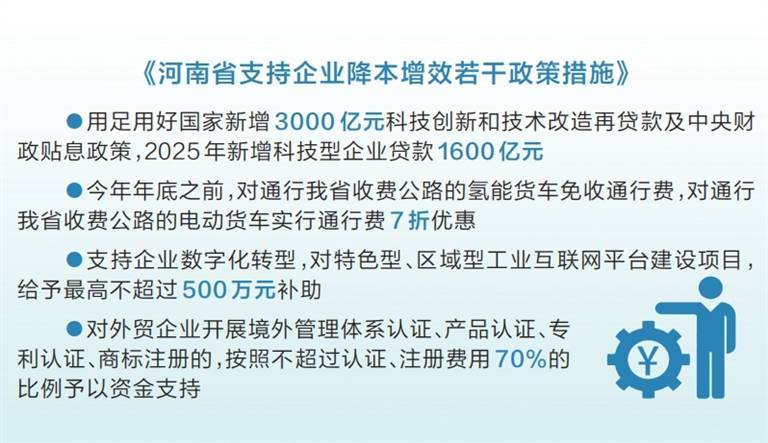
Core Viewpoint - The Henan provincial government has introduced a series of policies aimed at reducing costs and increasing efficiency for enterprises, focusing on various aspects such as research and development, funding, energy use, logistics, and human resources to enhance the competitiveness and profitability of businesses [2][3]. Group 1: Policy Measures - The new measures include 20 specific initiatives designed to support enterprises in reducing costs and improving efficiency, addressing key areas such as accounts receivable, credit services, resource supply, administrative enforcement, and information access [2]. - The policies are structured to provide comprehensive support through a combination of incentives, exemptions, loans, and investments, aiming to maximize the overall effectiveness of cost reduction for enterprises [2]. Group 2: Financial Support - The measures focus on optimizing credit services and expanding financing channels, including the utilization of an additional 300 billion yuan in loans for technological innovation and transformation, with a target of 160 billion yuan in new loans for technology-based enterprises by 2025 [3]. - Financial institutions will benefit from tax exemptions on interest income from small loans to micro-enterprises and individual businesses, as well as exemptions from stamp duty on loan contracts with these entities [3]. Group 3: Cost Reduction in Key Areas - The policies aim to lower costs in logistics, land use, and labor, with specific initiatives such as waiving tolls for hydrogen trucks and offering a 30% discount for electric trucks on tolls until the end of the year [4]. - The government encourages the use of "standard land" for new industrial land and will not impose additional land price charges for increasing the utilization rate of existing industrial land [4]. - Labor cost reductions will be supported through social insurance subsidies, job retention policies, and one-time expansion subsidies [4]. Group 4: Support for Small and Medium Enterprises - The measures include enhancing service capabilities for industrial parks and providing rental discounts for "industrial guarantee housing" aimed at small and micro enterprises, along with the construction of supportive facilities such as talent apartments and co-working spaces [4]. - Support for digital transformation is also emphasized, with subsidies of up to 5 million yuan for projects related to industrial internet platforms [5]. Group 5: International Trade Support - The policies provide financial support for foreign trade enterprises to obtain various certifications, covering up to 70% of the certification costs, and promote cross-border e-commerce facilitation measures [5].

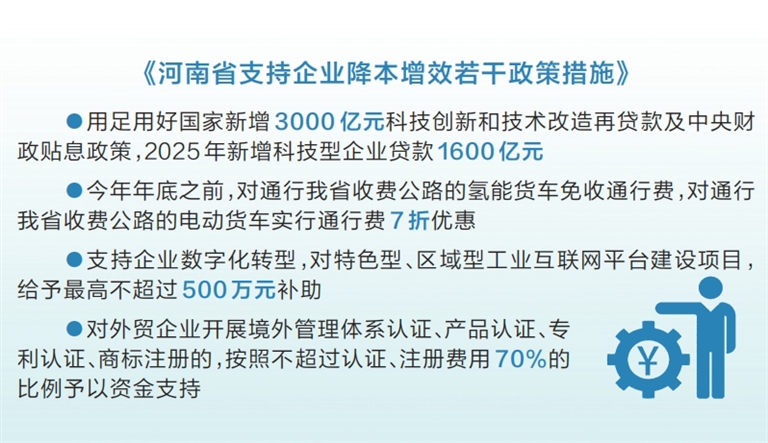
我省20项举措助力企业降本增效
Sou Hu Cai Jing· 2025-08-11 23:16
Group 1 - The core viewpoint of the article emphasizes the importance of cost reduction and efficiency improvement for enterprises, which directly impacts their profitability and market competitiveness, as well as the economic vitality and investment attractiveness of a region [2] - The Henan Provincial Government has issued a set of policies titled "Several Policy Measures to Support Enterprises in Reducing Costs and Increasing Efficiency," which includes 20 specific measures across ten areas such as research and development, funding, energy use, logistics, and human resources [2][3] - The measures aim to enhance the service and support for the real economy, focusing on key areas such as accounts receivable clearance, credit services, factor supply, administrative enforcement, and information access [2] Group 2 - The policies include optimizing credit services, broadening financing channels, and implementing tax and fee reductions, such as utilizing a new 300 billion yuan technology innovation and technical transformation relending policy [3] - Specific initiatives include supporting qualified enterprises in issuing technology innovation bonds, green bonds, and rural revitalization bonds, as well as providing tax exemptions for financial institutions lending to small and micro enterprises [3] - The article highlights the sensitivity of manufacturing enterprises to costs related to land, energy, and logistics, with measures such as road toll exemptions for hydrogen and electric trucks, and reforms in industrial land supply [4] Group 3 - The policies also address human resource costs by implementing social insurance subsidy policies and continuing to provide job retention subsidies [4] - The measures aim to enhance the comprehensive service capabilities of industrial parks, including the construction of rental-only "industrial guarantee housing" for small and micro enterprises [5] - Support for digital transformation and funding for certification processes for foreign trade enterprises are also included, with specific financial support measures outlined [5]
劲拓股份:8月8日召开董事会会议
Mei Ri Jing Ji Xin Wen· 2025-08-11 12:36
(记者 张喜威) 每经头条(nbdtoutiao)——人形机器人撕掉"花瓶"标签还要多久?亿元大单"破冰",商业化元年终于 来了! 2024年1至12月份,劲拓股份的营业收入构成为:工业占比100.0%。 截至发稿,劲拓股份市值为61亿元。 每经AI快讯,劲拓股份(SZ 300400,收盘价:24.94元)8月11日晚间发布公告称,公司第六届第四次 董事会会议于2025年8月8日在深圳市宝安区石岩街道水田社区祝龙田北路8号劲拓高新技术中心研发中 心15楼第一会议室召开。会议审议了《关于<2025年半年度报告>及摘要的议案》等文件。 ...

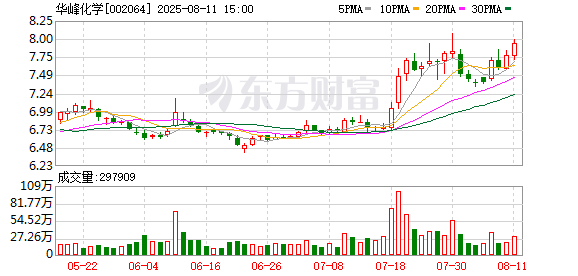
华峰化学:8月11日召开董事会会议
Mei Ri Jing Ji Xin Wen· 2025-08-11 11:30
华峰化学(SZ 002064,收盘价:7.94元)8月11日晚间发布公告称,公司第九届第十二次董事会会议于 2025年8月11日以现场结合通讯表决的方式召开。会议审议了《《2025年半年度募集资金存放与实际使 用情况的专项报告》等文件。 2024年1至12月份,华峰化学的营业收入构成为:工业占比99.73%,物流服务占比0.27%。 (文章来源:每日经济新闻) ...

中国工博会高效出行指南 Plan Your CIIF Visit
半导体芯闻· 2025-08-11 10:09
Core Insights - The China International Industry Fair (CIIF) is a significant platform for innovation and technology, gathering industry leaders to shape the future of manufacturing and technology [6][7]. Group 1: Event Overview - CIIF is the longest-running national-level industrial event in China, established in 1999, and has been held annually in Shanghai for over 20 sessions [6][7]. - The fair focuses on promoting emerging industries and the new economy, reinforcing its role in high-end sectors, and fostering an open and innovative industrial ecosystem [6][7]. Group 2: Event Details - The 25th CIIF will take place from September 23 to September 27, 2025, at the National Exhibition and Convention Center in Shanghai [34]. - The event will feature a Trade Visitor Day from September 23 to 26, followed by a Public Visitor Day on September 27 [7]. Group 3: International Participation - In 2025, China will expand its unilateral visa-free policy to include over 40 countries, facilitating international visitors to attend the CIIF [14]. - For citizens of countries without visa exemption, a visa is required to enter mainland China, and invitation letters can be requested for visa applications [10]. Group 4: Venue and Transportation - The venue for CIIF is the National Exhibition and Convention Center located at 333 Songze Avenue, Qingpu District, Shanghai [8][19]. - The venue is accessible via various transportation options, including metro lines and taxis, with a one-hour high-speed train covering a population of 76 million in the Yangtze River Delta [17][18].

苏州外贸创新高,淮安增速又领跑
Xin Hua Ri Bao· 2025-08-11 05:27
Economic Overview - The province achieved a GDP of 66,967.8 billion yuan in the first half of the year, reflecting a year-on-year growth of 5.7% at constant prices [1] - Five cities surpassed a GDP of 500 billion yuan, indicating stable economic development [1] - Seven cities exceeded the provincial growth rate of 5.7%, while three cities maintained this growth rate [1] City Performance - Suzhou led the province with a GDP of 13,002.35 billion yuan, the only city to exceed 10,000 billion yuan in the first half [1] - Nanjing's GDP reached 9,179.18 billion yuan, ranking second, while Wuxi's GDP was 7,735.15 billion yuan, placing third [1] - Nantong and Changzhou also surpassed 500 billion yuan in GDP, with figures of 6,581.19 billion yuan and 5,079.13 billion yuan, respectively [2] Growth Drivers - Suzhou's industrial development showed both quantity and quality improvements, with a focus on stabilizing internal and external demand [1] - The city implemented the "1030" industrial system and "1840" service system, alongside the "Suzhou Intelligent Manufacturing Ten Actions," leading to an 8.0% year-on-year growth in industrial added value [1] - Suzhou's foreign trade reached a record high of 12,958.8 billion yuan, growing by 5.7% [2] Emerging Cities - Xuzhou's GDP reached 4,509.30 billion yuan, positioning it as a potential "trillion city" [2] - The city aims to complete its "14th Five-Year Plan" goals and is on track to become the sixth "trillion city" in Jiangsu [2] Leading Growth Cities - Huai'an maintained the highest growth rate in the province at 6.8%, driven by rapid industrial production and strong performance in key industries [2][3] - The city's industrial added value, sales, and electricity consumption grew by 8.9%, 8.8%, and 7.5%, respectively [3] - Huai'an's fixed asset investment increased by 5.3%, with industrial investment growing by 17.2% [3]
翻倍股掀热浪!1个月新增超100只,六成市值不足百亿
Bei Ke Cai Jing· 2025-08-11 01:35
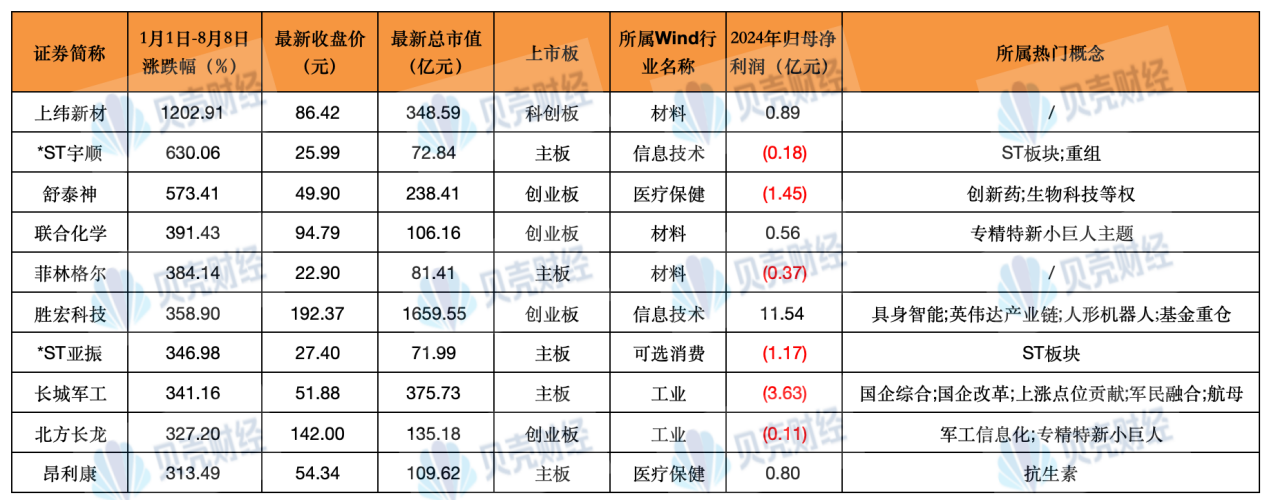
Core Viewpoint - The A-share market has shown a strong upward trend in the second half of the year, with the Shanghai Composite Index surpassing 3600 points and a significant increase in the number of doubling stocks, indicating a potential investment opportunity in the market [1][5]. Group 1: Market Performance - As of August 8, the Shanghai Composite Index closed at 3635.13 points, reaching a year-to-date high, with the ChiNext Index rising by 9.86% and the Shenzhen Component Index and Shanghai Composite Index increasing by 7.23% and 6.16%, respectively [5]. - The number of doubling stocks reached 253, an increase of 117 stocks compared to the end of June [2][6]. Group 2: Characteristics of Doubling Stocks - Doubling stocks are primarily small and mid-cap stocks, with a market capitalization concentrated below 10 billion yuan, and over 60% of these stocks have a market value between 1 billion and 10 billion yuan [3][11]. - Among the doubling stocks, 176 are profitable, but only six companies are projected to have a net profit exceeding 1 billion yuan in 2024 [9][10]. Group 3: Industry and Sector Analysis - The industrial sector leads with 73 doubling stocks, followed by information technology with 49 and healthcare with 45 [8]. - Notable concepts driving the performance of these stocks include DeepSeek, restructuring, and biomedicine [13]. Group 4: Fund Involvement and Performance - Many doubling stocks are heavily weighted in public funds, particularly in the healthcare and technology sectors, which have seen significant fund inflows [16]. - For instance, the number of funds holding shares in Shuotai Shen increased to 50 by the end of the second quarter, with a market value of 1.229 billion yuan [17].
224只港股获南向资金大比例持有
Sou Hu Cai Jing· 2025-08-11 01:16
Group 1 - The overall shareholding ratio of southbound funds in Hong Kong Stock Connect stocks is 18.42%, with 224 stocks having a shareholding ratio exceeding 20% [1] - As of August 8, southbound funds held a total of 4,616.99 million shares, accounting for 18.42% of the total share capital of the stocks, with a market value of 55,983.79 billion HKD, representing 13.97% of the total market value [1] - The highest shareholding ratio by southbound funds is in China Telecom, with 1,036.75 million shares held, representing 74.70% of the issued shares [2] Group 2 - Southbound funds with a shareholding ratio exceeding 20% are mainly concentrated in the healthcare, financial, and industrial sectors, with 45, 33, and 33 stocks respectively [2] - Among the stocks with a shareholding ratio over 20%, 124 are AH concept stocks, making up 55.36% of that group [1] - The stocks with high southbound fund holdings include China Telecom, Green Power Environmental, and China Shenhua, with shareholding ratios of 74.70%, 70.03%, and 68.18% respectively [2][3]


中国中小企业协会公布最新数据显示:中小企业运行发展预期平稳
Zhong Guo Zheng Quan Bao· 2025-08-11 01:02
Core Insights - The China SME Development Index for July remains stable at 89.0, indicating a steady performance amidst external uncertainties and slow domestic demand growth [1] - The index shows a positive trend in various sectors, with six industries experiencing growth while two saw slight declines [1] Industry Performance - The construction, transportation, real estate, social services, information transmission software, and accommodation and catering sectors all reported significant increases in their indices, rising by 0.6, 0.4, 0.3, 0.3, 0.3, and 0.3 points respectively [1] - The industrial and wholesale retail sectors experienced minor declines of 0.2 and 0.1 points respectively [1] Financial Conditions - The financial situation for SMEs has improved, with the funding index rising by 0.2 points in July [1] - There is an increase in working capital and a faster turnover of accounts receivable, with six out of eight surveyed industries reporting growth in working capital and quicker collection of receivables [1] Investment Sentiment - Investment willingness among SMEs has shown signs of recovery, with the investment index increasing by 0.1 points in July [1] - Six out of the eight surveyed industries reported an increase in their investment indices [1] Future Outlook - The China SME Association emphasizes the need for comprehensive economic reforms to stimulate domestic demand, foster new growth points in service consumption, and enhance private and SME investment vitality [2] - The focus will be on stabilizing employment, businesses, markets, and expectations to support the innovative development and quality improvement of private and small enterprises [2]