非银金融

Search documents
投顾晨报:震荡整固看风格,中盘蓝筹谋先机-20251118
Orient Securities· 2025-11-18 14:12
Market Strategy - The current market is expected to experience limited index growth, with a judgment of "fluctuating up and down, sideways consolidation, slightly strengthening" [7] - Mid-cap blue chips are anticipated to rise again after four years, presenting investment opportunities in manufacturing, consumption, and cyclical sectors [7] - Related ETFs include 中证 500ETF (159922) and 中证 1000ETF (512100) [7] Chemical Industry - Global chemical supply is expected to contract due to high costs and aging equipment, leading to a structural adjustment in the supply chain [7] - European chemical sales account for approximately 13% of the global market, but high energy costs and punitive carbon taxes are causing continued capacity exit [7] - Domestic production progress has slowed, and with the implementation of "anti-involution" policies, the chemical sector is likely to enter a new prosperity cycle [7] - Related stock: 万华化学 (600309, Buy) [7] - Related ETF: 化工 ETF (159870/516020) [7] Financial Technology - Hong Kong's "FinTech 2030" strategy marks a shift from application-focused development to a more systemic, forward-looking, and ecological approach [7] - This strategy emphasizes the collaborative development of data, AI, resilience, and tokenization, providing valuable insights for the high-quality development of mainland financial technology [7] - Related ETFs include 金融科技 ETF (159851/515720/159103) and 香港证券 ETF (513090) [7]

11月18日深证国企ESG(970055)指数跌0.8%,成份股中来股份(300393)领跌
Sou Hu Cai Jing· 2025-11-18 10:30
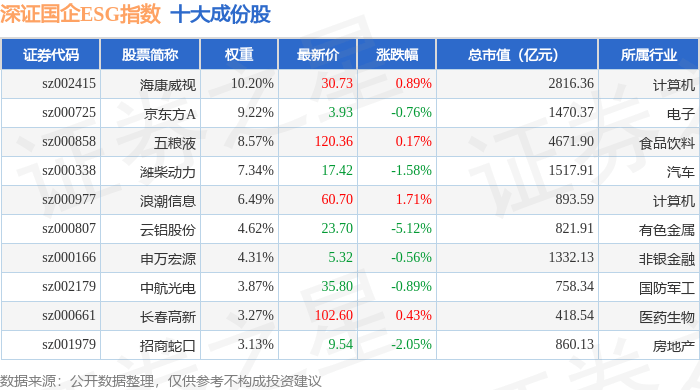
Core Points - The Shenzhen State-owned Enterprise ESG Index (970055) closed at 1382.09 points, down 0.8%, with a trading volume of 27.288 billion yuan and a turnover rate of 1.05% [1] - Among the index constituents, 15 stocks rose while 35 fell, with Inspur Information leading the gainers at 1.71% and Zhonglai Co., Ltd. leading the decliners at 7.27% [1] Index Constituents - The top ten constituents of the Shenzhen State-owned Enterprise ESG Index include Hikvision, BOE Technology Group, Wuliangye Yibin, Weichai Power, Inspur Information, Yun Aluminum, Shenwan Hongyuan, AVIC Optoelectronics, Changchun High-tech, and China Merchants Shekou [1] - The weights of the top constituents are as follows: Hikvision (10.20%), BOE Technology Group (9.22%), Wuliangye Yibin (8.57%), Weichai Power (7.34%), and Inspur Information (6.49%) [1] Capital Flow - The net outflow of main funds from the index constituents totaled 1.02 billion yuan, while retail investors saw a net inflow of 574 million yuan [1] - Detailed capital flow for specific stocks shows that Zhongtung High-tech had a net inflow of 168 million yuan from main funds, while Inspur Information experienced a net outflow of 74.51 million yuan from main funds [2]


“申”挖数据 | 估值水温表
申万宏源证券上海北京西路营业部· 2025-11-18 02:40
Core Viewpoint - The current valuation levels of the A-share market indicate potential investment opportunities and risks, particularly in the non-bank financial and food and beverage sectors, which are currently undervalued compared to their historical averages [1][6]. Valuation Levels - The current Buffett Indicator for A-shares stands at 89.92%, indicating a relatively high valuation compared to historical data [6][21]. - Major broad market indices have PE (TTM) valuations above 20%, with specific indices like the Shenzhen Component Index and CSI 300 at 80.70% and 86.50% historical percentiles, respectively, suggesting caution due to high valuations [7][19]. - Non-bank financial and food and beverage sectors have PE (TTM) valuations at 5.78% and 14.57% historical percentiles, respectively, making them areas of focus for potential investment [7][31]. Industry Valuation Levels - The steel, coal, electronics, computer, real estate, and retail sectors have PE (TTM) valuations at 81.52%, 81.60%, 86.09%, 95.02%, 98.64%, and 98.97% historical percentiles, indicating higher investment risks in these areas [7][31]. - The food and beverage sector shows a PE (TTM) valuation of 16.52, with a recent increase of 5.99%, suggesting a positive trend [31]. - The banking sector has a low PE (TTM) valuation of 4.31, indicating potential undervaluation compared to other sectors [31]. Market Overview - The total market capitalization for the Shanghai market is approximately 645.14 billion, with an average PE ratio of 16.36 [18]. - The Shenzhen market has a total market capitalization of around 426.13 billion, with an average PE ratio of 31.13, reflecting a significant difference in valuation between the two markets [19].

【早盘三分钟】11月18日ETF早知道
Xin Lang Ji Jin· 2025-11-18 00:56
Core Insights - The article discusses the current trends in the ETF market, highlighting the performance of various sectors and the impact of geopolitical tensions on the defense industry [1][7]. Market Temperature - The market temperature indicator shows that the Shanghai Composite Index, Shenzhen Component Index, and ChiNext Index have percentile valuations of 97.53%, 80.71%, and 39.08% respectively, indicating a mixed valuation landscape [1]. Sector Performance - The top-performing sectors on November 17, 2025, included: - Computer: +1.67% - Defense Industry: +1.59% - Banking: +1.10% - The sectors that experienced declines were: - Real Estate: -1.11% - Non-bank Financials: -1.31% - Pharmaceuticals: -1.73% [2]. Fund Flow Signals - The top three sectors with net inflows were: - Computer: 4.331 billion - Defense Industry: 2.657 billion - Banking: 0.838 billion - The sectors with the highest net outflows included: - Pharmaceuticals: -6.216 billion - Electronics: -5.311 billion - Power Equipment: -4.718 billion [2]. ETF Performance - The "创业板人工智能ETF华宝" showed a 6-month increase of 78.53% and a daily increase of 2.20% [5]. - The "国防军工ETF" has a strong outlook due to geopolitical tensions and is expected to benefit from increased military orders and technological advancements [7][10]. Geopolitical Impact on Defense Sector - The defense industry is experiencing a surge due to heightened geopolitical tensions, with the 中证军工指数 rising over 1% on November 17, 2025. Key stocks like 长城军工 and 航天发展 reached new highs [7]. - The upcoming "十五五" military orders are anticipated to boost the sector further, alongside military trade catalysts [7].

A股市场大势研判:指数低开低走
Dongguan Securities· 2025-11-17 23:30
Market Performance - The A-share market experienced a decline, with the Shanghai Composite Index closing at 3972.03, down by 0.46% [2] - The Shenzhen Component Index closed at 13202.00, down by 0.11%, while the CSI 300 Index fell by 0.65% to 4598.05 [2] - The ChiNext Index and the STAR 50 Index also saw declines of 0.20% and 0.53%, respectively [2] Sector Performance - The top-performing sectors included Computer (1.67%), Defense and Military Industry (1.59%), Coal (1.32%), Communication (1.10%), and Real Estate (1.00%) [3] - Conversely, the worst-performing sectors were Pharmaceutical Biology (-1.73%), Banking (-1.31%), Non-Bank Financials (-1.11%), Building Materials (-0.93%), and Home Appliances (-0.84%) [3] Concept Index Performance - The leading concept indices were related to Military Equipment Restructuring (4.72%), MLOps (3.42%), Web3.0 (3.10%), Digital Watermarking (2.71%), and Electronic ID (2.68%) [3] - The lagging concept indices included Cell Immunotherapy (-1.87%), Weight Loss Drugs (-1.87%), Innovative Drugs (-1.72%), Recombinant Proteins (-1.71%), and Fentanyl (-1.68%) [3] Future Outlook - The market is expected to experience short-term fluctuations due to profit-taking, but a gradual improvement in the economic fundamentals is anticipated in the fourth quarter, supported by policy measures [5] - The report suggests focusing on sectors such as Banking, Non-Bank Financials, Transportation, Public Utilities, Coal, and TMT for potential investment opportunities [5] Water Conservation Industry - The water conservation industry in China is showing robust growth, with an estimated market size exceeding 760 billion yuan, driven by key regions such as Beijing-Tianjin-Hebei, Yangtze River Delta, and Guangdong-Hong Kong-Macau Greater Bay Area [4][5] - The development of water-saving industrial parks and leading enterprises in agriculture, industry, and urban life is contributing to this growth [5]
浙商早知道-20251118
ZHESHANG SECURITIES· 2025-11-17 23:30
Market Overview - On November 17, the Shanghai Composite Index fell by 0.46%, the CSI 300 decreased by 0.65%, the STAR 50 dropped by 0.53%, while the CSI 1000 rose by 0.27%, and the ChiNext Index declined by 0.2%. The Hang Seng Index also decreased by 0.71% [4][5]. - The best-performing sectors on November 17 included Computer (+1.67%), Defense and Military Industry (+1.59%), Coal (+1.32%), Communication (+1.1%), and Real Estate (+1%). The worst-performing sectors were Pharmaceutical and Biological (-1.73%), Banking (-1.31%), Non-Bank Financials (-1.11%), Building Materials (-0.93%), and Home Appliances (-0.84%) [4][5]. Key Recommendations - The report recommends Yanzhou Coal Mining Company (600188) with a focus on its capacity expansion towards 300 million tons, indicating a potential turnaround in the industry cycle. The company is expected to benefit from both internal expansion and external acquisitions, with coal prices anticipated to rebound [6]. - The target price for Yanzhou Coal is set at 18.9 CNY, representing a 29% upside from the current price [6]. - Revenue projections for Yanzhou Coal from 2025 to 2027 are estimated at 130,266.60 million CNY, 170,012.53 million CNY, and 186,826.14 million CNY, with growth rates of -6.37%, 30.51%, and 9.89% respectively. Net profit is forecasted at 10,017.42 million CNY, 15,232.49 million CNY, and 18,048.79 million CNY, with growth rates of -30.56%, 52.06%, and 18.49% respectively [6]. Industry Insights - The report highlights that the TMT (Technology, Media, and Telecommunications) sector and the pharmaceutical industry have significantly contributed to the profitability of the STAR Market, with overall earnings improving compared to the mid-year reports [8]. - The rapid development of the AI industry, particularly in the upstream computing power segment, is driving growth in the technology sector, with notable increases in net profit for companies in computing, communication, and electronics [8][9]. - Approximately 80% of industries reported positive capacity expansion rates in the third quarter of 2025, indicating a favorable supply-demand outlook [9].

2026年港股和海外中资股投资策略:从彼岸,到此岸
Shenwan Hongyuan Securities· 2025-11-17 14:43
Group 1 - The report suggests that the Hong Kong stock market is at the beginning of a systematic valuation uplift, with the implied equity risk premium (ERP) reaching a low of approximately 5%, indicating potential for further downward adjustment in the long term [10][20][28] - The report highlights that the Hong Kong stock market's industry structure has significantly changed over the past decade, with new economy sectors like technology surpassing traditional sectors in market capitalization and trading volume, which should lead to an upward adjustment in valuation levels [28][31] - The report emphasizes the importance of AI in driving growth in the technology sector, with companies like Alibaba Cloud showing strong revenue growth and profitability improvements due to AI-related services [87][90] Group 2 - The report discusses the interwoven dynamics of fundamentals and liquidity in the Hong Kong stock market, noting that improvements in the Producer Price Index (PPI) are expected to enhance risk appetite and attract foreign investment [4][62] - The report indicates that the Hong Kong stock market is experiencing a significant inflow of foreign capital, particularly through the Stock Connect program, which is expected to reduce the offshore discount and align valuations more closely with global markets [31][35] - The report identifies the cyclical themes and dividend-paying stocks as attractive investment opportunities, particularly in sectors like non-bank financials and utilities, which are expected to benefit from improving economic indicators [91]
8.75亿元资金今日流出银行股
Zheng Quan Shi Bao Wang· 2025-11-17 14:30
Market Overview - The Shanghai Composite Index fell by 0.46% on November 17, with 17 industries experiencing gains, led by the computer and defense industries, which rose by 1.67% and 1.59% respectively [1] - The pharmaceutical and banking sectors had the largest declines, with drops of 1.73% and 1.31% respectively [1] Capital Flow - The net outflow of capital from the two markets was 31.953 billion yuan, with six industries seeing net inflows [1] - The computer industry had the highest net inflow of capital at 7.211 billion yuan, followed by the defense industry with 2.892 billion yuan [1] - A total of 25 industries experienced net capital outflows, with the pharmaceutical industry leading at 8.789 billion yuan, followed by the power equipment sector with 7.644 billion yuan [1] Banking Sector Performance - The banking sector declined by 1.31% with a net outflow of 875 million yuan, out of 42 listed banks, only 2 saw gains while 40 experienced losses [2] - Among the banks, Minsheng Bank had the highest net inflow of 141 million yuan, followed by China Merchants Bank and Qilu Bank with inflows of 99.896 million yuan and 73.512 million yuan respectively [2] - The banks with the largest net outflows included Agricultural Bank of China, Postal Savings Bank, and Shanghai Pudong Development Bank, with outflows of 428 million yuan, 279 million yuan, and 134 million yuan respectively [2] Individual Bank Performance - The table of bank performance shows various banks' daily changes, turnover rates, and main capital flows, highlighting significant outflows from major banks [3] - Agricultural Bank of China saw a decline of 2.12% with a net outflow of 427.5 million yuan, while Minsheng Bank was the only bank to gain, increasing by 0.99% with a net inflow of 1.414 billion yuan [3]





主力资金丨4股尾盘获大手笔加仓
Zheng Quan Shi Bao Wang· 2025-11-17 11:44
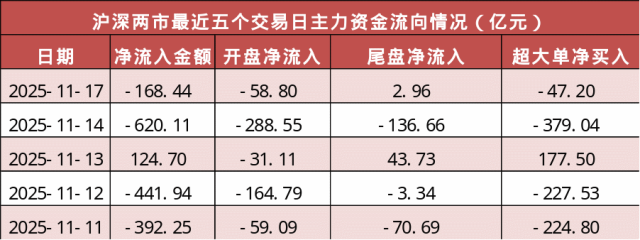
Group 1 - The core point of the article highlights that the main funds in the Shanghai and Shenzhen markets experienced a net outflow of 168.44 billion yuan on November 17, with the ChiNext board seeing a net outflow of 75.05 billion yuan and the CSI 300 index stocks a net outflow of 83.5 billion yuan [2] - Among the 17 industries tracked, 10 industries saw a net inflow of main funds, with the computer industry leading at 43.31 billion yuan, followed by the national defense and military industry at 26.57 billion yuan [2] - The pharmaceutical and biological industry faced the largest net outflow of 62.16 billion yuan, while the electronic industry had a net outflow of 53.12 billion yuan [2] Group 2 - In terms of individual stocks, 94 stocks had a net inflow of over 1 billion yuan, with 20 stocks exceeding 3 billion yuan in net inflow [3] - The stock of Zhongdian Xindong, involved in smart city projects, saw a net inflow of 8.63 billion yuan, marking a significant breakthrough in the urban rail transit sector [3] - Longcheng Military Industry also attracted a net inflow of 7.9 billion yuan, benefiting from a strong opening in the military equipment sector [3] Group 3 - Conversely, 100 stocks experienced a net outflow of over 1 billion yuan, with three leading stocks seeing significant outflows: Ningde Times at 17.62 billion yuan, and both Sunshine Power and Century Huatuo exceeding 10 billion yuan [5] - Century Huatuo's stock hit a limit down, closing with a drop of 9.16% [5] - In the tail end of trading, the total net inflow was 2.96 billion yuan, with Zhongdian Xinchuan leading at 2.6 billion yuan [6][7]




【17日资金路线图】两市主力资金净流出近170亿元 计算机等行业实现净流入
Zheng Quan Shi Bao· 2025-11-17 11:40
Market Overview - The A-share market experienced an overall decline on November 17, with the Shanghai Composite Index closing at 3972.03 points, down 0.46%, the Shenzhen Component Index at 13202 points, down 0.11%, and the ChiNext Index at 3105.2 points, down 0.2% [1] - The total trading volume for both markets was 19107.91 billion yuan, a decrease of 472.88 billion yuan compared to the previous trading day [1] Capital Flow - The net outflow of main funds from the Shanghai and Shenzhen markets reached approximately 170 billion yuan, with an opening net outflow of 58.8 billion yuan and a closing net inflow of 2.96 billion yuan, resulting in a total net outflow of 168.44 billion yuan for the day [2][3] - The CSI 300 index saw a net outflow of 83.5 billion yuan, while the ChiNext index experienced a net outflow of 75.05 billion yuan [4][5] Sector Performance - The computer industry achieved a net inflow of 80.23 billion yuan, with a growth of 1.92%, driven by stocks like Tuowei Information [6][7] - Other sectors with net inflows included media (31.27 billion yuan), communication (16.87 billion yuan), coal (10.69 billion yuan), and food and beverage (9.40 billion yuan) [7] - Conversely, the biopharmaceutical sector faced a significant net outflow of 156.04 billion yuan, declining by 1.57%, along with the electric equipment sector (90.44 billion yuan outflow) and banking (53.47 billion yuan outflow) [7] Institutional Activity - Notable institutional buying included Yahua Group with a net purchase of 41.69 million yuan and Binhai Energy with 19.24 million yuan [11] - Conversely, significant selling was observed in stocks like Shida Shenghua with a net outflow of 24694.51 million yuan and Zhongkuang Resources with 26231.12 million yuan [11] Analyst Recommendations - Recent analyst ratings include TuoBang Co. with a target price of 15.71 yuan, currently at 13.42 yuan, indicating a potential upside of 17.06% [12] - Other stocks with favorable ratings include Kede CNC with a target price of 86.95 yuan, currently at 60.79 yuan, suggesting a 43.03% upside [12]