
纺织业

Search documents
万事利:“万事利人工智能工厂项目”拟投资71261.51万元
Mei Ri Jing Ji Xin Wen· 2025-10-20 09:48
Core Points - The company plans to invest 712.6151 million yuan in the "Wanshili Artificial Intelligence Factory Project" [1] - The project aims to achieve a production capacity of approximately 10 million meters of digital printing, focusing on products such as silk scarves, self-owned brand clothing, home textiles, silk fabrics, and digital printing processing services [1] - Detailed information regarding the project will be disclosed in the company's fundraising prospectus on October 31, 2024 [1]

前三季度核心CPI持续回升,PPI降幅有所收窄
Guo Jia Tong Ji Ju· 2025-10-20 02:18
Group 1: Consumer Price Trends - Consumer prices remained stable in the first three quarters, with CPI decreasing by 0.1% year-on-year, consistent with the first half and the first quarter [2] - Core CPI, excluding food and energy, has shown a continuous recovery since March, rising to 1% in September, the highest in nearly 19 months [4] - Food prices saw a year-on-year decline of 1.8%, with fresh vegetable prices averaging a drop of 7.9% and pork prices shifting from an increase of 3.8% in the first half to a decrease of 2.9% in the first three quarters [2] Group 2: Energy Price Trends - Energy prices decreased by 3.3% year-on-year in the first three quarters, with gasoline prices dropping by 7.3% due to international oil price fluctuations [3] Group 3: Producer Price Trends - PPI decreased by 2.8% year-on-year in the first three quarters, with a narrowing decline of 0.3 percentage points in the third quarter compared to the second quarter [5] - The domestic market's competitive order has improved, leading to a recovery in prices for certain industries, such as coal processing and black metal smelting, which saw a reduction in year-on-year price declines [5] Group 4: External Influences on Prices - International oil prices have generally trended downward, impacting domestic oil-related industry prices, with a 9.9% decline in the oil and gas extraction industry [6] - Conversely, international non-ferrous metal prices have risen, leading to a 5.6% year-on-year increase in domestic non-ferrous metal smelting and rolling industries [6] Group 5: High-Tech Industry Developments - The development of high-tech industries and effective macro policies have driven price increases in certain sectors, such as integrated circuit packaging and testing, which rose by 3.0% year-on-year [7] - Upgraded consumer demand has also contributed to price increases in sectors like arts and crafts manufacturing, which saw a 12.7% rise [7]
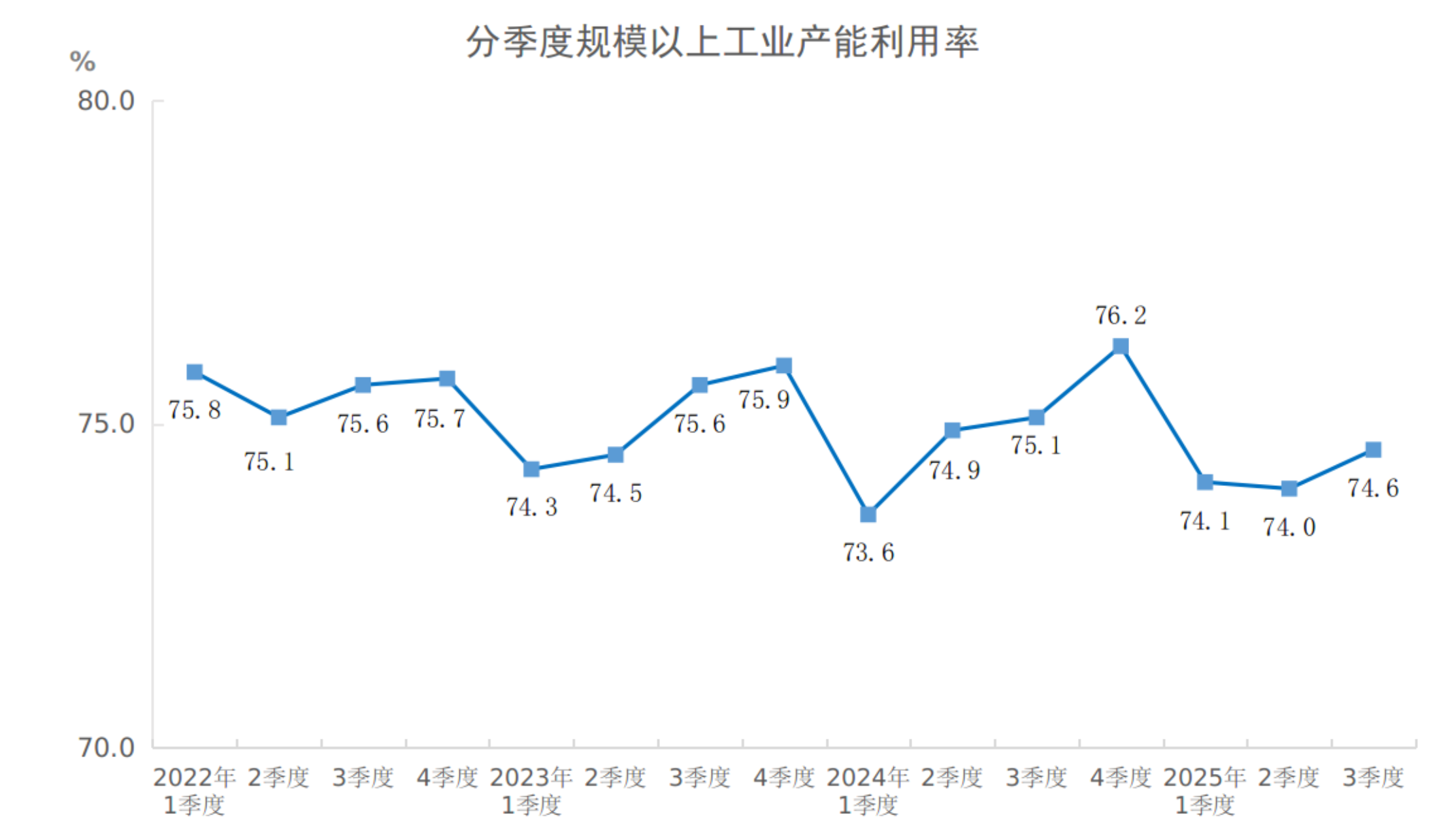
国家统计局:三季度,全国规模以上工业产能利用率为74.6%
Guo Jia Tong Ji Ju· 2025-10-20 02:12
Core Insights - The national industrial capacity utilization rate for large-scale industries in Q3 2025 is 74.6%, an increase of 0.6 percentage points from Q2, but a decrease of 0.5 percentage points compared to the same period last year [1] Group 1: Overall Capacity Utilization - The capacity utilization rate in the mining industry is 72.5% [1] - The manufacturing industry has a capacity utilization rate of 74.8% [1] - The electricity, heat, gas, and water production and supply industry shows a capacity utilization rate of 74.3% [1] Group 2: Industry-Specific Capacity Utilization - The coal mining and washing industry has a capacity utilization rate of 68.9% [1] - The food manufacturing industry reports a capacity utilization rate of 70.1% [1] - The textile industry has a capacity utilization rate of 77.2% [1] - The chemical raw materials and chemical products manufacturing industry shows a capacity utilization rate of 72.5% [1] - The non-metallic mineral products industry has a capacity utilization rate of 62.0% [1] - The black metal smelting and rolling processing industry reports a capacity utilization rate of 80.1% [1] - The non-ferrous metal smelting and rolling processing industry has a capacity utilization rate of 77.8% [1] - The general equipment manufacturing industry shows a capacity utilization rate of 78.9% [1] - The special equipment manufacturing industry reports a capacity utilization rate of 75.5% [1] - The automobile manufacturing industry has a capacity utilization rate of 73.3% [1] - The electrical machinery and equipment manufacturing industry shows a capacity utilization rate of 74.9% [1] - The computer, communication, and other electronic equipment manufacturing industry reports a capacity utilization rate of 79.0% [1]
2025年三季度全国规模以上工业产能利用率为74.6%
Guo Jia Tong Ji Ju· 2025-10-20 02:01
Core Insights - The industrial capacity utilization rate for Q3 2025 is reported at 74.6%, showing a decrease of 0.5 percentage points compared to the same period last year [4] - The mining industry has a capacity utilization rate of 72.5%, down by 2.1 percentage points year-on-year [4] - The manufacturing sector's capacity utilization stands at 74.8%, reflecting a decline of 0.4 percentage points from the previous year [4] - The electricity, heat, gas, and water production and supply industry maintains a capacity utilization rate of 74.3%, unchanged from the previous year [4] Industry Breakdown - In the mining sector, coal mining and washing have a capacity utilization rate of 68.9%, down 3.8 percentage points year-on-year [4] - The oil and gas extraction industry shows a high capacity utilization rate of 91.2%, an increase of 1.0 percentage points from the previous year [4] - The food manufacturing industry has a capacity utilization rate of 70.1%, decreasing by 0.6 percentage points [4] - The textile industry reports a capacity utilization of 77.2%, down by 0.7 percentage points [4] - The chemical raw materials and products manufacturing industry has a capacity utilization rate of 72.5%, down 3.5 percentage points [4] - The black metal smelting and rolling industry shows a strong capacity utilization rate of 80.1%, up by 2.7 percentage points [4] - The non-metallic mineral products industry has a low capacity utilization rate of 62.0%, slightly up by 0.3 percentage points [4] - The automotive manufacturing industry reports a capacity utilization of 73.3%, with a minor increase of 0.1 percentage points [4] - The computer, communication, and other electronic equipment manufacturing industry has a capacity utilization rate of 79.0%, up by 1.1 percentage points [4]

2025年4月中国纺织原料进出口数量分别为20万吨和19万吨
Chan Ye Xin Xi Wang· 2025-10-20 01:23
Core Insights - The report by Zhiyan Consulting outlines the development strategy and investment direction for the Chinese textile industry from 2025 to 2031 [1] Import and Export Data - In April 2025, China's textile raw material imports amounted to 200,000 tons, representing a year-on-year decrease of 60.1%, with an import value of $48.6 million, down 58.6% year-on-year [1] - In April 2025, China's textile raw material exports reached 190,000 tons, showing a year-on-year increase of 18.8%, with an export value of $30.3 million, up 4% year-on-year [1] Industry Analysis - Zhiyan Consulting is recognized as a leading industry consulting firm in China, specializing in in-depth industry research reports, business plans, feasibility studies, and customized services [1] - The firm emphasizes its professional approach, quality services, and keen market insights to provide comprehensive industry solutions that empower investment decisions [1]

焦点访谈丨“风雨兼程见彩虹” 中国经济巨轮破浪前行
Yang Shi Xin Wen Ke Hu Duan· 2025-10-19 04:28
Economic Overview - The "14th Five-Year Plan" has guided China's economic and social development, achieving high-quality growth despite challenges [1][12][16] - China's GDP is projected to reach approximately 140 trillion yuan this year, with an average annual growth rate of 5.5% over the past four years [5][9] - The plan's target was to maintain GDP growth within a reasonable range, allowing for flexibility in macroeconomic governance [7][11] Consumption and Domestic Demand - Consumption contributed approximately 60% to economic growth during the "14th Five-Year Plan" period [21] - The government has implemented policies such as the "old-for-new" program, with 69 billion yuan allocated to stimulate consumption [22] - Service consumption is expected to grow at an annual rate of 9.6% from 2020 to 2024, reflecting increased demand for services as GDP per capita exceeds $13,000 [24][25] Foreign Trade and Global Positioning - China's foreign trade has shown resilience, with merchandise trade surpassing $6 trillion, maintaining its position as the world's largest trader [25][31] - Exports are projected to increase from $2.6 trillion in 2020 to $3.6 trillion by 2024, demonstrating strong growth despite global trade tensions [31] Research and Development - National R&D investment is expected to exceed 3.6 trillion yuan in 2024, marking a 48% increase since 2020, with R&D intensity reaching 2.68% [35][36] - The focus on innovation has led to significant advancements, including the operation of China's first fourth-generation nuclear power plant and the completion of the Tiangong space station [38][40] Industrial Transformation - The "14th Five-Year Plan" emphasizes the transformation of traditional industries and the growth of emerging sectors, with a focus on high-quality development [40][44] - Companies are increasingly adopting technology and sustainable practices to enhance productivity and product quality [42][44] Future Outlook - As the "14th Five-Year Plan" concludes, the groundwork is laid for the "15th Five-Year Plan," aiming for significant breakthroughs by 2035 [46][48]

一次对中国企业的“望闻问切”
Sou Hu Cai Jing· 2025-10-19 02:12
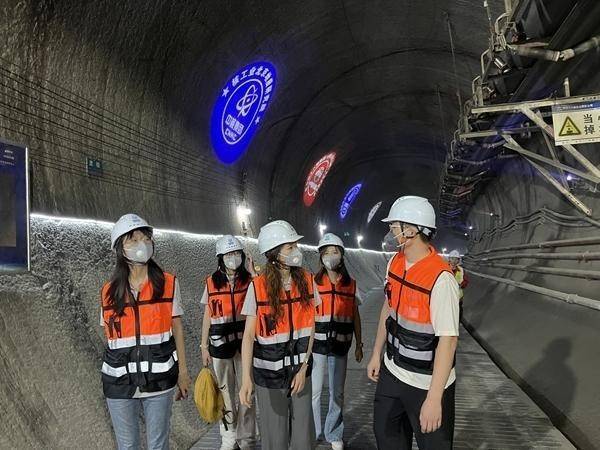
Core Insights - The article discusses the "Hundred Cities, Ten Thousand Enterprises" project initiated by Central University of Finance and Economics, focusing on the resilience and vitality of Chinese enterprises and the obstacles they face in their development [2][5]. Group 1: Research and Development - The project aims to engage students in practical research to understand the economic and social conditions of China, transforming academic knowledge into actionable insights for modernizing the economy [2][6]. - Research teams have been established across 84 rural revitalization service stations, emphasizing the importance of firsthand data collection and collaboration among students from various disciplines [2][5]. Group 2: Industry Insights - In Yuncheng County, known as the "Capital of Chinese Liquor Packaging," the local industry is transitioning from traditional liquor packaging to cosmetics and overseas markets due to declining domestic demand [4]. - The packaging industry in Yuncheng employs approximately 100,000 workers, highlighting the local economic impact and potential for replicating this model in other counties [4]. Group 3: Technological Integration - The project encourages students to explore the application of digital technologies, green technologies, and "AI+" in driving innovation within industries [5][6]. - In Hai'an City, research focused on how technology companies can address agricultural needs, revealing challenges such as high costs and the necessity for order-driven production [6]. Group 4: Environmental and Safety Concerns - The research also includes studies on major technological projects, such as the North Mountain Laboratory, which addresses the safe disposal of high-level radioactive waste, emphasizing the importance of public trust in such initiatives [7].
“十四五”·答卷|中国经济“成绩单”彰显高质量发展新成效
Yang Shi Wang· 2025-10-18 13:29
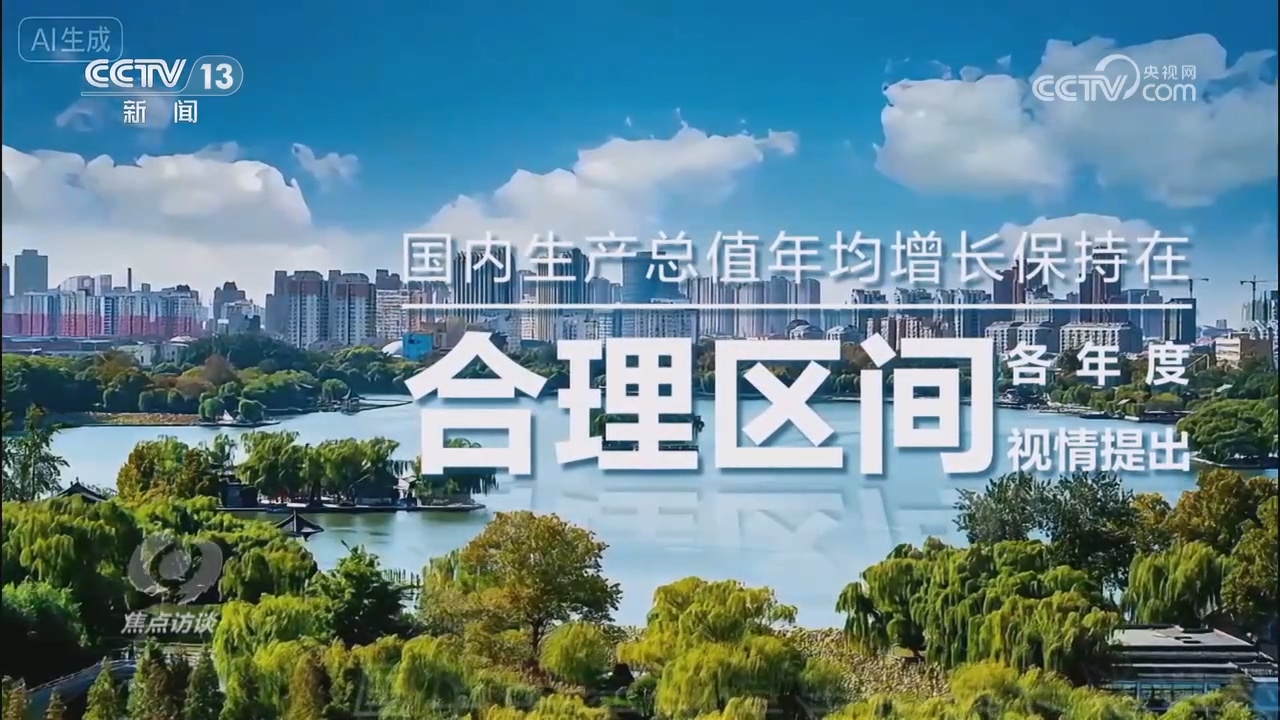
我国经济总量连续跨越110万亿元、120万亿元、130万亿元,今年预计可以达到140万亿元左右;过去4年,国民经济保持了年均5.5%的增长速度。"十四 五"增量有多可观——预计超过35万亿元,相当于再造一个长三角,也超过了世界排名第三国家的经济总量。 央视网消息(焦点访谈):用中长期规划指导经济社会发展是我们党治国理政的一种重要方式。今年是"十四五"规划收官之年。"十四五"期间,全党全国各 族人民完整准确全面贯彻新发展理念,加快构建新发展格局,高质量发展不断取得新成效、迈出新步伐、跃上新台阶。从今天开始,《焦点访谈》推出系列 节目《"十四五"·答卷》。这五年,中国经济爬坡过坎,风雨兼程见彩虹。先来通过一些数据,看看经济发展这张答卷的成绩单。 经济是国家发展的核心支柱,发展是解决我国一切问题的基础和关键,这五年,中国发展得怎么样?经济数据来说话。 "十四五"规划对于经济提出的目标是:国内生产总值年均增长保持在合理区间、各年度视情提出。 实际完成情况如何呢? 让14亿多人奔向好日子,中国经济向前走的每一步都不容易。回顾这五年,世界百年未有之大变局加速演进,全球进入新的动荡变革期,国内改革发展稳定 任务艰巨繁重,中 ...
百宏实业10月17日斥资31.76万港元回购7.2万股
Zhi Tong Cai Jing· 2025-10-17 09:53
Core Viewpoint - 百宏实业 announced a share buyback plan, indicating confidence in its stock value and potential for future growth [1] Summary by Categories Company Actions - The company plans to repurchase 72,000 shares at a total cost of HKD 317,600 [1] - The buyback price per share ranges from HKD 4.27 to HKD 4.52 [1] Financial Implications - The total expenditure for the buyback reflects the company's strategy to enhance shareholder value [1]
第十四届江苏(盛泽)纺织品博览会暨2025苏州湾时尚周开幕
Zhong Guo Jing Ji Wang· 2025-10-17 08:26
Core Insights - The 14th Jiangsu (Shengze) Textile Expo and 2025 Suzhou Bay Fashion Week opened on October 15, showcasing Shengze's reputation as a textile hub with over 2,500 textile enterprises, including two Fortune Global 500 companies, and an annual trading volume exceeding 200 billion yuan in the Oriental Silk Market [1][2] - The event highlighted Shengze's commitment to innovation and modernization in the textile industry, positioning it as a leader in China's textile modernization efforts, with a focus on sustainable and high-quality development [1][3] Group 1 - The opening ceremony featured the release of the Wujiang Textile Industry Transformation and Upgrade Strategy, the Shengze Textile Industry Transformation Platform, and the "Smart Green Together" initiative for low-carbon development [2] - The digital platform "Cloud Textile City" was launched, along with the signing of several projects aimed at enhancing green innovation and blockchain technology in the textile supply chain [2] - The event included the "Oriental Cup · 2025 China Women's Wear Design Competition," showcasing designs that utilized high-quality fabrics from Shengze, emphasizing the transformation from fabric to finished garments [2] Group 2 - The Shengze Textile Expo has evolved into a high-level platform for industry trends and global resource connections, featuring over 300 textile enterprises and more than 1,500 global buyers for a three-day supply-demand matching event [3] - The expo will host nine fashion shows, three top industry competitions, and two international conferences, reinforcing the theme "The World Fabric Looks at Shengze" and promoting high-end textile leadership [3] - Key figures from various textile and fashion associations, as well as government officials, attended the opening ceremony, highlighting the collaborative spirit of the industry [3]