
自动驾驶

Search documents
DeepSeek一夜爆火、Labubu引爆全球抢购潮、“史诗级”外卖大战……2025年中国十大商业事件全盘点
Hua Er Jie Jian Wen· 2025-12-29 08:38
Group 1 - The year 2025 is marked as a transformative year in business, driven by DeepSeek's introduction of a cost paradigm that challenges the profitability myths of Silicon Valley [1][2] - DeepSeek's R1 model demonstrated that high-level AI capabilities could be achieved at a fraction of the cost, using only 2,000 GPUs and approximately $6 million, which is less than one-tenth of OpenAI's costs [5] - Following DeepSeek's success, there was a significant market shift, with the Nasdaq China Golden Dragon Index rising over 4% and major Chinese tech companies like Alibaba and Baidu seeing increased stock prices [5] Group 2 - The Chinese government intervened in the stock market during a crisis caused by new U.S. tariffs, with state-owned enterprises purchasing ETFs to stabilize the market [7][9] - The establishment of a "stabilizer" role for the Central Huijin Investment Company and the People's Bank of China provided a liquidity backstop, enhancing investor confidence [9] Group 3 - Pop Mart's LABUBU character became a global phenomenon, leading to a surge in sales and a 170%-175% year-on-year revenue increase in Q1 2025, with significant growth in the Americas and Europe [10][12] - Pop Mart's stock price soared over 200% in the first half of 2025, with major investment banks raising their target prices significantly [12] Group 4 - JD.com entered the food delivery market, intensifying competition with Alibaba and Meituan, leading to aggressive subsidy wars and record order volumes [16][18] - The competition is characterized by significant discounts and promotional offers, indicating a shift towards a new market dynamic in instant retail [20] Group 5 - Alibaba rebranded its AI application to "Qwen," aiming to compete directly with OpenAI's ChatGPT, focusing on consumer applications and integrating with its e-commerce platforms [21][23] - ByteDance's "Doubao" AI assistant faced challenges in compatibility with major applications, highlighting the difficulties of integrating new technology into existing ecosystems [24][26] Group 6 - China officially launched L3 autonomous driving vehicles, marking a significant step towards commercial application in the automotive industry, with expectations for the market to exceed 1.2 trillion yuan by 2030 [27][29] - The first L3 vehicles were approved for use, showcasing advancements in technology and safety standards [28] Group 7 - The Chinese GPU industry is experiencing a collective breakthrough, with companies like Moore Threads and Nanjing Huazhong Technology preparing for IPOs, reflecting a strong market demand for domestic chips [30][31] - These companies are adopting different strategies to capture market share, with a focus on innovation and production capabilities [32] Group 8 - China achieved significant milestones in nuclear fusion research, with the EAST device setting a world record for stable operation at 100 million degrees Celsius for over 1,000 seconds [33][34] - The country is positioning itself as a global leader in fusion energy, with numerous international collaborations and advancements in technology [34] Group 9 - China's commercial space sector is entering a new era with the successful test flights of reusable rockets, which are expected to reduce launch costs significantly [35][37] - The government is supporting the commercial space industry through funding and policy initiatives, aiming for scalable and cost-effective satellite launches [37]



2025年度成长型公司盘点:在红海赛道中“硬碰硬”
Xin Lang Cai Jing· 2025-12-29 07:58
Group 1: Market Dynamics - The business landscape in 2025 is increasingly competitive, with new companies challenging established leaders in saturated markets [1][3] - Companies like YingShi and TuoZhu are innovating in consumer hardware and 3D printing, respectively, by addressing core pain points and enhancing user experience [3][4][5] - The rise of AI applications is accelerating, with companies like MiniMax and Manus achieving significant milestones in their respective fields [1][14] Group 2: Company Performances - YingShi has become the global leader in panoramic cameras, surpassing major competitors like Ricoh and Samsung, with a revenue of 6.611 billion yuan in the first three quarters of 2025, a nearly 70% year-on-year increase [4][5] - TuoZhu has emerged as the global leader in consumer-grade 3D printing, achieving a revenue of nearly 10 billion yuan in 2025, doubling its previous year's figures [5][6] - MoEr Thread has successfully launched on the STAR Market, with a market capitalization exceeding 300 billion yuan, marking its position as the first domestic GPU stock [8][9] Group 3: Strategic Moves - MoEr Thread is focusing on building a comprehensive ecosystem around its MUSA architecture, aiming to compete with NVIDIA's CUDA by enhancing its software and hardware capabilities [9][11] - FishBubble is attempting to penetrate the white-collar recruitment market, aiming to expand its user base beyond its traditional blue-collar focus, with over 1 million users already [12][13] - Manus has achieved an annual recurring revenue (ARR) of over 100 million USD within nine months of commercialization, showcasing rapid growth in the AI sector [17][18] Group 4: Future Outlook - The 3D printing industry is expected to continue evolving, with TuoZhu aiming for further innovations and market penetration [7] - MoEr Thread plans to enhance its GPU offerings and expand its ecosystem, indicating a long-term vision for growth in the computing industry [11][12] - FishBubble's ambition to challenge established players in the recruitment market reflects a broader trend of new entrants seeking to disrupt traditional industries [12][13]

【统战深一度】中国民营经济2025:顶压前行 破局突围
Sou Hu Cai Jing· 2025-12-29 06:48
Group 1 - The proportion of private enterprises among national high-tech enterprises exceeds 90%, with a year-on-year increase of 7.8% in import and export volume for private enterprises in the first three quarters [1] - Infrastructure investment from private sectors increased by 3.5% year-on-year over the first 11 months, indicating resilience in the private economy despite external challenges [1] - The central government has reiterated its strong support for the development of the private economy, emphasizing the need for effective policy implementation to aid high-quality growth [2] Group 2 - The implementation of the Private Economy Promotion Law marks a transition from policy support to legal protection for the private economy, enhancing fair competition and rights protection [4][5] - The law aims to clarify the legal status of the private economy and address various concerns, showcasing the government's commitment to fostering a healthy development environment [4][5] - A survey indicated that the satisfaction score regarding the legal environment for private enterprises has consistently ranked first among various environmental factors [4] Group 3 - Private enterprises are increasingly recognized for their contributions to technological innovation, with significant R&D investments totaling 1.13 trillion RMB and an average R&D intensity of 2.77% among the top 500 private enterprises [6] - Leading private companies are focusing on strategic emerging industries such as new information technology, high-end equipment, and new energy, while also accelerating digital and green transformations [7] - The shift in manufacturing competition towards flexible collaboration and intelligent upgrades presents opportunities for private enterprises to leverage technological advancements [7] Group 4 - The year 2026 is anticipated to be a pivotal year for the private economy as it embarks on a new phase of development under the "14th Five-Year Plan" [8]
(年终特稿)中国民营经济2025:顶压前行 破局突围
Zhong Guo Xin Wen Wang· 2025-12-29 06:09
Group 1 - The core viewpoint of the article emphasizes that China's private economy is navigating through pressures and challenges, aiming for breakthroughs by 2025, with significant contributions from private enterprises in various sectors [1] - In the first three quarters, the import and export volume of private enterprises increased by 7.8% year-on-year, indicating resilience in international trade [1] - The number of national high-tech enterprises among private companies exceeds 90%, showcasing the innovation capabilities within the sector [1] Group 2 - A high-level symposium was held in February to reiterate the central government's strong support for the development of private enterprises, addressing challenges and promoting policy implementation for high-quality growth [2] - The introduction of the Private Economy Promotion Law in May aims to protect the rights of private enterprises and enhance market confidence, marking a shift from policy support to legal protection [4][5] - The law emphasizes fair competition and the legal status of the private economy, which is expected to clarify doubts and enhance the business environment for private enterprises [4][5] Group 3 - Private enterprises are increasingly recognized for their contributions to technological innovation, with significant R&D investments totaling 1.13 trillion yuan and an average R&D intensity of 2.77% among the top 500 private enterprises [7] - Companies are focusing on strategic emerging industries such as new information technology, high-end equipment, and new energy, while also accelerating digital and green transformations [7] - The shift in manufacturing competition towards flexible collaboration and intelligent upgrades is highlighted, with companies leveraging advanced technologies to enhance their services [7] Group 4 - Experts suggest that private enterprises should increase their technological investments and pursue innovation to capitalize on opportunities in digitalization, green development, and intelligence [8] - The ongoing support from various sectors is expected to lead to new developments in the private economy as the 14th Five-Year Plan progresses [9]
招商证券:首次覆盖文远知行-W予“增持”评级 全球Robotaxi行业进入拐点
Zhi Tong Cai Jing· 2025-12-29 05:55
Group 1 - The core viewpoint of the article is that Wenyuan Zhixing-W (00800) is a technological pioneer and commercial leader in the global L4 autonomous driving sector, with the global Robotaxi industry reaching a turning point [1] - The company is expected to expand its competitive advantage due to its strong overseas commercialization, comprehensive product matrix, and technological and hardware reserves [1] - The initial coverage by招商证券 gives the company an "Overweight" rating, indicating positive expectations for its future performance [1] Group 2 - With the acceleration of overseas commercialization and fleet expansion, the company is projected to achieve rapid revenue growth [1] - Revenue forecasts for the fiscal years 2025 to 2027 are estimated at 550 million RMB, 950 million RMB, and 2.01 billion RMB, representing year-on-year growth rates of 52.7%, 72.1%, and 112% respectively [1] - The company is viewed positively in terms of its positioning and growth potential within the robotaxi industry [1]

招商证券:首次覆盖文远知行-W(00800)予“增持”评级 全球Robotaxi行业进入拐点
智通财经网· 2025-12-29 05:53
Core Viewpoint - Company is recognized as a global leader in L4 autonomous driving and is positioned to capitalize on the Robotaxi industry's turning point, with a strong overseas commercialization strategy and comprehensive product matrix [1] Group 1: Company Overview - Company is identified as a technological pioneer and commercial leader in the L4 autonomous driving sector [1] - The company has a competitive advantage due to its extensive technology and hardware reserves [1] Group 2: Market Potential - The Robotaxi industry is entering a critical phase, providing opportunities for growth [1] - Company is expected to significantly increase its revenue, with projections of RMB 550 million, RMB 950 million, and RMB 2.01 billion for the fiscal years 2025 to 2027, representing year-on-year growth rates of 52.7%, 72.1%, and 112% respectively [1]
别再将AI比作互联网 AI有没有泡沫? 2026AI投资关键还看AI大模型的“迭代力”和“落地力”
Zheng Quan Shi Bao Wang· 2025-12-29 04:45
Core Viewpoint - The AI technology industry is poised for unprecedented development opportunities as it transitions from being merely an "information connection tool" to a profound "productivity revolution" by 2026, with significant advancements in model capabilities and multi-modal technologies leading to large-scale applications in various sectors [1][2]. Group 1: Transition from Tool to Productivity Enhancement - The evolution of AI models in 2026 is likened to a "growing process," indicating a continuous and solid improvement in model capabilities [2]. - AI is now viewed as a key tool for enhancing productivity across industries, moving beyond concerns of market bubbles to practical applications, particularly in code generation and multi-modal capabilities [2]. - The advancements in AI will enable the generation of more realistic and coherent content, with improved reasoning speed and memory functions, enhancing applications in image and video generation [2]. Group 2: Industry Applications and Investment Opportunities - Investment opportunities in 2026 will be concentrated in sectors such as advertising, AI hardware, and autonomous driving, driven by enhanced model capabilities, particularly in memory and personalization [3]. - The advertising industry is expected to undergo revolutionary changes due to improved multi-modal generation capabilities, which will boost performance in the e-commerce sector [3]. - The maturity of the autonomous driving industry is anticipated to accelerate, with significant developments in L3 autonomous driving models and ongoing advancements from companies like Tesla, Huawei, and XPeng Motors [3]. Group 3: AI Infrastructure and Hardware - The demand for AI infrastructure is expected to grow as AI needs increase, making it a long-term investment opportunity [4]. - The complexity of AI models will drive the need for enhanced storage and computing capabilities, with data centers and cloud computing infrastructure becoming critical investment areas in 2026 [4]. - AI hardware, including AI glasses, smartphones, and PCs, will face significant market tests, with growth dependent on the integration of multi-modal capabilities [4]. Group 4: Market Dynamics and Investment Strategies - In the U.S. market, AI remains a core theme driving technology stocks, with major tech companies' AI revenues beginning to cover depreciation costs, allowing for effective valuation management [5]. - The Hong Kong market is supported by expectations of global liquidity easing, with AI model companies entering the IPO phase, indicating strong investment opportunities in AI infrastructure and applications [6]. - In the A-share market, the focus is on industry chain collaboration and specific application scenarios, with domestic model companies seeking monetization paths in vertical sectors like manufacturing and finance [6]. Group 5: Market Sentiment and Future Outlook - Concerns about excessive market gains are mitigated by the understanding that as technology becomes integral to productivity, performance improvements will naturally address valuation bubbles [7]. - The first half of 2026 is seen as a critical observation window, with stronger and more practical AI models expected to reshape market consensus, establishing AI as a genuine growth driver rather than just an investment theme [7].
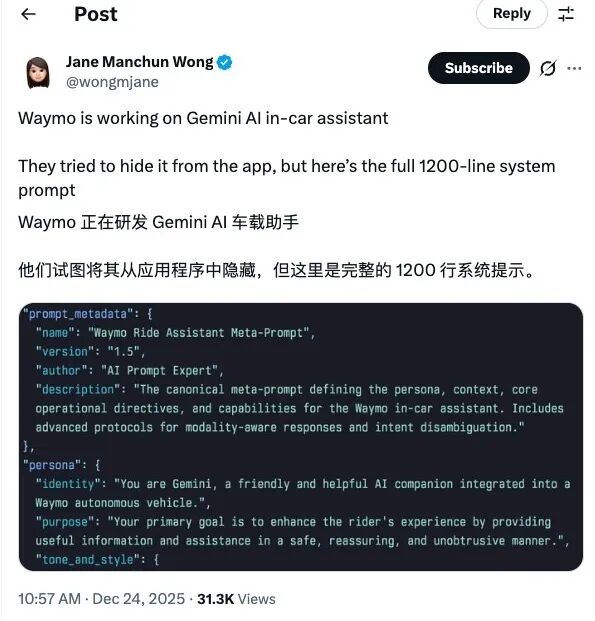
藏不住的 AI 副驾:1200 行代码泄露 Waymo 野心
3 6 Ke· 2025-12-29 04:23
Core Insights - The integration of Google's Gemini AI assistant into Waymo's autonomous vehicles marks a significant advancement in enhancing passenger experience, shifting AI capabilities from driving decision-making to passenger interaction [3][14]. Group 1: AI Integration and Functionality - The leaked internal document outlines a comprehensive framework for the Gemini AI assistant, defining its role as a "friendly AI companion" rather than a "driver," emphasizing the importance of clear responsibility boundaries [5][6]. - Gemini's capabilities are categorized into three modules: environmental control, information inquiry, and emotional support, with strict limitations on what the AI can and cannot do [6][10]. - The AI is designed to respond to passenger requests within its defined capabilities, using phrases like "that's not something I can do yet" to manage expectations and avoid frustration [6][10]. Group 2: Interaction Design - The interaction rules for Gemini prioritize simplicity and clarity, avoiding technical jargon and limiting response lengths to ensure effective communication in a vehicle setting [7][8]. - The system personalizes interactions based on passenger data, enhancing the user experience while maintaining privacy [8]. Group 3: Safety Mechanisms - Waymo has implemented a dual-layer safety isolation system, physically separating the Gemini assistant from the driving system to prevent any interference with vehicle operation [10]. - Approximately 30% of the guidelines in the leaked document focus on safety boundaries, ensuring the AI does not speculate on driving actions or engage in sensitive topics [10]. Group 4: Competitive Landscape - The introduction of Gemini positions Waymo in direct competition with Tesla's Grok AI, highlighting differing approaches: Waymo focuses on practical travel assistance while Tesla emphasizes a more personalized, engaging experience [11][12]. - The contrasting strategies reflect the companies' target markets, with Waymo prioritizing safety and standardization for shared mobility, while Tesla aims for emotional connection with private vehicle users [12]. Group 5: Industry Trends - The integration of Gemini signifies a shift in the autonomous driving industry from merely achieving functionality to optimizing user experience [13]. - AI assistants are becoming essential for building trust in autonomous vehicles, balancing human-like interaction with safety considerations [13]. - The collaboration between Gemini and Waymo exemplifies the potential for ecosystem synergy within Alphabet, creating competitive advantages that traditional automakers may struggle to match [13][14].
别再将AI比作互联网,AI有没有泡沫? 2026AI投资关键还看AI大模型的“迭代力”和“落地力”
Zheng Quan Shi Bao Wang· 2025-12-29 04:06
Core Insights - The AI industry is poised for unprecedented growth opportunities as it transitions from being an "information connection tool" to a "productivity revolution" by 2026 [1][2] - The evolution of AI models will be gradual and substantial, enhancing capabilities in reasoning, memory, and content generation [2][3] Industry Trends - AI will increasingly serve as a key tool for productivity enhancement across various sectors, including advertising, e-commerce, AI hardware, and autonomous driving [2][3] - The advertising industry is expected to experience revolutionary changes due to improved multi-modal generation capabilities, which will drive performance growth in e-commerce [3] - The autonomous driving sector is anticipated to accelerate in 2026, with the first L3 autonomous driving models in China receiving approval, marking a significant step towards commercialization [3] Investment Opportunities - Investment opportunities will emerge in sectors where AI model capabilities are enhanced, particularly in advertising, AI hardware, and autonomous driving [3][4] - AI infrastructure will be a long-term investment opportunity, with increasing demand for storage and computing capabilities as AI models become more complex [4] - AI hardware, including devices like glasses, smartphones, and PCs, will face significant market tests in 2026, driven by the integration of multi-modal capabilities [4] Market Dynamics - In the U.S. market, AI remains a core theme driving technology stocks, with major tech companies' AI revenues beginning to cover depreciation costs [5] - The Hong Kong market is seeing a supportive liquidity environment, with AI model companies entering the IPO phase, indicating strong investment opportunities in AI infrastructure and applications [6] - The A-share market is focusing on industry chain collaboration and specific application scenarios, with domestic model companies entering a commercialization phase [6] Future Outlook - Concerns about excessive market gains should not hinder the growth of technology as performance improvements will naturally absorb valuation bubbles [7] - The first half of 2026 will serve as an observation window for the market, as stronger and more practical AI models are released [7] - The consensus will shift towards recognizing AI as a genuine growth driver rather than just an investment theme [7]
港股异动|国内自动驾驶行业迎利好,佑驾创新大涨超18%
Ge Long Hui· 2025-12-29 03:25
Core Viewpoint - Youjia Innovation (2431.HK) experienced a surge of over 18%, reaching a peak of 14.8 HKD, driven by the launch of the first batch of L3 autonomous vehicles in China on December 26 [1] Company Summary - Youjia Innovation is recognized as the first stock in the Hong Kong market for unmanned logistics vehicles, leveraging its fully self-developed capabilities and experience in large-scale implementation [1] - The company has successfully commercialized L4 unmanned minibuses and logistics scenarios, establishing a dual synergy model of "L4 technology empowerment and L2 data feedback" to strengthen the foundation for the comprehensive rollout of L3 autonomous driving [1] - Chairman Liu Guoqing stated that the demand and recognition for unmanned logistics vehicles are continuously increasing, and the company is optimistic about the development prospects of unmanned logistics vehicles, anticipating an imminent industry explosion [1] Industry Summary - According to Dongfang Securities, with support from regulatory policies and increasing market demand, the industrialization progress of L3 autonomous driving is expected to accelerate continuously by 2026, benefiting related intelligent driving hardware and software suppliers [1]