公用事业

Search documents
兴蓉环境:控股子公司招标新增2712.49万元关联交易
Xin Lang Cai Jing· 2025-10-28 11:46
Core Viewpoint - The announcement from Xingrong Environment indicates that its subsidiary has won a bid for a water service project, which involves a significant related party transaction [1] Group 1: Project Details - The bidding for the water service project was awarded to Environmental Construction Company with a total bid price of 27.1249 million yuan, including tax [1] - The transaction is classified as a related party transaction since Environmental Construction Company is an affiliate of Xingrong Environment [1] Group 2: Financial Performance - Environmental Construction Company is projected to generate revenue of 2.505 billion yuan and a net profit of 24.6761 million yuan in 2024 [1] - For the period from January to September 2025, the company is expected to achieve revenue of 1.691 billion yuan and a net profit of 19.066 million yuan [1] - Since the beginning of 2025, the cumulative related party transactions between the company and its affiliates amount to approximately 810 million yuan [1]

10月28日上证央企(000042)指数跌0.18%,成份股中金黄金(600489)领跌
Sou Hu Cai Jing· 2025-10-28 10:01
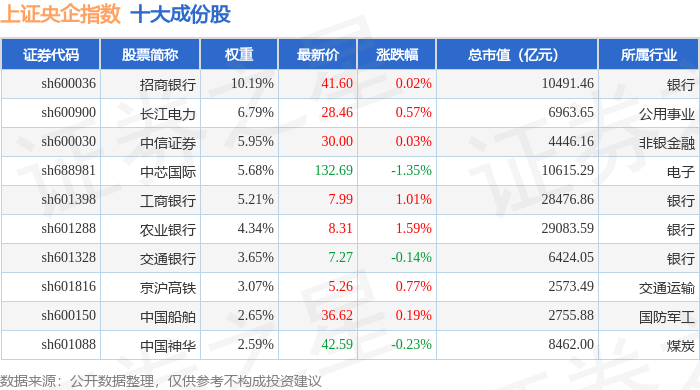
Market Overview - The Shanghai Central Enterprise Index (000042) closed at 1852.7 points, down 0.18%, with a trading volume of 79.123 billion yuan and a turnover rate of 0.33% [1] - Among the index constituents, 16 stocks rose while 33 fell, with AVIC Shenyang Aircraft (中航沈飞) leading the gainers at 1.92% and Zhongjin Gold (中金黄金) leading the decliners at 3.49% [1] Key Constituents - The top ten constituents of the Shanghai Central Enterprise Index are as follows: - China Merchants Bank (招商银行): 10.19% weight, latest price 41.60 yuan, market cap 1,049.146 billion yuan [1] - Yangtze Power (长江电力): 6.79% weight, latest price 28.46 yuan, market cap 696.365 billion yuan [1] - CITIC Securities (中信证券): 5.95% weight, latest price 30.00 yuan, market cap 444.616 billion yuan [1] - SMIC (中芯国际): 5.68% weight, latest price 132.69 yuan, market cap 1,061.529 billion yuan [1] - Industrial and Commercial Bank of China (工商银行): 5.21% weight, latest price 7.99 yuan, market cap 28,476.86 billion yuan [1] - Agricultural Bank of China (农业银行): 4.34% weight, latest price 8.31 yuan, market cap 29,083.59 billion yuan [1] - Bank of Communications (交通银行): 3.65% weight, latest price 7.27 yuan, market cap 6,424.05 billion yuan [1] - Beijing-Shanghai High-Speed Railway (京沪高铁): 3.07% weight, latest price 5.26 yuan, market cap 257.349 billion yuan [1] - China Shipbuilding Industry (中国船舶): 2.65% weight, latest price 36.62 yuan, market cap 275.588 billion yuan [1] - China Shenhua Energy (中国神华): 2.59% weight, latest price 42.59 yuan, market cap 846.200 billion yuan [1] Capital Flow - The net outflow of main funds from the index constituents totaled 3.92 billion yuan, while retail investors saw a net inflow of 2.021 billion yuan [1] - The detailed capital flow for key stocks includes: - AVIC Shenyang Aircraft: Main funds net inflow of 284 million yuan [2] - Yangtze Power: Main funds net inflow of 231 million yuan [2] - Agricultural Bank of China: Main funds net inflow of 127 million yuan [2] - Industrial and Commercial Bank of China: Main funds net inflow of 86 million yuan [2] - China Petroleum (中国石油): Main funds net inflow of 6.5195 million yuan [2] ETF Information - The Gold Stock ETF (product code: 159562) tracks the CSI Hong Kong-Shanghai Gold Industry Index, with a recent five-day change of -0.55% and a P/E ratio of 24.55 times [4] - The latest share count is 1.26 billion, a decrease of 32 million shares, with a net inflow of main funds amounting to 7.874 million yuan [4]






2025年金融街论坛年会(证监会)点评:对内稳定,对外开放,以多层次市场改革助力金融强国
Datong Securities· 2025-10-28 08:33
Group 1: Market Stability and Reform - The capital market is crucial for national development and economic flow, serving the mission of building a "financial power" [1] - The "14th Five-Year Plan" emphasizes the need for capital markets to fulfill their role in financing the real economy, making high-quality development timely [1] - Internal stability must be reinforced through mergers and acquisitions to enhance the quality of listed companies [1] Group 2: Investment Opportunities - Focus on sectors benefiting from the reform of the Science and Technology Innovation Board, particularly in chips, artificial intelligence, and communications [1] - Opportunities for mergers and acquisitions are highlighted against the backdrop of high-quality development of listed companies [1] - Long-term capital is expected to favor high-dividend stocks such as banks, coal, and public utilities [1] Group 3: International Investment Trends - Over $150 billion of international funds flowed into emerging markets in the first nine months of the year, indicating a growing interest in Chinese assets [2] - The quality of Chinese assets is being re-evaluated, with northbound capital inflows reflecting global investor confidence [2] - The optimization of the Qualified Foreign Institutional Investor (QFII) system aims to lower barriers for foreign investment [11] Group 4: Regulatory and Risk Management - The meeting emphasized the importance of risk prevention and regulatory enforcement to maintain a healthy capital market environment [11] - Continuous efforts to protect the rights of small and medium investors are crucial for sustainable market development [11]
Iberdrola's 9-month reported net profit falls 3%
Reuters· 2025-10-28 07:53
Core Insights - Spanish utility Iberdrola reported a 3% decline in net profit for the first nine months of the year, amounting to 5.31 billion euros ($6.19 billion), down from 5.47 billion euros in the same period last year [1] Financial Performance - The reported net profit for Iberdrola decreased by 3% year-on-year [1] - The profit for the first nine months of the year is 5.31 billion euros ($6.19 billion) compared to 5.47 billion euros in the same period last year [1]

热点思考 | 投资“失速”的真相?(申万宏观·赵伟团队)
申万宏源研究· 2025-10-28 01:36
Group 1 - The core viewpoint of the article highlights a significant decline in fixed asset investment growth across various sectors, reaching historical lows in the second half of 2025, with a notable drop of 9.1 percentage points to -6.5% by September, marking the lowest point in five years [1][10][19] - Investment in broad infrastructure, services, real estate, and manufacturing has all seen substantial declines, with respective drops of 13.1, 11.1, 9.3, and 9.1 percentage points, leading to negative growth rates of -3.3%, -6.6%, -21.2%, and -1.5% [1][10][19] - The decline in investment is attributed to several factors, including accelerated debt resolution efforts that have occupied investment funds, with over half of the investment decline explained by this issue [2][29] Group 2 - The construction and installation investment has decreased significantly, contributing to the overall decline in fixed asset investment, with a drop of 16.4 percentage points to -15.7% by September [2][19] - The eastern region has experienced a more pronounced decline in construction and installation investment compared to central and western regions, with cumulative declines of 3.9, 3, and 2.3 percentage points respectively [2][19] - The article identifies that the push for debt resolution has led to a requirement for enterprises to expedite the repayment of debts, further impacting investment negatively [3][40] Group 3 - The lack of new projects is also affecting current investment levels, with renovation projects maintaining high growth while new construction investments have significantly declined [4][44] - The article notes that the yield rates for investments in transportation, public utilities, and environmental management have fallen into negative territory, indicating poor returns on investment in these sectors [4][44] - Recent fiscal measures have been implemented to alleviate the pressure on investment caused by debt resolution, including the allocation of 500 billion yuan for local projects aimed at addressing debt issues [6][66] Group 4 - The article discusses the potential for policy optimization to improve corporate financial health, as high accounts receivable ratios have been noted, particularly among private enterprises [5][53] - The reduction in accounts receivable growth rates for both joint-stock and private enterprises suggests a potential recovery in cash flow, which could support investment revitalization [5][59] - Historical precedents indicate that effective debt repayment policies can lead to significant improvements in corporate investment activity, as seen in past government initiatives [5][60]
开盘下挫!
中国基金报· 2025-10-28 01:23
Group 1 - The Nikkei 225 index opened at 50,357.15 points, with a decline of 0.31% [3] - Notable stock performances include DENA with a rise of 9.19%, Furukawa Electric at 4.06%, and SoftBank Group increasing by 2.96% [4] - President Trump arrived in Tokyo for a three-day official visit, with discussions expected to focus on defense spending and a joint document on rare earth mineral supply [5] Group 2 - The South Korean Composite Stock Price Index opened lower, initially dropping over 1% before recovering [8] - South Korea's economy accelerated in Q3, with a quarter-on-quarter GDP growth of 1.2%, surpassing market expectations of 1% [10] - The Bank of Korea maintains a positive outlook for future growth, projecting 2.0% growth for 2024 [11]

SHAREHOLDER ALERT: The M&A Class Action Firm Announces An Investigation of Sotherly Hotels Inc. (NASDAQ: SOHO)
Prnewswire· 2025-10-27 21:30
Core Viewpoint - Class Action Attorney Juan Monteverde and his firm, Monteverde & Associates PC, are investigating Sotherly Hotels Inc. regarding its proposed sale to KW Kingfisher LLC, where shareholders would receive $2.25 per share in cash, raising questions about the fairness of the deal [1]. Group 1: Company Overview - Monteverde & Associates PC is recognized as a Top 50 Firm in the 2024 ISS Securities Class Action Services Report and has a successful track record in recovering millions for shareholders [1]. - The firm is headquartered in the Empire State Building, New York City, and specializes in class action securities litigation [2]. Group 2: Investigation Details - The investigation focuses on the sale of Sotherly Hotels Inc. (NASDAQ: SOHO) to KW Kingfisher LLC, specifically evaluating whether the cash offer of $2.25 per share is fair for shareholders [1]. - The firm encourages shareholders with concerns to reach out for additional information at no cost [2].


2025年9月工业企业利润点评:工业企业利润恢复加快,装备制造业支撑有力
KAIYUAN SECURITIES· 2025-10-27 14:42
Report Summary 1. Report Industry Investment Rating No industry investment rating is provided in the report. 2. Core Viewpoints - Industrial enterprise profits are recovering at an accelerated pace, with the cumulative year - on - year growth of profits of industrial enterprises above designated size significantly increasing. The profit growth rate in September continued to be high, indicating an accelerated recovery of corporate profitability [4]. - Structurally, the year - on - year total profits of the three major sectors have all increased compared to the previous period, and the equipment manufacturing industry has provided strong support. Profits of enterprises of different types and scales have improved [5][6]. - In the bond market, it showed an independent trend on the day of the report. The central bank will resume open - market treasury bond trading. In the context of economic expectation correction, bond yields are expected to rise trend - wise [7][8]. 3. Section Summaries Industrial Enterprise Profit Situation - **Overall Profit Growth**: From January to September, the profits of industrial enterprises above designated size increased by 3.2% year - on - year, 2.3 percentage points higher than that from January to August, reaching the highest cumulative growth rate since August 2024. In September, the profits increased by 21.6% year - on - year, 1.2 percentage points higher than in August [4]. - **Factor Analysis**: From January to September, the added value of industrial enterprises above designated size increased by 6.2% year - on - year, remaining the same as from January to August; the PPI of all industrial products decreased by 2.8% year - on - year, with the decline narrowing by 0.1 percentage points; the operating income profit margin decreased by 0.19 percentage points year - on - year, with the decline recovering by 1.68 percentage points. Stable volume, slightly rising prices, and recovering profit margins led to a significant increase in the cumulative profits of industrial enterprises above designated size [5]. Structural Analysis - **By Sector**: From January to September, the total profits of the mining industry decreased by 29.3% year - on - year (previously - 30.6%), the manufacturing industry increased by 9.9% (previously + 7.4%), and the public utilities increased by 10.3% (previously + 9.4%). The profit decline of the mining industry narrowed by 1.3 percentage points, the manufacturing industry increased by 2.5 percentage points, and the public utilities increased by 0.9 percentage points. The profits of the equipment manufacturing industry above designated size increased by 9.4%, 6.2 percentage points higher than the average level of all industrial enterprises above designated size, driving the profit growth of all industrial enterprises above designated size by 3.4 percentage points [5]. - **By Enterprise Nature**: From January to September, the profits of state - owned enterprises decreased by 0.3% year - on - year (previously - 1.7%), joint - stock enterprises increased by 2.8% (previously + 1.1%), foreign - invested and Hong Kong, Macao, and Taiwan - invested enterprises increased by 4.9% (previously + 0.9%), and private enterprises increased by 5.1% (previously + 3.3%). The profit growth of private enterprises was 1.9 percentage points higher than the average level of all industrial enterprises above designated size, and 1.8 percentage points faster than from January to August. The profits of large, medium, and small enterprises all improved [6]. - **By Industrial Chain Position**: From January to September, the cumulative profit of upstream raw material mining accounted for 11.9% of the profits of industrial enterprises above designated size (previously 12.1%), the middle - stream material manufacturing accounted for 15.8% (previously 15.6%), the downstream equipment manufacturing accounted for 38.1% (previously 37.5%), the downstream consumer goods manufacturing accounted for 21.1% (previously 21.3%), other manufacturing accounted for 0.6% (unchanged), and public utilities accounted for 12.5% (previously 12.9%) [6]. Inventory and Asset - Liability Ratio - At the end of September, the nominal and real inventory year - on - year were 2.6% (previously + 2.1%) and 4.9% (previously + 5.0%) respectively, with changes of + 0.5 percentage points and - 0.1 percentage points compared to the previous period. The real inventory decreased year - on - year. The overall asset - liability ratio of industrial enterprises at the end of September was 58.0%, the same as the previous period [7]. Bond Market Situation - **Market Performance**: In the morning session, bond yields rose, possibly pricing in the positive outcome of China - US negotiations. Although the equity market performed well during the day, it did not suppress the bond market. The bond market showed an independent trend, and the yields of interest - rate bonds generally declined. After the central bank's statement on resuming open - market treasury bond trading, long - term yields dropped rapidly. The yield of the 10 - year treasury bond active bond dropped by about 3bp, and the yields of the 10 - year CDB active bond and the 30 - year treasury bond active bond dropped by about 4bp [7]. - **Market Outlook**: In the context of economic expectation correction, bond yields are expected to rise trend - wise. The report maintains its view on stock - bond allocation [8].
【27日资金路线图】电子板块净流入逾34亿元居首 龙虎榜机构抢筹多股
Zheng Quan Shi Bao· 2025-10-27 13:54
Market Overview - The A-share market experienced an overall increase on October 27, with the Shanghai Composite Index closing at 3996.94 points, up 1.18%, the Shenzhen Component Index at 13489.4 points, up 1.51%, and the ChiNext Index at 3234.45 points, up 1.98%. The North Star 50 Index decreased by 0.2%. Total trading volume reached 23,567.99 billion yuan, an increase of 3,649.94 billion yuan compared to the previous trading day [1]. Capital Flow - The A-share market saw a net outflow of 75.9 billion yuan in main funds, with an opening net outflow of 19.28 billion yuan and a closing net inflow of 1.68 billion yuan [2]. - The CSI 300 index recorded a net outflow of 37.83 billion yuan, while the ChiNext saw a net outflow of 49.68 billion yuan, and the Sci-Tech Innovation Board had a net inflow of 11.01 billion yuan [4]. Sector Performance - Among the 14 sectors, the electronics industry led with a net inflow of 34.32 billion yuan, followed by public utilities with 28.22 billion yuan and non-ferrous metals with 21.67 billion yuan. The power equipment sector experienced the largest net outflow at -50.06 billion yuan [6][7]. Individual Stock Highlights - Shenghong Technology topped the list with a net inflow of 9.47 billion yuan [8]. - Institutions showed significant interest in several stocks, with notable net purchases in Jingzhida and others, while stocks like Demingli saw net selling [10]. Institutional Focus - Recent institutional ratings highlighted several stocks with potential upside, including Tian Nai Technology with a target price of 78.00 yuan, representing a 39.73% upside from the latest closing price [12].
暴增11890%!多只A股,业绩利好!
Zheng Quan Shi Bao· 2025-10-27 11:47
Core Insights - Multiple A-share companies reported significant profit growth in their Q3 earnings, indicating a positive trend in the market. Group 1: Company Performance - Jiangshan Co., Ltd. reported a Q3 revenue of 1.157 billion yuan, a year-on-year increase of 2.75%, with a net profit of 86.73 million yuan, up 11,890.01% [1][2] - Yongmaotai's Q3 revenue reached 1.655 billion yuan, a 59.65% increase year-on-year, with a net profit of 30.41 million yuan, up 6,319.92% [1][2] - Nanjing Public Utilities achieved Q3 revenue of 3.102 billion yuan, a 165.53% increase year-on-year, with a net profit of 84.62 million yuan, up 2,492.12% [3][4] - Daheng Technology reported Q3 revenue of 453 million yuan, a 26.86% increase year-on-year, with a net profit of 71.48 million yuan, up 1,960.72% [1][5] - Gaode Infrared's Q3 revenue was 1.134 billion yuan, a 71.07% increase year-on-year, with a net profit of 401 million yuan, up 1,143.72% [1][6] Group 2: Factors Driving Growth - Jiangshan's profit surge was attributed to increased sales volume, reduced costs, and investment gains from stock sales [1] - Yongmaotai's profit growth was driven by substantial revenue increase and improved operational efficiency in its automotive parts business [1][2] - Nanjing Public Utilities' significant profit increase was due to the delivery of larger real estate projects compared to the previous year [3][4] - Daheng Technology's growth was linked to improved performance in machine vision and digital broadcasting systems, along with gains from financial assets [1][5] - Gaode Infrared's revenue boost was due to the resumption of delayed project deliveries and expansion into consumer markets [1][6]