
工业机器人

Search documents
权威解读|从上半年成绩单看中国经济增长点
Xin Hua She· 2025-07-19 02:12
Economic Growth - In the first half of the year, China's GDP reached 66,053.6 billion yuan, with a year-on-year growth of 5.3% at constant prices, indicating a stable economic performance despite pressures [1] - The contribution rates to GDP growth were 52% from final consumption expenditure, 16.8% from capital formation, and 31.2% from net exports of goods and services, highlighting consumption as the main driver of growth [1] Manufacturing and Investment - The equipment manufacturing sector showed significant growth, with an increase in value added and investment, reflecting strong resilience and potential for future development [3] - Industrial production grew rapidly, with value added in equipment manufacturing increasing by 10.2% and high-tech manufacturing by 9.5% in the first half of the year [8] Consumer Market - The retail sales of consumer goods totaled 24.55 trillion yuan, marking a 5% year-on-year increase, driven by effective consumption support policies and an upgrade in consumption structure [5] - The "old-for-new" policy has stimulated accelerated growth in commodity consumption [5] Trade Performance - The total import and export value reached 21,787.6 billion yuan, with a year-on-year growth of 2.9%, and exports of electromechanical products increased by 9.5%, accounting for 60% of total exports [10] - The complete and resilient industrial chain has contributed positively to trade performance, supported by fiscal subsidies for durable consumer goods [10] Policy Impact - The implementation of proactive macroeconomic policies has played a crucial role in stabilizing the economy, with further policy measures expected to be introduced in the second half of the year [10]

东海证券晨会纪要-20250718
Donghai Securities· 2025-07-18 05:08
Group 1: Retail Sales Insights - In June 2025, the total retail sales of consumer goods reached 42,287 billion yuan, with a year-on-year growth of 4.8%, which was below the consensus expectation of 5.56% [5][6] - For the first half of 2025, the total retail sales amounted to 245,458 billion yuan, reflecting a year-on-year growth of 5.0%, with Q2 showing a 5.4% increase compared to Q1 [5][6] - Urban retail sales in June were 36,559 billion yuan, growing by 4.8% year-on-year, while rural retail sales were 5,728 billion yuan, with a growth rate of 4.5% [5][6] Group 2: Consumer Behavior and Trends - Online retail sales showed rapid growth, with a year-on-year increase of 8.5% for the first half of 2025, while physical retail improved steadily with a 3.59% year-on-year growth in June [5][6] - The food and beverage sector experienced a significant decline, with restaurant service revenue in June rising only 0.9% year-on-year, a drop of 5.0 percentage points from the previous month [6][8] - Essential goods continued to perform well, with year-on-year growth rates for essential and discretionary items at 5.92% and 2.15%, respectively [6][8] Group 3: Economic Indicators - In June 2025, the Consumer Price Index (CPI) rose by 0.1% year-on-year, while the Producer Price Index (PPI) fell by 3.6%, leading to an expanded PPI-CPI gap of -3.7% [7][14] - The unemployment rate remained stable at 5.0% in June, indicating a steady labor market [7] Group 4: Rare Earth Industry Insights - The rare earth industry maintains a strong global position, with strict mining and smelting quotas continuing into 2025, and the first batch of rare earth quotas for the year expected to remain stable or slightly increase [11][12] - Export controls have been upgraded, particularly for heavy rare earths, with a focus on high-end applications driving growth in the sector [11][12] - Opportunities exist for leading companies to receive policy support for mining, which may alleviate the current shortage of rare earth minerals [12][15] Group 5: Investment Recommendations - The report suggests focusing on high-end liquor and regional leaders in the beverage sector, as the white liquor market is expected to recover with the expansion of domestic demand policies [8][9] - In the cosmetics sector, despite a slight year-on-year decline of 2.3% in June, the report highlights strong growth potential for quality domestic brands [9][15]
长城战略咨询武文生:深圳独角兽企业领跑全国!新增第一!
Feng Huang Wang Cai Jing· 2025-07-18 03:40
Core Insights - The report highlights Shenzhen's dominance in the growth of unicorn companies, with 42 unicorns and a total valuation of $159.9 billion, making it the city with the highest number of new unicorns in China [2][4] Group 1: Unicorn Growth in Shenzhen - In 2024, Shenzhen added 13 new unicorns, accounting for 25% of the national total, while the overall number of new unicorns in China decreased by 10 [2] - Shenzhen's unicorns have an average valuation of $3.71 billion, with a total valuation of $159.9 billion [2] - The city is the only one among "Beijing, Shanghai, Shenzhen, Guangzhou, and Hangzhou" to see an increase in unicorn numbers [2] Group 2: Characteristics of Shenzhen Unicorns - Shenzhen's unicorns are heavily concentrated in "hard technology" sectors, with 66.7% of them in advanced technology fields such as integrated circuits and robotics [4] - The average number of authorized invention patents per unicorn in Shenzhen is 141, significantly higher than Beijing and Shanghai [4] - Over 80% of Shenzhen's unicorns are global companies, expanding through overseas factories and marketing networks [4] Group 3: Regional Distribution - Nanshan District leads with 20 unicorns, accounting for 48% of the total, followed by Bao'an District with 7 [5] - Nanshan's unicorns contribute a valuation of over $70 billion, representing 45% of the total valuation [5] - The presence of two super unicorns, Honor and Huolala, significantly boosts the valuation in the Futian District, which has a total valuation of over $49 billion [5]
智库观点丨刘英:新质生产力提速中泰友谊金色50年
Sou Hu Cai Jing· 2025-07-18 01:04
Core Viewpoint - The article discusses the impact of the US's proposed 36% "reciprocal tariffs" on Thailand's economy, which has a high external dependency of around 120%. It emphasizes the need for China and Thailand to strengthen practical cooperation to mitigate the effects of the US tariff war, particularly in emerging sectors like digital economy and artificial intelligence [1]. Group 1: Economic Cooperation - China has been Thailand's largest source of investment for five consecutive years and the largest trading partner for twelve years, highlighting the deepening economic ties between the two nations [1]. - The two countries are committed to enhancing strategic cooperation, having elevated their relationship to a comprehensive strategic partnership in 2012 and signed a "Belt and Road" cooperation memorandum in 2017 [2]. - The joint efforts in infrastructure development, particularly in transportation, are crucial for enhancing trade and economic integration between China and ASEAN, with projects like the China-Laos Railway and the ongoing construction of the China-Thailand Railway [3]. Group 2: Industry Development - Thailand's "Thailand 4.0" strategy aims to develop ten key industries, including automotive manufacturing, smart electronics, and digital economy, positioning itself as a significant player in the global market [4]. - The collaboration in emerging industries such as semiconductors, electric vehicles, and high-end electronics is expected to enhance supply chain connectivity between China and Thailand [2]. Group 3: Technological and Educational Collaboration - The article highlights the importance of aligning standards and regulations in emerging fields like artificial intelligence and digital economy to foster cooperation between China and Thailand [5]. - There is a strong emphasis on educational cooperation, with both countries aiming to develop a skilled workforce to support the growth of new productive forces, particularly in technology and vocational education [6].
链接世界 中国企业积极赋能全球产业链、供应链
Zheng Quan Ri Bao· 2025-07-17 16:43
Core Viewpoint - The third China International Supply Chain Promotion Expo (Chain Expo) serves as a significant platform for observing global industrial collaboration and supply chain resilience amidst deep restructuring of global supply chains, attracting 651 enterprises and institutions from 75 countries and regions, with foreign exhibitors accounting for 35%, a historical high [1] Group 1: Supply Chain Resilience - The Chain Expo features six themed areas including advanced manufacturing, clean energy, smart automotive, digital technology, healthy living, green agriculture, and a service area, along with an innovation chain zone focusing on cutting-edge technology applications and industrial collaboration [2] - The advanced manufacturing area showcases the latest technologies in smart manufacturing, satellite communication, industrial robotics, and high-end CNC machine tools, drawing significant attention from visitors [2] - Companies like Goldwind Group are establishing comprehensive industrial chain layouts, integrating various sectors such as finance and logistics, and positioning themselves as connectors in the global market [2][3] Group 2: Innovation and Technology - Domestic innovative enterprises are rapidly emerging, leveraging "hard technology" to enhance the resilience of advanced manufacturing supply chains, with products like humanoid robots and advanced robotic hands showcased at the expo [3] - Beijing YunYao Aerospace Technology Co., Ltd. is deploying a satellite constellation project to create a leading global meteorological detection network, currently operating 46 satellites, filling a gap in minute-level meteorological monitoring [3] - National-level specialized "little giant" enterprises are exhibiting their achievements in artificial intelligence, precision manufacturing, and life sciences, highlighting the advancements made by domestic companies [3] Group 3: Globalization Strategies - Listed companies are accelerating their globalization strategies, transitioning from merely "going out" to deeply "integrating in" the global supply chain [5] - China CITIC Group showcased its latest achievements in supply chain services across various sectors, establishing a global cooperation network covering over 160 countries and regions [6] - Companies like Lanjian Intelligent Technology Co., Ltd. are enhancing their smart equipment capabilities and expanding into overseas markets, demonstrating the ongoing evolution of supply chain enterprises [6] Group 4: Collaborative Ecosystem - The current global supply chain is shifting from an efficiency-first approach to a balance of safety and efficiency, with leading enterprises innovating to reshape the global supply chain landscape [7] - The "leading goose and accompanying geese" ecological model is emerging in advanced manufacturing clusters, promoting collaborative innovation and injecting new vitality into global supply chains [7]
凯尔达: 第四届监事会第七次会议决议公告
Zheng Quan Zhi Xing· 2025-07-17 09:17
Group 1 - The fourth meeting of the supervisory board of Hangzhou Kaierda Welding Robot Co., Ltd. was held on July 17, 2025, with all three supervisors present [1] - The supervisory board approved the cancellation of certain unvested restricted stocks, stating it complies with relevant regulations and does not harm shareholder interests [1][2] - The board also agreed that the conditions for the first vesting period of the 2024 restricted stock incentive plan have been met, allowing for the vesting of 200,083 shares to five eligible recipients [2][3] Group 2 - The voting results for both resolutions were unanimous, with all three votes in favor and no opposition or abstentions [2][3]

东海证券晨会纪要-20250717
Donghai Securities· 2025-07-17 04:02
Group 1 - The report emphasizes the solid global dominance of the rare earth industry, highlighting growth opportunities in high-end applications, particularly in sectors like new energy vehicles, wind power, and industrial robots [5][6][10] - The report outlines strict mining and smelting quotas in China, with the first batch of rare earth quotas for 2025 expected to remain stable or slightly increase, indicating no comprehensive relaxation of controls [5][6] - Export controls are tightening, particularly for heavy rare earths, which may lead to increased demand for domestic resources and support for leading companies in the industry [6][10] Group 2 - The report notes that the tightening of export controls on medium and heavy rare earths is expected to pressure downstream supply, with potential instability in imports from Myanmar [8] - It highlights the dual driving forces of new energy and high-end manufacturing, with a focus on increasing the export share of high-end permanent magnets while reducing low-value product exports [8][11] - The report suggests that leading companies may receive policy support for priority mining, which could alleviate the current shortage of rare earth resources [6][10] Group 3 - The report discusses the impact of U.S. inflation data, indicating that the June 2025 CPI data aligns with expectations, with a year-on-year increase of 2.7% and a core CPI of 2.9% [12][13] - It highlights that inflation is influenced by rising energy prices, tariff transmission, and expectations from new fiscal policies, which may lead to increased "stagflation" risks in the U.S. economy [13][16] - The report indicates that the core service inflation remains stable, primarily affected by the housing market, while other core services like medical and transportation show moderate increases [15][16] Group 4 - The report provides insights into the A-share market, noting a slight decline in the Shanghai Composite Index, with a closing value of 3503 points, indicating a mixed market performance [20][21] - It mentions that the chemical pharmaceutical sector showed the highest increase among industry sectors, while energy metals and steel sectors faced declines [22][23] - The report emphasizes the importance of monitoring key support levels in the index, particularly the 10-day moving average, to gauge short-term market trends [20][21]
研判2025!中国码垛机器人行业发展背景、市场规模、竞争格局及发展趋势:制造业转型升级,推动行业规模上涨16.78%[图]
Chan Ye Xin Xi Wang· 2025-07-17 01:18
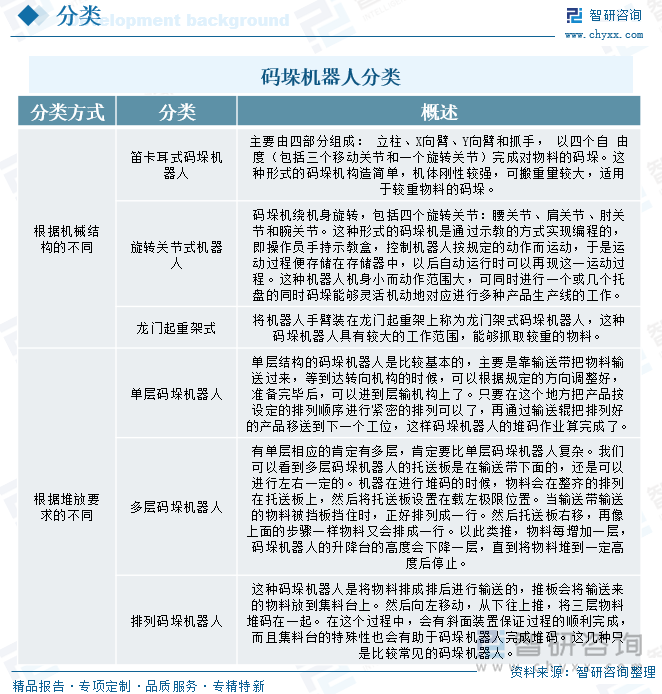
Core Viewpoint - The traditional manual stacking methods in industrial manufacturing are increasingly inadequate, leading to a shift towards automation in the stacking process, with palletizing robots becoming essential for enhancing production efficiency and safety [1][13]. Industry Overview - The palletizing robot is an automated device that mimics human arm movements for grabbing, transporting, and stacking items, integrating multiple technologies such as mechanics, electronics, and artificial intelligence [3]. - The working principle of palletizing robots involves three stages: perception, decision-making, and execution, utilizing various sensors to gather environmental data, process it to formulate optimal strategies, and execute tasks through mechanical arms [3]. Market Size and Growth - The market size of China's palletizing robot industry is projected to reach 31.52 billion yuan in 2024, representing a year-on-year increase of 16.78% [1][13]. - The rapid growth of the palletizing robot market is expected to continue as its applications expand across various sectors [1]. Industry Chain - The upstream of the palletizing robot industry includes the development and production of key components such as precision reducers, servo motors, and sensors, which are crucial for the robots' performance [9]. - The midstream consists of manufacturers that integrate these components into complete palletizing systems tailored to customer needs [9]. - The downstream encompasses various application fields, including food and beverage, chemicals, construction materials, and logistics, where palletizing robots play a vital role in material handling and storage [9]. Competitive Landscape - The palletizing robot market is experiencing a new wave of technological iteration and restructuring, with leading companies consolidating resources while emerging firms exploit market gaps through differentiated strategies [15]. - High-precision 3D vision systems and flexible gripping algorithms are becoming critical competitive differentiators [15]. Industry Trends 1. **Intelligent Development**: The industry is moving towards greater intelligence, enhancing human-machine interaction capabilities [20]. 2. **Integration**: There is a growing demand for multifunctional and versatile palletizing robots, necessitating a shift towards modular and integrated designs [21]. 3. **Environmental Responsibility**: The industry is increasingly focusing on environmental issues, with a trend towards eco-friendly technologies in palletizing robots [23].


三维度看中国经济半年报的“含金量”
Zheng Quan Ri Bao· 2025-07-16 16:25
Economic Performance - In the first half of 2025, China's GDP reached 66,053.6 billion yuan, with a year-on-year growth of 5.3%, exceeding the annual growth target of around 5% [1] - Domestic demand contributed 68.8% to GDP growth, with final consumption expenditure accounting for 52%, highlighting its role as the main driver of economic growth [1][2] Consumption Recovery - The recovery in consumption is driven by three main factors: enhanced fiscal policies, structural upgrades in consumption, and increased income levels [2] - Fiscal policies, including trade-in programs, have significantly boosted sales, with related goods sales exceeding 1.4 trillion yuan in the first half of the year [2] - The actual per capita disposable income of residents grew by 5.4%, with rural income growth (6.2%) outpacing urban income growth (4.7%), stimulating consumption in lower-tier markets [2] Foreign Trade Resilience - China's foreign trade demonstrated strong resilience, with total goods import and export reaching 21.79 trillion yuan, a year-on-year increase of 2.9% [2][3] - The contribution of net exports of goods and services to economic growth was 31.2% [2] Trade Highlights - Exports of mechanical and electrical products grew by 9.5%, accounting for 60% of total exports, while "new three samples" products saw a growth of 12.7% [3] - The proportion of trade with Belt and Road Initiative countries rose to 51.8%, with significant growth in trade with Africa and Central Asia [3] New Quality Productivity - The core industries of the digital economy accounted for about 10% of GDP, indicating a shift towards new quality productivity [3] - R&D expenditure as a percentage of GDP is close to 2.7%, surpassing the EU average and nearing the OECD average [3] Overall Economic Outlook - The 5.3% economic growth reflects solid consumer foundations, resilient foreign trade, and the emergence of new quality productivity [4] - There is ample policy reserve and space to ensure stable economic growth in response to external uncertainties [4]
外媒热议中国经济“半年报”:增长超出预期,外贸韧性凸显
Zhong Guo Xin Wen Wang· 2025-07-16 15:56
Group 1 - The core viewpoint of the article highlights that despite a complex and uncertain international environment, China's economy has shown stable performance and exceeded growth expectations, achieving a growth rate of 5.3% in the first half of the year [1][2][3]. Group 2 - China's manufacturing sector has been a significant driver of economic growth, with industrial added value increasing by 6.4% year-on-year in the first half of the year, supported by rising demand for 3D printing equipment, new energy vehicles, and industrial robots [3]. - The service sector, including transportation, finance, and technology, has also experienced good growth, contributing to the overall economic stability [3]. - Consumer spending has played a crucial role, with final consumption expenditure contributing over 52% to economic growth in the second quarter, indicating a continued upward trend [3]. Group 3 - Despite challenges from high tariffs and fluctuating trade policies, China's import and export scale remained robust, reaching a historical high of 20 trillion yuan in the first half of the year [4]. - Exports increased by 5.9% year-on-year in the first six months, demonstrating the resilience of China's manufacturing and export sectors amid ongoing trade disputes with the U.S. [4]. - China's diversified trade relationships have mitigated the impact of declining exports to the U.S., with double-digit growth in exports to ASEAN and Africa, as well as stable growth to the EU [4].