服装

Search documents
今年前11月柬埔寨服装鞋类及旅行用品出口达148亿美元 劲增16.9%
Shang Wu Bu Wang Zhan· 2025-12-20 04:27
Core Viewpoint - The report from the Cambodian Ministry of Commerce indicates a steady growth in the export of garments, footwear, and travel goods, reaching $14.84 billion in the first 11 months of the year, a 16.9% increase compared to $12.69 billion in the same period last year [1] Export Performance - Garment exports amounted to $10.46 billion, reflecting a year-on-year growth of 17% [1] - Textile exports reached $620 million, showing a significant increase of 36.7% [1] - Footwear exports totaled $1.91 billion, marking a growth of 26.4% [1] - Travel goods exports were valued at $1.85 billion, with a modest increase of 3.7% [1] Economic Impact - The garment, footwear, and travel goods sectors are crucial drivers of economic growth in Cambodia and represent the largest source of foreign exchange earnings [1] - The primary export markets for these products include the United States, Europe, the United Kingdom, Canada, South Korea, and Japan [1] Labor Market Update - The minimum wage for workers in the garment, footwear, and travel goods sectors will increase from $208 to $210 next year [1] - Currently, the minimum wage system applies only to these three manufacturing sectors, with other industries not yet included [1]
被退货逼疯的女装店家,选择了超长预售期
经济观察报· 2025-12-20 03:15
Core Viewpoint - The clothing industry is facing a decline, prompting merchants to control production through pre-sales as a strategy to "exchange time for survival space" [1][7]. Group 1: Pre-sale Dynamics - Pre-sale is defined as the sale of products before they officially enter the market, a practice that has evolved since its introduction by platforms like Taobao in 2012 [5]. - In 2024, major platforms like Taobao and JD.com announced the cancellation of pre-sales during the "618" shopping festival, but reintroduced them during "Double 11," indicating a fluctuating reliance on this sales model [5]. - Merchants like "DuoDuo" utilize pre-sales to manage inventory effectively, often only producing a fraction of the total orders based on expected return rates [6][11]. Group 2: Consumer Experience and Challenges - Consumers have expressed frustration with pre-sales, citing issues such as indefinite shipping times, order cancellations, and quality concerns [4][18]. - A survey indicated that 78% of respondents believe pre-sale periods are lengthening, with 80% stating that extended pre-sales diminish their shopping experience [18]. - The average return rate for some merchants has escalated, with "A Jie" reporting an increase from 50% to 80% in return rates, largely attributed to consumer behavior changes [15]. Group 3: Production and Supply Chain Implications - The overall scale of the clothing industry is shrinking, with significant declines in revenue and profit reported by major companies [7]. - Manufacturers face challenges with production timelines, as frequent changes in orders and styles lead to increased costs and inefficiencies [20][22]. - The shift towards smaller order quantities has resulted in higher production costs, complicating the supply chain for manufacturers [22]. Group 4: Regulatory and Market Trends - New regulations from platforms aim to shorten pre-sale periods to improve consumer experience, yet complexities in the industry mean that not all products can be treated the same [24]. - Some merchants are exploiting category misclassifications to extend pre-sale periods, indicating a potential loophole in the regulatory framework [25]. - Experts suggest that while pre-sales can lead to inefficiencies, they also represent a shift towards demand-driven production, which could be beneficial if managed properly [25].



首饰黄金每克便宜176元 海南封关后 你会去“买买买”吗?
2 1 Shi Ji Jing Ji Bao Dao· 2025-12-20 02:41
Group 1 - The Hainan Free Trade Port officially launched its full island closure on December 18, which is expected to impact consumer behavior positively [1] - On the first day of the closure, consumers lined up to purchase Apple products, with the iPhone 17 Pro Max 2TB version priced at 15,859 yuan after applying government tax-free consumption vouchers, resulting in a discount of 2,140 yuan compared to the official price [1] - The price of tax-free gold on the same day was reported at 1,180 yuan per gram, which is 176 yuan cheaper than the taxed price of 1,356 yuan per gram [1] Group 2 - The official mini-program of China Duty Free Group in Hainan features various high-value items, including Canada Goose down jackets and Dyson hair dryers, indicating a diverse range of products available for consumers [1]
中国品牌日益注重展现传统文化
Xin Lang Cai Jing· 2025-12-20 02:38
Core Viewpoint - Chinese brands are increasingly integrating local landscapes, aesthetics, and cultural features into their marketing strategies, reflecting a growing confidence in their cultural strength and a belief that Chinese culture is mature enough to stand out on its own [1][2]. Group 1: Marketing Strategies - More Chinese enterprises are moving away from relying on Western landmarks to showcase modernity and global influence, opting instead for local heritage sites and natural landscapes for marketing activities [1]. - Brands like Bosideng are conducting promotional activities in iconic Chinese locations, such as the Xinjiang Kalajun Grassland, to highlight their products' adaptability to local climates [1]. Group 2: Consumer Behavior - The shift in marketing strategies is driven by generational factors, with younger Chinese consumers placing greater emphasis on emotional connections in their purchasing decisions [2]. - The Z generation exhibits an unprecedented level of cultural identity and national pride, leading them to prefer domestic cultural representations over foreign ones [2]. Group 3: Government Influence - The national emphasis on "cultural confidence" is reflected in local government initiatives aimed at protecting cultural heritage while stimulating consumption and tourism [2]. - Local governments are leveraging brand collaborations and cultural activation projects as part of broader economic growth strategies [2].

首饰黄金每克便宜176元,海南封关后,你会去“买买买”吗?
2 1 Shi Ji Jing Ji Bao Dao· 2025-12-20 02:15
据极目新闻,封关首日,便有消费者排起长队选购苹果产品。店员介绍,免税苹果产品不能使用国家补 贴,但可以叠加政府免税消费券。以售价最贵的iPhone17proMax2TB版本为例,其叠加消费券后,最终 售价为15859元,这比官网售价便宜了2140元。 据每日经济新闻,19日,老庙黄金价格展示牌显示,当天免税金价为1180元/克,有税金价为1356元/ 克,免税价便宜176元/克。 此外,中免海南官方商城的小程序上还有一些性价比单品,如加拿大鹅羽绒服、戴森吹风机等。 (原标题:首饰黄金每克便宜176元,海南封关后,你会去"买买买"吗?) (来源:每日经济新闻、极目新闻) 12月18日,海南自由贸易港正式启动全岛封关。封关对普通人有哪些影响?到海南买买买会不会更爽 快? ...
预售围城
Jing Ji Guan Cha Bao· 2025-12-20 01:35
Core Viewpoint - The article discusses the growing trend of pre-sale in the fashion industry, highlighting consumer frustrations and the operational challenges faced by merchants due to extended pre-sale periods and high return rates [1][6][23]. Group 1: Consumer Experience - Consumers are increasingly frustrated with pre-sale items that take too long to ship, leading to cancellations and dissatisfaction with product quality [1][2][3]. - A survey of approximately 30 consumers revealed various issues with pre-sale purchases, including unpredictable shipping times and receiving incorrect or low-quality items [3][4]. - A significant percentage of consumers (78%) believe that pre-sale periods are lengthening, and 80% feel that extended pre-sale negatively impacts their shopping experience [16][21]. Group 2: Merchant Strategies - Merchants like "DuoDuo" utilize pre-sale as a strategy to manage inventory and cash flow, often only producing a fraction of the orders to mitigate risks associated with high return rates [4][12][16]. - The average return rate for some merchants has increased significantly, with one brand reporting a rise from 50% to 80% in returns, indicating a shift in consumer behavior towards trying multiple items before returning [13][14]. - Larger brands have different pre-sale strategies, often using it as a means to gauge demand before committing to production, while smaller merchants rely on pre-sale to manage cash flow and inventory [14][15][22]. Group 3: Industry Trends - The overall scale of the clothing industry is declining, with significant drops in revenue and production reported by major companies [5][6]. - Pre-sale has become a necessary tactic for survival in a challenging market, allowing merchants to "trade time for survival space" amidst declining sales [6][23]. - The article notes that the pre-sale model in the fashion industry resembles early real estate pre-sale practices, suggesting potential for market bubbles and the need for regulatory oversight [23][24]. Group 4: Operational Challenges - Manufacturers face increased complexity and costs due to frequent changes in production lines and the need to adapt to varying order sizes, which complicates the production process [17][20]. - The time required for production has increased, with manufacturers reporting longer wait times for orders due to the need for adjustments in production lines [17][19]. - The handling of returns adds additional operational costs for merchants, as each returned item requires inspection and potential refurbishment before resale [21][22].
一觉醒来!知名巨头耐克股价崩了
Xin Lang Cai Jing· 2025-12-20 01:35
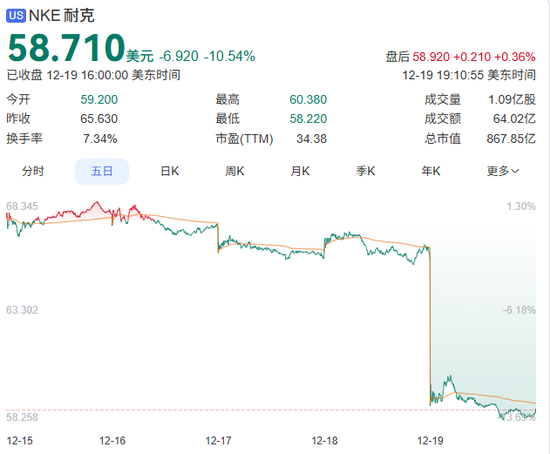
Core Insights - Nike's stock price dropped by 10.54% on December 19, 2025, marking a 22.41% decline year-to-date and a 23.85% drop over the past 52 weeks [1][8] Financial Performance - For the second quarter of fiscal year 2026, Nike reported a net profit decline of 32%, falling from $1.16 billion to $792 million, with diluted earnings per share decreasing from $0.78 to $0.53, surpassing market expectations of $0.38 [3][10] - Net sales reached $12.43 billion, a slight increase of 1% compared to the previous year, exceeding market expectations of $12.22 billion [3][10] - The Nike brand's revenue for the second quarter was $12.1 billion, growing 1% year-over-year, primarily driven by North American market performance, although offset by declines in Greater China and APLA regions [3][10] Regional Performance - Revenue in Greater China decreased by 17% to $1.7 billion, with EBIT dropping by 49%, indicating significant market challenges [3][10] - Direct-to-consumer sales fell by 8% to $4.6 billion, with digital sales down 14% and in-store sales down 3% [3][10] Wholesale and Other Segments - Nike's wholesale channel revenue grew by 8% to $7.5 billion, while Converse brand revenue plummeted by 30% to $300 million due to declines across all regions [4][11] - Footwear revenue remained flat at $7.7 billion, while apparel sales increased by 4% to $3.9 billion [4][11] Strategic Challenges - The decline in profits was attributed to increased tariffs in the U.S. and ongoing weakness in the Chinese market [4][11] - Analysts suggest that Nike must replicate its success in running shoes across other sports categories and improve its cultural connection in the Chinese market [5][11] - The company is refocusing on rebuilding relationships with wholesale partners after facing challenges with its direct-to-consumer strategy [5][12]

年服热带动新春消费 童装之都浙江织里转型焕新机
Zhong Guo Xin Wen Wang· 2025-12-19 23:13
Group 1 - The children's clothing industry in Wuzhen, Huzhou, Zhejiang Province, is experiencing a surge in production and sales as the year-end approaches, driven by design innovation and market expansion [1][2] - The demand for children's clothing is strong, with significant sales reported during the peak season from October to before the Spring Festival, reflecting robust consumer purchasing power [2] - Brands like "Tangjia Guixiu" have achieved a threefold increase in sales by integrating traditional elements like zodiac embroidery with modern design trends, while "Bala Belle" reports that 70% of their annual clothing sales come from popular combinations like the Ma Mian skirt and new Chinese-style tops [2] Group 2 - Companies in Wuzhen are adopting an "addition and subtraction" strategy to optimize their development paths, with Huzhou Jintong Wang Garment Co., Ltd. focusing on youth clothing for ages 8-18, enhancing brand recognition and market share [3] - Huzhou Beitini Clothing Co., Ltd. has diversified into pet clothing while maintaining its core children's clothing business, achieving over 2 million yuan in sales for pet apparel in 2023 and expanding into offline wholesale and overseas orders [3] - The local government is promoting differentiated and branded development in the children's clothing industry, encouraging companies to delve into niche markets such as school uniforms, outdoor sportswear, and family-themed clothing [3]
开开实业:公司一直以来专注于主业的发展
Zheng Quan Ri Bao Zhi Sheng· 2025-12-19 16:09
Core Viewpoint - The company is focused on developing its main business and aims to enhance both market and intrinsic value through various strategies, including governance improvement and innovation [1] Group 1: Business Strategy - The company has been actively expanding into the health industry and developing regional SPD business [1] - The company is exploring new opportunities in the dental sector with the launch of the Lei Yun Shang dental project [1] - The company is implementing comprehensive reforms in its apparel segment to release subsequent benefits [1] Group 2: Financial Outlook - The company acknowledges that the development of its transformation business requires ongoing cultivation and gradual growth [1] - Short-term operational performance may not reflect the company's efforts and could negatively impact profits [1]

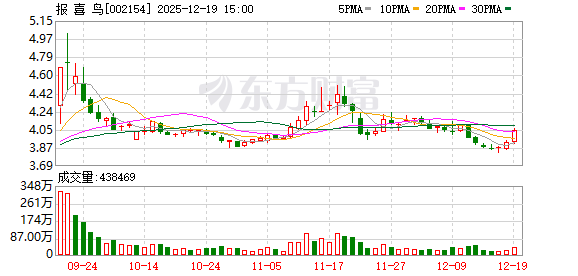
报喜鸟:第九届董事会第四次会议决议公告
Zheng Quan Ri Bao· 2025-12-19 15:49
Core Viewpoint - The company announced the establishment of a Sustainable Development Committee and the election of its members during the fourth meeting of the ninth board of directors [2] Group 1 - The board of directors approved the proposal to set up the Sustainable Development Committee [2] - The board also approved the proposal for the committee's operational guidelines [2]