电池

Search documents
法国纪录片:“在中国,劲往一处使”
Xin Lang Cai Jing· 2026-01-27 23:08
来源:环球 该片还很好地反映了节奏上的差异。在欧洲,我们照计划按部就班,先监管再建造;在中国则是"好 的,现在就开工"。尽管并非一切完美,但通过启动、迭代和优化,能够形成一个"快速"的工业模式。 片中的场景多次重复这点:所有环节都围绕着缩短从"设想"到"落地"的周期展开。供应链从不是需要纠 结的问题——它已然存在,而且高度集中、随取随用、响应迅速。需要某个零部件?几公里范围内就能 找到;需要一个样品?在中国,交付时间之快在我们这里简直无法想象。 欧洲认为工厂只是"普通生产设施",中国人则明白制造就是学习,学习就是进步,进步的终点就是创 新。该纪录片展现了一个转折点:中国不再"沉迷模仿",而是越来越多地投身于"创造"——在机器人、 电池、电动汽车和人工智能等诸多前沿领域皆是如此。(西方对中国商品的)刻板印象,在中国真实的 产品实力面前不堪一击。 最令人震惊的还是"在中国,劲往一处使",体现在研发、供应链、资金和政府意愿上。欧洲情况正相 反:分散的渠道,短暂的政治举措,各种相互矛盾的禁令。有人通过这部纪录片总结出了差异:在欧 洲,人们寻求完美模型;在中国,人们构建真实世界。 这部纪录片说"中国已准备好了",发人深 ...
外媒:中国如何实现科技逆袭
Huan Qiu Wang Zi Xun· 2026-01-27 22:59
Group 1 - The article discusses the significant reversal in global technology flow, highlighting how China has transitioned from being a market for Western companies to becoming a leader in various technology sectors such as electric vehicles, batteries, and drones [1] - Western companies have historically benefited from China's large market and cheap labor, but now they are increasingly collaborating with Chinese firms to access advanced technologies and platforms [1] - In the electric vehicle and battery sectors, China has emerged as a global leader, with companies like Ford and Volkswagen partnering with Chinese firms to leverage their technological advancements [1] Group 2 - The trend of Western companies seeking Chinese technology is not limited to the automotive industry; it extends to biotechnology, robotics, and artificial intelligence, with significant investments being made to acquire Chinese intellectual property [2] - Meta's acquisition of the AI startup Manus for over $2 billion exemplifies the growing interest of U.S. tech companies in Chinese innovations, as they aim to gain competitive advantages in the AI race [2] - China's rise in technology is attributed to a systematic approach to planning and long-term vision, which has provided structural advantages that many Western countries lack [3]
全固态电池汽车离我们还有多远
Qi Lu Wan Bao· 2026-01-27 14:25
Core Insights - The successful trial production of the first prototype of the Hongqi all-solid-state battery marks a significant milestone in China's solid-state battery technology, transitioning from laboratory validation to real vehicle testing [1] - The solid-state battery industry in China is at a critical transitional phase, moving towards semi-solid state applications and accelerating the verification of all-solid-state technologies [1][2] Group 1: Industry Development - The solid-state battery industry in China has established a development pattern characterized by "policy guidance + enterprise leadership + industry chain collaboration," with a focus on multiple technological pathways including sulfide, oxide, and polymer [2] - The Ministry of Industry and Information Technology has included all-solid-state batteries in the new industry standardization pilot project, with the first national standards set to be released soon [2] - 2025 is designated as the "year of semi-solid state battery industrial application," with significant breakthroughs in technology development and mass production [2] Group 2: Technological Advancements - The Hongqi prototype features a sulfide all-solid-state battery with a 66Ah cell energy density of 380Wh/kg and an electrolyte ionic conductivity exceeding 10mS/cm, showcasing advancements in high-pressure packaging and system integration [3] - The L6 Max model from Zhiji Automotive, a pioneer in semi-solid state battery production, achieves a battery capacity of 133kWh and an energy density of 368Wh/kg, with a range exceeding 1080km under CLTC conditions [3] - CATL, a leading global power battery manufacturer, has developed a condensed battery with an energy density of 500Wh/kg and plans to achieve small-scale production by 2027 [4] Group 3: Future Outlook - The path for solid-state battery industrialization is clear, with semi-solid state batteries expected to see large-scale application by 2025, while all-solid-state batteries are projected to require 2-3 more years for technological maturation [5] - Major companies like Hongqi and SAIC plan to achieve small-scale production of all-solid-state batteries by the end of 2027, with significant improvements in energy density and cost reduction strategies [5] - The industry faces challenges such as high material costs, technical bottlenecks, and insufficient industry chain collaboration, which could impact the efficiency of large-scale production [6]

从极寒测试到万套装车!半固态电池今年有望搭载多款新车:各大厂商摩拳擦掌 动力电池技术迎来迭代年
Mei Ri Jing Ji Xin Wen· 2026-01-27 14:05
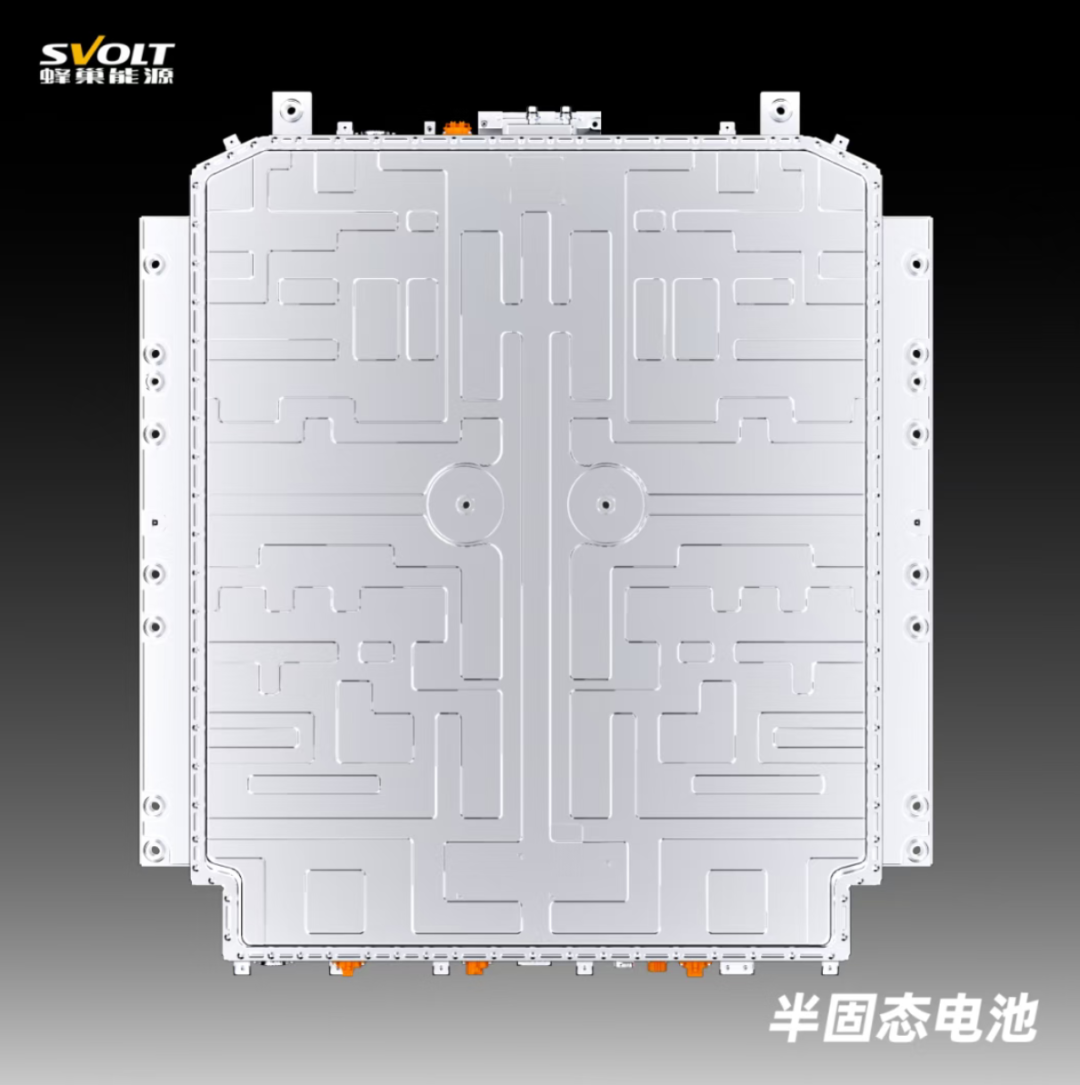
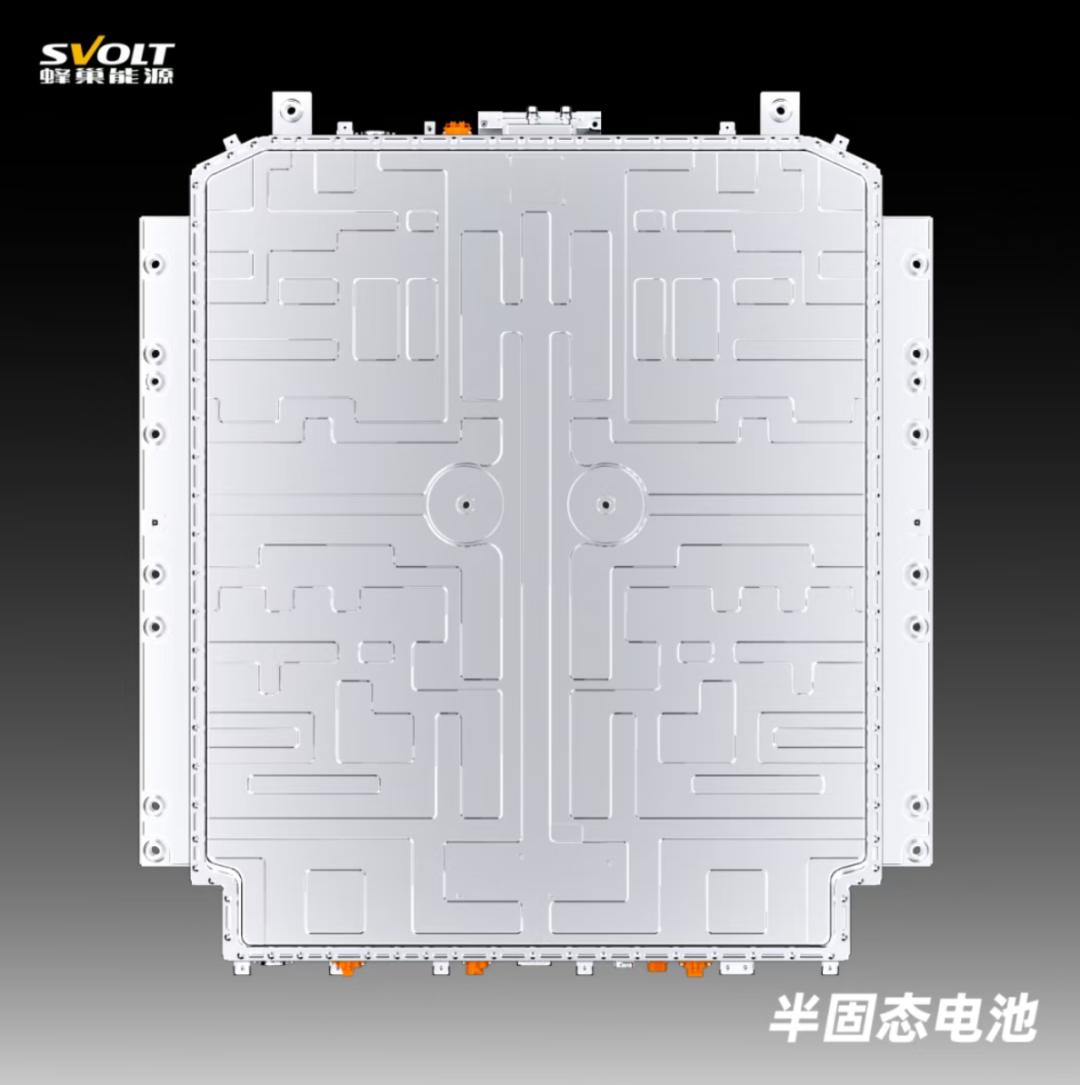
Core Insights - The article highlights the significant progress in the commercialization of semi-solid batteries, which are now seen as a viable alternative to traditional liquid batteries, marking a shift in the battery industry towards mass production and broader application [1][20]. Group 1: Testing and Commercialization - SAIC-GM-Wuling engineers conducted extreme cold tests on vehicles equipped with semi-solid batteries, successfully validating their low-temperature endurance and charging stability, which is crucial for the upcoming strategic release [1][2]. - Foton Motor has reported that over 10,000 units equipped with customized semi-solid batteries have been produced, with plans for a production line capable of 60,000 units annually to meet market demand [2][3]. - Multiple automotive companies, including SAIC Group and NIO, have disclosed their progress in integrating semi-solid batteries, with a critical milestone set for 2026 [2][3]. Group 2: Supply Chain and Production Capacity - Battery manufacturers are ramping up production capabilities, with Honeycomb Energy's dedicated production line for semi-solid batteries expected to commence mass production in the second half of the year, having already secured orders from both domestic and international brands [3][6]. - The supply chain for semi-solid batteries is evolving, with material suppliers like Haitian Pharmaceutical preparing to deliver key components, indicating a comprehensive approach to meeting the anticipated demand [6][15]. Group 3: Technical Advantages and Market Position - Semi-solid batteries offer enhanced safety and environmental adaptability compared to traditional lithium-ion batteries, significantly reducing the risk of thermal runaway due to their solid-liquid mixed electrolyte system [7][11]. - The energy density of semi-solid batteries is projected to be between 300-450 Wh/kg, surpassing that of traditional batteries, which positions them favorably in the market [8][11]. - The production compatibility of semi-solid batteries with existing manufacturing lines allows for faster scaling without significant capital investment, making them a more attractive option for manufacturers [11][12]. Group 4: Industry Trends and Future Outlook - The industry is witnessing a shift towards semi-solid batteries as a practical solution amidst ongoing debates about the feasibility of fully solid-state batteries, with many experts advocating for the former as a more immediate path to commercialization [12][20]. - The next few years are expected to see semi-solid batteries gain a substantial foothold in the power battery sector, driven by technological advancements and market demand, potentially reshaping the entire battery industry [20].

从极寒测试到万套装车!半固态电池今年有望搭载多款新车:各大厂商摩拳擦掌,动力电池技术迎来迭代年
Mei Ri Jing Ji Xin Wen· 2026-01-27 13:44
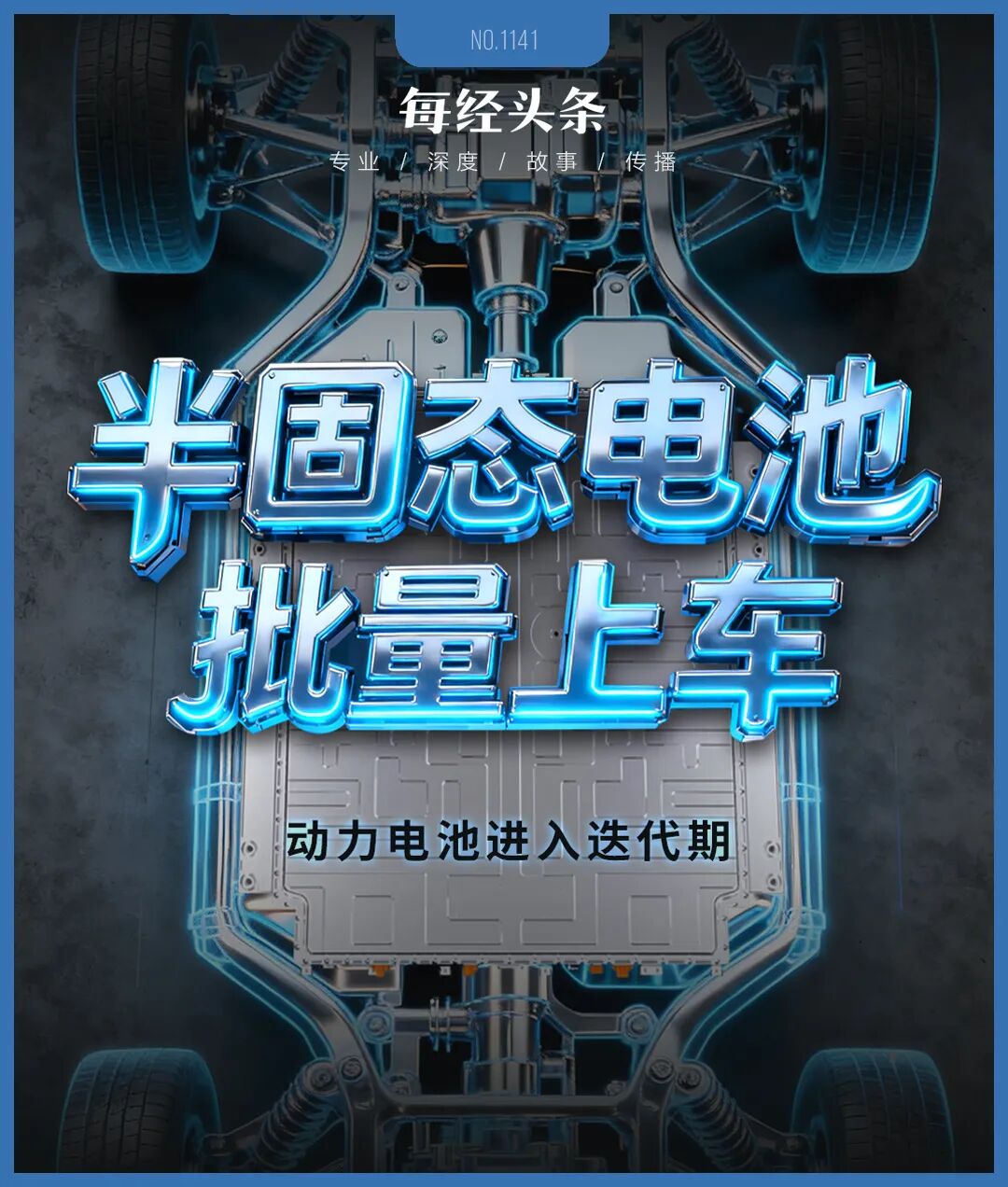
Core Insights - The article highlights the significant progress in the commercialization of semi-solid state batteries, marking a shift from being seen as a transitional technology to entering mass production readiness [2][8] - The year 2026 is identified as a critical milestone for the adoption and scaling of semi-solid state batteries across the automotive industry [3][7] Industry Developments - Several companies, including SAIC-GM-Wuling and Foton Motor, have reported advancements in the deployment of semi-solid state batteries, with Foton having already installed over 10,000 units [3][4] - A production line dedicated to semi-solid state batteries with a capacity of 2.3 GWh has been completed by Honeycomb Energy, with plans for mass production to begin in the second half of this year [4][19] Technical Advantages - Semi-solid state batteries offer enhanced safety and environmental adaptability compared to traditional liquid batteries, significantly reducing the risk of thermal runaway [9][10] - The energy density of semi-solid state batteries ranges from 300-450 Wh/kg, which is superior to that of traditional lithium-ion batteries [9][10] Supply Chain Transformation - The acceleration of semi-solid state battery technology is prompting a deep transformation in the supply chain, with a focus on new materials and production processes [18][19] - Companies are rapidly developing lithium sulfide, a key material for solid-state batteries, with several firms, including Tianqi Lithium, already achieving pilot production [19][21] Market Outlook - The commercialization of semi-solid state batteries is expected to expand into various applications, including eVTOLs and high-end consumer electronics, which require high energy density and safety [17][24] - The industry anticipates that semi-solid state batteries will play a significant role in the battery market over the next three to five years, potentially reshaping the competitive landscape [24]
同兴达:公司进行布局的固态电池体系,主要以高分子复合硫化物、氧化物为主体的复合式固态体系
Zheng Quan Ri Bao Wang· 2026-01-27 13:12
Group 1 - The core viewpoint of the article is that Tongxingda is actively developing a solid-state battery system, focusing on composite solid-state systems primarily based on polymer composite sulfides and oxides [1] - The company recognizes that transforming solid-state batteries cannot rely on a single material, thus it is making comprehensive layouts at the module, battery, and material levels [1] - Initially, the company is targeting micro smart device batteries as the entry point for its solid-state battery development [1]
从极寒测试到万套装车,半固态电池今年有望搭载多款新车:各大厂商摩拳擦掌,动力电池技术迎来迭代年
3 6 Ke· 2026-01-27 12:57
Core Insights - The article highlights the significant progress in the commercialization of semi-solid batteries, which are now seen as a viable alternative to traditional liquid batteries, with a focus on their performance in extreme cold conditions [1][2][3] - The industry is moving towards mass production, with several companies, including SAIC-GM-Wuling and Foton, reporting successful tests and production milestones, aiming for a key rollout by 2026 [2][3][5] - The semi-solid battery technology is gaining traction due to its safety, environmental adaptability, and cost control capabilities, leading to a transformative period in the battery supply chain [1][14][18] Group 1: Commercialization Progress - SAIC-GM-Wuling's engineers successfully tested semi-solid battery vehicles in extreme cold, validating their performance and paving the way for a strategic release in three months [1][2] - Foton has already assembled over 10,000 units of vehicles equipped with customized semi-solid batteries, with plans for a production capacity of 60,000 units per year [2][3] - Multiple automakers, including SAIC Group and NIO, have disclosed their progress in integrating semi-solid batteries, with most targeting 2026 for significant deployment [2][3] Group 2: Technical Advantages - Semi-solid batteries offer enhanced safety and environmental adaptability compared to traditional lithium-ion batteries, significantly reducing the risk of thermal runaway [6][9] - The energy density of semi-solid batteries ranges from 300-450 Wh/kg, outperforming traditional lithium batteries [7][8] - The production compatibility of semi-solid batteries with existing manufacturing lines allows for faster scaling without significant capital investment [9][10] Group 3: Industry Dynamics - The supply chain is undergoing a transformation, with a shift towards new materials and processes, particularly in the electrolyte sector, as companies compete for dominance in the semi-solid and solid-state battery markets [14][15] - Key materials such as lithium sulfide are becoming focal points for companies like Tianqi Lithium and Haitian Pharmaceutical, which are ramping up production capabilities [15][16] - The semi-solid battery technology is expected to play a crucial role in various applications, including eVTOLs and high-end consumer electronics, as it meets specific safety and performance requirements [13][14] Group 4: Future Outlook - The industry anticipates that the semi-solid battery will not be the final form of battery technology but will serve as a practical step forward given current technological and market conditions [17][18] - The next few years are expected to see semi-solid batteries occupy a significant position in the power battery sector, potentially driving a wave of technological innovation across the industry [17][18]
“新三样”增速超九成,长沙外贸“含新量”持续飙升
Xin Lang Cai Jing· 2026-01-27 12:39
Core Insights - In 2025, Changsha's foreign trade is expected to show a steady growth of 3.5% year-on-year, reaching a total of 287.54 billion yuan, contributing to 53.1% of Hunan Province's total foreign trade value [1][2] Group 1: Trade Performance - Changsha ranks 10th among provincial capital cities and 4th in Central China for foreign trade scale, maintaining its position as a leader in Hunan's foreign trade [2] - The number of enterprises engaged in import and export activities reached 4,841, a year-on-year increase of 12.5%, with significant contributions from enterprises exceeding 20 billion yuan and 50 billion yuan in trade [2] - Exports reached 185.7 billion yuan, growing by 4.2%, while imports totaled 101.84 billion yuan, increasing by 2.3% [1][2] Group 2: Trade Structure and Growth - Changsha maintained trade relations with over 220 countries and regions, with more than half of its trading partners experiencing growth [2] - Exports to ASEAN, Latin America, Africa, and the Middle East grew by 10.1%, 16.1%, 28.9%, and 20.3% respectively, with trade with Africa reaching a historical high [2] - The export of "new three items" such as lithium batteries, electric vehicles, and photovoltaic products saw significant increases of 160.4%, 840.4%, and 62.1% respectively [2][3] Group 3: Policy and Support - The Huanghua Comprehensive Bonded Zone and the Jinxia Bonded Logistics Center are recognized as top-tier platforms in the country and Central China [4] - The Starsha Customs implemented innovative regulatory models, facilitating over 1,037 China-Europe freight trains, which has effectively reduced customs clearance times and costs for enterprises [4] - The issuance of RCEP certificates increased by 21.8%, helping enterprises save approximately 830 million yuan in tariffs [4]
观望
第一财经· 2026-01-27 11:23
Core Viewpoint - The A-share market shows signs of recovery with the three major indices collectively rising, indicating a potential shift in market sentiment and investment strategies [5][6]. Market Performance - The Shanghai Composite Index has formed dual support at the 5-day and 10-day moving averages, closing above 4130 points after a V-shaped reversal [5]. - The market experienced a significant decrease in trading volume, with total turnover dropping to 89 trillion, a decline of 10.88%, reflecting a cautious market sentiment [7]. Sector Analysis - The market saw 1928 stocks rise, with a notable performance in gold stocks and the semiconductor and AI computing power supply chain, while sectors like coal, pharmaceuticals, and retail faced declines [6]. - Institutional investors are shifting their focus from sectors like non-ferrous metals and electric grid equipment to hard technology sectors such as semiconductors and communication equipment, while maintaining positions in undervalued defensive stocks like banks and insurance [9]. Investor Sentiment - Mainstream funds showed a net outflow of 559 million, while retail investors experienced a net inflow of 6.3 million, indicating a divergence in investment behavior [8]. - Retail investor sentiment is cautious, with 75.85% of investors adopting a wait-and-see approach, reflecting a decrease in trading enthusiasm and a lower risk appetite [10].

技术看市:A股再现“神秘力量”强控盘,沪指四平八稳背后,方向选择一触即发
Jin Rong Jie· 2026-01-27 11:05
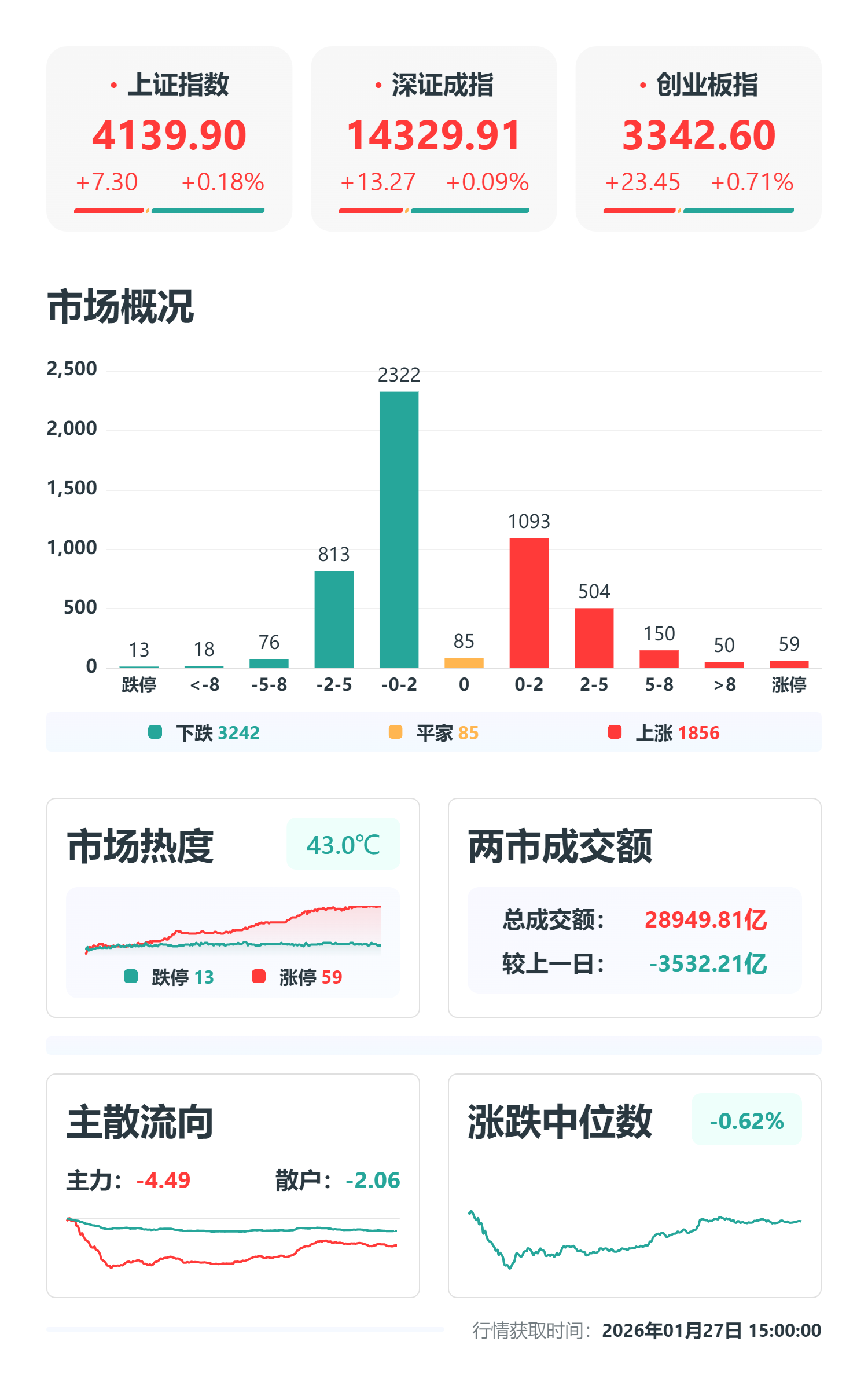
Group 1 - The A-share market experienced a reversal on January 27, with major indices recovering after an early drop, closing in the green despite some late-session control by unidentified forces [1] - The Shanghai Composite Index rose by 0.18% to 4139.9 points, while the Shenzhen Component increased by 0.09%, and the ChiNext Index gained 0.71%. The CSI 300 fell by 0.03%, and the STAR 50 rose by 1.51% [1] - A total of 1856 stocks rose, 3237 fell, and 90 remained unchanged, with a total trading volume of 2.89 trillion yuan, a decrease of approximately 353.22 billion yuan from the previous trading day, and a net outflow of 55.94 billion yuan in major funds [1] Group 2 - Semiconductor sector saw the highest net inflow of major funds, followed by communication equipment, banking, insurance, and aerospace, while non-ferrous metals experienced the largest net outflow [7] - Notable gains were observed in themes such as silver, automotive chips, analog chips, and semiconductors, while declines were seen in lithium sulfide, VC concepts, and epoxy propane [7] - Market analyst Xu Xiaoming noted the current market remains divided, with a significant number of individual stocks declining despite stable index performance, suggesting a cautious approach until market conditions change [7]