
高技术制造业

Search documents
国家发改委:持续发力、适时加力实施宏观政策 有信心实现全年目标任务
智通财经网· 2025-09-29 08:15
Economic Overview - In August, China's economy showed overall stability, supported by continuous macro policies and strong resilience in demand [1][5] - Manufacturing and service sectors experienced steady growth, with key areas performing well [5][6] - The added value of major industries such as equipment manufacturing and high-tech manufacturing grew by 8.1% and 9.3% year-on-year, respectively [5][6] Policy Initiatives - The National Development and Reform Commission (NDRC) is implementing macro policies to maintain economic stability and achieve annual targets [1][7] - A notification was issued to promote the regular application of Real Estate Investment Trusts (REITs) in infrastructure, aiming to support private investment [3][4] Artificial Intelligence Development - The "Artificial Intelligence+" initiative aims for over 70% application penetration of new intelligent terminals and agents by 2027 [8][9] - The initiative emphasizes the importance of AI in enhancing productivity across various sectors, including manufacturing and services [8][9] Investment Trends - In the first eight months, manufacturing investment increased by 5.1%, with significant growth in information services and aerospace sectors [6][7] - The total import and export volume in August rose by 3.5% year-on-year, indicating a diversified trade performance [7] Environmental Initiatives - The "Three Norths" project, a long-term ecological restoration initiative, has been revised to set more ambitious goals for forest coverage and land management by 2050 [10][12] - The establishment of the China-Shanghai Cooperation Organization Green Industry Cooperation Platform aims to enhance international collaboration in green technology and finance [21][22]
国家统计局:研究与试验发展经费投入稳定增长 投入强度较快提升
Sou Hu Cai Jing· 2025-09-29 07:57
Core Insights - The total R&D expenditure in China for 2024 is projected to exceed 3.6 trillion yuan, marking an 8.9% increase from the previous year, indicating a stable growth trend in R&D investment [2] - China's R&D expenditure intensity is expected to reach 2.69% of GDP in 2024, up by 0.11 percentage points from the previous year, reflecting a faster increase compared to the average growth rate since the 14th Five-Year Plan [2] R&D Expenditure Growth - R&D expenditure from enterprises, government research institutions, and higher education institutions for 2024 is projected at 28,211.6 million yuan, 4,231.6 million yuan, and 3,065.5 million yuan respectively, with growth rates of 8.8%, 9.7%, and 11.3% [3] - Enterprises contribute over 75% of total R&D funding, with a contribution rate of 77.1%, making them the primary driver of R&D growth in China [3] Basic Research Investment - Basic research funding is expected to reach 250.09 billion yuan in 2024, growing by 10.7%, and its share of total R&D expenditure has reached a historical high of 6.88% [4] - Government research institutions and higher education institutions are the main contributors to basic research funding, accounting for 52.0% and 40.0% of the growth respectively [4] Fiscal Support for R&D - National fiscal expenditure on science and technology is projected to be 12,629.2 million yuan in 2024, an increase of 5.3% from the previous year, focusing on basic research and scientific research plans [5] - Tax incentives for R&D have shown effectiveness, with the number of enterprises benefiting from R&D expense deductions increasing by 16.7% compared to 2021 [5] Regional Development and Innovation - R&D expenditure in various regions, including East, Central, West, and Northeast China, is expected to grow at rates of 9.0%, 8.4%, 9.2%, and 8.6% respectively in 2024 [7] - Key regions such as Beijing, Shanghai, and Guangdong are leading in R&D expenditure, with Guangdong surpassing 500 billion yuan [7][8]
国家统计局:进一步拓宽R&D经费筹集渠道,巩固深化税费减免等相关政策成效
Sou Hu Cai Jing· 2025-09-29 07:24
Core Insights - The total R&D expenditure in China for 2024 is projected to exceed 3.6 trillion yuan, reaching 36,326.8 billion yuan, marking an 8.9% increase from the previous year, indicating a stable growth trend [1] - China's R&D expenditure intensity is 2.69% of GDP, up by 0.11 percentage points from last year, reflecting a faster increase compared to the average growth rate since the 14th Five-Year Plan [1] Group 1: R&D Expenditure Growth - R&D expenditure from enterprises, government research institutions, and higher education institutions for 2024 is 28,211.6 billion yuan, 4,231.6 billion yuan, and 3,065.5 billion yuan respectively, with growth rates of 8.8%, 9.7%, and 11.3% [2] - Enterprises contribute over 75% of total R&D funding, accounting for 77.1% of the overall growth, making them the primary driver of R&D expenditure in China [2] Group 2: Basic Research Investment - Basic research funding reached 2500.9 billion yuan in 2024, growing by 10.7%, with its share of total R&D expenditure rising to 6.88%, the highest in history [3] - Government research institutions and higher education contribute 52.0% and 40.0% to the growth of basic research funding respectively [3] Group 3: Fiscal Support and Tax Incentives - National fiscal science and technology expenditure for 2024 is 12,629.2 billion yuan, an increase of 633.3 billion yuan or 5.3% from the previous year, focusing on basic research and scientific facilities [4] - Tax incentives for R&D have led to a 16.7% increase in the number of enterprises benefiting from R&D expense deductions compared to 2021 [4] Group 4: Regional Development - R&D expenditure in eastern, central, western, and northeastern regions for 2024 is 23,773.0 billion yuan, 6,582.1 billion yuan, 4,759.8 billion yuan, and 1,211.9 billion yuan respectively, with all regions showing rapid growth [5] - Key regions like Beijing and the Yangtze River Delta are leading in R&D expenditure, with significant contributions to national innovation [5] Group 5: Overall R&D Landscape - In 2024, 12 provinces have R&D expenditures exceeding 100 billion yuan, with 6 provinces surpassing 200 billion yuan, maintaining the previous year's figures [6] - Seven provinces exceed the national average R&D expenditure intensity, collectively accounting for 55.7% of the national total [6]
国家统计局:2024年我国研究与试验发展(R&D)经费投入稳定增长 投入强度较快提升
智通财经网· 2025-09-29 07:23
Core Insights - The total investment in research and development (R&D) in China is projected to exceed 3.6 trillion yuan in 2024, reaching 36,326.8 billion yuan, which represents an 8.9% increase from the previous year, indicating a stable growth trend [3][4] - China ranks second globally in R&D expenditure, only behind the United States, and is 3.5 times that of Japan and 3.7 times that of Germany [3] Group 1: R&D Investment Growth - R&D expenditure in China has shown a consistent annual growth rate of 10.5% over the first four years of the 14th Five-Year Plan, surpassing the planned target [3] - The R&D investment intensity (R&D expenditure as a percentage of GDP) for 2024 is 2.69%, an increase of 0.11 percentage points from the previous year, reflecting a faster growth rate than the average of 0.03 percentage points since the start of the 14th Five-Year Plan [3] Group 2: Contribution by Different Sectors - Enterprises, government research institutions, and higher education institutions are the three main entities executing R&D activities in China, with their respective R&D expenditures in 2024 being 28,211.6 billion yuan, 4,231.6 billion yuan, and 3,065.5 billion yuan, showing growth rates of 8.8%, 9.7%, and 11.3% respectively [4] - Enterprises contribute over 75% of the total R&D funding, accounting for 77.1% of the overall growth in R&D expenditure, making them the primary driver of R&D growth in China [4] Group 3: Basic Research Investment - In 2024, basic research funding is expected to reach 2,500.9 billion yuan, with a growth rate of 10.7%, which is higher than the overall R&D expenditure growth rate [5] - The contribution rates to basic research funding from government research institutions and higher education institutions are 52.0% and 40.0% respectively, indicating their significant role in advancing basic research [5] Group 4: Fiscal Support and Tax Incentives - National fiscal expenditure on science and technology is projected to be 12,629.2 billion yuan in 2024, an increase of 5.3% from the previous year, focusing on basic research and scientific research facilities [7] - Tax incentives for R&D have been implemented, with the number of enterprises benefiting from R&D expense deductions increasing by 16.7% and the amount of expenses by 25.5% compared to 2021, effectively encouraging enterprises to increase R&D investments [7] Group 5: Regional Development and Innovation - R&D expenditure in various regions of China, including East, Central, West, and Northeast, has shown significant growth, with East China leading at 23,773.0 billion yuan, a 9.0% increase from the previous year [8] - Key regions such as Beijing, Shanghai, and Guangdong have R&D expenditures exceeding 5,000 billion yuan, highlighting their role as innovation hubs [8]
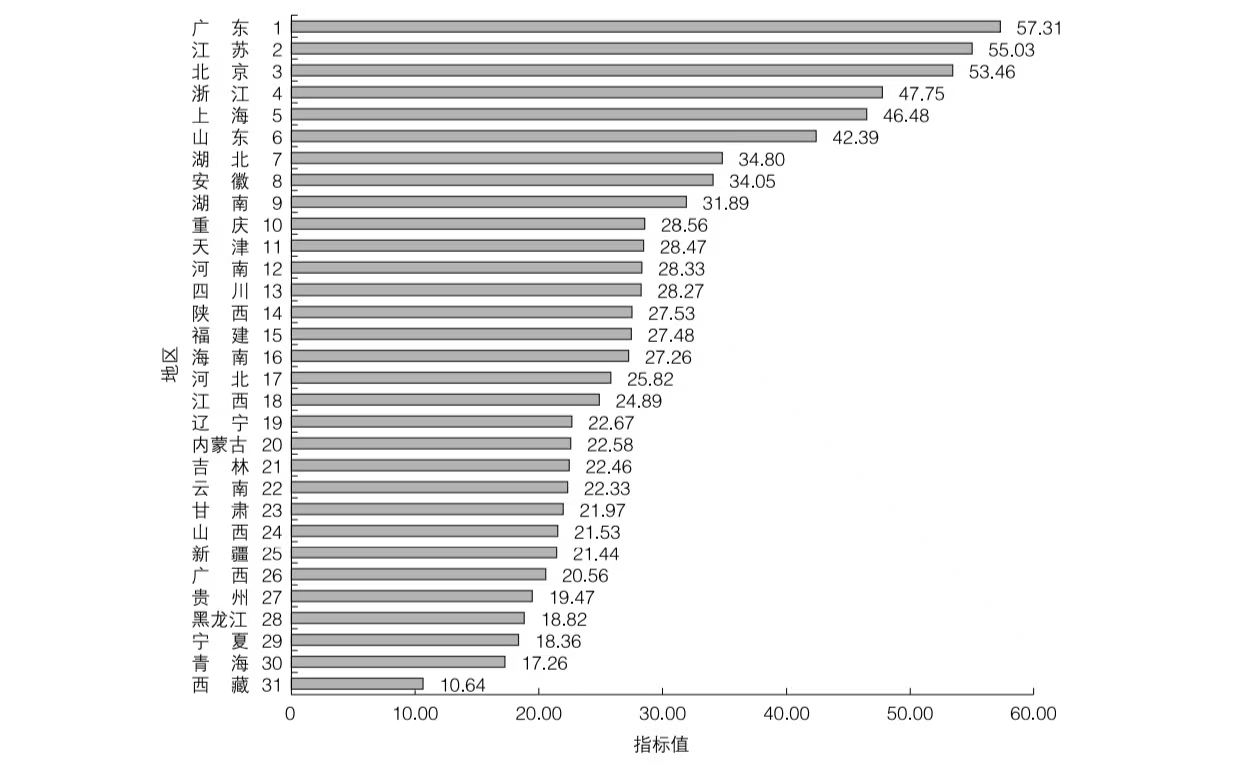
连续9年全国第一 广东凭什么稳坐“创新王座”?
2 1 Shi Ji Jing Ji Bao Dao· 2025-09-28 13:00
Core Viewpoint - Guangdong continues to rank first in the national innovation capability evaluation for nine consecutive years, showcasing strong performance in enterprise innovation and innovation environment, but faces challenges in maintaining its leading edge as other provinces catch up [1][3][7]. Summary by Sections Overall Performance - Guangdong ranks first in overall innovation capability, with enterprise innovation and innovation environment both at the top, knowledge creation at second, knowledge acquisition at fourth, and innovation performance at second [3][4]. Innovation Metrics - In 2023, Guangdong's R&D expenditure from large industrial enterprises reached 342.664 billion yuan, accounting for 16.34% of the national total, maintaining the top position [4][9]. - The province has a high number of patent applications and authorizations, with 143,141 invention patents granted and 164,853 applications filed, both ranking first nationally [4][9]. Industrial Strength - Guangdong's advanced manufacturing and high-tech manufacturing sectors are projected to increase their value-added shares to 56.7% and 31.6% respectively by 2024, with significant contributions from sectors like new energy vehicles and industrial robots [4][5]. Supportive Ecosystem - Approximately 77,000 high-tech enterprises form a robust support system, with a significant portion of R&D resources and patent applications originating from private enterprises [5][9]. - The province is enhancing its innovation infrastructure, with major investments in basic research and the establishment of key laboratories [9][10]. Future Directions - To transition from a "leader" to a "long-term frontrunner," Guangdong must improve its growth rate and address declining efficiency and potential [7][8]. - Recommendations include strengthening supply chains, improving market conditions for private enterprises, and enhancing talent acquisition strategies [8][10].

1至8月份泰安市经济延续回升向好态势 新动能投资增长迅速,高新技术产业投资同比增长24.2%
Qi Lu Wan Bao Wang· 2025-09-28 08:47
Economic Overview - The city's economy has shown stable recovery and continuous improvement from January to August, with a more pronounced upward trend [1] - Industrial production remains steady, with the industrial added value of large-scale enterprises increasing by 7.7% year-on-year [1] Industrial Performance - The manufacturing sector leads the growth, with an added value increase of 8.5%, contributing 6.7 percentage points to the overall industrial growth [1] - Among 37 industrial categories, 27 reported year-on-year growth, resulting in a growth coverage of 73.0% [1] - Key sectors such as equipment manufacturing, high-tech manufacturing, and consumer goods manufacturing saw added value increases of 9.3%, 8.9%, and 8.8% respectively [1] Investment Trends - Fixed asset investment in the city grew by 3.7% year-on-year, with significant growth in the secondary industry at 22.9% [2] - Industrial investment increased by 22.8%, with manufacturing investment rising by 20.0% [2] - New momentum investments, including "Four New" investments and high-tech industry investments, grew by 11.0% and 24.2% respectively [2] Consumer Market - The retail market accelerated recovery, with retail sales of above-limit units reaching 36.91 billion yuan, a year-on-year increase of 14.5% [2] - Categories such as home appliances and audio-visual equipment, grain and oil products, and petroleum products saw significant retail sales growth of 48.7%, 18.3%, and 16.6% respectively [2] Service Sector - The revenue of large-scale service enterprises increased by 11.6% year-on-year, with 19 out of 29 industry categories showing growth [3] - Key sectors like scientific research, information technology services, and cultural and entertainment services experienced double-digit growth [3] Financial Indicators - The city's general public budget revenue reached 18.53 billion yuan, a year-on-year increase of 3.8% [3] - By the end of August, the balance of deposits in financial institutions was 738.65 billion yuan, up 11.0% year-on-year [3] Energy Consumption - Total electricity consumption reached 20.65 billion kilowatt-hours, a year-on-year increase of 5.0%, with industrial and tertiary sector electricity consumption growing by 3.0% and 8.8% respectively [3] Price Trends - The Consumer Price Index (CPI) was 99.6, reflecting a year-on-year decrease of 0.4%, with five categories of goods and services experiencing price increases [3]
透过数据感知我国工业发展活力 新动能加速蓄势聚力
Yang Shi Wang· 2025-09-28 02:21
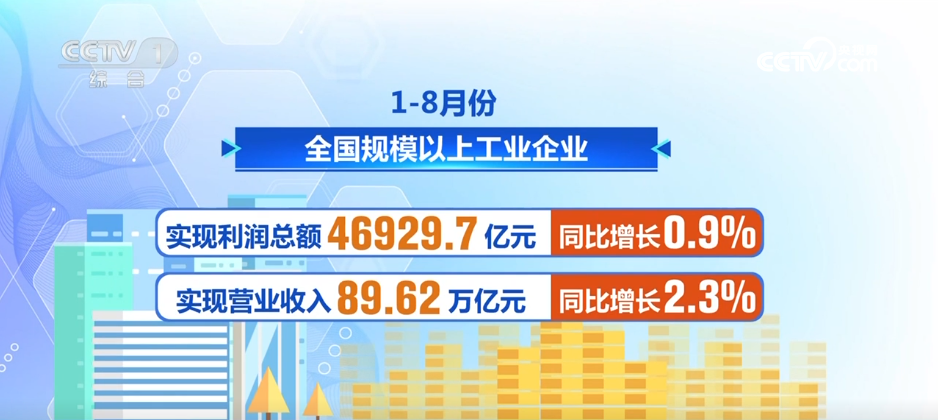
Core Insights - China's industrial sector continues to show resilience and improvement despite challenging external conditions and insufficient domestic demand, with industrial profits increasing by 0.9% year-on-year from January to August [1][3]. Industrial Performance - From January to August, the total profit of large-scale industrial enterprises reached 46,929.7 billion yuan, marking a 0.9% increase year-on-year, while operating revenue grew by 2.3% to 89.62 trillion yuan [3]. - In August alone, profits for large-scale industrial enterprises surged by 20.4%, reversing a decline observed in July [5]. Sector Analysis - The equipment manufacturing sector has played a crucial role, with profits increasing by 7.2% from January to August, particularly in the railway, shipbuilding, aerospace, and electrical machinery industries [5]. - High-tech manufacturing is driving significant growth, with Hubei province's industrial added value rising by 7.8% year-on-year, and high-tech manufacturing contributing a 14.2% increase [8]. Technological Innovation - Companies are leveraging advanced technologies such as AI and IoT to enhance production efficiency, with one icebox manufacturer reporting a 20% increase in production efficiency and a 15% reduction in product quality loss [8]. - The automotive industry in Hubei is rapidly advancing, with significant breakthroughs in core technologies, including the development of a new generation of hybrid engines with leading thermal efficiency [10]. Policy and Collaboration - The Ministry of Industry and Information Technology emphasizes the importance of deepening cooperation in the automotive sector, supporting collaboration in capital, technology, management, and talent [13]. - The government has lifted foreign ownership restrictions in the new energy vehicle sector, encouraging foreign companies to operate in China and collaborate with domestic firms [17].

黑龙江:前8个月工业技术改造投资同比增长47.4%
Zhong Guo Xin Wen Wang· 2025-09-25 09:31
Core Insights - Heilongjiang Province's industrial technology transformation investment increased by 47.4% year-on-year from January to August 2023, surpassing the national growth rate by 45.4 percentage points [1] Group 1: Industrial Growth - The equipment industry in Heilongjiang experienced a year-on-year growth of 14.7%, exceeding the national average by 5 percentage points [1] - Manufacturing investment in the province grew by 12.4% year-on-year, which is 7.3 percentage points higher than the national average [1] - High-tech manufacturing investment maintained strong momentum, with a year-on-year increase of 39.8% [1] Group 2: Future Plans - Heilongjiang Province aims to continue focusing on promoting new industrialization and cultivating new productive forces [1] - The province plans to intensify efforts in the fourth quarter to ensure the successful completion of annual industrial revitalization and development goals [1]
1-8月,济南规上工业增加值同比增长8.1%
Qi Lu Wan Bao Wang· 2025-09-24 09:58
Core Insights - Jinan's industrial production has shown stability in the first eight months of the year, with a year-on-year increase of 8.1% in industrial added value, outperforming both national and provincial averages by 1.9 and 0.3 percentage points respectively, ranking second among the sixteen cities in the province [1] Group 1: Key Drivers - The manufacturing sector in Jinan has continued to lead, with a year-on-year increase of 8.4% in added value, contributing 7.1 percentage points to the overall industrial growth [3] - The equipment manufacturing industry saw a significant year-on-year increase of 21.3%, exceeding the growth rates of the overall industrial and manufacturing sectors by 13.2 and 12.9 percentage points respectively, contributing 9.6 percentage points to the industrial growth [3] - High-tech manufacturing also performed well, with a year-on-year increase of 21.1%, contributing 4.2 percentage points to the overall industrial growth [3] Group 2: Industry Performance - 51.2% of the major industrial categories in Jinan experienced year-on-year growth in added value [3] - Notable growth was observed in the computer, communication, and other electronic equipment manufacturing sectors, which increased by 63.3%, and the automotive manufacturing sector, which grew by 27.6%, together contributing 8.3 percentage points to the overall industrial growth [3] - The black metal smelting and rolling processing industry experienced a year-on-year decline of 9.6%, although the decline was narrower by 2.0 percentage points compared to the previous month [3] Group 3: Production and Sales Coordination - The industrial sales rate in Jinan reached 98.5%, ranking first among the sixteen cities in the province, exceeding the provincial average by 3.6 percentage points and improving by 1.0 percentage point compared to the same period last year [3] - Key products showed varied performance, with generator set production increasing by 21.3%, metal cutting machine tool production rising by 12.1%, and server production growing by 12.6%, while crude steel and steel product outputs declined by 9.5% and 12.7% respectively [3]
月日国新会点评:政策定调明朗,股指震荡上行可期:发布会核心要点:从成就总结到改革深化的政策信号
Chang Jiang Qi Huo· 2025-09-23 03:00
Report Industry Investment Rating No relevant content provided. Core View of the Report The report suggests that the stock index (centered on the Shanghai Composite Index) will consolidate in the short term and show a clear upward trend in the long term. Attention should be paid to the traction of structural forces on the index weights [17]. Summary by Related Catalogs 1. Press Conference Core Points: Policy Signals from "Achievement Summary" to "Reform Deepening" (1) Five - year Report Card of "Stable Quantity and Improved Quality" in the Capital Market - **Mature institutional system**: With the new Securities Law as the core, relevant regulations have been implemented, and the legal foundation for the capital market has been solidified [2]. - **Deepened multi - level market**: Reforms in the Sci - tech Innovation Board, ChiNext, and the high - quality expansion of the Beijing Stock Exchange have improved the multi - level market system, with 964 futures and options varieties covering major industries [2]. - **Coordinated investment and financing functions**: In the past five years, equity and bond financing totaled 57.5 trillion yuan, and the direct financing ratio increased to 31.6%. Over 90% of newly listed companies are technology - related, and the market value of the technology sector in A - shares exceeds 1/4 [2]. - **Enhanced market resilience**: The annualized volatility of the Shanghai Composite Index dropped to 15.9%, and the total market value of A - shares increased by 10 trillion yuan in the past year [4]. - **Effective supervision**: Fines for illegal activities increased by 30% compared to the "13th Five - Year Plan", and regulatory measures such as delisting and mergers have maintained market order [4]. (2) Expansion of the "Circle of Friends" in Reform and Opening - up: Full - chain Breakthroughs from the Financing End to the Investment End - **Investment end**: By the end of the month, long - term funds held 21.4 trillion yuan of A - share floating market value, a 32% increase from the end of the "13th Five - Year Plan" [5]. - **Financing end**: The registration system has been fully implemented, and reforms on the Sci - tech Innovation Board have improved resource allocation efficiency [5]. - **Quality of listed companies**: Dual - wheel drive of information disclosure and governance, and active mergers and acquisitions have improved the overall quality of listed companies [5]. - **Open end**: Foreign ownership restrictions have been lifted, and the internationalization of the capital market has increased, with foreign investors holding 3.4 trillion yuan of A - share market value [5]. (3) Current Policy Tone The regulatory authorities focus on "long - term healthy and stable" development, emphasizing zero - tolerance for violations and leaving room for subsequent policies, which helps stabilize market expectations [7]. 2. Market Reaction and Short - term Logic - **Policy expectation shift**: The market is expected to enter a consolidation phase as there is no strong stimulus, and the index is at a relatively high level [9]. - **Technology and high - end manufacturing as the main lines**: The market has responded to policies supporting technology, making the technology sector a core area for long - term capital allocation [10]. - **Limited short - term incremental funds**: Long - term funds prefer to "buy on dips", and short - term incremental funds mainly come from portfolio rebalancing [11]. 3. Long - term Outlook - **Resilient economic fundamentals**: New economic drivers such as high - tech manufacturing will improve corporate profitability and support the stock index [13]. - **Adequate policy tools**: The regulatory authorities have a mechanism to stabilize the market, and global liquidity improvement will enhance the attractiveness of RMB assets [14]. - **Deepened capital market reform**: The capital market's "market - oriented, legal, and international" level has been improved, and foreign investors' willingness to allocate A - shares will increase [15]. 4. Overall Judgment - **Short - term**: The Shanghai Composite Index is expected to consolidate around 3800 points, with a fluctuation range of 3700 - 3900 points [17]. - **Long - term**: Driven by economic fundamentals, policies, and reforms, the stock index has an upward trend [18].