
医药制造

Search documents
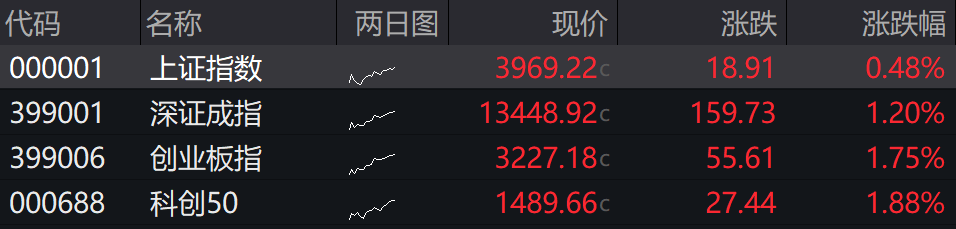
A股三大指数集体高开
第一财经· 2025-10-27 01:49
Core Viewpoint - The article highlights a significant rise in the storage chip sector and related stocks, indicating a positive market sentiment and potential investment opportunities in this area [3][6]. Market Opening Summary - The A-share market opened with all three major indices showing gains: Shanghai Composite Index up by 0.48%, Shenzhen Component Index up by 1.20%, and ChiNext Index up by 1.75% [4][5]. - The Hang Seng Index also opened positively, increasing by 1.28%, with the Hang Seng Tech Index rising by 2.06% [7]. Sector Performance - The storage chip sector experienced a collective surge, with companies like Shikong Technology, Dawi Co., and Yingxin Development hitting the daily limit up, while others like Puran Co. and Weic Technology rose over 10% [3][6]. - Breakthroughs in the photolithography adhesive field contributed to the significant rise in related stocks, while the deep earth economy concept saw a notable pullback, with agriculture, retail, and coal sectors experiencing slight declines [6]. Notable Stock Movements - Specific stock movements included a jump in WuXi AppTec's shares by 7% following a third-quarter net profit that exceeded market expectations [7]. - The overall market sentiment was buoyed by strong performances in technology and pharmaceutical sectors, alongside a general rise in precious metals and related industries [7].


滚动更新丨A股三大指数高开,光刻胶概念股集体大涨
Di Yi Cai Jing· 2025-10-27 01:35
Group 1 - The domestic market has made significant breakthroughs in the photolithography sector, leading to a collective surge in related concept stocks [1] - The storage chip sector continues to perform strongly, with companies like Shikong Technology, Dwei Co., and Yingxin Development hitting the daily limit up, while others like Puran Co. and Weice Technology rose over 10% [1][3] - The A-share market opened with all three major indices rising: Shanghai Composite Index up 0.48%, Shenzhen Component Index up 1.20%, and ChiNext Index up 1.75% [2][3] Group 2 - The Hong Kong market opened with the Hang Seng Index up 1.28% and the Hang Seng Tech Index up 2.06%, driven by gains in tech and pharmaceutical stocks [4][5] - WuXi AppTec saw a significant jump of 7% in its stock price after reporting third-quarter net profits that exceeded market expectations [4] - The central bank conducted a 7-day reverse repurchase operation of 337.3 billion yuan at an interest rate of 1.40%, with 189 billion yuan of reverse repos maturing today [5]
工业稳大盘 连续三个季度增长7%以上
Si Chuan Ri Bao· 2025-10-25 22:03
Core Insights - The industrial sector in Sichuan is showing stable growth, with 35 out of 41 major industries reporting an increase in value added, resulting in a growth coverage of 85.4% [6][7] - The six major advantageous industries in Sichuan have seen a year-on-year increase of 7.5% in value added, with the electronic information industry growing by 15.8% [7][8] - High-tech manufacturing continues to thrive, with a year-on-year increase of 11.6% in value added, maintaining double-digit growth for nine consecutive months [8][9] Industry Performance - The automotive manufacturing sector in Sichuan has experienced a significant year-on-year increase of 18.3% in value added, contributing to the overall industrial growth [6][7] - The electrical machinery and equipment manufacturing sector, along with computer, communication, and other electronic equipment manufacturing, collectively contributed 3.5 percentage points to the province's industrial growth [6][7] - The advanced materials industry has shown a year-on-year growth of 4.7%, with an acceleration of 3.8 percentage points compared to the first half of the year [7][8] High-Tech Manufacturing - The aerospace and equipment manufacturing sector has reported a remarkable year-on-year growth of 21.6%, while the electronic and communication equipment manufacturing sector has grown by 20.2% [9] - New products and applications are driving growth, with companies like Chengdu Weichip Pharmaceutical achieving significant production milestones through innovative drug development [8][9] - The overall revenue for Sichuan's large-scale industrial enterprises reached 32,114.1 billion yuan, with a year-on-year growth of 3.4%, and total profits of 2,193.3 billion yuan, reflecting a 5.8% increase [9]
ST天瑞:10月23日召开董事会会议
Mei Ri Jing Ji Xin Wen· 2025-10-25 03:53
Group 1 - ST Tianrui held its 17th meeting of the 6th board of directors on October 23, 2025, to review the "Q3 2025 Report" and other documents [1] - For the year 2024, ST Tianrui's revenue composition is as follows: Instrument manufacturing accounts for 64.21%, ecological protection and environmental governance accounts for 23.45%, third-party testing services account for 10.42%, and pharmaceutical manufacturing accounts for 1.91% [1] Group 2 - As of the report, ST Tianrui has a market capitalization of 2.3 billion yuan [2] - A well-known brand has made a significant investment of 170 million yuan to acquire 2,000 shares of a target company with a registered capital of only 10,000 Hong Kong dollars, raising questions about the necessity of the acquisition [2]

东北首个万亿城市,越来越近了
Mei Ri Jing Ji Xin Wen· 2025-10-24 23:54
Economic Overview - Dalian's GDP for the first three quarters reached 724.82 billion, with a year-on-year growth of 6.0%, consistent with the first half of the year and 0.8 percentage points higher than the national average [1] - The primary industry added value was 37.03 billion, growing by 4.2%; the secondary industry added value was 257.55 billion, increasing by 8.0%; and the tertiary industry added value was 430.24 billion, rising by 4.9% [1] Industrial Performance - The industrial added value of Dalian increased by 12.8% year-on-year, which is 0.3 percentage points higher than the first half of the year and 10.6 percentage points above the provincial average [2] - Key sectors such as petrochemical and equipment manufacturing showed significant growth, with the petrochemical industry increasing by 8.9% and equipment manufacturing by 17.5%, including a remarkable 64.5% growth in the railway and shipbuilding sector [3] Future Outlook - Dalian aims to achieve a GDP of 951.69 billion by 2024, positioning itself close to the trillion-yuan target, with a strong emphasis on high-quality economic growth [1] - The city is focusing on upgrading traditional industries and has introduced initiatives like the "Green Petrochemical Cluster Cultivation and Enhancement Action Plan (2025-2027)" to enhance its industrial capabilities [2]
天士力医药集团股份有限公司2025年第三季度报告
Shang Hai Zheng Quan Bao· 2025-10-24 20:20
Core Viewpoint - The company, Tian Shi Li Pharmaceutical Group Co., Ltd., has released its third-quarter report for 2025, indicating a decline in revenue across its pharmaceutical industrial and commercial sectors [3][11]. Financial Performance - The company's revenue for the first nine months of 2025 decreased by 2.35% compared to the same period last year, with pharmaceutical industrial revenue down by 0.47% and pharmaceutical commercial revenue down by 16.70% [3][11]. - The financial statements for the third quarter are unaudited, and the company has confirmed the accuracy and completeness of the financial information provided [2][3]. Corporate Governance - The board of directors and senior management have guaranteed the authenticity and completeness of the quarterly report, taking legal responsibility for any misrepresentation or omissions [2][8]. - The ninth board meeting of the company was held on October 23, 2025, where the third-quarter report and organizational structure adjustments were approved unanimously by all attending members [8][9]. Organizational Changes - The company has proposed adjustments to its organizational structure to enhance operational efficiency and effectiveness in response to its development needs [8].

城市24小时 | 东北首个万亿城市,越来越近了
Mei Ri Jing Ji Xin Wen· 2025-10-24 15:55
Economic Overview - Dalian's GDP for the first three quarters reached 724.82 billion yuan, with a year-on-year growth of 6.0%, matching the growth rate of the first half of the year and exceeding the national average by 0.8 percentage points [1][2] - The primary industry added value was 37.03 billion yuan (up 4.2%), the secondary industry 257.55 billion yuan (up 8.0%), and the tertiary industry 430.24 billion yuan (up 4.9%) [1] Industrial Performance - Dalian's industrial output value for large-scale enterprises grew by 12.8% year-on-year, an increase of 0.3 percentage points compared to the first half of the year, and outperformed the provincial average by 10.6 percentage points [2][3] - The petrochemical industry saw an increase of 8.9%, while the equipment manufacturing sector grew by 17.5%, with notable growth in the railway and shipbuilding industries at 64.5% and the automotive industry at 26.3% [3] Strategic Initiatives - Dalian has launched initiatives to upgrade traditional industries, including the "Green Petrochemical Cluster Cultivation and Enhancement Action Plan (2025-2027)" aimed at elevating the city's petrochemical sector to a world-class level [2] - The city aims to establish a world-class base for green shipbuilding and marine engineering by 2027, targeting an industry scale exceeding 100 billion yuan [2] Future Outlook - Dalian is positioned to achieve its annual GDP growth target of over 5.5%, supported by strong industrial performance and strategic initiatives [2][3] - The city is on track to reach a GDP of 951.69 billion yuan in 2024, nearing the trillion-yuan milestone [1]

健友股份:10月24日召开董事会会议
Mei Ri Jing Ji Xin Wen· 2025-10-24 12:40
Group 1 - The core point of the article is that Jianyou Co., Ltd. (SH 603707) held its 15th meeting of the 5th board of directors on October 24, 2025, to review the proposal for the company's Q3 2025 report [1] - For the year 2024, Jianyou Co., Ltd.'s revenue composition is 99.85% from the pharmaceutical manufacturing industry and 0.15% from other businesses [1] - As of the report date, Jianyou Co., Ltd. has a market capitalization of 15.6 billion yuan [1] Group 2 - The article mentions that Chinese innovative drugs have sold overseas licenses worth 80 billion USD this year [1] - It highlights a conversation with Lu Gang, a partner at Chuangdong Investment, discussing the hot secondary market in biomedicine while the primary market faces fundraising challenges [1]

哈药股份前三季度净利3.29亿元,同比下降35.35%
Bei Jing Shang Bao· 2025-10-24 11:05
Core Viewpoint - The company reported a decline in both revenue and net profit for the first three quarters of 2025, reflecting challenges in the pharmaceutical industry due to structural adjustments and intensified competition [1] Financial Performance - The company's revenue for the first three quarters reached 12.021 billion, a year-on-year decrease of 1.92% [1] - The net profit attributable to shareholders was 329 million, down 35.35% year-on-year [1] Industry Context - The pharmaceutical industry is undergoing structural adjustments and deepening transformations, leading to increased market competition [1] - Resources in the industry are rapidly concentrating towards leading enterprises, resulting in a significant increase in market concentration [1] - Non-pharmaceutical formulations are aggressively capturing market share through strong promotional efforts [1] Sales and Market Dynamics - The third quarter experienced a sales lull, leading to decreased customer demand [1] - Despite the company's timely adjustments in sales strategies and increased promotional efforts to stabilize market share, sales pressure remains evident [1] - Major products such as compound calcium gluconate oral solution, double yellow liquid, amoxicillin capsules, and calcium-iron-zinc oral solution saw a decline in revenue, contributing to the downturn in the pharmaceutical industrial segment [1] Pharmaceutical Commercial Sector - The wholesale segment is facing ongoing impacts from centralized procurement policies, which are tightening profit margins [1] - Changes in sales have led to corresponding fluctuations in operating expenses [1] - An increase in provisions for bad debts has been noted due to changes in the aging of accounts receivable [1]

我武生物:接受中泰证券等投资者调研
Mei Ri Jing Ji Xin Wen· 2025-10-24 10:16
Group 1 - The core viewpoint of the news is that Iwubio (SZ 300357) is actively engaging with investors, as evidenced by a recent investor meeting where the company's chairman addressed questions [1] - Iwubio's revenue composition for the first half of 2025 shows that pharmaceutical manufacturing accounts for 99.59% of its total revenue, indicating a strong focus on this sector [2] - As of the latest report, Iwubio's market capitalization stands at 17.2 billion yuan, reflecting its valuation in the market [3] Group 2 - The Chinese innovative drug market has seen significant overseas licensing deals, totaling 80 billion USD this year, highlighting the growth potential in the biopharmaceutical sector [3] - There is a contrast between the hot secondary market for biopharmaceuticals and the cooling fundraising environment in the primary market, suggesting challenges ahead for new capital raising [3]

