机械

Search documents
再融资超8000亿,双刃剑会砍翻两个两种股!
Sou Hu Cai Jing· 2025-09-14 12:40
Core Viewpoint - The A-share refinancing market has reached a historical high of 800 billion, raising concerns about a potential repeat of past market behaviors where institutional investors manipulate stock prices, leaving retail investors vulnerable [1][12]. Group 1: Market Dynamics - The current market exhibits a "stronger gets stronger" phenomenon, driven by external leverage, with retail investors often misattributing stock price increases to news stimuli [3][5]. - Institutional investors are engaging in a "hot potato" game, where they inflate stock prices through positive news, only to exit when prices peak, leaving retail investors to bear the losses [5][12]. Group 2: Institutional Behavior - A classification system for institutional trading characteristics reveals four levels of activity, with the first two levels indicating active participation and strategic locking of positions, respectively [7][10]. - During periods of price decline, retail investors tend to panic and sell, which is often a calculated move by institutions to buy at lower prices [9][12]. Group 3: Investment Strategy - To avoid being exploited in the 800 billion refinancing frenzy, retail investors must focus on understanding the true movements of capital rather than relying on traditional technical analysis [12][15]. - The influx of refinancing funds into technology innovation sectors should be approached with caution, as the ultimate burden of these investments will fall on someone, often the retail investors [12][15].

9月14日周末公告汇总 | 大基金入股拓荆科技子公司;东材科技高速电子树脂间接供应英伟达等主流服务器体系
Xuan Gu Bao· 2025-09-14 11:54
Group 1: Capital Increase, Mergers, and Acquisitions - Aerospace Electronics plans to swap assets worth 800-1,000 million to enhance its industrial chain [1] - Tianhua New Energy intends to acquire 75% equity of Suzhou Tianhua Times for 1,254 million, transferring control of lithium resource investment to the listed company [1] - Tuojing Technology aims to raise no more than 4,600 million through a private placement for high-end semiconductor equipment industrialization projects; additionally, the Big Fund Phase III will invest no more than 450 million in Tuojing Technology, becoming its second-largest shareholder [1] - Qianjin Pharmaceutical's plan to increase capital for acquiring 28.92% equity of Hunan Qianjin Xiangjiang Pharmaceutical and 68% equity of Qianjin Xieli Pharmaceutical has been approved [1] Group 2: Share Buybacks and Equity Transfers - Yishitong plans to repurchase shares worth 30-55 million, with a maximum price of 40.69 yuan per share [2] - Shanghai Yizhong intends to repurchase shares worth 30-35 million, with a maximum price of 106.08 yuan per share [3] - Chuangyuan Co. plans to repurchase 2.8-3.7 million shares, with a maximum price of 41.5 yuan per share, for future employee stock ownership plans [3] - JinkoSolar's shareholder plans to transfer 4% of shares through inquiry [4] - Huading Co.'s shareholder intends to transfer a total of 9.26% of shares through public solicitation [5] - BGI's shareholder plans to transfer 4% of shares through inquiry [6] Group 3: External Investments and Daily Operations - Nanfeng Co. plans to invest 50 million in fixed assets for a 3D printing service project [7] - Jingjiawei signed a strategic cooperation agreement with Anchaoyun Software [8] - Longjing Environmental Protection's wholly-owned subsidiary acquired 80% of GML, gaining development rights for a 140MW hydropower project in the Democratic Republic of the Congo, with a total investment of approximately 399 million [8] - Boshi Co. signed a contract with Guoneng Yulin for a chemical packaging operation project, with a contract amount of approximately 235 million [8] - Zhongchao Holdings signed a strategic cooperation agreement with Hefei Intelligent Robot Research Institute [9] - Dongcai Technology's high-speed electronic resin has been supplied to major server systems including Nvidia [10] - Chiplink Integration plans to transfer some technology and equipment for no less than 458 million [10] - Huibo Yuntong's related party plans to acquire 22.0875% of Baode Computing [10] - Shanghai Mechanical and Electrical plans to transfer 67% equity of its subsidiary Simik Welding Materials [10] - Wan'an Technology intends to acquire 2.72% equity of Tongchuan Technology through capital increase [10] - Guodun Quantum plans to sign two sales contracts with China Telecom Quantum Group [10] - Sinopec Oilfield Services' wholly-owned subsidiary is expected to win a construction project worth 858 million from the National Pipeline Group [11]

新一轮重点行业稳增长方案出台 “稳”字背后释放哪些深意?
Xin Hua Wang· 2025-09-12 23:51
Core Viewpoint - A new round of growth stabilization plans for ten key industries has been launched, focusing on maintaining reasonable growth rates and improving efficiency and structure in the context of changing external environments and internal economic adjustments [1][2]. Group 1: Reasons for Launching the Growth Stabilization Plans - The previous growth stabilization plan was initiated when the industrial added value growth rate was only 3.8%, amidst pressures from domestic demand contraction, supply shocks, and weakened expectations [2]. - Currently, the industrial economy is showing a positive trend, with a 6.4% year-on-year growth in industrial added value in the first half of the year, but challenges remain due to external complexities and structural contradictions [2][4]. - The new plans aim to enhance the quality of supply, optimize the development environment, and achieve both qualitative and reasonable quantitative growth in key industries [2][6]. Group 2: Key Industries Identified - The ten key industries targeted in the growth stabilization plans include steel, non-ferrous metals, petrochemicals, chemicals, building materials, machinery, automobiles, power equipment, light industry, and electronic information manufacturing [3][4]. - These industries collectively account for approximately 70% of the industrial output above designated size, indicating their critical role in stabilizing the industrial and national economy [4]. Group 3: Policy Focus Areas - The plans emphasize stimulating innovation by addressing both supply and demand sides, including enhancing technological innovation, quality standards, and promoting digital, intelligent, and green transformations [6][8]. - Artificial intelligence is highlighted as a key driver for innovation across the entire industrial chain, with specific initiatives in electronic information manufacturing and power equipment sectors [7][8]. - The plans also propose measures to upgrade traditional consumption, expand new consumption scenarios, and promote new business models [8][9]. Group 4: Opportunities for Enterprises - The plans provide tailored strategies for each segment of the industrial chain, signaling a shift from price competition to competition based on technology, quality, and brand [10]. - Specific innovation targets are outlined, such as developing high-performance lightweight XR devices and supporting key product innovation projects in new energy and smart grid equipment [10]. - Support measures for enterprises include tax incentives, platform construction for testing, and encouragement for small and medium enterprises to focus on differentiated development [10][11].
新一轮重点行业稳增长方案出台 背后释放哪些深意?
Xin Hua Wang· 2025-09-12 22:58
Core Viewpoint - A new round of growth stabilization plans for ten key industries has been launched, focusing on maintaining reasonable growth rates and improving efficiency and structure in the context of changing external environments and internal economic adjustments [1][2]. Group 1: Reasons for Launching the Growth Stabilization Plans - In 2023, the industrial added value growth rate was only 3.8%, necessitating measures to stabilize the industrial base amid domestic demand contraction and supply shocks [2]. - Currently, the industrial economy is showing a positive trend, with a 6.4% year-on-year growth in industrial added value in the first half of the year, but challenges remain due to external uncertainties and structural contradictions [2]. - The plans aim to enhance the quality of supply, optimize the development environment, and promote both qualitative and quantitative improvements in the industry [2]. Group 2: Key Industries Identified - The ten key industries targeted for growth stabilization include steel, non-ferrous metals, petrochemicals, chemicals, building materials, machinery, automobiles, electrical equipment, light industry, and electronic information manufacturing, which collectively account for about 70% of the industrial economy [3][4]. Group 3: Policy Focus Areas - The plans emphasize innovation and transformation on both the supply and demand sides, including strengthening technological innovation, quality standards, and promoting digital and green transformations [6]. - Artificial intelligence is highlighted as a crucial element in the plans, driving innovation across the entire industry chain from chips to smart terminals [7][8]. Group 4: Opportunities for Enterprises - The plans signal a shift from price competition to competition based on technology, quality, and brand, encouraging enterprises to focus on high-value-added products [10]. - Specific measures include tax incentives, support for key product innovation projects, and encouragement for small and specialized enterprises to develop differentiated products [10]. - The plans also emphasize the role of major projects in driving investment and consumption, which is vital for stabilizing and improving the quality of key industries [9]. Group 5: Future Potential - As the growth stabilization plans are implemented, the development potential of these key industries is expected to be continuously released [11].
【新华解读】新一轮重点行业稳增长方案出台 “稳”字背后释放哪些深意?
Xin Hua She· 2025-09-12 18:01
Core Viewpoint - A new round of key industry growth stabilization plans has been launched, focusing on ten major industries to support economic stability and growth amid changing external environments and internal economic adjustments [1][2]. Group 1: Key Industries - The ten key industries targeted for growth stabilization include steel, non-ferrous metals, petrochemicals, chemicals, building materials, machinery, automobiles, power equipment, light industry, and electronic information manufacturing [3][4]. - These industries collectively account for approximately 70% of the industrial output above a designated scale, indicating their critical role in stabilizing the industrial and national economy [4]. Group 2: Economic Context - In 2023, the industrial added value growth rate was only 3.8%, necessitating measures to stabilize the industrial base and maintain reasonable growth rates to support the overall economy [2]. - By the first half of the year, the industrial added value had increased by 6.4% year-on-year, reflecting a positive trend despite ongoing external uncertainties and structural challenges [2]. Group 3: Policy Focus - The stabilization plans emphasize enhancing supply capabilities, optimizing industry development environments, and promoting qualitative improvements and reasonable growth in key industries [2][6]. - Specific measures include strengthening technological innovation, improving quality standards, and facilitating digital, intelligent, and green transformations within industries [6]. Group 4: Role of New Technologies - Artificial intelligence is highlighted as a crucial element in the stabilization plans, driving innovation across the entire industrial chain from chips to smart terminals [7]. - The plans also focus on promoting major engineering projects to stimulate investment and consumption, which are vital for improving quality within key industries [7]. Group 5: Opportunities for Enterprises - The plans provide tailored strategies for each segment of the industry chain, encouraging a shift from price competition to competition based on technology, quality, and brand [9]. - Support measures for enterprises include tax incentives, platform construction for testing innovations, and encouragement for small and medium enterprises to focus on niche markets [9]. Group 6: Future Potential - As the growth stabilization plans are implemented, the development potential of these key industries is expected to be continuously released, contributing to overall economic stability [10].

新华解码|新一轮重点行业稳增长方案出台 “稳”字背后释放哪些深意?
Xin Hua Wang· 2025-09-12 16:49
Core Viewpoint - A new round of growth stabilization plans for ten key industries has been launched, focusing on maintaining reasonable growth rates and improving efficiency and structure in the context of changing external environments and internal economic adjustments [1][2]. Group 1: Reasons for Launching the New Plans - The previous growth stabilization plan was initiated when the industrial added value growth rate was only 3.8%, amidst pressures from domestic demand contraction, supply shocks, and weakened expectations [2]. - Currently, the industrial economy is showing a positive trend, with a 6.4% year-on-year growth in industrial added value in the first half of the year, but challenges remain due to external complexities and structural contradictions [2][4]. - The new plans aim to enhance the quality of supply, optimize the development environment, and achieve both qualitative and reasonable quantitative growth in key industries [2][6]. Group 2: Key Industries Identified - The ten key industries targeted in the growth stabilization plans include steel, non-ferrous metals, petrochemicals, chemicals, building materials, machinery, automobiles, electric equipment, light industry, and electronic information manufacturing [3][4]. - These industries collectively account for approximately 70% of the industrial output above designated size, indicating their critical role in stabilizing the industrial and national economy [4]. Group 3: Policy Focus Areas - The plans emphasize stimulating innovation by addressing both supply and demand sides, including enhancing technological innovation, quality standards, and promoting digital, intelligent, and green transformations [6][10]. - Artificial intelligence is highlighted as a key driver for innovation across the entire industrial chain, with specific initiatives in electronic information manufacturing and electric equipment sectors [7][8]. - The plans also propose measures to upgrade traditional consumption, expand new consumption scenarios, and promote new business models [10]. Group 4: Opportunities for Enterprises - The plans signal a shift from irrational competition to a focus on technology, quality, and brand, encouraging enterprises to develop high-value-added products [10]. - Specific guidance is provided for technological and industrial innovation, including the development of new terminal devices and support for key product innovation projects in renewable energy and smart grid equipment [10]. - Support measures for enterprises include tax incentives, platform construction for testing, and encouragement for small and specialized enterprises to focus on differentiated development [10][11].
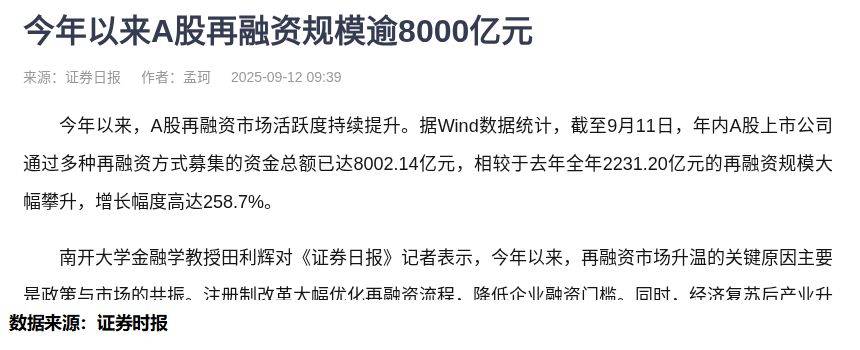
今年以来A股再融资规模逾8000亿元 较去年全年增幅高达258.7%
Cai Jing Wang· 2025-09-12 10:54
Group 1 - The A-share refinancing market has seen significant activity in 2023, with total funds raised reaching 800.21 billion yuan, a 258.7% increase compared to last year's total of 223.12 billion yuan [1] - The surge in refinancing is attributed to a combination of policy and market factors, including the optimization of the refinancing process through the registration system reform and increased funding needs in sectors like new energy and semiconductors [1][2] - The private placement market has been particularly strong, with 108 projects completed, raising 756.43 billion yuan, marking a 337.1% increase from the previous year [1] Group 2 - Three main factors driving the refinancing market's growth include improved macro policy environment, increased internal demand from companies due to economic recovery, and ample market liquidity with institutional investors actively participating [2] - The number of disclosed private placement plans has reached 424, with an average expected fundraising of 1.10 billion yuan per project [2] - The manufacturing and high-tech industries are the primary drivers of refinancing, with significant activity in sectors such as chemicals, machinery, and semiconductors [3] Group 3 - The characteristics of the refinancing market in 2023 include a notable rebound in private placements and a targeted flow of funds towards technological innovation [3] - The active refinancing market enhances the capital market's ability to serve the real economy, supporting companies in expanding investments and upgrading technology [3] - The allocation of refinancing funds towards key areas like technological innovation and green low-carbon initiatives promotes economic structure optimization and fosters new productive forces [3]
西部唯一沿海省份,不愿放过出海生意
3 6 Ke· 2025-09-12 02:11
Group 1: Trade Relations and Economic Impact - ASEAN has become an important part of China's foreign trade, with China being ASEAN's largest trading partner for 16 consecutive years and ASEAN being China's top trading partner for five years [1][2] - In the first seven months of this year, trade between China and ASEAN reached $597 billion, a year-on-year increase of 8.2%, accounting for 16.7% of China's total foreign trade [1] - From 2004 to 2024, Guangxi's trade with ASEAN increased from 8.29 billion to 397.82 billion, a growth of approximately 48 times [6] Group 2: Challenges Faced by Guangxi - Guangxi faces geographical limitations, as its rivers flow eastward into Guangdong, leading to increased transportation costs and causing goods to be exported through the Pearl River Delta instead of Guangxi [8][9] - The industrial structure in Guangxi is relatively weak, with many industries being at the low end of the value chain, resulting in limited competitiveness [10] - Despite being a coastal province, Guangxi's trade with ASEAN is overshadowed by Guangdong, which has become ASEAN's largest trading partner since 2020, with trade expected to reach 1.5 trillion by 2024 [7] Group 3: Infrastructure and Industrial Development - Guangxi is actively working on infrastructure projects, such as the Pinglu Canal, which is expected to significantly shorten shipping routes and save logistics costs [12] - The region is also enhancing its transportation network to connect with the Guangdong-Hong Kong-Macao Greater Bay Area, aiming to establish a modern comprehensive transportation system [12] - Guangxi is focusing on strengthening its industrial chains in sectors like new energy vehicles and fine chemicals, aiming to become a key supplier for the Greater Bay Area [12][13] Group 4: Digital Economy and AI Initiatives - The upcoming China-ASEAN Expo will focus on artificial intelligence and the digital economy, marking a shift in cooperation towards a "3.0 era" [1] - Guangxi aims to establish itself as a hub for AI industries, with plans to achieve an output value of over 100 billion in AI-related industries by 2027 [14] - The region is also looking to leverage its geographical advantages to capitalize on the growing digital economy in ASEAN, which is projected to reach $263 billion in 2024 [13][14]
今年以来A股再融资规模逾8000亿元
Zheng Quan Ri Bao· 2025-09-11 16:45
Group 1 - The A-share refinancing market has seen significant activity in 2023, with total funds raised reaching 800.21 billion yuan, a 258.7% increase compared to last year's total of 223.12 billion yuan [1] - The surge in refinancing is attributed to policy and market resonance, including the optimization of the refinancing process through registration system reforms and increased funding needs in sectors like new energy and semiconductors [1][2] - The private placement market has been particularly strong, with 108 projects completed, raising 756.43 billion yuan, marking a 337.1% increase from the previous year [1][2] Group 2 - Three main factors driving the refinancing market's growth include improved macro policy environment, increased internal demand from companies, and ample market liquidity [2] - The number of disclosed private placement plans has reached 424, with an average expected fundraising of 1.10 billion yuan per project [2] - The manufacturing and high-tech industries are the primary drivers of refinancing, with significant activity in sectors such as chemicals, machinery, and semiconductors [3] Group 3 - The active refinancing market enhances the capital market's ability to serve the real economy, supporting companies in expanding investments, upgrading technology, and facilitating mergers and acquisitions [3] - The allocation of refinancing funds is increasingly directed towards technology innovation and green low-carbon initiatives, promoting economic structure optimization [3] - The refinancing market provides diverse investment tools for investors, attracting long-term capital and contributing to a multi-tiered capital market system [3]
对话菁英投顾——“多金多玉组合”主创洪金钰
申万宏源证券上海北京西路营业部· 2025-09-11 02:51
Core Viewpoint - The article emphasizes the importance of balancing value investing with trend following, highlighting that investors often lose money during bull markets due to overconfidence and neglecting risk management [2][3]. Market Overview - The A-share market is currently experiencing wide fluctuations with clear structural characteristics, indicating that quality assets often present buying opportunities during corrections [7]. - The driving forces behind this year's structural market include continuous inflows of incremental capital, the relocation of household deposits, expanded financing balances, and foreign capital returning [7]. - Growth stocks, particularly in technology sectors like AI computing and semiconductors, remain favored in the current market environment [7]. Investment Philosophy - The "Four Good Principles" for stock selection include: - Good Industry: Focus on high-ceiling industries with clear business models and avoid sunset industries [10]. - Good Company: Select leading firms with strong competitive advantages and solid financial health [10]. - Good Price: Invest when the market undervalues a company, adhering to the principle of safety margin [10]. - Good Patience: Maintain a long-term perspective and avoid reacting to short-term market noise [11]. Investment Strategy - The "Duojin Duoyu Combination" service product has achieved a relative return of 114.37% compared to the CSI 500 index over its first year [13]. - The strategy combines deep fundamental research with trend-following tactics, focusing on both long-term value and short-term growth opportunities [13]. Trend Analysis - True Trends (Fundamental Trends): Focus on industries aligned with national policies and societal changes, selecting sectors expected to thrive in the next 3-5 years [14]. - Market Trends: Identify stocks in upward price channels through technical indicators and gauge market sentiment to capture thematic investment opportunities [16]. Positioning Strategy - Core Position (50%-70%): Invest in high-quality companies for long-term growth, making adjustments only for significant fundamental changes [17]. - Swing Position (30%-50%): Target stocks with both strong fundamentals and market momentum for capturing mid-term investment opportunities [17]. Buying and Selling Strategies - Buying Strategy: - Core Position: Use a pyramid buying approach, adding to positions as prices decline [18]. - Swing Position: Enter when stocks break through key resistance levels [18]. - Selling Strategy: - Core Position: Sell if fundamental logic is broken or if valuations reach historical highs [19]. - Swing Position: Sell upon reaching target returns or if technical trends deteriorate [20]. Risk Management - Maintain strict risk control measures, including limiting exposure to any single industry and individual stock [20]. - Regularly reassess portfolio allocations based on market conditions and overall valuation levels [21]. Insights - The article concludes with the importance of maintaining rationality, adhering to established strategies, and having patience in the investment journey [23].