
生猪养殖

Search documents
温氏股份涨2.01%,成交额7.24亿元,主力资金净流入3270.10万元
Xin Lang Cai Jing· 2025-11-10 05:26
Core Viewpoint - The stock of Wens Foodstuff Group Co., Ltd. has shown a positive trend with a 14.23% increase year-to-date, despite a slight decline in recent trading days [1][2]. Financial Performance - For the period from January to September 2025, Wens achieved a revenue of 758.17 billion yuan, reflecting a year-on-year growth of 0.53%. However, the net profit attributable to shareholders decreased by 17.98% to 52.56 billion yuan [2]. - Cumulatively, the company has distributed 301.10 billion yuan in dividends since its A-share listing, with 69.35 billion yuan distributed over the past three years [3]. Shareholder Information - As of September 30, 2025, the number of shareholders for Wens was 81,100, a decrease of 10.94% from the previous period. The average number of tradable shares per shareholder increased by 12.11% to 73,543 shares [2]. - Among the top ten circulating shareholders, Hong Kong Central Clearing Limited holds 144 million shares, an increase of 5.50 million shares compared to the previous period. Conversely, E Fund's ChiNext ETF reduced its holdings by 19.09 million shares to 113 million shares [3]. Stock Market Activity - On November 10, Wens' stock price rose by 2.01% to 18.29 yuan per share, with a trading volume of 724 million yuan and a turnover rate of 0.67%. The total market capitalization reached 121.7 billion yuan [1]. - The net inflow of main funds was 32.71 million yuan, with significant buying and selling activities recorded [1].

德康农牧早盘涨超5% 行业反内卷有望支撑猪价 机构看好公司后续估值修复空间
Zhi Tong Cai Jing· 2025-11-10 04:04
Group 1 - The core viewpoint of the article highlights the need for the pig industry to overcome challenges through capacity regulation and industry self-discipline to achieve high-quality development [1] - Analysts suggest that the industry's efforts to counteract internal competition are expected to support the medium to long-term performance of pig prices [1] - The stock price of Dekang Agriculture (02419) rose over 5% in early trading, reflecting positive market sentiment, with a current price of 69.7 HKD and a trading volume of 42.34 million HKD [1] Group 2 - Guosen Securities reports that Dekang Agriculture is innovatively implementing a "company + sow breeding and fattening farm" model, which allows for lighter asset expansion and more stable cooperation with farmers [1] - The company aims to exceed a slaughter scale of 10 million heads by 2025, maintaining a rapid growth rate in output [1] - Dekang Agriculture's profitability per head is expected to be above the industry average, indicating potential for valuation recovery in the future [1]
10月CPI同比回升0.2%,消费ETF龙头(560680)盘中冲高涨超2%,跟踪标的估值处近3年低位,权重股泸州老窖涨超6%
Xin Lang Cai Jing· 2025-11-10 03:49
Group 1: Economic Indicators - In October, the Consumer Price Index (CPI) increased by 0.2% month-on-month and year-on-year, while the core CPI, excluding food and energy, rose by 1.2%, marking the sixth consecutive month of growth [1] - The Producer Price Index (PPI) saw a month-on-month increase of 0.1%, representing the first rise of the year [1] - The improvement in core CPI and PPI indicates a positive trend, driven by stable service consumption, rising gold prices, and higher food prices [1] Group 2: Industry Analysis - The liquor sector has underperformed significantly since 2025, with the CITIC liquor index down 4.6% year-to-date, lagging behind major indices by 22.5 and 30.9 percentage points [2] - Despite ongoing pressure on the liquor industry's fundamentals, a bottoming out is anticipated in the second half of 2025, with expectations of a recovery in 2026 as demand gradually improves [2] - The pig farming industry is currently facing weak realities and expectations, with both fat and piglet prices at yearly lows, leading to widespread losses [2] - A reduction in breeding sow inventory by 0.77% in October suggests a potential market-driven capacity reduction, which may support long-term price increases for pigs [2] Group 3: ETF Performance - As of November 10, 2025, the major consumption index rose by 2.46%, with the leading consumption ETF (560680) increasing by 2.22% [3] - The top ten weighted stocks in the index accounted for 68.28%, with notable increases in stocks like Luzhou Laojiao and Shanxi Fenjiu [3] - The consumption ETF's price-to-earnings ratio (PE-TTM) stands at 19.95, indicating it is at a historical low compared to the past three years [3] - The leading consumption ETF saw a scale increase of 543.94 million yuan in the past week, with significant net inflows over the last five trading days [3]


猪价再度跌破12元/公斤,养殖端延续亏损,资金逆势布局“养猪ETF”
2 1 Shi Ji Jing Ji Bao Dao· 2025-11-10 03:37
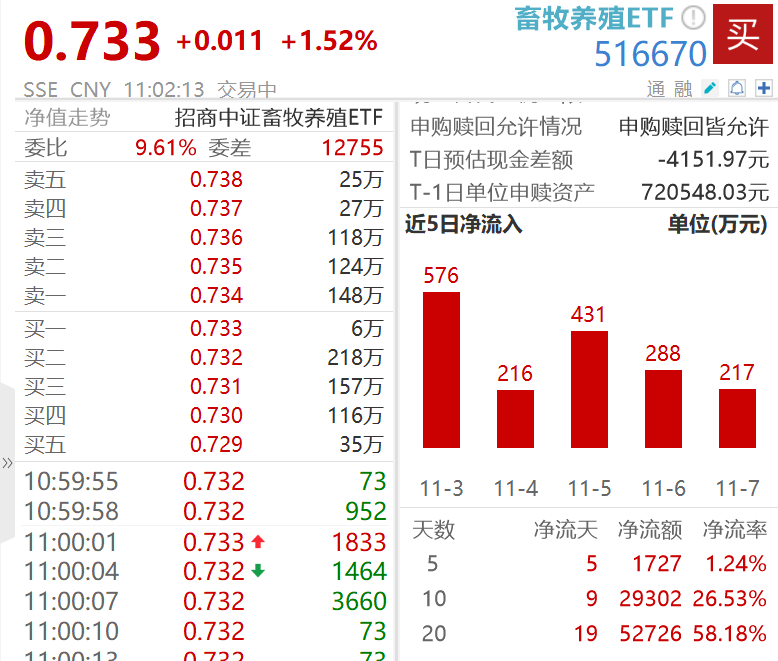
Core Insights - The pork stocks have shown strength, with notable increases in shares of companies like Luoniushan and Muyuan Foods, indicating a positive market sentiment in the pork industry [1] - The Livestock Breeding ETF (516670) has experienced significant net inflows, suggesting growing investor interest in the sector [1][4] Industry Summary - As of November 9, the average price of live pigs in China is 11.90 CNY/kg, reflecting a week-on-week decrease of 0.30 CNY/kg and a year-on-year decline of 4.80% [2][3] - Current breeding profits for self-bred pigs are at a loss of 89.21 CNY per head, while purchased piglets incur a loss of 175.54 CNY per head, indicating a challenging profitability landscape for pig farmers [3] - The industry is facing a potential capacity reduction due to weak prices and policy-driven initiatives, with the price of fat pigs dropping below 12 CNY/kg [3] - Short-term projections suggest an increase in piglet numbers from May to September 2025, which may lead to higher market supply and continued pressure on prices [3] - The Livestock Breeding ETF has the lowest management fee rate of 0.2% per year among ETFs tracking the livestock breeding index, making it an attractive option for investors [4]

牧原股份涨2.05%,成交额6.08亿元,主力资金净流入1048.79万元
Xin Lang Zheng Quan· 2025-11-10 02:49
截至9月30日,牧原股份股东户数18.56万,较上期减少11.19%;人均流通股20534股,较上期增加 12.60%。2025年1月-9月,牧原股份实现营业收入1117.90亿元,同比增长15.52%;归母净利润147.79亿 元,同比增长41.01%。 分红方面,牧原股份A股上市后累计派现265.76亿元。近三年,累计派现165.94亿元。 牧原股份今年以来股价涨37.26%,近5个交易日涨0.85%,近20日跌3.01%,近60日涨10.88%。 资料显示,牧原食品股份有限公司位于河南省南阳市卧龙区龙升工业园区,香港铜锣湾希慎道33号利园1 期19楼1920室,成立日期2000年7月13日,上市日期2014年1月28日,公司主营业务涉及生猪的养殖销 售、生猪屠宰。主营业务收入构成为:生猪98.68%,屠宰、肉食产品25.30%,饲料原料1.63%,其他 0.49%。 牧原股份所属申万行业为:农林牧渔-养殖业-生猪养殖。所属概念板块包括:猪肉概念、生态农业、合 成生物、乡村振兴、基金重仓等。 11月10日,牧原股份盘中上涨2.05%,截至10:40,报50.73元/股,成交6.08亿元,换手率0.32%, ...
农业重点数据跟踪周报:生猪供应仍存压力,产能去化或加速-20251109
CAITONG SECURITIES· 2025-11-09 14:34
Core Insights - The report maintains a positive outlook on the agricultural sector, particularly in pig farming, despite ongoing supply pressures and potential acceleration in capacity reduction [1][5][6]. Group 1: Pig Farming - Supply pressures continue to be significant, with a reported decrease in the number of breeding sows by 0.77% month-on-month in October [5][17]. - The average price of market pigs has declined to 12.16 CNY/kg as of November 6, reflecting a week-on-week decrease of 0.49% [5][26]. - The profitability of pig farming remains negative, with losses reported at -89.21 CNY per head for self-bred pigs and -175.54 CNY per head for purchased piglets as of November 7 [5][37]. Group 2: Poultry Farming - The average price of white feather broilers remained stable at 7.09 CNY/kg as of November 7, with a reported loss of -1.25 CNY per bird [5][38]. - The number of breeding chickens has increased significantly, with a 143.18% month-on-month rise in the number of grandparent stock updated in October [5][38]. Group 3: Animal Health - The demand for animal health products is expected to rebound, driven by a recovery in breeding cycles and an increase in inventory levels [5][47]. - The report highlights the ongoing development of vaccines, including progress in African swine fever vaccine trials, which may enhance the sector's growth potential [5][47]. Group 4: Seed Industry - The average prices for wheat, soybean meal, and corn have shown slight declines, with wheat at 2487 CNY/ton, soybean meal at 3098 CNY/ton, and corn at 2239 CNY/ton as of November 7 [5][51]. - The report emphasizes the importance of food security and the promotion of biotechnology in the seed industry [5][51]. Group 5: Pet Industry - Pet food exports amounted to 823 million CNY in September, reflecting a year-on-year decrease of 6.8%, while domestic sales continue to grow, with a 3% increase across major e-commerce platforms [5][56][59]. - The report suggests that companies with a lower proportion of export business may be less affected by tariff disruptions, while those focusing on domestic growth are likely to enhance their market share [5][56][59].


猪价“跌跌不休” 行业逼近亏损线,如何破局?
Zheng Quan Shi Bao· 2025-11-09 12:51
Core Viewpoint - The price of live pigs has dropped significantly, falling below 12 yuan/kg for the first time this year, with a year-on-year decline of over 30% [1][2] Group 1: Price Trends - In October, the average price of live pigs in the national market also fell below 12 yuan/kg, showing no clear signs of recovery [1] - The continuous decline in pig prices is primarily due to an oversupply in the market [1] Group 2: Cost and Production - Advances in large-scale production, breeding technology, and refined management have led to a decrease in overall pig farming costs [1] - Some companies have reported that their total breeding costs have fallen below 12 yuan/kg, with the best-performing farms achieving costs below 11 yuan/kg [1] Group 3: Financial Impact on Companies - The ongoing decline in pig prices has significantly impacted the revenue and profits of related pig farming companies, with many facing substantial drops in profitability [2] - Among 12 A-share listed companies in the pig farming sector, 6 reported a year-on-year decline in revenue for the first three quarters, while 9 saw a drop in net profit, with over half experiencing a profit cut by 50% or more [2] Group 4: Industry Outlook - If pig prices continue to decline sharply, widespread losses among pig farming companies may occur, negatively affecting sustainable operations and potentially impacting local employment and economies [2] - There is a need for government guidance and for companies to enhance technology and management to ensure quality and cost control, promoting high-quality development in the industry [2]
天邦食品预重整三度延期 董事长因信披违规收监管函
Zhong Guo Jing Ying Bao· 2025-11-09 12:45
Core Viewpoint - Tianbang Food's restructuring process has been delayed again, extending the pre-restructuring period to May 9, 2026, marking the third delay in this process [1][2]. Group 1: Restructuring Process - Tianbang Food initiated its pre-restructuring on August 9, 2024, and has since received multiple extensions from the Ningbo Intermediate People's Court [2]. - The company has been proactive in applying for restructuring due to its inability to repay debts, with a debt-to-asset ratio of 87% as of Q3 2023, which has since improved to 70% with total liabilities reduced from 162 billion to 94.78 billion [2][4]. - The restructuring investors are increasing, with agreements signed with various financial and industrial investors throughout 2025 [4][5]. Group 2: Financial Performance - In the first three quarters of 2025, Tianbang Food reported revenue of 6.719 billion, a year-on-year decrease of 5.98%, and a net profit of 260 million, down 80.65% [6]. - The company experienced a net loss of 92.485 million in Q3 2025, indicating ongoing financial struggles [6]. - In October 2025, the company sold 686,000 pigs, with a sales revenue of 607 million, but the average selling price dropped by 13.98% [7]. Group 3: Operational Challenges - The company faces high breeding costs, with the complete cost of raising pigs at 13.24 yuan/kg, which is higher than competitors like Muyuan Foods and Wens Foodstuffs [7]. - The utilization rate of production capacity is only around 50%, leading to high fixed costs [7][10]. - The overall industry is experiencing downward pressure on pig prices, with significant losses reported in October 2025 [8]. Group 4: Management Changes and Regulatory Issues - The resignation of Vice President Yan Xiaoming, who was responsible for the pork processing business, adds to the uncertainties within the management team [1][9]. - Tianbang Food has faced regulatory scrutiny for information disclosure violations, resulting in warnings issued to its chairman and board secretary [11][12].

农林牧渔行业周报:牛肉供给持续减少,看好牧业周期反转-20251109
SINOLINK SECURITIES· 2025-11-09 12:35
Investment Rating - The report suggests a neutral investment rating for the agricultural sector, indicating that the expected changes in the industry will be relatively stable compared to the broader market [68]. Core Insights - The agricultural sector index has shown a slight increase of 0.79% over the past week, but it has underperformed compared to the Shanghai Composite Index [13][14]. - The report highlights the ongoing challenges in the pig farming industry, with prices continuing to decline and the entire sector currently facing losses [3][21]. - In the poultry farming sector, while white feather chicken prices remain under pressure, yellow feather chicken prices have shown resilience due to improved downstream demand [4][30]. - The beef and dairy sectors are expected to see price increases as the consumption season approaches, despite ongoing losses in these industries [5][36]. - The planting industry is experiencing short-term supply and demand pressures, but there is potential for improvement if there are significant reductions in grain production [6][42]. - The feed and aquaculture sectors are stabilizing, with feed prices remaining steady and certain aquatic product prices showing upward trends [55][58]. Summary by Sections 1. Swine Farming - The average price of commodity pigs is currently 11.91 yuan/kg, down 4.64% week-on-week, with a significant loss in farming profits [21][22]. - The report anticipates a continued increase in pig output in the coming months, with limited seasonal accumulation space for prices to drop further [3][22]. - Long-term prospects for the swine industry remain positive, with recommendations to focus on low-cost, high-quality enterprises such as Muyuan Foods and Wens Foodstuffs [3][22]. 2. Poultry Farming - The average price for white feather chickens is stable at 7.09 yuan/kg, while yellow feather chicken prices are expected to improve due to better demand [4][30]. - The overall profitability in poultry farming is under pressure, but there is potential for recovery if consumer demand strengthens [4][30]. 3. Livestock - Live cattle prices in Shandong are at 26.87 yuan/kg, with expectations for steady increases as the consumption season approaches [5][36]. - The dairy sector is experiencing a decrease in stock trends, but prices are expected to stabilize in the coming year as supply gradually decreases [5][36]. 4. Planting Industry - Domestic corn prices are at 2152.86 yuan/ton, with fluctuations expected due to new crop listings and external uncertainties [6][42]. - The report emphasizes the importance of improving grain yields and the potential for the planting sector to recover if significant reductions in production occur [6][42]. 5. Feed and Aquaculture - Feed prices for fattening pigs are stable at 3.33 yuan/kg, while aquatic product prices are showing positive trends, particularly for shrimp and certain fish species [55][58]. - The report indicates a general stabilization in feed prices, which is beneficial for the overall profitability of the aquaculture sector [55][58].
二育减量明显,猪价僵持
Hua Lian Qi Huo· 2025-11-09 11:59
期货交易咨询业务资格:证监许可【2011】1285号 华联期货生猪周报 二育减量明显 猪价僵持 20251109 蒋琴 交易咨询号:Z0014038 从业资格号:F3027808 0769-22110802 审核:萧勇辉,从业资格号:F03091536,交易咨询号:Z0019917 1 周度观点及策略 2 期现市场 3 产能 4 供给端 5 需求端 6 成本及利润 u 展望:政策面虽持续释放积极信号,但实际产能去化不及预期,市场情绪转弱。本轮期现货共振下跌的行情并非单一因素主导,而 是产能长期过剩、政策调控落地滞后与消费疲软的三重压力叠加所致,目前行业正面临短期价格承压与长期产能出清的关键博弈期。 当前生猪产能依旧过剩,下游需求端疲软,二育短期的入场行为对猪价仅能起到"缓冲作用" ,无法扭转全国生猪市场供增需弱的 格局,养殖端整体进入全面亏损状态,市场情绪偏弱,短期生猪现货行情或延续弱势震荡,期货盘面震荡下跌修复基差。中期来看, 年底天气转冷后,终端对大体重猪的需求会有所增加,同时,南方地区腌腊、灌肠等传统消费需求逐步启动,或对行情形成阶段性 提振。但近年来传统意义上的生猪消费旺季均未能兑现,今年旺季不旺或已 ...