纺织服装

Search documents
鲁泰A(000726.SZ)发布前三季度业绩,归母净利润5.03亿元,增长74.63%
智通财经网· 2025-10-30 12:27
Core Viewpoint - Lutai A (000726.SZ) reported a decrease in revenue for the first three quarters of 2025, while net profit showed significant growth year-on-year [1] Financial Performance - The company's operating revenue for the first three quarters was 4.3 billion yuan, a year-on-year decrease of 2.30% [1] - Net profit attributable to shareholders was 503 million yuan, reflecting a year-on-year increase of 74.63% [1] - The net profit attributable to shareholders after deducting non-recurring gains and losses was 322 million yuan, a year-on-year decrease of 8.21% [1] - Basic earnings per share stood at 0.62 yuan [1]

《纺织服装行业ESG白皮书》发布 嘉麟杰以绿色智造引领产业可持续转型
Zhong Zheng Wang· 2025-10-30 12:04
Core Insights - The Chinese textile and apparel industry is experiencing a critical opportunity for ESG development amid the global green and low-carbon transition [1] - Shanghai Jialinjie Textile Co., Ltd. (嘉麟杰) demonstrates leading sustainable development capabilities in the high-end functional fabric sector [1] Group 1: Technological Innovation and Product Development - The company builds green competitiveness through technological innovation, with its wool and recycled polyester fabrics recognized as "national-level green design products" [2] - The apparel business now accounts for nearly 70% of the company's revenue, with high-value product lines like sports functional fabrics and knitted wool fabrics gaining market recognition [2] Group 2: Green Manufacturing and Smart Factory Initiatives - Jialinjie has made significant progress in green production systems, becoming the first company in mainland China to join the Bluesign Alliance and obtaining multiple international certifications [3] - The company is recognized as a national-level "green factory" and "demonstration enterprise for green product design" by the Ministry of Industry and Information Technology [3] - Jialinjie has implemented smart factory initiatives using IoT and digital twin technologies to optimize production processes and manage energy consumption effectively [3] Group 3: Circular Economy and International Expansion - The company has established an integrated supply chain from spinning to garment production, enabling full control over the production process [4] - Jialinjie is advancing research on textile recycling technologies and has collaborated with PrimaLoft to launch Bio Performance Fabric, which utilizes chemical recycling processes for polyester [4] - The company is expanding its international presence by developing overseas production bases and engaging in joint research, enhancing its sustainable competitiveness in the global supply chain [4] - As ESG disclosure requirements increase and investor interest in sustainability grows, Jialinjie is forming a differentiated sustainable competitive advantage in the textile and apparel industry's green transformation [4]

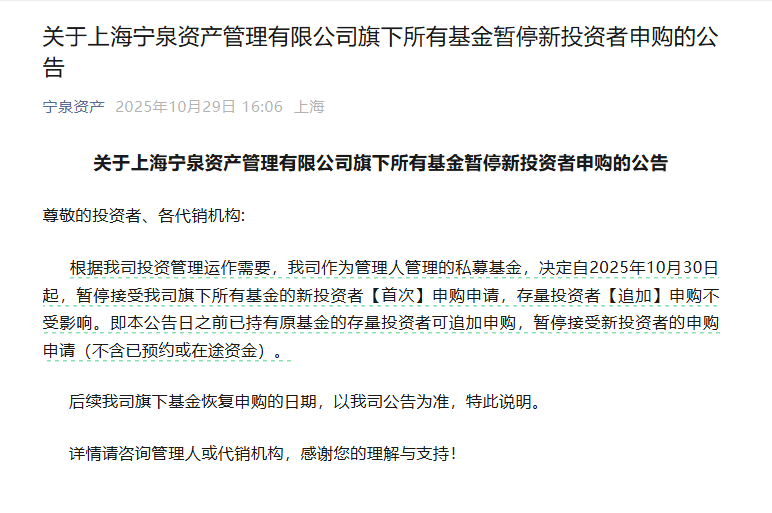
沪指再破4000点之际,知名基金经理杨东宣布“封盘”!宁泉资产今起暂停新投资者申购
Sou Hu Cai Jing· 2025-10-30 11:13
Core Viewpoint - Ningquan Asset, led by investor Yang Dong, announced the suspension of new investor subscriptions for all its funds starting October 30, 2025, while existing investors can still make additional subscriptions [3][9]. Group 1: Company Actions - Ningquan Asset will not accept new subscription applications from new investors, but existing investors can continue to add to their investments [3]. - The company has a management scale that has surpassed 40 billion yuan as of the first quarter of this year [7]. - The firm has been cautious about market conditions, particularly regarding the A-share index surpassing 4000 points [7]. Group 2: Market Context - On the day of the announcement, the Shanghai Composite Index rose by 0.7% to close at 4016.33 points, marking a 10-year high, but subsequently fell by 0.73% to 3986.90 points the following day [3]. - The private equity market remains active, with 806 new private securities investment funds registered in October, an increase from 721 in September [9][10]. - The number of private securities investment funds registered in the first three quarters of this year reached 8935, a significant increase of 89.38% compared to the same period last year [9]. Group 3: Investment Strategy - Ningquan Asset has focused on traditional industries and has not chased market hot spots, resulting in a slower net value performance compared to the market [7]. - The company holds significant positions in sectors such as real estate, basic chemicals, and power equipment [8]. - Despite the market's rapid rise, Ningquan Asset remains optimistic about the potential for a "slow bull" market, hoping for a steady progression rather than a rapid decline [7].

南山智尚:截至2025年10月20日,公司股东人数为27823户
Zheng Quan Ri Bao Wang· 2025-10-30 10:17
Group 1 - The company Nanshan Zhishang (300918) reported that as of October 20, 2025, the number of shareholders is 27,823 [1]
水星家纺(603365):三季报高增,看好科技大单品策略的未来前景
Orient Securities· 2025-10-30 07:09
Investment Rating - The report maintains a "Buy" rating for the company, with a target price of 23.70 CNY based on a 15x PE valuation for 2025 [3][5]. Core Insights - The company reported significant growth in Q3, with revenue and net profit attributable to the parent company increasing by 20% and 43% year-on-year, respectively. The growth was driven primarily by the e-commerce business, which is expected to continue to be a key growth driver [10]. - The strategy of focusing on high-tech, high-functionality flagship products has proven effective, contributing to the strong performance in Q3. The company has optimized its product mix and procurement strategies, leading to improved gross margins [10]. - The outlook for the company remains positive, with expectations of steady growth in the upcoming quarters and years, supported by a strategic focus on technology products and enhanced brand investment [10]. Financial Forecasts - Revenue projections for 2025-2027 are adjusted to 4.685 billion CNY, 5.139 billion CNY, and 5.485 billion CNY, respectively, reflecting an increase from previous estimates [3][11]. - Earnings per share (EPS) estimates for 2025-2027 are revised to 1.58 CNY, 1.79 CNY, and 1.94 CNY, respectively, up from earlier forecasts [3][11]. - The gross margin is expected to improve to 43.2% in 2025, with net profit margins projected to be 8.9% [3][10]. Key Financial Metrics - The company is projected to achieve a net profit of 416 million CNY in 2025, with a year-on-year growth of 13.5% [3][10]. - The return on equity (ROE) is expected to stabilize around 12.9% in 2025, indicating a solid profitability outlook [3][10]. - The company's market capitalization is approximately 5.305 billion CNY, with a total share count of 26.263 million shares [5].

科技现代化锚定四大“发力点” ——“十五五”科技坐标解读之二
Ke Ji Ri Bao· 2025-10-30 06:29
Group 1 - The core viewpoint of the news is that the 15th Five-Year Plan emphasizes the importance of technological modernization as a foundation for China's modernization, with specific focus on original innovation and integration of technology and industry [1][2][10] - The plan outlines four key areas for technological advancement: enhancing original innovation and core technology breakthroughs, promoting deep integration of technological and industrial innovation, advancing education and talent development, and furthering the construction of a digital China [1][2][10] Group 2 - Original innovation is highlighted as a fundamental driver of development, with a strategic shift from scale expansion to quality enhancement in China's innovation strategy [2][3] - The integration of scientific research with industrial practice is emphasized, showcasing successful examples of collaboration between academia and industry, leading to significant financial outcomes in technology transfer [5][6] - The plan calls for a systematic approach to education, technology, and talent development, aiming to cultivate interdisciplinary talents that can adapt to future societal needs [7][8] Group 3 - The news discusses the role of artificial intelligence and digital technologies in enhancing various sectors, indicating a strong push towards a digital economy that integrates with the real economy [9][10] - The importance of establishing a unified data market and promoting the development of industrial internet is underscored, aiming to facilitate the deep integration of digital and physical economies [9][10]
纺织服装行业:三季度运动品牌动销承压,运营健康
Dongxing Securities· 2025-10-30 06:20
Investment Rating - The industry investment rating is "Positive" [3] Core Viewpoints - Domestic sports brands have shown good growth in high-end functional and affordable mass-market segments, with online channels maintaining strong growth [1][2] - The operational capabilities of sports companies have been validated, with overall healthy inventory and discount management, indicating stable brand operations despite external fluctuations [1] - The running shoe category has performed well, driven by increased health awareness among consumers, while outdoor brands have also seen good growth due to rising interest in camping and trail running [2] Summary by Sections Channel Performance - Anta's online growth is slower than offline due to strategic adjustments, while FILA's online performance exceeds offline. Li Ning's online sales show high single-digit growth, outperforming the wholesale channel [1] - Tebu and 361° brands have better online growth compared to offline [1] Brand Performance - Anta's main brand shows low single-digit positive growth, while FILA's growth continues to slow. Other brands like Descente and Kelong have seen a combined growth of 45-50% [7] - Li Ning's overall sales have declined in the mid-single digits, but this is slightly better than the company's previous expectations [7] - Tebu's main brand retail sales have low single-digit growth, while Saucony's retail sales have grown over 20% [7] - 361° has seen approximately 10% growth in its main brand and children's clothing [7] Future Outlook - The industry faces macroeconomic challenges in Q4, with Anta lowering its annual revenue guidance. However, its multi-brand strategy and efficient management provide a strong competitive edge [2] - Li Ning aims to enhance brand momentum through Olympic marketing and NBA events, while Tebu continues its channel transformation [2] - 361° is increasing its outdoor product development in response to the domestic outdoor apparel trend [2]
苏美达股价涨5.01%,嘉实基金旗下1只基金重仓,持有3.85万股浮盈赚取2.04万元
Xin Lang Cai Jing· 2025-10-30 05:52
Core Viewpoint - Su Mei Da's stock price increased by 5.01% to 11.11 CNY per share, with a trading volume of 299 million CNY and a turnover rate of 2.09%, resulting in a total market capitalization of 14.518 billion CNY [1] Company Overview - Su Mei Da Co., Ltd. is located at 198 Changjiang Road, Nanjing, Jiangsu Province, established on June 24, 1996, and listed on July 1, 1996. The company operates in two main business segments: industrial chain and supply chain [2] - The industrial chain includes sectors such as consumer goods and environmental protection, with key products/services including textiles, home power products (garden machinery, cleaning machinery, gasoline generators), environmental engineering (wastewater treatment, waste management, soil remediation, kitchen waste treatment, biodegradable plastic industrial engineering), clean energy (photovoltaic products, engineering, operation and maintenance), and shipbuilding and shipping [2] - The supply chain focuses on integrated services for bulk commodity operations and import of electromechanical equipment. The revenue composition is as follows: supply chain 71.59%, industrial chain 28.20%, with advanced manufacturing at 11.86% and consumer goods at 8.65% [2] Fund Holdings - According to data, one fund under Jia Shi Fund has a significant holding in Su Mei Da. The Jia Shi Zhong Zheng 1000 Index Enhanced Initiation A (016776) increased its holdings by 11,800 shares in the third quarter, totaling 38,500 shares, representing 0.93% of the fund's net value, ranking as the fifth-largest holding [3] - The fund has a current scale of 26.8915 million CNY and has achieved a year-to-date return of 36.35%, ranking 1449 out of 4216 in its category, with a one-year return of 37.45%, ranking 1266 out of 3885 [3]

研报掘金丨华西证券:维持华利集团“买入”评级 新厂爬坡将贡献更大利润弹性
Ge Long Hui A P P· 2025-10-30 05:45
Core Viewpoint - Huayi Group's Q3 2025 revenue, net profit attributable to shareholders, and net profit excluding non-recurring items were 6.019 billion, 765 million, and 816 million yuan respectively, showing a year-on-year decline of 0.34%, 20.73%, and 14.83%, which aligns with market expectations [1] Financial Performance - The slight revenue decline is primarily due to inventory destocking by some existing customers [1] - The net profit drop is mainly influenced by the ramp-up of new plant capacity and tariff impacts [1] - Gross margin has shown improvement on a quarter-on-quarter basis due to the gradual ramp-up of the new plant [1] Future Outlook - The worst period for the company may have passed, with expectations of a return to a factory establishment speed of 1-2 plants in the future [1] - The ramp-up of new plants is expected to contribute greater profit elasticity [1] Customer Analysis - Despite short-term growth slowdowns for major clients like NIKE and DECKERS, there remains room for market share expansion [1] - Additional revenue contributions are anticipated from brands such as Adidas, ON, New Balance, and Reebok [1] Investment Rating - Given the potential for market share growth with major clients and the company's ability to rapidly expand production, a "Buy" rating is maintained [1]

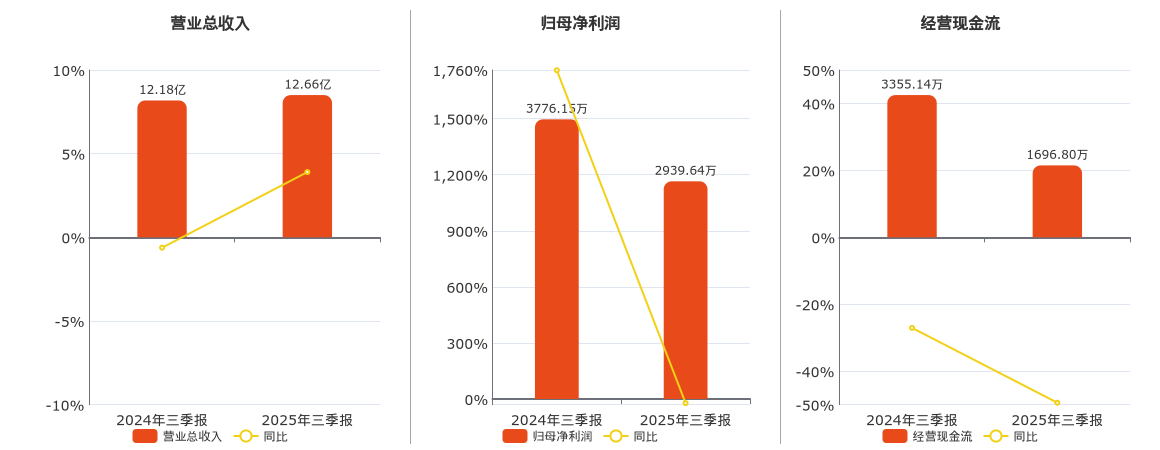
龙头股份(600630.SH):2025年三季报净利润为2939.64万元、同比较去年同期下降22.15%
Xin Lang Cai Jing· 2025-10-30 02:23
Core Insights - The company reported a total operating revenue of 1.266 billion yuan for Q3 2025, ranking 19th among peers, with a year-on-year increase of 47.5 million yuan, representing a 3.90% growth compared to the same period last year [1] - The net profit attributable to shareholders was 29.3964 million yuan, ranking 25th among peers, showing a decrease of 8.3651 million yuan, which is a 22.15% decline year-on-year [1] - The net cash inflow from operating activities was 16.968 million yuan, ranking 26th among peers, down by 165.834 million yuan, reflecting a 49.43% decrease year-on-year [1] Financial Ratios - The latest debt-to-asset ratio is 52.18%, ranking 36th among peers, which is an increase of 4.71 percentage points from the previous quarter, but a decrease of 1.18 percentage points compared to the same period last year [3] - The latest gross profit margin is 30.36%, ranking 31st among peers, down by 3.46 percentage points from the previous quarter and down by 1.14 percentage points year-on-year [3] - The latest return on equity (ROE) is 3.82%, ranking 17th among peers, which is a decrease of 1.20 percentage points compared to the same period last year [3] Earnings Per Share and Turnover Ratios - The diluted earnings per share is 0.07 yuan, ranking 23rd among peers, which is a decrease of 0.02 yuan, reflecting a 22.22% decline year-on-year [3] - The latest total asset turnover ratio is 0.76 times, ranking 6th among peers, which is an increase of 0.05 times, representing a 6.88% growth year-on-year [3] - The latest inventory turnover ratio is 2.53 times, ranking 12th among peers, with an increase of 0.47 times, achieving two consecutive years of growth, which is a 22.60% increase year-on-year [3] Shareholder Information - The number of shareholders is 60,000, with the top ten shareholders holding 156 million shares, accounting for 36.78% of the total share capital [3] - The largest shareholder is Shanghai Textile (Group) Co., Ltd., holding 30.0 million shares [3]