
油气

Search documents
【大宗周刊】大宗产业联盟正式揭牌!新型易货贸易助力企业“破圈”
Qi Huo Ri Bao· 2025-10-25 23:51
Group 1: Oil and Gas Industry Conference - The eighth Oil Merchants Conference was held in Zhoushan from October 21 to 23, focusing on "Deepening Open Cooperation to Build a Green, Low-Carbon, and Sustainable Bulk Commodity Market" [1] - A total of 366 domestic and international companies participated, with representatives from major firms like Saudi Aramco, BP, and S&P Global sharing insights on industry trends and opportunities in the Chinese market [1] - The conference provided decision-making references for Chinese companies to expand internationally and for foreign companies to enter the domestic market, facilitating the integration of domestic and international "dual circulation" [1] Group 2: Establishment of Commodity Alliance - The Zhejiang Free Trade Zone Commodity Resource Allocation Hub Industry Alliance was officially launched, with Chen Xin from Material Zhongda Group as the first chairman [2] - The alliance consists of over a hundred leading companies, industry associations, research institutions, and financial institutions, aiming to create a collaborative development system covering the entire commodity industry chain [2] - The initiative is supported by various provincial government offices and aims to enhance the efficiency of resource allocation in bulk commodities, focusing on storage, transportation, processing, trade, and maritime services [2] Group 3: Financial Innovation and Agreements - A specialized meeting on "Financial Innovation and Spot-Futures Linkage" was held during the conference, where a report on building an international bulk commodity trading center was released [3] - A total of 21 projects were signed during the conference, with a total agreement amount of approximately 643.6 billion yuan [3] - The establishment of the China Green Ship Repair International Certification Innovation Alliance and the unveiling of the International Bulk Commodity College at Zhejiang Ocean University also took place [3] Group 4: eRWA Product Launch - The first eRWA product based on physical asset anchoring was launched at a forum in Shenzhen, focusing on the digitalization of physical assets [5] - The MiWan.LOVE brown sugar chain product aims to create a new path for RWA in China, ensuring that digital rights correspond to physical assets [6] - The product leverages a high-standard sugarcane planting base and IoT technology to ensure traceability and compliance, addressing core challenges in the industry [6][7] Group 5: New Barter Trade Model - A new barter trade model is emerging, utilizing digital forms to reshape the commercial ecosystem amid challenges like inventory backlog and cash flow issues [8] - The YiDe International Barter Trading Platform allows for the exchange of various goods and services using barter credits, enhancing resource allocation and operational efficiency for businesses [9] - The platform has expanded to over 40 regions, serving more than 70,000 enterprises, with a projected barter credit transaction volume of 610 million yuan by mid-2025 [9][10]
海内外油商共商能源供应与低碳转型
Shang Hai Zheng Quan Bao· 2025-10-24 19:15
Core Insights - The global energy industry is at a historic crossroads, with oil and gas remaining essential for economic growth while facing pressure to reduce emissions and enhance efficiency [1][2] - The oil market is undergoing a deep transformation, with a shift in demand from traditional fuels to aviation fuels and chemical feedstocks [2] - The transition to green energy is creating new growth opportunities, particularly in emerging fields like green marine fuels, hydrogen, and carbon capture [2][3] Group 1: Oil and Gas Industry Trends - The global oil market is expected to remain oversupplied until 2030, with Brent crude prices consistently below $65 per barrel [2] - Continuous integration of refining capacity is anticipated to boost industry profits despite the oversupply [2] - The shipping industry's decarbonization is leading to the development of multiple pathways for marine fuel solutions, with natural gas and biofuels showing competitive advantages [2] Group 2: Chemical Industry Developments - The future of the petrochemical industry is focused on "greening, high-end, intelligent, and safe" production [4] - China's petrochemical sector faces both challenges and opportunities, with a need to enhance high-end product supply and reduce low-end capacity [4][5] - Southeast Asia and the Middle East are becoming preferred targets for Chinese companies' international expansion due to resource and policy advantages [4] Group 3: Marine Fuel Innovations - The International Maritime Organization (IMO) is working on a legally binding net-zero emissions framework, which will significantly impact marine fuel choices [6] - Companies are developing platforms to collect and analyze carbon emissions data to comply with emerging regulations [6] - The demand for green methanol is expected to surge if the IMO's net-zero framework is approved, with significant projects already underway in China [6][7] Group 4: Green Methanol Market Outlook - Approximately half of the global green methanol supply is located in China, with many projects in the research and pre-construction phases [7] - By 2028, China is projected to achieve an annual green methanol production capacity of 4 to 5 million tons [7] - The demand for green methanol as a marine fuel is expected to reach 6 to 7 million tons globally by 2030 [7]
放量普涨,下周科技稳了
Sou Hu Cai Jing· 2025-10-24 11:16
今日股市在政策预期与科技主线的共振下表现强势,A股与港股同步上扬,科技成长板块成为市场上涨 的核心驱动力。中共中央二十届四中全会明确了"十五五"时期科技自立自强的目标,国家发改委也强调 加快建设现代化产业体系,政策红利持续释放,为市场注入了强劲信心。 在全球层面,存储芯片涨价潮持续发酵,三星与SK海力士第四季度报价上调30%,叠加AI算力需求的 显著爆发,共同推动了HBM、半导体硅片等细分领域的走强,多只相关个股涨停,市场热点高度聚焦 于科技成长方向。同时,高盛、摩根大通等国际机构纷纷唱多,反映出中长期资金对配置科技成长板块 的共识正在增强。 市场情绪明显回暖,从谨慎转向积极。科创50指数大涨4.35%,创业板指涨幅达3.57%,两市成交额放 大至1.99万亿元。涨停家数超过70家,连板梯队保持完整,反映出资金风险偏好的显著提升。港股同样 出现反弹,恒生科技指数上涨1.82%,科技板块整体表现强劲,显示出外资对中概科技股的配置意愿增 强。 从板块表现来看,分化特征较为突出。存储芯片、商业航天、CPO等科技赛道表现活跃,而冰雪旅 游、地产、油气开采等传统行业则因政策预期偏弱或季节性因素持续调整。此外,三季报业绩 ...
ETF市场日报|通信、芯片板块领涨!下周一有5只产品开始募集
Sou Hu Cai Jing· 2025-10-24 07:26
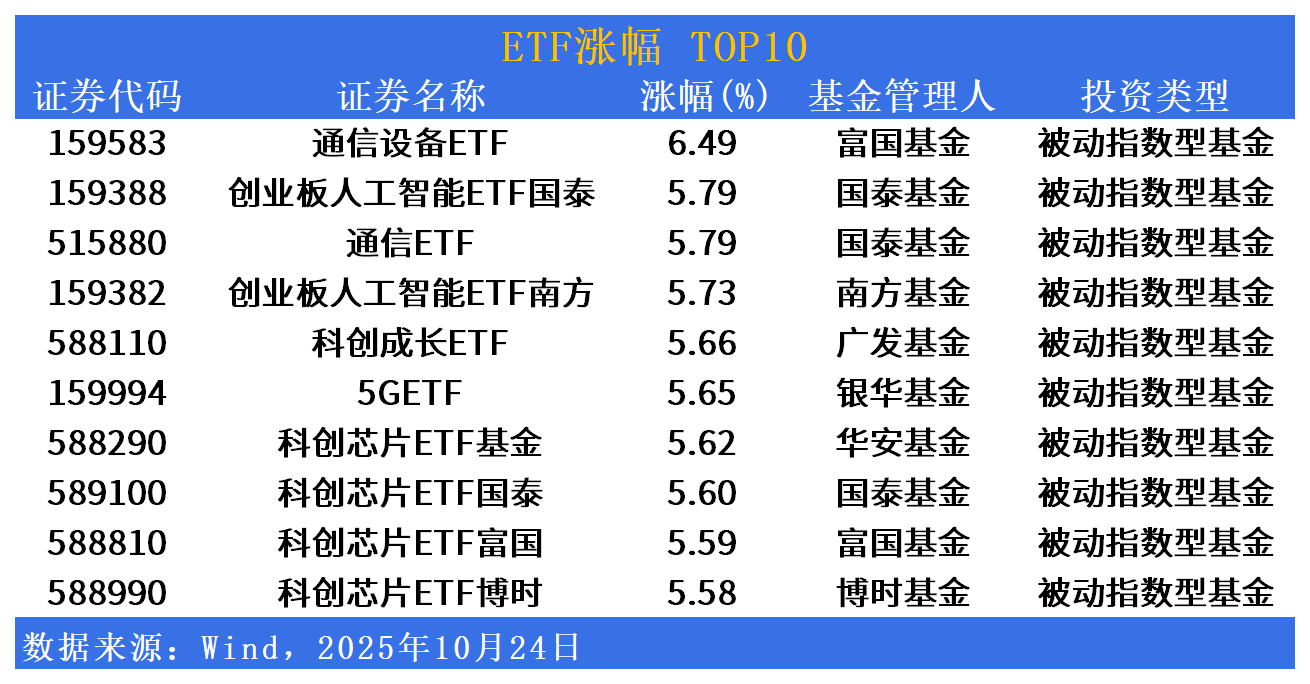
Market Performance - A-shares indices collectively strengthened, with the Shanghai Composite Index reaching a ten-year high, closing up 0.71%, Shenzhen Component Index up 2.02%, and ChiNext Index up 3.57% [1] - The total trading volume in the Shanghai and Shenzhen markets reached 1,974.2 billion [1] Sector Performance - The communication and chip sectors led the gains, with the Communication Equipment ETF rising by 6.49% and several other ETFs in the AI and chip sectors also showing significant increases of over 5% [2][3] - The core message from a high-level meeting emphasized strengthening original innovation and key core technology breakthroughs, promoting deep integration of technological and industrial innovation, and focusing on the real economy [3] ETF Trading Activity - The Short-term Bond ETF had the highest trading volume at 39.674 billion, followed by the Silver Day Benefit ETF at 27.350 billion and the Hua Bao Tian Yi ETF at 16.645 billion [6] - The turnover rate for the China-Korea Semiconductor ETF reached 240%, indicating high trading activity in this sector [7] Upcoming ETF Issuance - Five new ETFs will begin fundraising next Monday, focusing on industrial software, Hong Kong technology, photovoltaic industries, and satellite applications [8][9]

沪指续创10年新高,存储芯片板块集体大涨
Feng Huang Wang· 2025-10-24 07:15
Core Points - The Shanghai Composite Index rose by 0.71%, the Shenzhen Component Index increased by 2.02%, and the ChiNext Index surged by 3.57% [1] - The total trading volume in the Shanghai, Shenzhen, and Beijing markets reached 1.9916 trillion yuan, an increase of 330.9 billion yuan compared to the previous day [1] - Over 3,000 stocks in the market experienced gains [1] Sector Performance - The computing hardware sector continued to see explosive growth, with CPO concept stocks leading the gains [1] - The three major companies in the "optical module" sector all performed strongly, with Zhongji Xuchuang rising over 12% to reach a historical high [1] - The storage chip sector also showed strength, with both Shannon Chip and Purun Co., Ltd. hitting the daily limit of 20% and reaching new highs [1] - The commercial aerospace sector experienced a wave of limit-up stocks, with over ten stocks, including Aerospace Science and Technology, hitting the daily limit [1] - In contrast, coal stocks collectively adjusted, with Antai Group hitting the daily limit down [1] - The storage chip, CPO, and semiconductor sectors saw the largest gains, while coal and oil & gas sectors faced the largest declines [1]
从核电到深水油气,中国能源领域项目建设跑出“加速度”
Huan Qiu Wang· 2025-10-24 06:30
Core Insights - The Chinese energy sector has achieved multiple significant breakthroughs on October 16, including the successful cold test of the world's first land-based commercial modular small reactor "Linglong No. 1," the inauguration of the first national deep-water oil and gas emergency rescue base, and the full production of the first million-kilowatt peak-shaving thermal power project in the northwest region [1][2][3]. Group 1: Major Breakthroughs - "Linglong No. 1" is the world's first land-based commercial modular small reactor that has passed the International Atomic Energy Agency's safety review, marking a significant advancement in China's nuclear power innovation [2]. - The successful cold test of "Linglong No. 1" demonstrates China's comprehensive capabilities in new nuclear energy system design, high-end equipment manufacturing, and complex engineering management, solidifying its competitive advantage in the international small reactor market [2]. - The establishment of the national deep-water oil and gas emergency rescue base in Hainan significantly shortens emergency response times in southern maritime areas, enhancing the safety production capabilities in critical sectors [2]. Group 2: Technological Innovations - Recent years have seen the completion of several major projects, including the Baihetan Hydropower Station and the third-generation nuclear power projects "Hualong No. 1" and "Guohe No. 1," showcasing China's hard-core technological innovation [4]. - The National Energy Administration has indicated that the 14th Five-Year Plan period is crucial for achieving greater breakthroughs in energy technology innovation [4]. - China has made significant advancements in key areas such as nuclear power, new energy, and smart grids, establishing itself as a global leader in these sectors [4]. Group 3: Industry Development - By the end of 2027, China plans to establish 28 million charging facilities with over 300 million kilowatts of public charging capacity, as part of a three-year action plan to enhance electric vehicle charging infrastructure [6]. - The energy sector is increasingly integrating with industries such as transportation, leading to the emergence of new fields and production capabilities [7]. - China leads the world in new energy technologies, holding over 40% of global new energy patents and achieving record-breaking efficiencies in solar and offshore wind energy [7]. Group 4: Future Prospects - The new energy storage capacity in China has reached approximately 95 million kilowatts, growing nearly 30 times in five years, which is essential for the new power system [7]. - The hydrogen production and consumption scale in China is expected to exceed 36 million tons in 2024, making it the world's largest, with renewable energy-based hydrogen production capacity surpassing half of the global total [7]. - Artificial intelligence is increasingly being applied in the energy sector, enhancing various operations such as new energy generation and oil and gas resource discovery, thus revitalizing the industry [7].
油商大会达成643.6亿元协议金额
Zhong Guo Hua Gong Bao· 2025-10-24 02:52
Core Insights - The eighth Oil Merchants Conference was held in Zhoushan, Zhejiang, focusing on "Deepening Open Cooperation to Build a Green, Low-Carbon, and Sustainable Bulk Commodity Market" with 366 participating companies, including 112 foreign and 254 domestic firms [1] - A total of 21 projects were signed at the conference, with a total agreement amount of 64.36 billion yuan [1] Group 1: Opportunities and Challenges - The global oil and gas market is undergoing a critical transformation, presenting both opportunities and challenges [1] - Energy transition is creating new growth spaces in emerging fields such as marine green fuels, hydrogen energy, and carbon capture, while challenges include supply chain resilience, low-carbon transition pressures, and the need for improved market governance [1][2] Group 2: Recommendations for Industry Development - Four key recommendations were proposed to address industry challenges: 1. Strengthening market connectivity through platform co-construction, promoting a cooperation mechanism led by government, enterprises, and associations [2] 2. Promoting green transition through technological collaboration, focusing on the development and application of alternative fuels [2] 3. Improving governance systems by aligning rules with international standards and enhancing cooperation with Belt and Road countries [2] 4. Achieving sustainable development through ecological collaboration across the entire industry chain [2] Group 3: Key Initiatives and Agreements - The establishment of the China (Zhejiang) Free Trade Zone Bulk Commodity Resource Allocation Hub All-Industry Chain Alliance, consisting of 100 leading companies, industry associations, and research institutions [3] - The conference also released the "Green Marine Fuel Development Zhoushan Declaration 2025" and conducted a signing ceremony for 21 major projects, primarily in sectors such as petrochemical new materials, oil storage and transportation, bulk trade, shipping services, digital ocean, and financial services [3] - Among the signed projects, 15 were related to physical investments with an agreement amount of 28.56 billion yuan, while 6 were trade cooperation projects totaling 35.8 billion yuan [3]
连板股追踪丨A股今日共72只个股涨停 这只煤炭股8连板
Di Yi Cai Jing· 2025-10-23 08:50
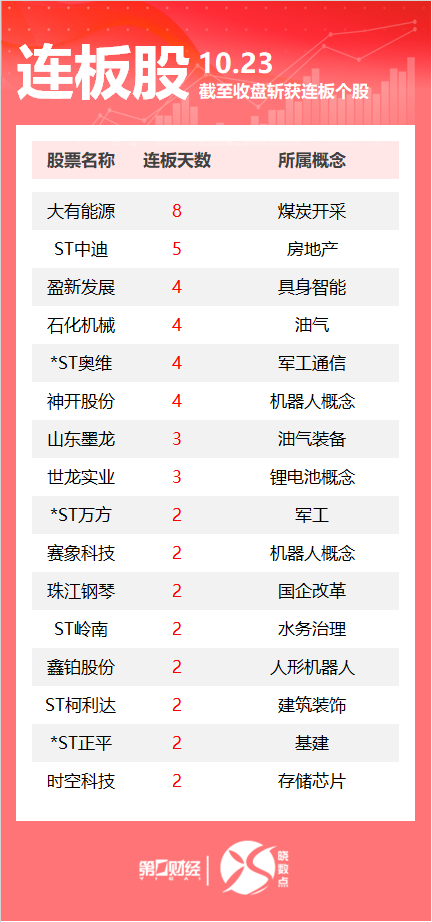
Core Viewpoint - The A-share market experienced significant activity on October 23, with 72 stocks hitting the daily limit-up, indicating strong investor interest and market momentum [1] Group 1: Stock Performance - Day's top performer, Dayou Energy, achieved an impressive 8 consecutive limit-up days, highlighting its strong position in the coal mining sector [1] - Other notable stocks include ST Zhongdi with 5 consecutive limit-ups in the real estate sector, and Yingxin Development, along with Shihua Machinery, both achieving 4 consecutive limit-ups in their respective sectors [1] Group 2: Sector Highlights - Coal mining sector showed robust performance with Dayou Energy leading the way [1] - The oil and gas sector also demonstrated strength, with Shihua Machinery recording 4 consecutive limit-ups [1] - Emerging sectors such as robotics and lithium battery concepts are gaining traction, as evidenced by multiple stocks in these categories achieving consecutive limit-ups [1]

【A股收评】三大指数震荡上扬,煤炭、锂电齐上涨!
Sou Hu Cai Jing· 2025-10-23 07:49
Market Overview - On October 23, major indices experienced fluctuations, with the Shanghai Composite Index rising by 0.22%, the Shenzhen Component Index also up by 0.22%, and the ChiNext Index increasing by 0.09%. The Sci-Tech Innovation 50 Index fell by 0.3%. Over 2900 stocks in the two markets rose, with a total trading volume of approximately 1.64 trillion yuan [2]. State-Owned Enterprise Reform - The concept of state-owned enterprise reform gained strength, with notable stock increases: JianKaoYuan (300675.SZ) surged by 20%, while TeFa Information (000070.SZ), TeLi A (000025.SZ), ShenSaiGe (000058.SZ), ShenFangZhi A (000045.SZ), and Shenzhen Energy (000027.SZ) rose by 10% [2]. Coal Sector Performance - The coal sector also showed strong performance, with DaYou Energy (600403.SH), YunMei Energy (600792.SH), and Shanxi Black Cat (601015.SH) each rising by 10%. ZhongMei Energy (601898.SH) and YanKuan Energy (600188.SH) also saw increases [3]. Lithium Battery Sector Activity - The lithium battery sector was active, with ShengXin Lithium Energy (002240.SZ) increasing by 10%, and RongJie Shares (002192.SZ) rising by 7.52%. Other companies like Tibet Mining (000762.SZ) and GanFeng Lithium (002460.SZ) experienced significant gains. The main contract for lithium carbonate futures rose by over 4%, with expectations of increased production in October due to new production lines coming online [4]. Quantum Technology Sector - The quantum technology sector performed well, with KeDa GuoChuang (300520.SZ) rising by 20%. Other companies such as DiPu Technology (300768.SZ), DaHua Intelligent (002512.SZ), ShenZhou Information (000555.SZ), and GuoDun Quantum (688027.SH) also saw substantial increases. This surge was driven by Google's announcement of a breakthrough in quantum algorithms, achieving a speed 13,000 times faster than the best supercomputers [4]. Declining Sectors - The oil and gas, as well as engineering machinery sectors, showed weakness, with companies like JianShe Machinery (600984.SH), LiuGong (000528.SZ), HengLi Hydraulic (601100.SH), and Sany Heavy Industry (600031.SH) experiencing declines. The pharmaceutical and semiconductor sectors also weakened, with Canxin Shares (688691.SH) dropping over 11%, alongside RongChang Bio (688331.SH) and Maiwei Bio (688062.SH) [5].




缩量调整,耐心等待市场企稳
Sou Hu Cai Jing· 2025-10-23 05:58
Core Viewpoint - The A-share market continues to adjust, with major indices experiencing weak fluctuations and significant selling pressure in growth sectors, while the Hong Kong market shows relative resilience supported by energy stocks [1][2] Market Performance - A-share indices opened lower and declined, with the Shanghai Composite Index closing at 3888.08 points, down 0.66%, and the Shenzhen Component Index falling 0.87% to 12883.89 points [2] - The Hong Kong market saw the Hang Seng Index drop slightly by 0.09% to 25757.60 points, while the Hang Seng Tech Index fell 0.81% to 5875.23 points, indicating a defensive market characteristic [2] Industry Highlights and Driving Logic - The coal sector experienced a surge, with a 2% increase in the index, driven by winter supply expectations and policies enhancing industry concentration [3] - The oil and gas sector also performed well, supported by rising international oil prices and domestic energy security policies [3] - Shenzhen local stocks surged due to merger and acquisition policies, with a focus on strategic emerging industries like integrated circuits and artificial intelligence [3] - Growth sectors faced significant pressure, particularly in technology, with the CPO concept and storage chip sectors experiencing declines of over 4% [3] Investment Strategy Recommendations - The market is in a "volume contraction and structural rotation" phase, suggesting a focus on quality stocks within the technology growth sector, particularly in AI and quantum technology [4] - Opportunities in cyclical and resource sectors are highlighted, with coal stocks benefiting from supply policies and rising winter demand [4] - The consumer sector is advised to focus on brands benefiting from improving consumption expectations, while state-owned enterprise reform themes remain active [5] Policy-Driven Opportunities - The "new quality productivity" and reform dividends are emphasized, with attention on Shenzhen local tech firms and semiconductor equipment benefiting from merger and acquisition policies [5] - The overall market faces volume shrinkage, limiting the potential for a broad rebound, but structural opportunities in cyclical resources and policy-driven themes are expected to yield excess returns [5]