
直播电商

Search documents
今天亲身经历了一次“一字断魂刀”
Ge Long Hui· 2025-08-19 19:18
Core Viewpoint - The article discusses the strategic shift of Dongfang Zhenxuan after the departure of its key figure, Dong Yuhui, and highlights the potential for growth in its business model, which is transitioning from traditional live-stream selling to a more diversified approach similar to Sam's Club and Pinduoduo [1][4]. Company Strategy - Dongfang Zhenxuan is moving towards a business model that reduces reliance on top streamers, aiming to enhance brand reputation and market confidence through product innovation and quality control [1][5]. - The company plans to increase its membership base significantly, targeting 50,000 to 100,000 members by improving its reputation and leveraging word-of-mouth marketing [5][6]. Membership Growth - Membership numbers have shown rapid growth, with approximately 40,000 members by the end of July 2023, and a daily increase in new members from 300 in June to 410 in July, indicating a 40% month-over-month increase [6][7]. - The company’s focus on high-quality products is expected to drive repeat purchases among members, contributing to exponential profit growth as the scale of operations increases [7][8]. Financial Performance - The Gross Merchandise Value (GMV) is projected to reach approximately 880 million by June 2025, reflecting a year-over-year growth of 28%, with self-operated products contributing around 350 million, a 15% increase [6]. - Sales data indicates strong demand for specific products, such as the newly launched sanitary napkins, which sold over 1.5 million packages shortly after release, highlighting consumer interest and market potential [6][7]. Market Positioning - The company is positioned to capitalize on the growing demand for high-quality consumer goods, as evidenced by the success of similar models like Sam's Club, which had 4 million members in 2021 and is expected to reach 9 million by 2025 [3][4]. - The overall market appears to be lacking in high-quality products, suggesting that Dongfang Zhenxuan's focus on quality and consumer trust could lead to significant market share growth [5][6].
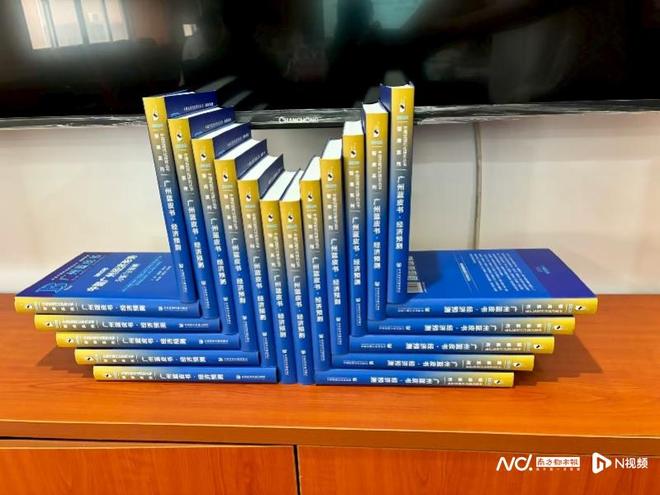
广州蓝皮书:固投主引擎亟待重构 建议用政策资金撬动大项目
Nan Fang Du Shi Bao· 2025-08-19 16:32
Economic Overview - The GDP growth rate of Guangzhou for 2024 is projected at 2.1%, lower than the initial expectations for the "14th Five-Year Plan" period and slightly below the national average growth rate [1] - The economic growth is expected to recover moderately in 2025, maintaining a growth rate between 3% and 4% [1] Industrial Sector - The added value of the automotive manufacturing industry decreased by 18.2%, significantly contributing to the slowdown in the growth of the secondary industry, which only grew by 0.7% in 2024 [1] - Despite challenges, the aerospace and equipment manufacturing industry saw a 16.3% increase in added value, and the cosmetics manufacturing industry grew by 47.4% due to policy support and brand cultivation [2] - Overall profits of large-scale industrial enterprises in Guangzhou fell by 3.9%, with inventory levels remaining high and accounts receivable collection periods extending from 58.4 days to 63.7 days [2] Consumer Sector - The tertiary industry achieved an added value of 22,858.58 billion yuan, growing by 2.6%, making it the fastest-growing sector [3] - Retail sales of social consumer goods reached 11,055.77 billion yuan, showing only a slight increase of 0.03%, significantly lower than pre-pandemic levels [3] - Notable growth in specific consumer categories includes furniture (55.4%), home appliances (4.5%), and building materials (10.9%), driven by policies encouraging upgrades [3] Investment Landscape - Fixed asset investment in Guangzhou grew by only 0.2%, with real estate development investment declining by 7.4% [5] - Industrial investment, particularly in manufacturing, increased by 13.6%, with high-tech manufacturing investment rising by 14.3% [5] - The number of new investment projects increased, but large projects (over 50 billion yuan) saw a significant decline, indicating a lack of strong support from major projects [5] Recommendations - The blue paper suggests enhancing project reserves and construction progress to stimulate investment and development [6] - It emphasizes leveraging special bonds and policy funds to activate major projects and structural investments [6]
东方甄选股价坐上过山车,“产品驱动”面临挑战
Di Yi Cai Jing Zi Xun· 2025-08-19 16:28
Core Viewpoint - The stock price of Dongfang Zhenxuan (01797.HK) experienced significant volatility, initially rising over 23% before closing down 20.89% due to rumors regarding CEO Zhou Chenggang and commission rates exceeding 30%, which were later denied by the company [2]. Group 1: Stock Performance - Dongfang Zhenxuan's stock price increased by 502% from a low of 8.92 HKD on December 31, 2024, to 53.7 HKD [3]. - The stock price surge was driven by optimistic market expectations regarding the company's recent positive developments [2]. Group 2: Financial Performance - For the fiscal year 2025 Q4, Dongfang Zhenxuan's revenue is projected to be approximately 150 million USD, reflecting a nearly 30% year-over-year decline, although the decline is narrowing quarter-over-quarter [2]. - The company's operating profit under non-GAAP is estimated at 79 million RMB, with an operating profit margin of about 7%, showing a quarter-over-quarter increase of approximately 3% [2]. - The company's net revenue from ongoing operations (self-operated products and live-streaming e-commerce) decreased by 9.3% year-over-year [5]. Group 3: Business Strategy and Challenges - Dongfang Zhenxuan is focusing on self-operated products and supply chain development, aligning with new consumption trends and offering expansion opportunities [3]. - The company is attempting to shift from a host-driven model to a product-driven model, but is still facing challenges due to the departure of several key hosts [5]. - The company needs to establish an effective host team and brand operation model to improve profitability expectations [5]. - In the e-commerce retail sector, Dongfang Zhenxuan faces challenges such as maintaining a high-frequency but low-margin product line, improving supply chain efficiency, and developing a membership system comparable to Sam's Club and Costco [5].

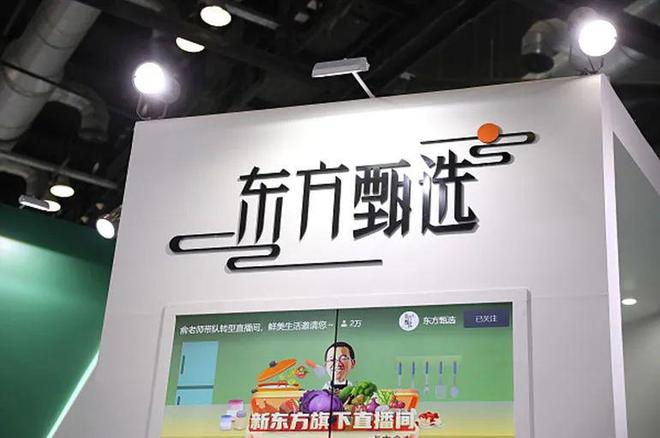
辛巴退场,超头主播时代渐远
Bei Jing Shang Bao· 2025-08-19 16:16
Core Viewpoint - The departure of Xinba from the live streaming industry marks a significant shift away from the era of super anchors, reflecting broader challenges and changes within the live commerce sector [1][2]. Group 1: Industry Changes - Xinba announced his exit from the live streaming industry due to health reasons, with his company, XinXuan Group, being taken over by his wife, Chu Ruixue [1]. - The live commerce industry is witnessing a trend of de-emphasizing super anchors, as evidenced by the decline in support for individual influencers and a shift towards a more corporate and professional model [1][2]. - The era characterized by rapid growth and the dominance of super anchors is coming to an end, with increasing regulatory scrutiny and a slowdown in growth [2]. Group 2: Challenges Faced - The live commerce sector is facing systemic risks, including declining influence and purchasing power of super anchors, leading to a consensus among stakeholders to mitigate these risks [1]. - Consumers are becoming disillusioned with the live streaming experience, realizing that low prices offered by super anchors do not guarantee quality or a good shopping experience [2]. - The role of anchors has evolved from being a bridge between production and consumption to becoming a controversial middleman, raising concerns about product quality and the sustainability of the business model [2]. Group 3: Future Directions - The industry is expected to transition from a focus on individual influencers to a focus on professionalism and expertise, with platforms regaining control over traffic distribution [2]. - There is a push for resetting selection rules and empowering competitive brands to reclaim their voice, ultimately benefiting consumers through improved supply chain practices [2].
解决选品、直播内容生产等多环节合规痛点 AI技术助力直播电商监管
Zheng Quan Shi Bao Wang· 2025-08-19 14:06
Core Viewpoint - The implementation of AI technology in live commerce regulation is transforming the industry, enhancing compliance and operational efficiency while addressing regulatory challenges. Group 1: AI in Live Commerce Regulation - The "Live Commerce Full Process Smart Supervision System" launched in Shanghai's Changning District has monitored over 2,000 live sessions and identified more than 160 illegal clues within six months of operation [1] - The system utilizes generative large language model technology to conduct real-time monitoring across various platforms such as Douyin, Kuaishou, Taobao, Pinduoduo, and Xiaohongshu [1] - AI technology is becoming a key variable in driving transformation in the live commerce industry, improving efficiency and quality in core processes like product selection, data analysis, and compliance review [2] Group 2: Compliance and Efficiency Enhancements - The "Lingke System" developed by Qianxun Holdings integrates with national enterprise credit systems to enhance compliance checks during product selection, significantly shortening compliance review cycles [3] - AI has improved the efficiency of creating live broadcast scripts from 20-30 minutes to just 3 minutes, achieving nearly a tenfold increase in productivity while ensuring compliance by automatically filtering prohibited content [3] - The "Pengyou Cloud" platform has integrated the DeepSeek model to automate compliance checks across three dimensions: business qualifications, brand authorization, and product information, resulting in over a 30% increase in compliance rates [4] Group 3: Regulatory Framework and Future Developments - The National Market Supervision Administration has proposed a regulatory framework for live commerce, introducing a "blacklist" system and cross-platform constraints to address issues like false marketing and counterfeit goods [4][5] - The new regulations provide clear legal boundaries for innovative business models such as AI-driven live streaming and virtual hosts, promoting sustainable and high-quality development in the industry [5]
广州蓝皮书:固投主引擎亟待重构,建议用政策资金撬动大项目
Nan Fang Du Shi Bao· 2025-08-19 12:45
Economic Overview - The "Blue Book" predicts Guangzhou's GDP growth rate for 2024 to be 2.1%, lower than the initial expectations for the "14th Five-Year Plan" and slightly below the national average growth rate [1] - The economic growth is attributed to the gradual decline of traditional growth drivers and the nascent stage of new growth drivers, leading to a relatively low economic growth phase [1] - A moderate recovery in economic growth is expected in 2025, with a forecasted growth rate of 3% to 4% [1] Industrial Sector - The added value of the secondary industry in Guangzhou is projected to be 783.945 billion yuan in 2024, with a mere 0.7% year-on-year growth, indicating insufficient growth momentum during the transition period [3] - The automotive manufacturing sector experienced a significant decline, with a year-on-year decrease of 18.2%, which is the primary reason for the slowdown in the added value of the secondary industry [3] - Despite challenges, emerging sectors show promise, such as aerospace manufacturing, which grew by 16.3%, and the cosmetics manufacturing sector, which saw a 47.4% increase in added value [3][4] Consumer Sector - The tertiary industry in Guangzhou achieved an added value of 22,858.58 billion yuan in 2024, growing by 2.6%, making it the fastest-growing sector and contributing 73.66% to the GDP [5] - Retail sales of social consumer goods reached 1,105.577 billion yuan, with a minimal increase of 0.03%, significantly lower than pre-pandemic growth rates [5] - Structural highlights include substantial growth in furniture (55.4%), home appliances (4.5%), and building materials (10.9%), driven by policies promoting replacement [5] Investment Landscape - Fixed asset investment in Guangzhou grew by only 0.2% in 2024, remaining at a historical low, with real estate development investment declining by 7.4% [7] - Industrial investment, particularly in manufacturing, showed resilience with a 13.6% year-on-year increase, continuing a trend of double-digit growth since 2022 [7] - The number of new investment projects increased, but large projects (over 50 billion yuan) saw a significant decline, highlighting a lack of substantial industrial investment [7][8] Recommendations - The "Blue Book" suggests enhancing project reserves and construction progress to stimulate investment and development [8] - It emphasizes leveraging special bonds and policy funds to activate major projects and structural investments [8] - The report advocates for increasing capital and expansion in the manufacturing sector to unleash industrial investment potential [8]
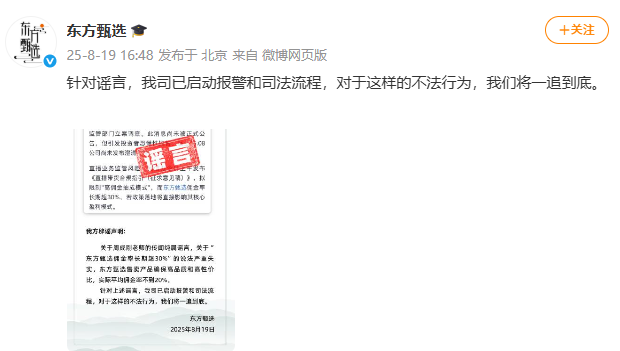
东方甄选股价大跌,公司回应来了
Zhong Guo Zheng Quan Bao· 2025-08-19 12:34
Core Viewpoint - The stock price of Oriental Selection dropped significantly by 20.89% to HKD 34.32 per share amid rumors regarding CEO Zhou Chenggang's alleged misconduct and high commission rates [1] Group 1: Company Response - Oriental Selection officially denied rumors about CEO Zhou Chenggang being investigated for misappropriating company interests through related party transactions, labeling them as false [1] - The company clarified that claims regarding a long-term commission rate exceeding 30% are severely inaccurate, stating that the actual average commission rate is below 20% [1] - In response to the rumors, the company has initiated legal actions and will pursue those responsible for spreading false information [1] Group 2: Industry Context - New Oriental also issued a strong statement refuting the rumors about Zhou Chenggang, asserting that they will hold accountable those who maliciously spread false information [3] - Founder Yu Minhong described the rumors as completely unfounded, emphasizing the company's commitment to transparency [6] - Oriental Selection is scheduled to release its full-year results for the fiscal year ending May 31, 2025, on August 22 [6]
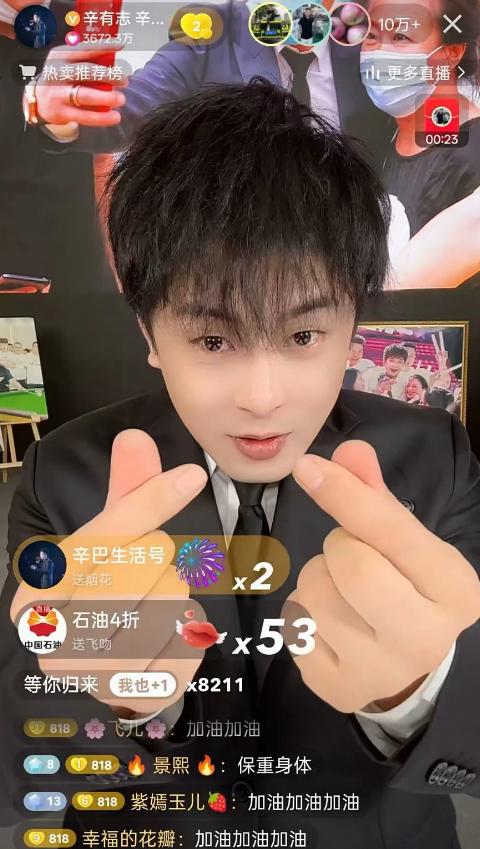
辛巴直播间幕后团队超200人,直播电商催生174个新职业
Xin Lang Cai Jing· 2025-08-19 12:24
辛巴直播间 0:00 幕后团队超200人,直播电商催生174个新职业 ...
辛巴“第五次退网”,单日销售64亿的头部神话,不干了
3 6 Ke· 2025-08-19 12:06
Core Points - The prominent live streamer Xinba announced his retirement from the live streaming industry on August 18, after a two-month hiatus, citing health issues and the inability to continue his work [1][4][6] - This marks Xinba's fifth retirement announcement since he began his streaming career in 2016, with previous announcements often being temporary [6][10] - The timing of this retirement coincides with a controversy surrounding his self-created sanitary napkin brand, "Mian Mima," which has been accused of being carcinogenic [3][10] Group 1: Xinba's Retirement Announcement - Xinba expressed deep emotions during his live stream, thanking fans and reflecting on his journey, while also revealing his health struggles [4][6] - His retirement announcement was made on a significant date, August 18, which he had previously established as a promotional event for his brand [8][10] - Despite his retirement, Xinba's influence remains strong, as he has a massive following and his past actions continue to generate media attention [3][10] Group 2: Business Transition and Challenges - Xinba's retirement reflects a broader trend in the live streaming industry, where reliance on personal charisma is diminishing as the market matures [23] - The XinXuan Group, which he founded, is undergoing a transformation to reduce dependence on Xinba's personal brand and develop a more sustainable business model [16][18] - The company has initiated a "de-Xinba" strategy, focusing on building a matrix of new influencers and enhancing supply chain capabilities [16][18] Group 3: Market and Industry Implications - The live streaming industry is experiencing a shift as it moves away from the "wild west" era characterized by individual influencers to a more structured and sustainable business approach [23] - Xinba's departure may signify a turning point for the industry, as other top streamers are also transitioning towards brand-focused and supply chain-oriented operations [14][23] - The controversy surrounding Xinba's product quality highlights the risks associated with self-branded products in the live commerce space, emphasizing the need for quality assurance [10][14]
“小作文”致股价崩盘,东方甄选跌超20%
Huan Qiu Lao Hu Cai Jing· 2025-08-19 11:24
Group 1 - The stock price of Dongfang Zhenxuan experienced significant volatility, dropping over 20% after a peak increase of more than 23% during the trading session, with a closing price of 34.32 HKD and a market capitalization of 359.1 billion HKD [1] - The sharp decline in stock price is linked to rumors regarding the CEO of New Oriental Group being investigated for alleged misappropriation of company interests through related party transactions, and potential regulatory restrictions on high commission models in the live streaming business [1] - Prior to the stock price drop, Dongfang Zhenxuan had seen a cumulative increase of 190% since July, reaching a two-year high of 53.7 HKD [1] Group 2 - Dongfang Zhenxuan's self-operated products include over 600 items across various categories such as agricultural products, household goods, snacks, and sanitary products, with a projected GMV of 350 million RMB by June 2025, reflecting a 15% year-on-year growth [2] - The sales of self-operated products have a 60% share from shelf channels, including platforms like Douyin, indicating a strong market presence [2] - The latest earnings forecast suggests that Dongfang Zhenxuan's revenue for the second half of the 2025 fiscal year will be approximately 2.16 billion RMB, with an operating profit of around 44.71 million RMB, resulting in an operating profit margin of about 7% [2]