
钢铁

Search documents
支撑位放量回升,螺纹钢见底了吗?
Xin Lang Cai Jing· 2026-02-26 12:03
Core Viewpoint - The rebar futures contract has shown a significant rebound near previous support levels, indicating a potential bottoming signal, with a notable increase in trading volume [1] Supply Side: Extremely Cautious Production Pace - As of February 20, 2026, the weekly production of rebar from 137 major steel mills was 1.7038 million tons, a week-on-week increase of 12,200 tons (0.72%) but a year-on-year decrease of 265,300 tons (13.47%) [3] - The production level post-Spring Festival remains low, reflecting a persistent lack of willingness among steel mills to resume production due to multiple factors, primarily profit margin pressures [3] - The anticipated crude steel production control policies for 2026 have made steel mills more cautious in their production plans, leading to a new normal of low supply, which provides a buffer for price stability [4] Demand Side: Signs of Recovery Beneath the Surface - The apparent weekly consumption of rebar was 411,600 tons as of February 20, 2026, a decrease of 607,500 tons (59.61%) week-on-week and a year-on-year decrease of 1.2746 million tons (75.59%) [5] - This consumption figure reflects the continuation of halted construction during the Spring Festival rather than a collapse in demand [5] - The real test for demand will come in the following weeks as workers return post-Lantern Festival and temperatures rise, determining if rebar consumption can quickly recover to normal levels [5] Inventory Side: Passive Accumulation at Absolute Low Levels - As of February 20, 2026, total rebar inventory was 7.1604 million tons, an increase of 1.2922 million tons (22.02%) week-on-week, but a year-on-year decrease of 1.3161 million tons (15.53%) [8] - The significant accumulation of inventory post-Spring Festival is a historical norm due to reduced production and halted sales, yet the current inventory level is relatively low compared to the past three years [8] Market Outlook - The current rebar fundamentals can be summarized as: extremely cautious supply providing price support, demand at a low point but showing signs of potential recovery, and manageable inventory levels that are lower year-on-year [11] - The recent bullish movement in the market reflects a collective expression of macro expectations, but whether this will lead to a sustained trend reversal depends on the realization of macro policies and actual demand recovery [11]


CBAM豁免政策深度剖析:哪些产品可以免除申报?
Sou Hu Cai Jing· 2026-02-26 11:31
Core Viewpoint - The EU Carbon Border Adjustment Mechanism (CBAM) exemption policy is crucial for alleviating compliance pressure on businesses, particularly benefiting small and medium-sized exporting enterprises. Clarifying the exemption scope and specifying the types of products eligible for exemption can help companies accurately avoid compliance risks and reduce declaration costs [1]. Group 1: Exemption Principles - The exemption policy follows three main principles: "de minimis exemption, specific circumstances exemption, and equivalent mechanism exemption," which are only applicable to qualifying products and enterprises that have completed the necessary registration or documentation in advance [1]. - The primary intention of the exemption policy is to reduce the compliance burden on small and medium enterprises and special trade scenarios while ensuring carbon control goals are met, alongside humanitarian and industrial supply considerations [1]. Group 2: Categories of Exempt Products - The products eligible for exemption are categorized into four main types, each with clear applicable boundaries, requiring companies to accurately match their situations to avoid misjudging exemption qualifications [3]. - The first category includes de minimis imports, where products with an annual import volume of CBAM-controlled categories not exceeding 50 tons are exempt from declaration obligations. Notably, hydrogen and electricity do not qualify for this exemption, regardless of import quantity [3]. - The second category consists of non-controlled industry products, where only six high-carbon industries (steel, aluminum, cement, fertilizers, electricity, and hydrogen) are currently covered by CBAM. Products from other industries, such as textiles and electronics, are exempt from declaration obligations [3]. Group 3: Special Use and Equivalent Mechanism Products - The third category includes special use products, such as military or humanitarian goods and critical materials in short supply within the EU, which can apply for exemption through special agreements or relevant documentation [5]. - The fourth category pertains to products under equivalent carbon pricing mechanisms, where if the country of origin has established a carbon pricing mechanism equivalent to the EU's, and the enterprise can provide official carbon payment proof, they may apply for exemption. Additionally, products processed and re-exported under customs processing trade can apply for deferred declaration and taxation [5]. Group 4: Compliance Requirements - The application of the CBAM exemption policy hinges on "condition matching + documentation compliance." Enterprises must accurately assess their export product categories, import volumes, and trade scenarios against exemption conditions while retaining relevant documentation to avoid losing exemption rights due to missing materials or non-compliance with conditions [5].
浙商证券浙商早知道-20260226
ZHESHANG SECURITIES· 2026-02-26 11:25
Market Overview - On February 26, the Shanghai Composite Index fell by 0.01%, the CSI 300 decreased by 0.19%, the STAR Market 50 rose by 0.85%, the CSI 1000 increased by 0.76%, the ChiNext Index dropped by 0.29%, and the Hang Seng Index declined by 1.44% [3][4] - The best-performing sectors on February 26 were telecommunications (+2.84%), electronics (+1.98%), defense and military (+1.52%), machinery and equipment (+1.41%), and steel (+1.33%). The worst-performing sectors were real estate (-2.25%), media (-1.45%), non-bank financials (-1.42%), retail (-1.22%), and food and beverage (-1.2%) [3][4] - The total trading volume for the A-share market on February 26 was 25,566 billion yuan, with a net outflow of 7.366 billion HKD from southbound funds [3][4] Important Insights - The report focuses on the fixed income credit bond market, analyzing the pricing dynamics around the Chinese New Year. Historical trends show a pattern of "rising before the festival, followed by divergence afterward," characterized by three phases: loose trading, expectation adjustments, and the establishment of macro themes [5] - The institutional buying patterns across the festival period indicate that insurance companies maintained stable net purchases, while funds followed market trends. Major banks increased net selling after the festival, and smaller banks and wealth management products are expected to see concentrated allocation windows post-festival [5] - The report highlights that the pricing power in the bond market is shifting from the allocation of institutional investors to trading dynamics as the festival approaches. Notable characteristics include major banks focusing on purchasing 7-10 year government bonds, while smaller banks tend to buy in the first half and sell in the second half of the period [5][6]
南昌市青山湖区以“满产模式”开启复工复产新篇章
Zhong Guo Xin Wen Wang· 2026-02-26 11:01
Group 1 - The companies in Qingshan Lake District are actively resuming production after the Spring Festival, demonstrating a strong commitment to high-quality development and market opportunities for the year ahead [1][6] - Fangda Special Steel plans to produce 16,000 tons of spring flat steel during the Spring Festival, ensuring continuous production through effective supply chain management and real-time adjustments [3] - Jiangxi Zhaochi Optoelectronics has achieved over 95% employee return rate and is operating automated production lines to capitalize on post-holiday market opportunities [3] Group 2 - Nanchang Zhongtuo Garment Co., Ltd. has reached an 80% resumption rate and is rapidly restoring production capacity to meet overseas orders, showcasing strong execution and market competitiveness [4] - Jiangxi Tianwu Artificial Intelligence Technology Co., Ltd. is focusing on AI technology research and development, reflecting the vitality and potential of tech companies in the new year [4] - Nanchang Xinyang Knitting Garment Co., Ltd. resumed operations on the eighth day of the new year with over 90% employee return rate, indicating robust development momentum and market prospects [4] Group 3 - Jiangxi Boshi Xinyun Cheng Trading Co., Ltd. has seen a significant increase in online consultations post-Spring Festival, with all hosts and customer service staff on duty to achieve new sales records [6] - The companies in Qingshan Lake District exemplify the spirit of "strivers" by starting the new year with full production capacity, laying a solid foundation for high-quality development [6]

世界钢铁协会:1月全球粗钢产量为1.473亿吨 同比下降6.5%
智通财经网· 2026-02-26 11:01
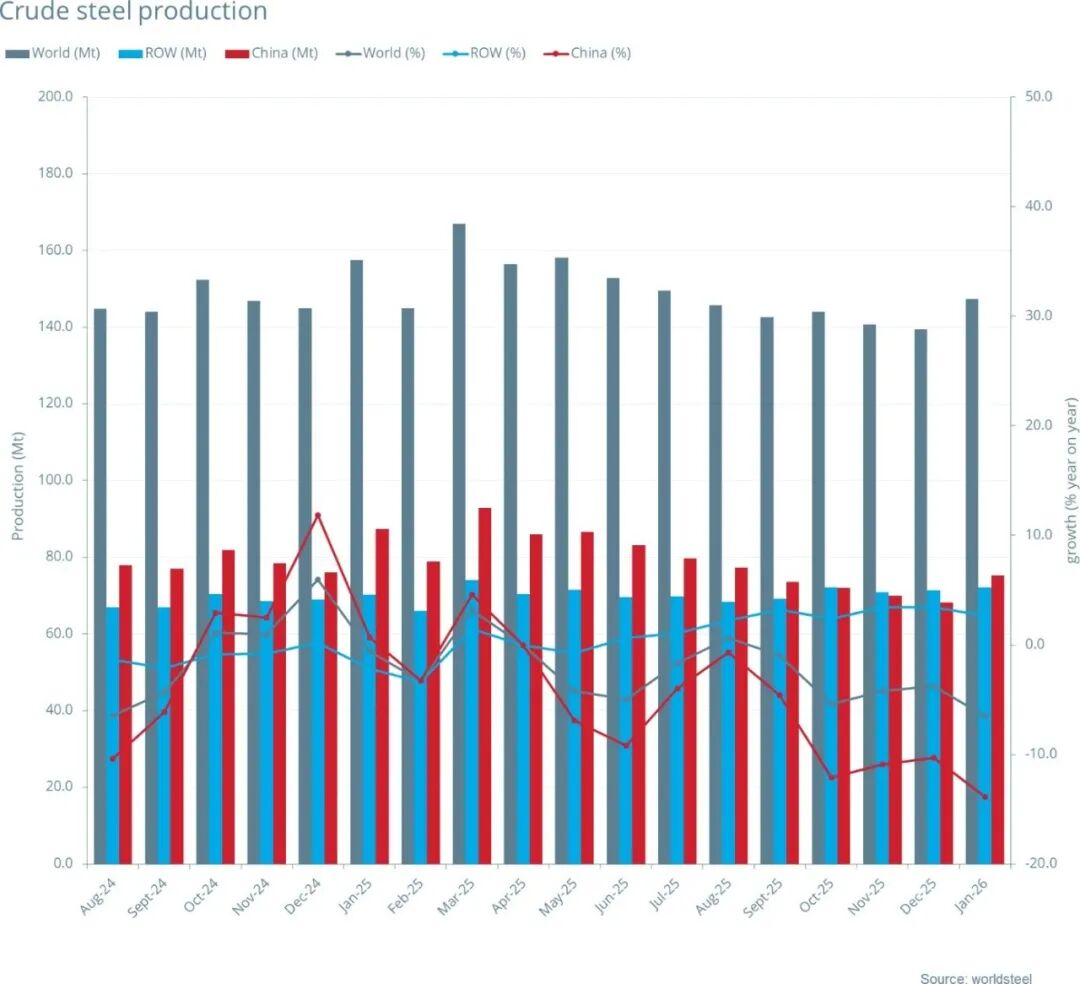
Core Viewpoint - The World Steel Association reported a decline in global crude steel production for January 2026, with a total output of 147.3 million tons, representing a year-on-year decrease of 6.5% [1]. Regional Steel Production - Africa's crude steel production reached 2 million tons in January 2026, an increase of 5.8% year-on-year [4]. - Asia and Oceania produced 107.6 million tons, down 8.6% year-on-year [4]. - The European Union (27 countries) saw a production of 10.3 million tons, a decrease of 2.3% [4]. - Other European countries produced 3.7 million tons, up 4.4% year-on-year [4]. - The Middle East's production was 4.8 million tons, an increase of 12.6% [4]. - North America produced 9.2 million tons, down 0.6% year-on-year [4]. - Russia and other CIS countries, including Ukraine, produced 6.5 million tons, a decrease of 8.6% [4]. - South America produced 3.4 million tons, down 1.2% year-on-year [4]. Top Ten Steel Producing Countries - China is estimated to produce 75.3 million tons, a decrease of 13.9% year-on-year [6][7]. - India’s production is expected to be 15.1 million tons, an increase of 10.5% [6][7]. - The United States is projected to produce 7.1 million tons, up 3.3% [6][7]. - Japan's production is estimated at 6.8 million tons, a slight decrease of 0.5% [6][7]. - South Korea is expected to produce 5.6 million tons, an increase of 5.0% [6][7]. - Russia's estimated production is 5.5 million tons, down 7.4% [6][7]. - Turkey is projected to produce 3.4 million tons, an increase of 5.8% [6][7]. - Germany's production is expected to be 3.1 million tons, up 15.0% [6][7]. - Brazil is estimated to produce 2.7 million tons, a decrease of 1.4% [6][7]. - Iran's production is expected to be 2.6 million tons, an increase of 15.1% [6][7].
每日期货全景复盘2.26:船司挺价基本落空,集运欧线期价全线走弱
Xin Lang Cai Jing· 2026-02-26 10:23
Group 1 - The shipping European index has significantly declined, indicating a bearish sentiment in the market, with the main contract dropping by 5.19% to 1236 points [20][35] - The rebar steel inventory has increased to 8.006 million tons, with a week-on-week increase of 845,600 tons, while rebar production decreased by 52,800 tons, a decline of 3.10% [11][27] - Domestic soda ash manufacturers have reported a total inventory of 1.8944 million tons, an increase of 30,640 tons, representing a rise of 19.29% [11][28] Group 2 - The manganese silicon main contract has seen a notable increase, closing at 5,918 yuan per ton, with a rise of 2.85%, supported by strong cost support from factories [33][34] - The coking coal main contract has experienced a decline of 2.46%, closing at 1,090 yuan per ton, due to increased supply and pressure on demand from steel mills [21][36] - The palm oil prices have remained strong throughout January, indicating a potential short-term structural bottom despite facing challenges from the delayed implementation of Indonesia's B50 biodiesel mandate [11][28]

管理者访谈 | 郭斐:守正创新谋改革 实干笃行求突破
Xin Lang Cai Jing· 2026-02-26 10:22
Core Viewpoint - The article emphasizes the importance of reform and innovation at Ma Steel, focusing on the implementation of the "three new" requirements and the establishment of "three platforms" to drive high-quality development [2][12]. Group 1: Reform and Strategy - The "new stage" is characterized by the restructuring of core businesses and the redefinition of responsibilities, while the "new strategy" focuses on deepening reforms and accelerating development [2][12]. - The "three platforms" are identified as the foundation for future development: a holding and investment platform for existing businesses, a service support platform for the Baowu Ma'anshan Steel Base, and an incubation platform for emerging industries [2][12]. Group 2: Achievements and Progress - By 2025, the Operations Improvement Department aims to enhance reform projects, reshape management systems, and implement differentiated management as core strategies, achieving significant progress [3][13]. - The department has successfully coordinated resources to complete key tasks such as organizational governance and compliance adjustments, ensuring independent operations [3][13]. Group 3: Challenges and Shortcomings - The company faces dual pressures from market competition and industrial transformation, with challenges in adapting to a changing supply-demand landscape and stricter environmental policies [5][15]. - Systemic resistance to deepening reforms is evident, with complex historical issues in some restructured units and a lack of consensus on reform initiatives [5][15]. Group 4: Future Directions - The Operations Improvement Department will focus on leading key reform tasks, promoting differentiated management, and optimizing organizational structures to support high-quality development [7][18]. - Plans include enhancing organizational efficiency, refining performance evaluation standards, and strengthening compliance and risk management systems [19][20].

世界钢铁协会:1月全球粗钢产量1.47亿吨,同比下降6.5%
Jin Rong Jie· 2026-02-26 10:20
Group 1 - The World Steel Association reported that global crude steel production in January 2026 was 147 million tons, a year-on-year decrease of 6.5% [1] - Crude steel production in Africa reached 2 million tons in January 2026, reflecting a year-on-year increase of 5.8% [1] - Asia and Oceania produced 108 million tons of crude steel in January 2026, marking a year-on-year decline of 8.6% [1] Group 2 - The European Union (27 countries) produced 10.3 million tons of crude steel in January 2026, down 2.3% year-on-year [1] - Other European countries saw crude steel production of 3.7 million tons, which is a year-on-year increase of 4.4% [1] - The Middle East's crude steel production was 4.8 million tons, showing a year-on-year increase of 12.6% [1] Group 3 - North America produced 9.2 million tons of crude steel in January 2026, a slight year-on-year decrease of 0.6% [1] - Crude steel production in Russia and other CIS countries, including Ukraine, was 6.5 million tons, down 8.6% year-on-year [1] - South America produced 3.4 million tons of crude steel, reflecting a year-on-year decline of 1.2% [1]
八一钢铁:非独立董事柯善良、刘文壮辞任
Mei Ri Jing Ji Xin Wen· 2026-02-26 10:08
Group 1 - The company Ba Yi Steel (600581) announced that non-independent directors Ke Shanliang and Liu Wenzhuang have resigned from their positions due to work reasons [1]

进口矿市场小幅下跌 预计明日市场窄幅震荡
Xin Lang Cai Jing· 2026-02-26 09:58
Group 1 - The imported iron ore market experienced a slight decline on February 26, with the Singapore iron ore swap main contract at $98.85, up 0.18% [1] - At Rizhao Port, the reference price for 60.8% PB powder was 745 yuan, down 5 yuan from the previous working day, while the 61% MAC powder reference price remained at 745 yuan, also down 5 yuan [1] - At Qingdao Port, the reference price for 60.8% PB powder was 745 yuan, down 10 yuan from the previous working day, while the 61% MAC powder reference price remained stable at 745 yuan [1] Group 2 - At Tianjin Port, the reference price for 61.5% PB powder was 770 yuan, indicating a slight fluctuation in the market [1] - The overall market is expected to experience narrow fluctuations in the coming days [1]