宠物经济

Search documents
大千生态:截至目前,公司宠物业务暂时没有在港澳市场的拓店计划
Zheng Quan Ri Bao Zhi Sheng· 2025-10-16 14:07
Group 1 - The company, Daqian Ecology, currently has no plans to expand its pet business in the Hong Kong and Macau markets [1] - The company aims to actively expand and improve its business layout in response to market conditions and industry development trends in the future [1]

盛世奇观:6亿人为情绪消费买单
Sou Hu Cai Jing· 2025-10-15 02:14
Core Insights - The article discusses the unique economic phenomenon in China where seemingly useless items are sold at high prices, indicating a shift in consumer behavior towards emotional spending rather than traditional necessities [2][4]. Group 1: Demographics and Consumer Behavior - The single population in China has reached 240 million, expected to exceed 300 million next year, while the population aged 60 and above has surpassed 310 million, together accounting for nearly half of the country's population [2]. - These demographics represent a significant shift in consumer behavior, as they are the first generation in China with disposable income that can be spent on personal desires rather than family obligations [2][4]. Group 2: Economic and Social Changes - The rise of the single population is attributed to changes in production methods and women's economic independence, leading to a transformation in marriage and family structures [4]. - The emotional consumption trend has emerged, where individuals are willing to spend significantly on non-essential items that provide emotional satisfaction, such as collectibles and pet products [4][5]. Group 3: Market Trends - The pet economy has reached 279.3 billion, projected to exceed 360 billion next year, reflecting the growing trend of emotional spending [5]. - The "one-person economy" is thriving, with products and services tailored to individual lifestyles, indicating a shift in consumption patterns [5]. Group 4: Emotional Value as a New Consumption Trend - Emotional value is identified as a new consumption trend, where products provide psychological satisfaction rather than just material utility [8]. - The emergence of a third type of value, "emotional value," is reshaping the market, driven by changes in economic conditions, consumer independence, and technological advancements [8][9]. Group 5: Implications of Social Change - The silver economy is projected to surpass 12 trillion, with expectations to reach 50 trillion, indicating a significant market opportunity in catering to the elderly population [9]. - The article highlights the societal transformation resulting from the liberation from traditional structures, leading to increased individualism and, consequently, loneliness [9][11]. Group 6: Future Outlook - The article suggests that the future of consumption will focus on emotional products, as the need for emotional fulfillment becomes a primary driver of spending [11]. - The market is adapting to meet the emotional needs of consumers, indicating a shift in the economic landscape towards providing emotional support and companionship [11].


由攻转守!年末基金优选顺周期品种
券商中国· 2025-10-14 23:27
Core Viewpoint - The stock market experienced significant volatility after the National Day holiday, influenced by public funds realizing high-yield investments and a shift towards defensive strategies in the fourth quarter to secure annual performance [1][2]. Group 1: Market Dynamics - Public fund managers anticipate a shift to defensive strategies in Q4, as high valuation states in certain sectors have become apparent, leading to profit-taking in high-performing segments [2][4]. - Historical data from 2010 to 2024 indicates that sectors with high gains in the first three quarters typically underperform in Q4, prompting institutional investors to lock in profits or reposition towards lower-risk assets [2][6]. Group 2: Fund Manager Insights - Fund managers are accelerating portfolio adjustments in October, seeking balanced allocations, which may contribute to market corrections. The focus is on switching between high and low-performing sectors [4][5]. - The market is expected to experience a controlled adjustment, as traditional blue-chip stocks have not shown significant gains and remain below historical average valuations, suggesting that the broader market trend remains intact despite short-term fluctuations [5][6]. Group 3: Investment Strategies - In light of the fourth-quarter strategy shift, public funds are likely to favor cyclical sectors such as consumer goods, resources, and finance, while adopting a more cautious approach compared to the previous quarters [6][7]. - The performance of cyclical sectors, particularly in consumer and resource stocks, is anticipated to be strong, with new consumption trends like beauty and pet economies leading the charge [7][8]. - The dual-driven market structure of "technology" and "cyclical" is expected, with technology representing future growth and cyclical stocks benefiting from liquidity and policy improvements [8].
融资折算率调整影响有限 公募切换仓位保“收成”
Zheng Quan Shi Bao· 2025-10-12 22:04
Group 1 - The stock market has experienced significant fluctuations post-holiday, with A-shares, Hong Kong stocks, and US stocks all declining, prompting public fund analysts to suggest a defensive strategy in Q4 to lock in annual performance [1][2] - Historical trends indicate that sectors with high gains in the first three quarters typically underperform in Q4, as institutional funds tend to secure profits or shift to lower-risk investments to mitigate high volatility [1][2] Group 2 - The adjustment of margin financing rates has had a minor impact on the market, with certain stocks seeing their financing rates drop to zero due to high static P/E ratios, affecting market sentiment but not being the primary cause of the recent downturn [2][4] - Fund managers are accelerating portfolio adjustments in October to preserve annual returns, with a focus on balancing sector allocations and identifying rotation opportunities [4][5] Group 3 - There is a growing emphasis on technology and innovation, with expectations that companies with strong technological barriers and commercialization capabilities will validate market expectations through solid performance [3][7] - The shift in fund positioning towards cyclical sectors such as consumer goods, resources, and finance is anticipated, as these sectors are expected to outperform in Q4 based on historical performance data [6][7] Group 4 - The market is likely to see a dual-driven pattern of technology and cyclical sectors, with traditional resource stocks being viewed as a favorable investment opportunity amid improving liquidity and policy expectations [7][8] - The focus is shifting from emotionally driven market movements to fundamental growth, particularly for innovative pharmaceutical companies with strong product pipelines and market potential [7][8]
科技股龙头调整,200亿撤出半导体,中兴通讯强势涨超4%
2 1 Shi Ji Jing Ji Bao Dao· 2025-10-10 07:53
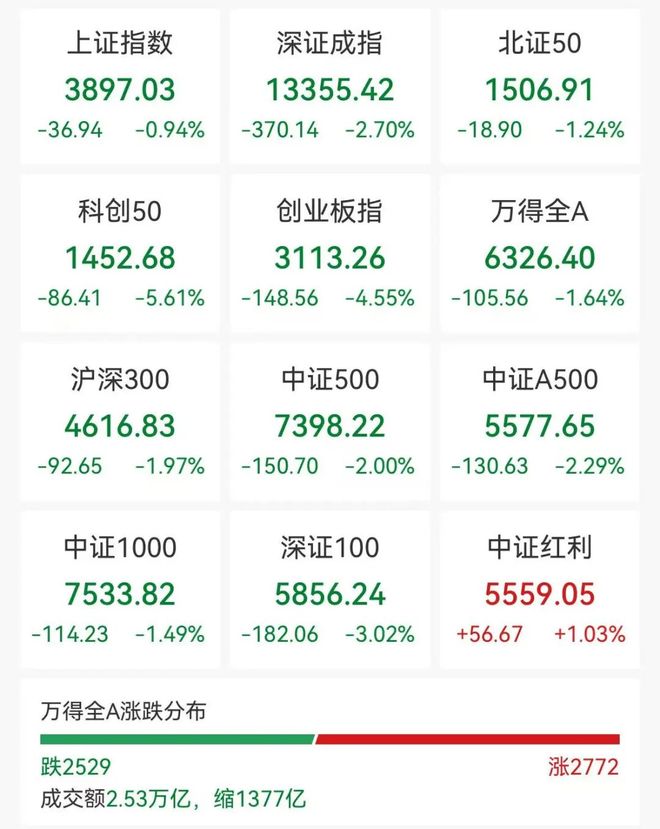
Market Overview - The A-share market experienced a day of volatility and adjustment, with all three major indices closing down: Shanghai Composite Index fell by 0.94%, Shenzhen Component Index dropped by 2.70%, and ChiNext Index decreased by 4.55% [1][2] - The total market turnover was 2.53 trillion yuan, a decrease of 137.7 billion yuan compared to the previous day [2] Sector Performance - Gas and coal sectors showed gains, while semiconductor, battery, and precious metals sectors faced significant declines, with semiconductor funds seeing an outflow exceeding 20 billion yuan [2][3] - Notable individual stock movements included CATL and Sanhua Intelligent Control, both experiencing fund outflows over 2 billion yuan, while ZTE Corporation saw a rise of over 4% [4] Precious Metals - The price of spot gold fell below the 4000 USD mark, closing at 3965 USD per ounce, leading to a decline in A-share precious metal stocks, with several stocks like Western Gold and Chifeng Jilong Gold dropping over 5% [8][10] - Analysts suggest that persistent inflation data in the U.S. could lead to a stronger dollar and higher real interest rates, reducing gold's attractiveness [11] Investment Sentiment - The first three quarters of the year saw significant gains in major indices: Shanghai Composite Index up 15.84%, Shenzhen Component Index up 29.88%, and ChiNext Index and Sci-Tech 50 Index both up 51.20% [14] - The best-performing sectors included non-ferrous metals, hardware equipment, and semiconductors, with emerging concepts like AI and controlled nuclear fusion gaining traction [14] - Market sentiment indicates a cautious outlook for the fourth quarter, with a potential shift in investment focus from technology to traditional sectors like real estate and machinery [15]




收评:沪指失守3900点跌0.94% 创指收跌4.55% 大消费板块逆势活跃
Xin Lang Cai Jing· 2025-10-10 07:09
Market Overview - The three major stock indices collectively declined, with the ChiNext Index falling over 4%, the Shenzhen Component Index down nearly 3%, and the Sci-Tech Innovation 50 Index dropping 5.61% [1][2] Sector Performance - The consumer sector was notably active, with new consumption areas like beauty and pet economy leading the gains, as stocks such as Zhuangyuan Pastoral and Yiyi Co. hit the daily limit [1] - The gas sector also performed well, with Dazhong Public Utilities and Hongtong Gas reaching the daily limit [1] - The military equipment sector strengthened in the afternoon, with Changcheng Military Industry hitting the daily limit [1] - Conversely, the semiconductor sector experienced a pullback, with stocks like Aojie Technology and Dongxin Co. dropping over 10% [1] - The battery sector declined, led by Liyuanheng, while the precious metals sector continued to adjust, with Western Gold seeing significant losses [1] Key Highlights - The consumer sector saw a surge in stocks ahead of the 2025 "Double 11" shopping festival, with platforms like Kuaishou and Douyin initiating pre-sales [3] - In the electric grid equipment sector, New Special Electric hit the daily limit, supported by a report from Goldman Sachs indicating a significant increase in power demand for data centers, raising investment expectations from $720 billion to $780 billion by 2030 [4]
A股宠物经济概念股逆势上涨,依依股份涨停
Ge Long Hui A P P· 2025-10-10 05:26
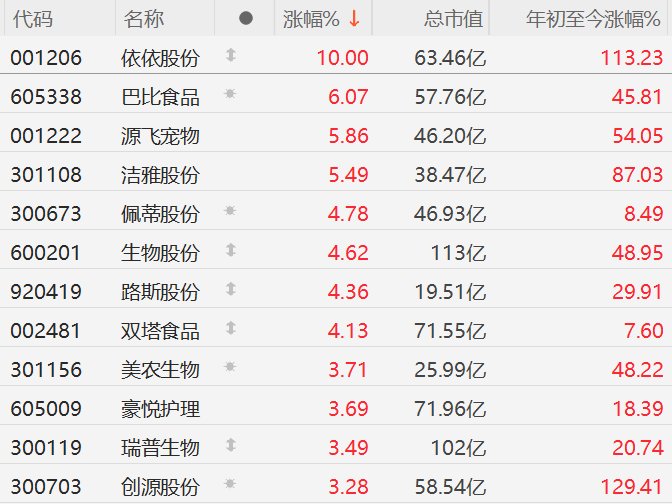
Group 1 - The pet economy concept stocks in the A-share market are experiencing a counter-trend rise, with notable increases in stock prices for several companies [1] - Yiyi Co., Ltd. reached a 10% limit up, while Babi Food increased by 6%, and other companies like Yuanfei Pet and Jieya Co. saw rises exceeding 5% [1] - The overall trend indicates a positive sentiment in the pet industry, as reflected by the MACD golden cross signal formation [1] Group 2 - Yiyi Co., Ltd. has a total market value of 6.346 billion and a year-to-date increase of 113.23% [2] - Babi Food has a market capitalization of 5.776 billion with a year-to-date increase of 45.81% [2] - Yuanfei Pet has a market value of 4.620 billion and a year-to-date increase of 54.05% [2] - Jieya Co. has a market capitalization of 3.847 billion and a year-to-date increase of 87.03% [2] - Petty Co. has a market value of 4.693 billion with a year-to-date increase of 8.49% [2] - Other companies like Biological Co. and Lusi Co. also showed significant increases in their stock prices and market values [2]

A股宠物经济概念股逆势上涨 依依股份涨停
Xin Lang Cai Jing· 2025-10-10 05:20
Group 1 - The A-share market's pet economy concept stocks are experiencing a counter-trend rise, indicating strong investor interest in this sector [1] - Yiyi Co., Ltd. has reached a 10% daily limit increase, showcasing significant market confidence [1] - Other notable performers include Babi Foods with a 6% increase, and Yuanfei Pet, Jeya Co., Ltd. with over 5% gains [1] Group 2 - Peti Co., Ltd., Bio Co., Ltd., Lusi Co., Ltd., and Shuangta Foods have all seen increases of over 4%, reflecting a broad positive sentiment in the pet industry [1] - Meino Biological, Haoyue Nursing, Ruipu Biological, and Chuangyuan Co., Ltd. have also reported gains exceeding 3%, further indicating the sector's resilience [1]
大消费板块持续活跃 遥望科技、依依股份双双涨停
Xin Lang Cai Jing· 2025-10-10 05:17
Core Viewpoint - The consumer sector is experiencing significant activity, particularly in new consumption areas such as beauty and pet economy, with companies like Yaowang Technology and Yiyi Co., Ltd. hitting their daily price limits [1] Group 1: Market Activity - The consumer sector, especially beauty and pet economy, is leading the market with notable gains [1] - Yaowang Technology and Yiyi Co., Ltd. have both reached their daily price limits [1] - Other companies such as Shuiyang Co., Petty Co., Lusi Co., and Lafang Jiahua are also seeing upward movement [1] Group 2: Upcoming Promotions - The prelude to the 2025 "Double 11" shopping festival has begun, with major platforms initiating their promotional activities [1] - Kuaishou started its pre-sale for the 2025 "Double 11" on October 7 [1] - Douyin officially launched its "Double 11" promotion at midnight on October 9, followed by JD.com starting its campaign at 8 PM the same day [1]

太突然!刚刚,A股突变!
天天基金网· 2025-10-10 05:09
Market Overview - On October 10, A-shares experienced a collective pullback, with the Sci-Tech 50 Index dropping over 4%, while the Shanghai Composite Index managed to hold above 3900 points [3][4] - The Shanghai Composite Index closed at 3913.8 points, down 0.51%, the Shenzhen Component fell 1.85%, and the ChiNext Index decreased by 3.4% [4] - The total trading volume in the Shanghai and Shenzhen markets was 1.64 trillion yuan, a decrease of 713 billion yuan from the previous trading day [5] Sector Performance - The financial and consumer sectors led the market, with significant gains in large financial stocks and consumer goods [5][10] - The gold and semiconductor sectors, which had seen substantial gains previously, experienced notable pullbacks [5][12] Financial Sector Highlights - Major brokerage stocks surged, with Guosen Securities hitting a 10% limit up, and other firms like GF Securities and Huatai Securities also performing well [8] - Notable stock performances included: - Guosen Securities: 14.25 yuan, up 5.87%, year-to-date increase of 31.26% [9] - GF Securities: 24.16 yuan, up 4.18%, year-to-date increase of 52.54% [9] - The banking sector also showed positive movement, with Qilu Bank and Shanghai Bank both rising over 2% [10] Consumer Sector Insights - The soft drink sector rose over 3%, with companies like Yangyuan Beverage and Dongpeng Beverage seeing gains [10] - The dairy sector saw significant activity, with Zhuangyuan Pasture hitting a 10% limit up, and other dairy stocks also performing well [10] Gold Sector Analysis - The gold sector faced a significant pullback, with the precious metals sector dropping nearly 4% [12] - Key declines included: - Western Gold: down 8.73%, year-to-date increase of 162.88% [14] - Xiaocheng Technology: down 8.58%, year-to-date increase of 89.79% [14] Semiconductor Sector Decline - The Sci-Tech 50 Index fell 4.64%, with the semiconductor sector leading the declines [18] - Notable stock declines included: - SMIC: down 7.35%, current market value of 6883 billion yuan [22] - Haiguang Information: down 7.24% [21] Solid-State Battery Sector - The solid-state battery sector also saw a downturn, with key stocks like CATL dropping 6.3% [24] - Other significant declines included: - Xianlead Intelligent: down 11.51% [26] - Yicheng Lithium Energy: down over 9% [26] Regulatory Update - The Ministry of Industry and Information Technology, along with the Ministry of Finance and the State Taxation Administration, announced adjustments to the technical requirements for energy-saving and new energy vehicles, effective January 1, 2026 [27]