
新能源

Search documents
中金 | 风光公用环保&电力设备新能源:中东冲突催化变革,全球能源转型步伐加快
中金点睛· 2026-03-22 23:54
Core Viewpoint - The escalation of conflicts in the Middle East is intensifying energy security concerns, while the world is firmly committed to low-carbon development [1] Group 1: Renewable Energy and Grid Equipment - The global determination for energy transition is strengthening, with significant long-term development potential for wind, solar, and storage, particularly benefiting residential storage in the short term [4] - Rising natural gas prices are expected to have a notable impact on solar storage in Europe, potentially driving demand if prices are sustained [4] - The European energy transition is likely to accelerate grid investments, with the EU proposing a €400 billion investment plan to meet offshore renewable energy integration by 2050 [4] Group 2: Wind Energy - Wind energy is seen as a long-term effective means to address energy supply fluctuations, with recent calls for expedited wind project approvals [7] - The global offshore wind market is expected to grow rapidly, with commitments from European countries to add 15 GW annually from 2031 to 2040 [9] - Emerging markets are showing potential for wind energy growth, with countries outside China expected to see significant increases in installed capacity [8] Group 3: Solar Energy - The rise in energy costs is boosting the return on investment for solar storage in Europe, with residential storage systems benefiting first [12] - The conflict in the Middle East is expected to marginally increase demand for solar energy, providing some price support [18] - The current lower cost of solar power generation compared to previous conflicts suggests a potentially better return on investment for solar projects [19] Group 4: Energy Storage - Energy storage is becoming increasingly crucial in the power system, addressing the temporal mismatch of energy supply and demand [22] - Residential storage is expected to benefit quickly from rising natural gas and electricity prices, shortening investment payback periods [23] - Large-scale energy storage is essential for supporting the ongoing energy transition, with significant investments planned in the EU [27] Group 5: Electricity Pricing and Coal - Geopolitical conflicts may indirectly push up coal prices, with electricity companies having incentives to raise prices during peak demand seasons [28] - The domestic coal market is currently experiencing price fluctuations, with a notable increase in coal prices observed [29] - If geopolitical tensions persist into peak coal demand seasons, coastal power plants may raise electricity prices to alleviate operational pressures [30]

主题策略周报20260322:能源自主已成为主线-20260322
Orient Securities· 2026-03-22 14:43
Group 1 - Core viewpoint: Energy security is the main theme, and new energy manufacturing is leading the next stage of the mid-cap blue-chip market [2][10] - Current market assessment indicates that the index may face some pullback pressure but is expected to continue operating within a defined fluctuation range [3][11] - The manufacturing sector is becoming the leader in investment opportunities, particularly in the context of heightened global energy security demands [4][12] Group 2 - The primary theme of investment is "energy autonomy," driven by geopolitical events in the Middle East, which has created a rigid demand for energy infrastructure [5][13] - China's new energy manufacturing, particularly in photovoltaic, offshore wind, and power transmission sectors, is positioned to meet global security demands effectively [5][13] - There is a need to focus on investment opportunities in the manufacturing sector, especially in mid-cap blue-chip stocks, while gradually adjusting expectations for previously recommended cyclical sectors [4][12]
新材料产业周报:英伟达全球首款CPO交换机Spectrum X全面投产-20260322
Guohai Securities· 2026-03-22 14:34
Investment Rating - The report maintains a "Recommended" rating for the new materials industry [1]. Core Insights - The new materials sector is positioned as a crucial direction for the chemical industry, currently experiencing rapid growth in downstream demand. With policy support and technological breakthroughs, domestic new materials are expected to accelerate into a long-term growth phase. The report emphasizes that "one generation of materials leads to one generation of industries," highlighting the foundational role of the new materials industry in supporting other sectors [6][18]. Summary by Sections 1. Electronic Information Sector - Focus on semiconductor materials, display materials, and 5G materials [7]. - NVIDIA announced the full production of the world's first Co-Packaged Optics (CPO) switch, Spectrum X, which integrates photonic components directly onto chips, achieving a bandwidth of 409.6 Tb/s to support large-scale generative AI workloads [8][38]. - MediaTek, in collaboration with Microsoft Research, developed a next-generation Active Optical Cable using micro-sized Micro LED light sources, significantly enhancing transmission distance while maintaining high reliability [9][10]. 2. Aerospace Sector - Focus on PI films, precision ceramics, and carbon fibers [11]. - Successful launch of multiple satellites using the Kuaizhou-11 solid rocket, showcasing the capabilities of the rocket in commercial launch tasks [12]. 3. New Energy Sector - Focus on photovoltaic materials, lithium-ion batteries, proton exchange membranes, and hydrogen storage materials [13]. - In February 2026, the National Energy Administration issued 198 million green power certificates, with a significant portion attributed to wind and solar power generation [13]. 4. Biotechnology Sector - Focus on synthetic biology and scientific services [14]. - Research teams have developed a new type of artificial photosynthetic cell that allows industrial microorganisms to efficiently synthesize high-value chemicals using solar energy [16]. 5. Energy Conservation and Environmental Protection Sector - Focus on adsorption resins, membrane materials, and biodegradable plastics [17]. - The Ministry of Industry and Information Technology and other departments issued a plan to enhance the energy efficiency of energy-saving equipment, targeting key industries for energy conservation and carbon reduction [18]. Key Companies and Earnings Forecast - The report highlights several key companies with earnings forecasts for 2024 to 2026, including: - Ruihua Tai (688323.SH): EPS forecasted to improve from -0.32 in 2024 to 0.26 in 2026 [19]. - Guangwei Composite (300699.SZ): EPS expected to rise from 0.89 in 2024 to 0.97 in 2026 [19]. - Zhongfu Shenying (688295.SH): EPS projected to increase from -0.14 in 2024 to 0.23 in 2026 [19]. The report emphasizes the potential for the new materials industry to enter a prosperous cycle driven by downstream application sectors [18].

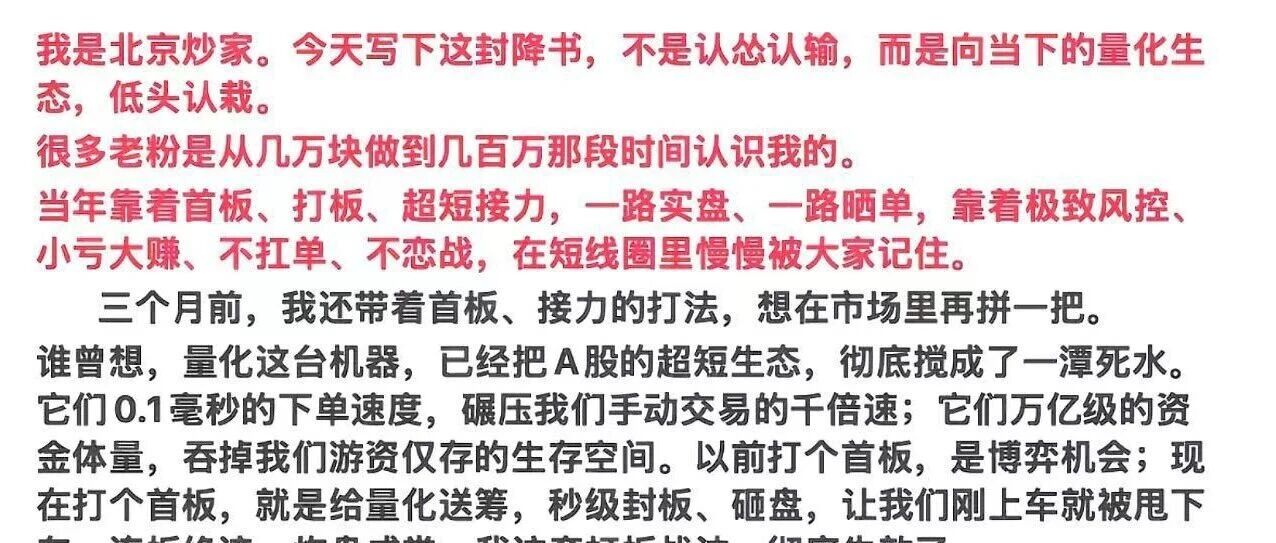
游资“投降”——A股一周走势研判及事件提醒
Datayes· 2026-03-22 14:13
Group 1 - The core viewpoint of the article highlights the significant shift in trading strategies, with retail investors, particularly short-term traders, withdrawing from the market in favor of quantitative trading strategies, which are becoming dominant in the A-share market [1][5] - Retail trading seats have seen a decline in transaction volume, reaching a three-year low, indicating a potential shift in market dynamics as notable traders exit or pause their operations [1][5] - Quantitative private equity funds have expanded significantly, surpassing traditional subjective long-only funds for the first time, indicating a shift in market influence [5] Group 2 - The market's recent decline is attributed to absolute return-oriented funds reducing their positions, rather than institutional reallocation, with certain sectors experiencing mismatched performance [7] - Investors are advised to remain patient and calm amid market fluctuations, as the period from April to May is expected to be crucial for decision-making [7] - Certain sectors, such as energy storage and domestic AIDC chains, are recommended for investment due to their potential resilience against geopolitical tensions and high oil prices [8] Group 3 - In the Hong Kong market, the short-selling volume has reached historical highs, similar to the bear market of 2021-2022, indicating limited upward potential [11] - However, high short-selling does not necessarily predict market declines; a market recovery could trigger a short squeeze, enhancing rebound strength [11] Group 4 - The article discusses the geopolitical tensions in the Middle East, with both the U.S. and Iran signaling a willingness to negotiate, which could impact market sentiment and investment strategies [12][15] - The U.S. seeks to include specific conditions in any agreement, while Iran has outlined six demands that must be met for negotiations to proceed [15] Group 5 - The article outlines various sectors that are expected to perform well, including renewable energy, particularly in wind and solar, as well as energy storage technologies, which are anticipated to benefit from ongoing geopolitical tensions and market demands [23][24] - The semiconductor and AI sectors are also highlighted, with significant investments and developments expected in the coming years, particularly in chip manufacturing and AI infrastructure [17][19][20]

策略周报:慢牛趋势不破,新能源投资机会凸显-20260322
Bank of China Securities· 2026-03-22 13:09
Core Insights - The report indicates that the structural slow bull trend in the A-share market remains intact despite recent adjustments due to geopolitical tensions, particularly the Israel-Iran conflict, which has led to rising oil prices and increased inflationary pressures in the U.S. [3][11][15] - The report highlights that the energy transition is becoming increasingly important, with significant investment opportunities in the new energy sector, including solar, wind, and battery storage, as these areas are less affected by geopolitical conflicts and fossil fuel price fluctuations [3][16][18]. Market Overview - The A-share market has experienced notable adjustments since March, with the Shanghai Composite Index falling below 4000 points. As of March 20, the total A-share index, Shanghai Composite, and CSI 300 have decreased by 6.78%, 4.94%, and 3.05% respectively, while the STAR 50 index has seen a decline of 11.41% [15][16]. - The report notes that only the ChiNext index has maintained positive returns in March, while the overall performance of major indices has turned negative for the year [15][16]. Inflation and Interest Rate Expectations - The U.S. Producer Price Index (PPI) rose by 3.4% year-on-year and 0.7% month-on-month in February, driven by the Israel-Iran conflict and rising oil prices. Market expectations for a rate cut by the Federal Reserve have been pushed back to 2027 [11][14]. - Despite the inflationary pressures, the Federal Reserve's policy stance remains unchanged, with expectations of at least one rate cut within the year according to the updated dot plot from the March meeting [11][14]. New Energy Sector Opportunities - The Brent crude oil price has remained above $100 per barrel since mid-March, highlighting the importance of energy structure transformation. The report emphasizes that sectors such as photovoltaics and wind power are less impacted by geopolitical tensions and fossil fuel prices [16][18]. - The new energy sector, including solar, wind, batteries, and energy storage, is expected to perform well in 2026, with high configuration cost-effectiveness and significant investment opportunities [16][18]. Sector Performance - The report identifies that the communication, new energy, and consumer sectors have shown relatively strong performance amid market adjustments, while sectors sensitive to global liquidity changes, such as non-ferrous metals, have underperformed [34][42]. - The report also notes that the current valuation-profitability ratio for sectors like computing, consumer services, media, and pharmaceuticals remains attractive, with projected net profit growth for 2026 expected to be high [43][47].
策略周报:底线思维,布局中期赢家-20260322
East Money Securities· 2026-03-22 13:05
Strategy Insights - The report emphasizes a bottom-line thinking approach, focusing on mid-term winners in the context of a globally slowing economy and potential stagflation [1] - It highlights the importance of China's new energy system and manufacturing cost advantages, maintaining an optimistic outlook for the Chinese stock market despite external turbulence [1][3] - The report suggests that the current global asset expectations are leaning towards mild stagflation, with specific attention to the performance of various asset classes [1][3] Global Economic Context - The report notes that the Iranian situation introduces significant uncertainty, impacting global energy supply and leading to a mild stagflation scenario reflected in the financial markets [3][8] - It discusses how the U.S. stock market remains relatively stable, with no immediate concerns about recession or severe stagflation, despite external pressures [3][8] Industry Configuration Strategies - Three key strategies for industry allocation are proposed: focusing on energy substitution, low volatility dividends, and industries with certain growth prospects [3][29] - The report identifies specific sectors to watch, including new energy (wind, storage, solar, electric vehicles), coal, natural gas, banking, insurance, optical modules, PCB, storage, optical fiber, semiconductor equipment, and real estate [3][29] Export Dynamics - The report indicates that while global demand may weaken due to overseas stagflation, China's export share could still increase due to rising overseas costs and China's resource advantages [22][29] - It highlights that China's exports in January-February reached 46,178 billion yuan, a year-on-year increase of 19.2%, reflecting a significant recovery in foreign trade [22][27] Asset Pricing and Market Behavior - The report discusses how the U.S. dollar has strengthened due to increased demand for safe-haven assets amid geopolitical tensions, while U.S. Treasury yields have shown volatility due to conflicting economic signals [8][15] - It notes that commodity prices are experiencing divergence, with oil prices rising significantly while industrial metals are under pressure due to weak demand and macroeconomic concerns [20][21] Focus on New Energy - The report underscores the strategic value of the new energy sector, particularly in light of rising oil prices and the need for energy security, suggesting that sectors like solar and wind energy will benefit from increased demand [38]
配置银行等板块,静待更多“稳市场”政策出台
HUAXI Securities· 2026-03-22 12:01
Market Review - The global stock markets mostly declined this week, with A-shares and European markets experiencing the largest drops. The geopolitical situation between the US and Iran remains uncertain, leading to increased risks of economic stagflation and volatility in oil prices and inflation. The Federal Reserve's decision to maintain interest rates in March, coupled with a hawkish statement, has raised concerns about a tightening dollar, suppressing market risk appetite. Consequently, A-shares have seen a general pullback, with trading volumes continuing to shrink, indicating a cooling of investor sentiment in a rapidly rotating sector environment. Defensive sectors such as food and beverage, banking, and high-growth areas like storage and AI computing have performed relatively better [1][2][3]. Market Outlook - The report suggests focusing on banking and other defensive sectors while awaiting more "stabilizing market" policies. The ongoing US-Iran conflict and delayed expectations for overseas interest rate cuts are likely to continue suppressing global risk appetite. In contrast, the domestic policy environment appears more certain, with regulators signaling a commitment to stabilize the capital market. Anticipated policies include the establishment of a "stabilization fund," optimization of structural tools for the capital market, and measures to encourage medium- to long-term capital inflows [2][4]. Geopolitical Risks - The trajectory of geopolitical events remains highly uncertain, and the market must remain vigilant regarding extreme tail risks associated with oil supply disruptions. The recent three-week period of the US-Iran conflict has seen global stock indices decline, but the drops have been less than 10%, indicating a more optimistic pricing of the conflict compared to the significant declines seen during the 2022 Russia-Ukraine conflict. If oil shipping disruptions persist or the conflict spreads, there could be further spikes in oil prices and supply chain interruptions, reminiscent of the oil crises in the 1970s [3][4]. Domestic Policy Environment - The domestic regulatory framework continues to emphasize stabilizing the capital market and promoting medium- to long-term capital inflows. The People's Bank of China has indicated a commitment to maintaining the stability of financial markets, with potential policies including a "stabilization fund" mechanism supported by liquidity from the central bank, optimization of structural monetary policy tools, and enhancements to the A-share investment environment [4][5]. Monetary Policy and Economic Outlook - Input-driven inflation is expected to have limited constraints on China's monetary policy, with a continued focus on maintaining a loose liquidity environment. The central bank aims to promote stable economic growth and reasonable price recovery, with a commitment to using various monetary policy tools to ensure ample liquidity. Fiscal policies are also expected to become more proactive, focusing on improving public services and increasing government investment in livelihood projects, which could help enhance consumer expectations and create a positive inflation-wage cycle [5][6]. Sector Allocation - The report recommends a defensive strategy, focusing on sectors such as banking, public utilities, and essential consumer goods. Additionally, there is an emphasis on energy independence through investments in new energy and electricity sectors, as well as high-growth areas like AI computing and energy storage [5][6].
【太平洋研究院】3月第四周线上会议(总第51期)
远峰电子· 2026-03-22 11:57
Group 1 - The article discusses a series of online meetings scheduled for March 2023, focusing on various sectors including pharmaceuticals, agriculture, new energy, and chemicals [24]. - The first meeting on March 23, 2023, at 19:00, will cover a deep report on Zai Ding Pharmaceutical, presented by the chief analyst and an analyst from the pharmaceutical sector [24]. - The second meeting on March 23, 2023, at 20:00, will focus on investment strategies in the planting sector, led by the chief agricultural analyst and an agricultural analyst [24]. Group 2 - A meeting on March 25, 2023, at 20:30, will explore new opportunities in the new energy sector, specifically the seventh series of discussions, presented by the vice president and chief analyst of the electric new energy sector [24]. - On March 27, 2023, at 11:00, a session titled "Europe's Risks, China's Opportunities" will address the impact of natural gas supply shocks on the vitamin industry, led by a chemical industry analyst [24]. - The final meeting on March 27, 2023, at 15:00, will provide insights into the electronic industry for April, presented by the chief analyst of the electronic sector [24].


周观点:美国AI泡沫延续或将深化地缘冲突-20260322
Huafu Securities· 2026-03-22 11:45
Group 1 - The report highlights that the intensity of AI investment in the US is high, but the sustainability of marginal returns is questionable. There is a possibility of external pressure being transferred to maintain the expansion path until a systemic correction occurs in the related bubble [2][3] - The process of maintaining AI valuations in the US may create a siphoning effect on global sovereign wealth, exacerbating the fragility of the global financial system. If energy prices continue to rise, the probability of the Federal Reserve restarting the interest rate hike cycle may increase [3] - In the context of rising global fragility, RMB assets may have relatively outstanding allocation value. It is suggested to focus on the two main lines of the RMB's phase appreciation and rising energy prices, and to conduct structural adjustments in the Chinese market on an annual basis [3] Group 2 - The report expresses a mid-term positive outlook on coal, new energy, agriculture, electricity, oil, and US capital goods related to inflation [3] - For the long term, the report favors insurance, central state-owned enterprises, anti-involution, and Chinese internet companies [3] Group 3 - The report indicates that the Federal Reserve maintains a positive outlook on the resilience of the US economy, raising the GDP growth forecast for 2026 from 2.3% to 2.4%. However, inflation concerns have significantly increased, with the overall PCE inflation forecast for 2026 raised from 2.4% to 2.7% [8][10] - The report notes that the US AI infrastructure expansion is driving capital expenditure growth, but the commercialization process is relatively lagging, raising doubts about the sustainability of marginal capital returns [9]
AH股市场周度观察(3月第3周)
ZHONGTAI SECURITIES· 2026-03-22 02:50
Group 1: A-Share Market Overview - The A-share market faced overall pressure this week, with major indices declining, including the CSI 500, CSI 2000, and Northbound 50, which fell by 5.82%, 5.70%, and 5.76% respectively[7] - The ChiNext index showed relative resilience, with a cumulative increase of 1.26% this week[7] - Average daily trading volume was 2.21 trillion yuan, down 11.51% week-on-week[7] Group 2: Market Analysis and Influencing Factors - The market's performance was influenced by multiple factors, including hawkish signals from the Federal Reserve, which exerted liquidity pressure on A-shares[7] - Ongoing geopolitical tensions in the Middle East led to a rapid increase in oil prices, impacting liquidity and causing significant declines in precious metals and non-ferrous metals[7] - The steel, non-ferrous metals, and basic chemicals sectors experienced substantial declines this week[7] Group 3: Future Outlook - The outlook suggests a potential long-term trend in the US-Iran conflict, with short-term trading in the oil and petrochemical sectors becoming crowded and less attractive[7] - There is a focus on the long-term demand for alternative energy sources and opportunities in sectors like engineering machinery due to global manufacturing expansion[7] Group 4: Hong Kong Market Overview - The Hong Kong market experienced a slight adjustment, with the Hang Seng Index down 0.74%, the Hang Seng Tech Index down 2.12%, and the Hang Seng China Enterprises Index down 1.12%[8] - Defensive sectors such as financials and comprehensive enterprises showed gains of 2.23% and 1.78% respectively, while materials and information technology sectors saw declines of 11.26% and 5.02%[8] Group 5: Investment Strategy - The recommendation for the Hong Kong market is to adopt a "barbell strategy," allocating to high-dividend defensive assets (energy, telecommunications, public utilities) while also considering internet leaders with significant valuation corrections for potential recovery[8] - The Hang Seng Tech Index is noted to have a high valuation attractiveness, indicating potential for mid-to-long-term investment[8] Group 6: Risk Factors - Risks include potential tightening of global liquidity beyond expectations, increased complexity in market dynamics, and unpredictable policy changes[9]