
航空航天器及设备制造业

Search documents
详解10月经济数据:工业增速高位放缓,服务消费成为重要增长点
第一财经· 2025-11-14 12:30
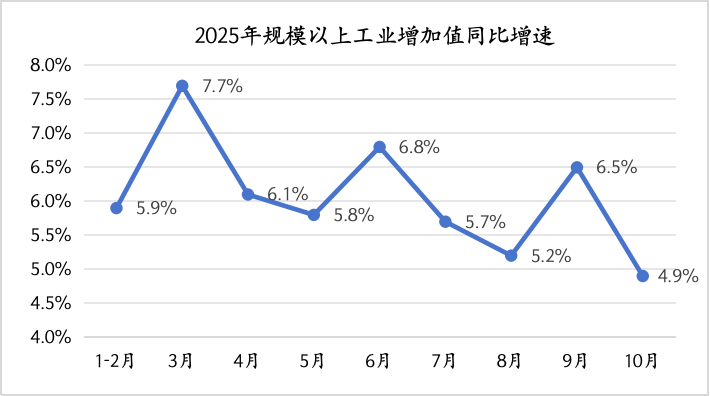
Core Viewpoint - The macroeconomic indicators in October showed fluctuations due to last year's high base and increased external uncertainties, with industrial production growth slowing down and fixed asset investment declining [3][5]. Industrial Growth - In October, the industrial added value above designated size grew by 4.9% year-on-year, a decrease of 1.6 percentage points from September. The cumulative growth from January to October was 6.1% [5][6]. - Among 41 major industries, 29 maintained growth, accounting for 70.7%. Additionally, 50.2% of 623 major products saw production increases [5][6]. - The industrial production is supported by proactive macro policies, but external complexities and insufficient market demand pose challenges [5][6]. Consumer Spending - The retail sales of consumer goods increased by 4.3% year-on-year from January to October, with service retail sales growing by 5.3% [8][9]. - Policies promoting the replacement of old consumer goods and the growth of digital and service consumption have effectively released consumption potential [8][9]. - Online retail sales rose by 9.6%, with physical goods retail growing by 6.3%, indicating a shift towards digital consumption [8][9]. Investment Trends - Fixed asset investment (excluding rural households) totaled 408914 billion yuan from January to October, down 1.7% year-on-year, with private investment declining by 4.5% [12][13]. - Real estate investment fell by 14.7%, significantly impacting overall investment growth, while manufacturing investment increased by 2.7% [12][13]. - Investment in high-tech sectors, such as aerospace and information services, saw substantial growth, with increases of 19.7% and 32.7% respectively [13]. Future Outlook - The economic outlook suggests continued support for industrial production through new policy tools and local government debt limits, despite ongoing supply-demand imbalances [6][9]. - The need for a consumption-oriented policy framework is emphasized, focusing on income distribution reforms and enhancing residents' consumption capacity [10].

权威数读|10月份国民经济持续稳中有进
Xin Hua She· 2025-11-14 12:00
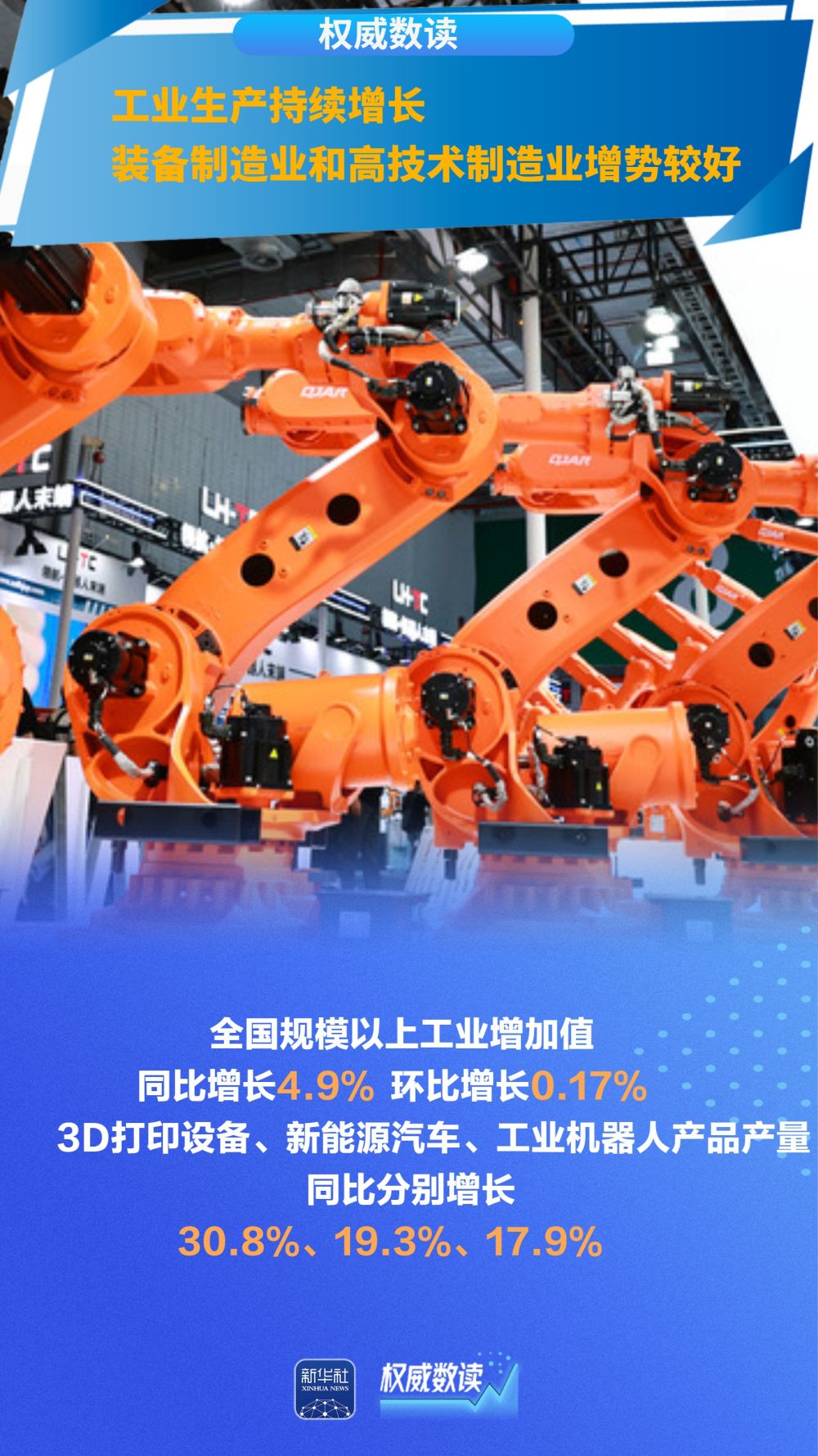
Group 1 - The national service industry production index increased by 4.6% year-on-year, with specific sectors such as information transmission, software, and IT services growing by 13.0%, leasing and business services by 8.2%, and financial services by 5.6% [4] - The retail sales of social consumer goods reached 46,291 billion yuan, showing a year-on-year growth of 2.9%, with significant increases in categories such as grain and oil food (9.1%), communication equipment (23.2%), cultural and office supplies (13.5%), and sports and entertainment products (10.1%) [7] - Fixed asset investment, excluding real estate development, grew by 1.7% from January to October, with manufacturing investment increasing by 2.7%. Notably, investments in information services, aerospace and equipment manufacturing, and computer and office equipment manufacturing rose by 32.7%, 19.7%, and 4.1% respectively [8] Group 2 - The total value of goods imports and exports reached 37,028 billion yuan, with a year-on-year growth of 0%. Trade with countries involved in the "Belt and Road" initiative increased by 5.9%, and private enterprises' imports and exports grew by 7.2%, accounting for 57.0% of the total [10] - The consumer price index has shifted from decline to growth, while the decline in industrial producer prices has narrowed [11]
10月份主要指标出炉,如何看待当前经济运行态势?
Xin Hua Wang· 2025-11-14 10:39
Economic Overview - In October, the industrial added value of large-scale enterprises increased by 4.9% year-on-year, while the service production index rose by 4.6% year-on-year, indicating stable economic performance [1][2]. Production and Supply - Agricultural production remains stable with an increase in autumn grain area and yield, suggesting a promising harvest for the year [2]. - The accommodation and catering industry saw a production index growth of 3.9% year-on-year, accelerated by the overlap of the National Day and Mid-Autumn Festival holidays [2]. Market Sales - The total retail sales of consumer goods in October grew by 2.9% year-on-year, with a notable increase in sales related to the replacement of old consumer goods [2]. - From January to October, the retail sales of services increased by 5.3% year-on-year [2]. Investment Trends - Fixed asset investment decreased by 1.7% year-on-year from January to October, but the actual workload of investment showed slight growth when excluding price factors [3]. - Manufacturing investment grew by 2.7% year-on-year, accounting for 25.6% of total investment [3]. Employment and Prices - The urban surveyed unemployment rate in October was 5.1%, a decrease of 0.1 percentage points from the previous month [3]. - The Consumer Price Index (CPI) rose by 0.2% year-on-year in October [3]. Structural Adjustments and New Growth Drivers - The economy is undergoing structural adjustments with significant growth in new driving forces, including a 19.7% year-on-year increase in investment in the aerospace and aviation equipment manufacturing sector [4]. - The online retail sales of physical goods accounted for 25.2% of total retail sales, reflecting the expansion of new consumption formats [4]. Emerging Industries - The added value of the digital industry manufacturing sector increased by 9.5% year-on-year, with smart device manufacturing and electronic components growing by 11.1% and 12.3%, respectively [5]. Economic Outlook - Despite facing risks and challenges, the long-term supportive conditions for economic growth remain unchanged, with a solid foundation for achieving annual targets [6]. - The GDP growth rate for the first three quarters was 5.2%, placing it among the top global economies [6]. Policy Measures - The implementation of proactive macroeconomic policies, including the introduction of 500 billion yuan in new policy financial tools, is expected to enhance economic momentum [7].
10月供需双双放缓,年底前稳增长政策有望进一步加力
Sou Hu Cai Jing· 2025-11-14 10:21
Economic Growth - China's economic growth momentum has slowed down in October, with both supply and demand sides experiencing a decline in growth rates [1][4] - The 20th Central Committee's Fourth Plenary Session emphasized the need to "resolutely achieve the annual economic and social development goals," focusing on stabilizing macroeconomic operations for the fourth quarter and the first quarter of next year [1][13] Supply Side - Industrial production has significantly declined, with the industrial added value of large-scale enterprises growing by 4.9% year-on-year in October, a decrease of 1.6 percentage points from September [3][4] - The decline in industrial added value is attributed to the impact of holidays and the tapering effects of "export rush" and "two new" policies (large-scale equipment updates and consumption upgrades) [4] - Notably, the added value of equipment manufacturing grew by 8.0% year-on-year, and high-tech manufacturing increased by 7.2%, indicating strong support from large-scale equipment updates and domestic manufacturing transformation [4] Service Sector - The service production index grew by 4.6% year-on-year in October, a decrease of 1.0 percentage point from the previous month [6] - Specific sectors such as information transmission, software, and IT services saw growth rates of 13.0% and 8.2%, respectively, while the financial sector's growth rate fell from 8.7% to 5.6% [6] Demand Side - Social retail sales increased by 2.9% year-on-year in October, a slight decrease of 0.1 percentage points from the previous month [6][8] - Exports in dollar terms decreased by 1.1% year-on-year, contrasting with an 8.3% increase in the previous month [6][8] - Consumer behavior remains cautious, with a significant reduction in household loans, indicating weak willingness to leverage [8] Investment Trends - Fixed asset investment saw a year-on-year decline of 1.7% from January to October, with the drop widening by 1.2 percentage points compared to the first nine months [9][11] - Manufacturing investment grew by 2.7%, down 1.3 percentage points from the previous period, while real estate investment fell by 14.7%, with the decline accelerating [11][12] - The decline in manufacturing investment is influenced by external environment fluctuations and high base effects from last year's equipment updates [12] Policy Response - Analysts suggest that the current uncertainties in exports and consumption necessitate increased macro policy support for investment [13] - The National Development and Reform Commission announced the full deployment of 500 billion yuan in new policy financial tools and an additional 500 billion yuan from local debt limits to support infrastructure [13][14] - Expectations are set for further fiscal policies to boost consumption and potential new rounds of interest rate cuts, given the low government debt ratio and current low domestic prices [13][14]
【新华解读】向新向绿稳中有进——解读10月份国民经济成绩单
Xin Hua Cai Jing· 2025-11-14 08:46
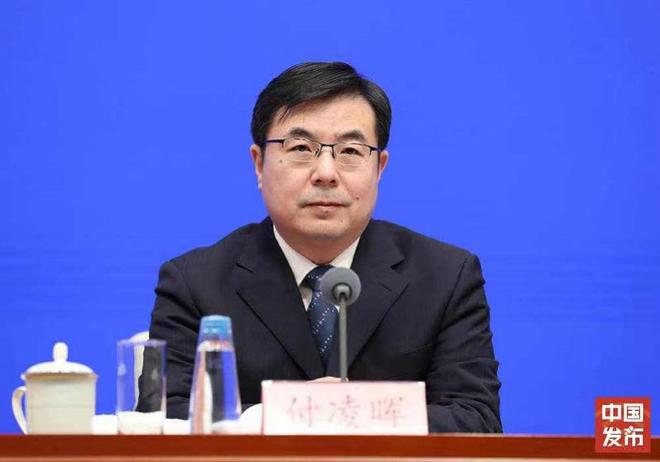
新华财经北京11月14日电(安娜、王春霞)四季度首月,国民经济运行情况如何?国家统计局14日公布 10月份国民经济成绩单。 "10月份国民经济运行基本平稳,稳中有进态势持续。"国家统计局新闻发言人付凌晖当日在国新办发布 会上说。这也是他对这份成绩单的总体评价。 但也应该看到,进入10月以来,多项指标同比增速均有所放缓。"这除了出口受外部因素扰动之外,还 与今年工作日较上年同期少一天,以及去年一揽子增量政策抬高了基数有关。"中国民生银行首席经济 学家温彬说,但从工业增加值和服务业生产指数累计增速推断,目前经济运行仍在5.0%的目标水平之 上。 产业转型升级态势持续 细看10月份经济结构变化,产业转型升级持续,向新向绿蹄疾步稳,为经济发展提供了强劲动力。 据付凌晖介绍,我国制造业向中高端稳步迈进,装备制造业对工业生产支撑作用明显。1至10月份,全 国规模以上装备制造业增加值同比增长9.5%,占规模以上工业比重达到36.1%,对规模以上工业增加值 增长的贡献率达到58.7%。 部分高端行业投资力度加大,科技创新和产业创新的融合发展带动了部分高技术行业投资较快增长。记 者从国家统计局了解到,1至10月份,我国航空航天 ...
国家统计局回应投资放缓:投资结构优化,制造业投资持续增长
Nan Fang Du Shi Bao· 2025-11-14 05:44
Core Viewpoint - The investment growth rate in China is slowing down, but the investment structure is optimizing, particularly in the manufacturing sector, which continues to see growth [1][4]. Investment Growth and Structure - Fixed asset investment decreased by 1.7% year-on-year in the first ten months of the year, but when excluding price factors, there was still a slight increase in the physical volume of investment [3]. - The slowdown in investment growth is attributed to multiple factors, including a complex external environment, intense domestic market competition, and declining investment returns, leading to cautious decision-making among market participants [3]. - Real estate investment saw a significant decline of 14.7% year-on-year, which negatively impacted overall investment growth by approximately 3 percentage points [3][4]. Manufacturing Sector Performance - Despite the overall slowdown, manufacturing investment grew by 2.7% year-on-year, accounting for 25.6% of total investment, an increase of 1.1 percentage points compared to the previous year [4]. - High-end industries are experiencing increased investment, with aerospace and equipment manufacturing up by 19.7% and information services by 32.7% year-on-year [4]. - Investments related to green transition are also on the rise, with clean energy investments (solar, wind, nuclear, and hydropower) growing by 10.4% year-on-year [4]. Future Investment Potential - China still has significant investment potential and space for growth, particularly in strengthening the real economy, promoting technological and industrial innovation, and addressing regional development imbalances [5]. - Continued investment is necessary to enhance public services in education, healthcare, housing, and other areas [5]. Foreign Trade Performance - In the first ten months, China's total goods import and export value increased by 3.6%, with exports growing by 6.2% [5]. - Despite challenges such as rising global trade protectionism, China's trade with ASEAN and the EU grew by 9.1% and 4.9%, respectively, outpacing overall trade growth [5]. - Private enterprises' imports and exports rose by 7.2%, significantly higher than the overall growth rate [6].
前三季度新设立外商投资企业同比增16.2%
Ren Min Ri Bao· 2025-11-02 22:21
Group 1 - The number of newly established foreign-invested enterprises in China reached 48,921 in the first three quarters, representing a year-on-year increase of 16.2% [1] - The actual utilized foreign capital amounted to 573.75 billion yuan, showing a year-on-year decrease of 10.4% [1] - In September alone, the actual utilized foreign capital increased by 11.2% year-on-year [1] Group 2 - In terms of industry, the manufacturing sector attracted 150.09 billion yuan in foreign investment, while the service sector attracted 410.93 billion yuan [1] - High-tech industries received 170.84 billion yuan in foreign investment, with significant growth in e-commerce services (155.2%), aerospace equipment manufacturing (38.7%), and medical instruments manufacturing (17%) [1] Group 3 - From the perspective of investment sources, foreign investments from Japan, UAE, the UK, and Switzerland increased by 55.5%, 48.7%, 21.1%, and 19.7% respectively [1]
投资逻辑质变:从规模扩张到效益优先
Sou Hu Cai Jing· 2025-10-29 05:14
Core Insights - The article emphasizes the importance of fixed asset investment in stabilizing economic growth and optimizing investment structure for high-quality economic development [1] Investment Landscape Changes - Recent years have seen significant changes in China's investment landscape, with fixed asset investment growth slowing to 3.2% in 2024 and 0.5% from January to August 2025 [2] - Real estate investment, once a primary driver, has declined significantly, with a 27.1% drop in 2024 compared to 2021, and a further 12.9% decrease from January to August 2025 [2] - The share of secondary industry in fixed asset investment has increased to 34.8% in 2024, up 6.1 percentage points from 2020, with manufacturing investment growing by 5.1% from January to August 2025 [2] High-Tech Industry Competition - The rapid growth of high-tech industry investment has led to "involution" competition, characterized by price wars and reduced quality, impacting profitability [3] - For instance, the profit growth of large-scale automotive manufacturing enterprises was -0.3% in the first eight months of 2025, contrasting sharply with a 20.2% investment growth [3] Enhancing Investment Efficiency - Improving investment efficiency involves several key areas, including necessary investment returns for enterprises, financial feasibility of infrastructure projects, and the efficiency of investments in driving economic growth [4][6][7] - The capital-output ratio in 2024 reached 9.38, the highest since 2020, indicating a need to enhance the relationship between investment and consumption [7] Role of Investment in Economic Quality - The quality of economic growth is linked to total factor productivity, which needs to be improved through targeted investments in technology and resource reallocation [8] - In 2024, total factor productivity contributed 2.2% to GDP growth, highlighting the importance of investment in enhancing economic potential [8] Recommendations for Investment Improvement - Addressing "involution" competition through government intervention and industry self-regulation is crucial for maintaining a healthy market environment [9] - Developing a sustainable financing model for infrastructure projects is essential, focusing on balancing government and private sector roles [10][11] - Enhancing investment's role in boosting consumption and optimizing supply structure is vital for future economic stability [12][13]
外资持续加码中国 空中客车在天津启用第二条总装线
Sou Hu Cai Jing· 2025-10-28 15:19
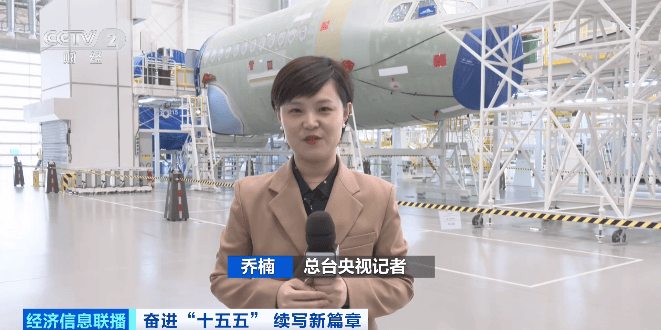
Core Insights - China's modernization requires open cooperation and mutual benefit, as evidenced by a 16.2% year-on-year increase in newly established foreign-invested enterprises, totaling 48,921, and actual foreign investment amounting to 573.75 billion yuan in the first nine months of the year [1] Group 1: Airbus Operations in Tianjin - Airbus has officially launched its second A320 series aircraft assembly line in Tianjin, which is expected to double the production capacity to 13 aircraft per month [3] - The CEO of Airbus stated that the new assembly line will enhance the company's production capabilities in China, with two out of ten global A320 assembly lines located in Tianjin [5] - The first assembly line in Tianjin, operational since 2008, has delivered over 780 A320 aircraft, with expectations to surpass 800 by the end of the year [7] Group 2: Integration into Global Supply Chain - The Tianjin facility not only assembles aircraft but also manufactures key components like wings and fuselage, indicating a deep integration of China's aviation manufacturing system into Airbus's global supply chain [11] - With the addition of the new assembly line, 20% of Airbus's single-aisle aircraft assembly will be completed in Tianjin, further strengthening China's role in the Airbus global system [11] Group 3: Future Production Goals - Airbus aims to increase the monthly production of A320 series aircraft to 75 by 2027, collaborating with around 200 local suppliers in China [13] - The company is expanding its business in China, focusing on engineering, design, and research and development to keep pace with the growth of the global and Chinese aviation markets [13]

前三季度全国新设立外商投资企业同比增长16.2%
Ren Min Ri Bao Hai Wai Ban· 2025-10-28 00:18
Core Insights - In the first three quarters of this year, a total of 48,921 new foreign-invested enterprises were established in China, representing a year-on-year increase of 16.2% [1] - In September, the actual utilization of foreign capital increased by 11.2% year-on-year [1] Industry Analysis - The actual utilization of foreign capital in the manufacturing sector reached 150.9 billion yuan [1] - The service sector saw an actual utilization of foreign capital amounting to 410.9 billion yuan [1] - High-tech industries attracted 170.8 billion yuan in foreign investment, with significant growth in specific sectors: - E-commerce services increased by 155.2% - Aerospace equipment manufacturing grew by 38.7% - Medical instruments and equipment manufacturing rose by 17% [1]