
银行理财

Search documents
银行理财,积极信号!底层配置和存续期限均有良性趋势显现
券商中国· 2026-01-24 02:50
Core Viewpoint - The 2025 wealth management industry report indicates a significant positive trend in the sector, with an increase in the proportion of closed-end products and a substantial extension of their average duration [1]. Group 1: Product Trends - The weighted average duration of newly issued closed-end wealth management products in 2025 ranges from 322 to 489 days, which is an increase of 38 to 97 days compared to the 2024 range of 284 to 392 days [1]. - By the end of 2025, the outstanding scale of closed-end wealth management products reached 6.7 trillion yuan, accounting for 20.13% of the total outstanding scale, up from 5.75 trillion yuan and 19.2% the previous year [1]. - The proportion of closed-end products with a duration of over one year reached 70.87%, an increase of 3.72 percentage points from the beginning of the year [1]. Group 2: Asset Allocation - Fixed income products still dominate the market, comprising 97.09% of the total outstanding scale at 32.32 trillion yuan, although this represents a decrease of 0.24 percentage points from the previous year [3]. - The scale of mixed products increased to 0.87 trillion yuan, accounting for 2.61% of the total, which is an increase of 0.17 percentage points [3]. - The allocation to equity products and financial derivatives remains small, with equity products increasing from 0.06 trillion yuan to 0.08 trillion yuan, and derivatives from 0.01 trillion yuan to 0.02 trillion yuan [3]. Group 3: Future Strategies - Industry professionals indicate that in 2026, there will be a common strategy to pursue returns through multi-asset and multi-strategy approaches, moving beyond simple equity asset allocation [4]. - Leading institutions have begun actively developing multi-asset and multi-strategy products since 2025, indicating a shift towards genuine asset management [4]. - Analysts predict that wealth management products will increasingly incorporate equity assets and index funds, while also expanding into low-risk, short-duration fixed income products and high-risk, long-duration products [4].


中国银行业理财市场年度报告(2025年)
银行业理财登记托管中心· 2026-01-24 02:10
Investment Rating - The report does not explicitly provide an investment rating for the industry Core Insights - The banking wealth management market in China reached a total scale of 33.29 trillion yuan by the end of 2025, reflecting an 11.15% increase from the beginning of the year, with 3.34 million new wealth management products issued, raising 76.33 trillion yuan in funds [6][20] - The report emphasizes the importance of the wealth management industry in supporting the real economy, with approximately 21 trillion yuan allocated to support various sectors [6] - The number of investors holding wealth management products reached 143 million, a growth of 14.37% year-on-year, generating returns of 730.3 billion yuan for investors throughout the year [6] Summary by Sections Development Environment of the Wealth Management Industry - The report highlights the complex changes in the development environment, including global geopolitical tensions and domestic economic challenges, while emphasizing the resilience and potential of China's economy [8] - The "14th Five-Year Plan" and the upcoming "15th Five-Year Plan" outline the strategic direction for the financial sector, focusing on technology finance, green finance, inclusive finance, pension finance, and digital finance [8][9] Wealth Management Products - By the end of 2025, the total number of wealth management products in the market was 46,300, with a total scale of 33.29 trillion yuan, marking a 14.89% increase in the number of products [21][24] - The report indicates a shift from single-asset driven strategies to multi-asset allocation, with a focus on risk management and dynamic adjustments to enhance portfolio resilience [26][27] - Fixed income products dominate the market, accounting for 97.09% of the total scale, while mixed and equity products remain relatively small [32][33] Investor Profile - The report notes that the wealth management industry has seen a significant increase in the number of investors, with a focus on enhancing investor protection and appropriate management of wealth management products [19][40] - The risk management framework is emphasized, with a focus on compliance and transparency to safeguard investor interests [14][16] Market Institutions and Services - The report discusses the establishment of various wealth management companies and the importance of digital financial services, including the use of AI and big data in wealth management [10][12] - It highlights the role of wealth management companies in supporting the pension finance sector and the ongoing development of a centralized data exchange platform for wealth management products [7][12]
20260119多策略及理财配置周报:CTA策略仍强,指增和中性策略回暖-20260122
Orient Securities· 2026-01-22 07:49
Group 1 - The report indicates that multi-strategy approaches, particularly A-share equity strategies and CTA strategies, are currently favored. Equity assets have returned to a state of fluctuation, with enhanced index strategies showing signs of recovery, and there are still opportunities for allocation in A-share equity strategies. In the context of ongoing trends in precious metals like gold and silver, as well as increased volatility in non-ferrous metals, CTA strategies continue to play a role in enhancing returns and reducing volatility in asset allocation [7][55]. - The performance of bank wealth management products has been positive overall, but there has not been a corresponding expansion in scale. Products in the commodity and derivative categories, as well as equity-related wealth management products, have led the gains. However, aside from a slight net increase in mixed wealth management products, the remaining categories have generally seen a decline in their existing scale [32][55]. Group 2 - In the recent week, the performance of multi-strategy approaches showed that small-cap index enhancement and CTA strategies led the gains, with the median return of public neutral strategies turning positive. Large-cap index enhancement strategies, however, showed weaker returns [10]. - The report highlights that the public neutral strategy products have seen an overall recovery in returns, with the highest, lowest, and median returns for public neutral strategy products being 2.39%, -1.05%, and 0.18% respectively. Private neutral strategy products had returns of 3.38%, -5.26%, and -0.43% respectively [26][27]. - The private CTA strategy remains strong, with the highest, lowest, and median returns for private CTA strategy products being 6.09%, -1.94%, and 0.35% respectively, indicating robust performance in the context of ongoing trends in precious metals and increased volatility in commodities [29][31].
银行理财周度跟踪(2026.1.12-2026.1.18):银行理财再掀“降费潮”,周开持有期新品亮相
HWABAO SECURITIES· 2026-01-21 07:25
Investment Rating - The report does not explicitly provide an investment rating for the banking wealth management industry Core Insights - A new wave of fee reductions has emerged in the banking wealth management sector, with several institutions lowering management and sales service fees, some to as low as 0.01% per year or even zero [3][11] - The fee reduction trend is driven by three main factors: the beginning of the year marketing push, the declining deposit rates highlighting the attractiveness of wealth management products, and intensified competition leading to fee reductions as a direct competitive strategy [11][12] - The introduction of innovative products, such as the "HeTai Weekly Open 1" by Zhaoyin Wealth Management, which features a "micro-wave fixed income+" strategy and a weekly holding period, aims to attract investors through temporary fee discounts [4][13] Regulatory and Industry Dynamics - The report highlights a significant fee reduction trend in the banking wealth management sector, with multiple institutions participating in lowering fees, primarily focusing on management and sales service fees [3][11] - The fee reductions are often temporary, lasting from a few weeks to the entire year of 2026, aimed at enhancing product attractiveness and driving sales growth [11] - The report notes that the ultra-low fee model may not be sustainable in the long term, as it could erode the profitability of wealth management companies, particularly smaller institutions [12] Peer Innovation Dynamics - Zhaoyin Wealth Management launched a new product called "HeTai Weekly Open 1," which employs a "micro-wave fixed income+" strategy and allows weekly subscriptions while requiring a one-year holding period for redemptions [4][13] - Zhongyou Wealth Management has invested in the IPOs of domestic GPU company BiRan Technology and AI company MiniMax, indicating a strategic focus on AI infrastructure and applications [4][14] Yield Performance - The annualized yield for cash management products was recorded at 1.26%, a decrease of 4 basis points week-on-week, while money market funds reported a yield of 1.16%, down 2 basis points [5][15] - Most pure fixed-income products saw an increase in yields, while yields for fixed-income plus products generally declined [5][19] - The report anticipates continued pressure on yields for wealth management products due to ongoing valuation adjustments and a low-interest-rate environment [20] Net Value Tracking - The net value ratio for banking wealth management products was 0.82%, a decrease of 0.19 percentage points week-on-week, with credit spreads also narrowing [6][26] - The report emphasizes the need to monitor credit spread trends closely, as an expansion could put upward pressure on the net value ratio [28]
纯固收长盈理财榜单出炉 重仓二永债产品近1月收益表现突出
2 1 Shi Ji Jing Ji Bao Dao· 2026-01-21 07:01
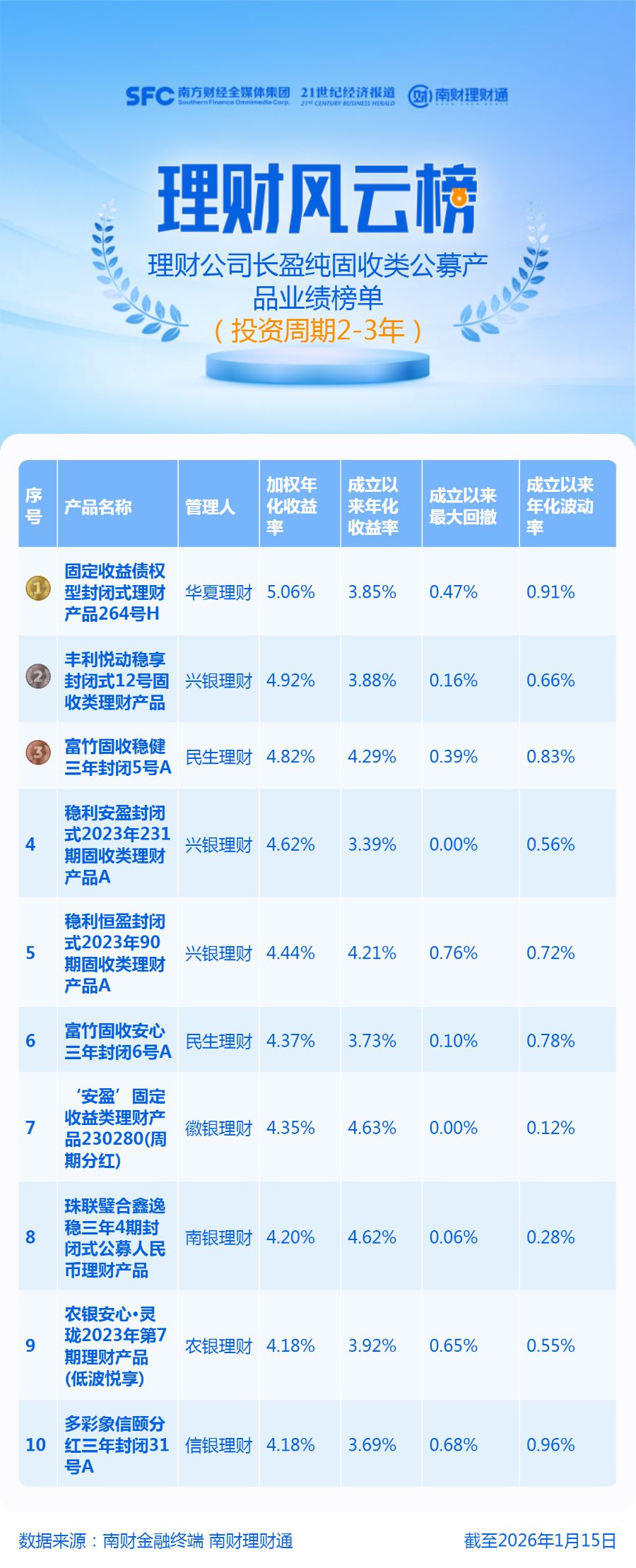
Core Insights - The article discusses the performance rankings of public pure fixed-income products issued by wealth management companies, focusing on those with a maturity period of 2-3 years and established for over a year [4][7]. Group 1: Market Performance - The bond market in 2025 experienced fluctuations with a continuous decline in interest rates. Many banks began issuing perpetual bonds to replace preferred shares to save on interest costs [5]. - By December 31, 2025, banks issued a record 71 perpetual bonds totaling 821.8 billion, with most new bonds having coupon rates between 2.0% and 3.0% [5]. - In 2025, 77 secondary capital bonds were issued, amounting to 934.67 billion, with an average coupon rate of 2.52%, down from 2.61% in 2024 [5]. Group 2: Product Performance - As of January 15, 2026, there were 980 public pure fixed-income products with a maturity of 2-3 years, of which 621 had disclosed annualized returns. The average weighted annualized return was 3.08%, with 131 products exceeding 3.5% [7]. - Seven wealth management companies made it to the ranking, with Xingyin Wealth Management having three products listed, while Minsheng Wealth Management had two, and others like Huaxia, Huizhou, Nanyin, Nongyin, and Xinyin each had one product [7]. Group 3: Highlighted Products - Huaxia Wealth Management's "Fixed Income Debt Type Closed-End Wealth Management Product 264" topped the list with a weighted annualized return exceeding 5%, achieving a return of 3.85% since inception. The product's investments include cash, bank deposits, interbank certificates, bonds, non-standard assets, and public funds, with a leverage level of 130.61% as of Q3 2025 [8]. - Xingyin Wealth Management's "Fengli Yuedong Stable Enjoyment Closed-End 12 Fixed Income Product" ranked second with a weighted annualized return of 4.92%. This product primarily invests in cash, bank deposits, and bonds, with over 40% of its top ten assets being secondary capital bonds issued between 2021 and 2022. Notably, its recent one-month annualized return reached 17.11%, surpassing all other products in the ranking [8].
银行理财周度跟踪(2026.1.12-2026.1.18):银行理财再掀“降费潮”,周开持有期新品亮相-20260121
HWABAO SECURITIES· 2026-01-21 05:54
Investment Rating - The report does not explicitly provide an investment rating for the industry [3] Core Insights - A new wave of fee reductions in bank wealth management products has emerged, with several institutions lowering management and service fees, some to as low as 0.01% per year or even zero [3][11] - The fee reduction trend is driven by three main factors: the beginning of the year marketing push, the declining deposit rates highlighting the attractiveness of wealth management products, and intensified competition leading to fee reductions as a direct competitive strategy [11][12] - The introduction of innovative products, such as the "HeTai Weekly Open 1" by Zhaoyin Wealth Management, which features a "micro-wave fixed income+" strategy and a weekly holding period, aims to attract investors through temporary fee discounts [4][13] Regulatory and Industry Dynamics - The report highlights the recent implementation of new public offering sales regulations and the deepening of wealth management subsidiaries' practices [2] - The fee reduction trend is characterized as a temporary measure, with varying durations from weeks to the entire year of 2026 [11] - The report notes that the current low fee model may not be sustainable in the long term, as it could erode the profitability of wealth management companies [12] Performance of Returns - Cash management products recorded a 7-day annualized yield of 1.26%, a decrease of 4 basis points from the previous week, while money market funds reported a yield of 1.16%, down 2 basis points [5][15] - Most pure fixed-income products saw an increase in yields, while yields for fixed-income plus products generally declined [19] - The report anticipates continued pressure on the bond market, with factors such as mixed expectations for monetary policy and significant government bond supply affecting market sentiment [19][20] Net Value Tracking - The net value ratio of bank wealth management products was 0.82%, a decrease of 0.19 percentage points week-on-week, with credit spreads also narrowing [26][30] - The report indicates a positive correlation between net value ratios and credit spreads, suggesting that if credit spreads continue to widen, it may put upward pressure on net value ratios [28]
【ESG投资周报】本月新发ESG基金1只,绿色债券稳步发行-20260119
GUOTAI HAITONG SECURITIES· 2026-01-19 12:00
Group 1: ESG Fund Overview - One new ESG fund was launched this month with an issuance of 0.11 million shares, primarily focused on ESG strategies[8] - A total of 189 ESG public funds were issued in the past year, with a total issuance of 711.78 billion RMB[8] - The total net asset value of existing ESG funds reached 1,173.33 billion RMB, with ESG strategy funds accounting for the largest share at 45.01%[10] Group 2: Market Performance - During the week of January 12-16, 2026, the A-share market experienced a pullback, with the CSI 300 index down by 0.57%, the ESG 300 index down by 0.51%, and the CSI ESG 100 index down by 0.65%[5] - The weekly average trading volume across the A-share market was approximately 6.37 trillion RMB, indicating a loosening of liquidity[5] Group 3: Green Bond Issuance - A total of 58 ESG bonds were issued this month, with a total issuance amount of 34 billion RMB[15] - In the past year, 1,267 ESG bonds were issued, totaling 1,372 billion RMB[15] - The existing ESG bond market comprises 3,911 bonds, with green bonds making up the largest share at 62.28% of the total outstanding amount of 5.76 trillion RMB[15] Group 4: Bank Wealth Management Products - This month, 57 ESG wealth management products were launched, primarily focusing on pure ESG and social responsibility themes[20] - Over the past year, 1,293 ESG bank wealth management products were issued, with 1,221 currently active in the market[20] - Pure ESG products account for the largest share of existing products at 53.48%[20] Group 5: Risk Factors - Potential risks include insufficient policy support for ESG initiatives, lack of standardized data reporting, and lower-than-expected product issuance volumes[23]
谁踩中了“硬科技”风口?2025年12月银行理财榜单来了
Zhong Guo Zheng Quan Bao· 2026-01-19 08:41
Group 1 - The capital market in December 2025 sees "hard technology" as the biggest trend, with investments focusing on high-growth sectors such as commercial aerospace, military industry, communication equipment, and robotics [1] - There is a clear shift in funding towards sectors with significantly improved fundamentals and low valuations, represented by non-ferrous metals and the chemical industry [1] - The bond market shows a high-level fluctuation in yields, with a slight increase in the 10-year government bond yield by 0.6 basis points to 1.85%, and a notable rise of 8 basis points in the 30-year government bond yield [1] Group 2 - As of the end of December 2025, there are 46,292 bank wealth management products in the market, an increase of 934 from November, with 22,871 being open-ended products [1] - Fixed-income products dominate the market, totaling 39,723, which is an increase of 829 from the previous month [1] - In December, 3,274 new wealth management products were launched, up by 507 from November, with wealth management subsidiaries accounting for 76.94% of the total issuance [1] Group 3 - The overall risk level of the products on the list has significantly increased compared to November, with 40% of products rated at level three (medium risk) and 2.86% at level four (medium-high risk) [12] - The competition among "fixed income plus" wealth management products is intense, with a further decline in retention rates for these products compared to November [13] - The investment strategies of the listed products reflect a dual focus on "growth + cycle," with significant allocations to both high-growth "hard technology" sectors and undervalued cyclical industries [17][18]
4000点之上股市四问:宏观迷思?增量资金何来?AI泡沫化了吗?如何擒牛?︱重阳Talk Vol.24
重阳投资· 2026-01-19 07:33
Core Viewpoint - The article discusses the current state of the A-share market, which has reached a ten-year high of 4000 points, and explores various concerns regarding the future of the Chinese economy and stock market, including whether it will follow Japan's path, the sources of new capital, and the implications of the AI boom [2][5][6]. Group 1: Future Debate - The "Future Debate" focuses on the prevalent concerns in the market, particularly the fear that the Chinese stock market may replicate Japan's long-term stagnation following its bubble burst in the late 1980s [6][9]. - The article asserts that China will not follow Japan's trajectory due to its superior innovation capabilities and economic structure, which differ significantly from Japan's stagnation period [10][12]. - The discussion emphasizes that the core question is whether the current market performance is sustainable and what the long-term investment value of the Chinese market is [6][9]. Group 2: Allocation Debate - The "Allocation Debate" examines the sources of new capital for the A-share market, highlighting a significant shift of funds from the real estate sector to the stock market [27][30]. - Historical data indicates a new trend where real estate prices are declining while stock prices are rising, marking a fundamental change in the role of the real estate market from a "drain" to a "reservoir" for stock market funds [28][30]. - The article notes that insurance funds are becoming a major source of capital for the stock market, with their direct holdings in the secondary market reaching 3.62 trillion yuan, surpassing that of actively managed equity mutual funds [30][33]. Group 3: Current Debate - The "Current Debate" centers on the AI industry, which is seen as a critical topic influencing market dynamics [35][36]. - The article identifies a contradiction within the AI industry: while there is a need for substantial capital investment, the industry also seeks high profit margins, which may hinder its growth [37][38]. - It discusses the potential for AI investments to hit a macroeconomic ceiling due to the high costs associated with capital expenditures and the need for significant revenue generation from downstream users [38][39].

固收及黄金主题产品成银行理财“香饽饽”
Zheng Quan Ri Bao· 2026-01-18 17:03
Core Insights - The domestic bank wealth management market is experiencing a surge in popularity, with fixed-income products remaining the mainstay, while gold-linked structured deposits have emerged as a "dark horse" category in early 2026 [1][3] Group 1: Market Trends - The wealth management market is expected to grow by 3.83 trillion yuan in 2026, driven by the release of funds from maturing fixed deposits and a focus on product structure optimization and differentiated competition [1][4] - From January 1 to 16, 2026, 1,212 new RMB wealth management products were launched, with fixed-income products accounting for 97.2% of the market [2] Group 2: Product Focus - The current focus is on low-risk products, with banks promoting short-duration pure fixed-income products and low-volatility "fixed-income+" products to meet investor demand for safety and stable returns [2] - Gold-linked structured deposits are gaining traction, with domestic banks targeting short-term, low-threshold products offering expected annualized returns of over 2%, while foreign banks focus on high-net-worth clients with products yielding up to 5% [3] Group 3: Future Outlook - The bank wealth management market is projected to grow steadily, with an expected annual growth rate of 5% to 10% in 2026, despite potential short-term fluctuations due to various market factors [4] - Future innovations in bank wealth management are expected to focus on multi-asset allocation, scenario-based services, and technology empowerment, enhancing the range of investment tools and improving customer service [4][5]