
锂离子电池制造

Search documents
11月份CPI同比上涨0.7% 物价水平进一步企稳
Zheng Quan Ri Bao· 2025-12-10 16:25
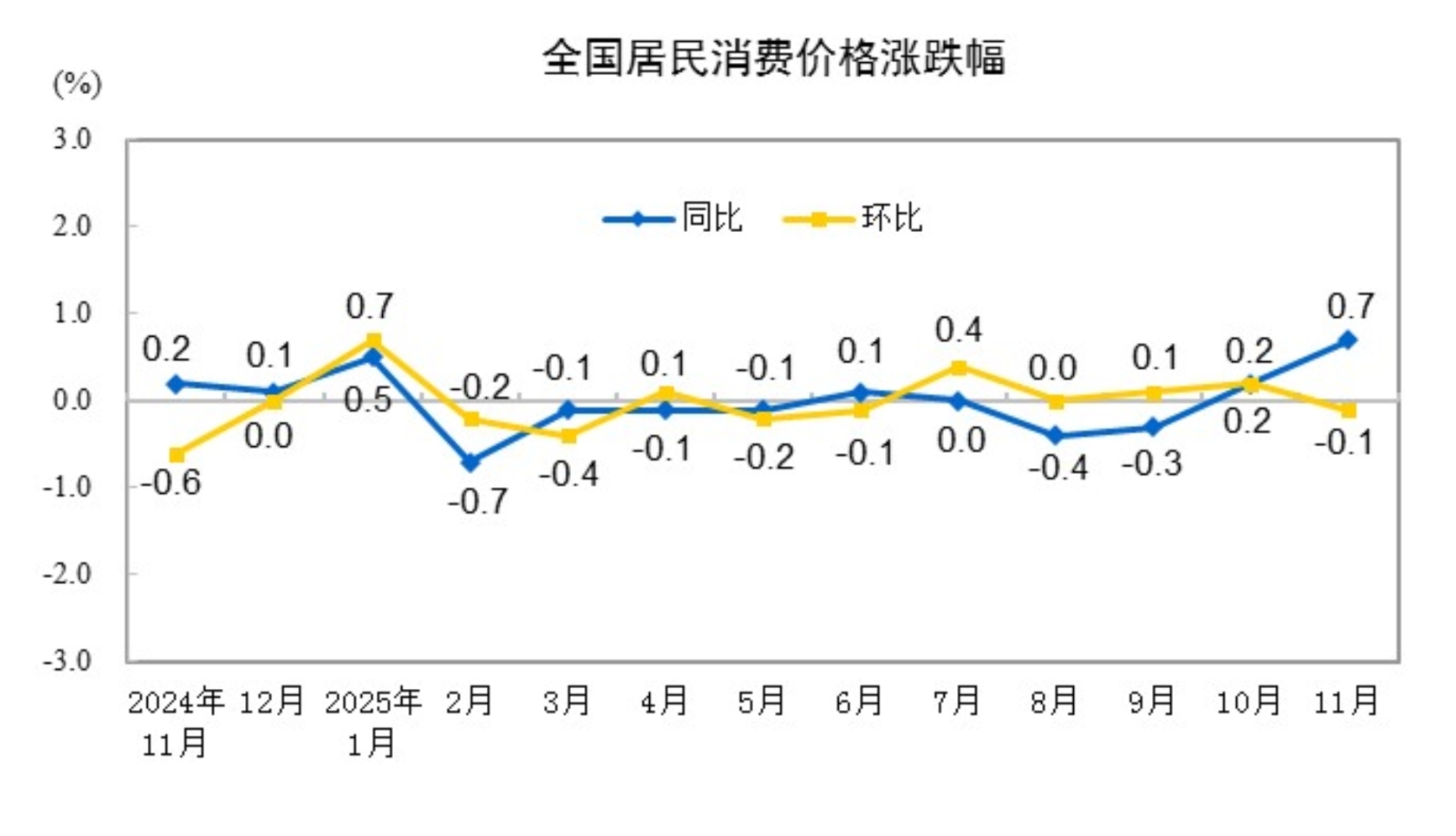
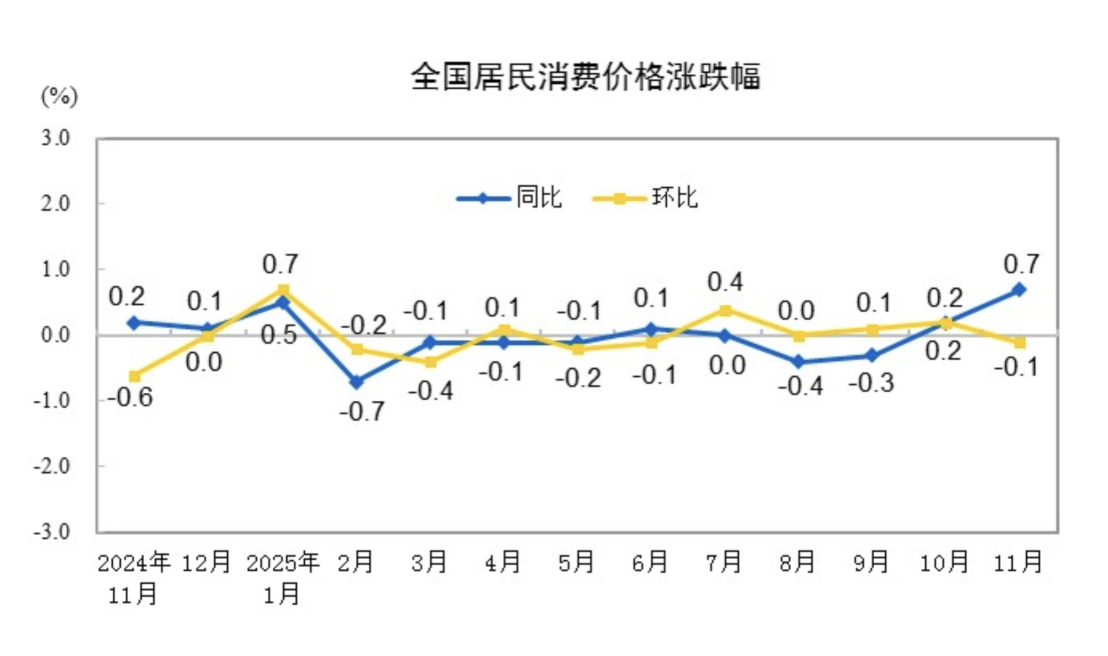
Consumer Recovery - In November, the Consumer Price Index (CPI) decreased by 0.1% month-on-month but increased by 0.7% year-on-year, marking the highest growth since March 2024, indicating a continuous recovery in consumer spending [1][2] - The year-on-year increase in CPI was primarily driven by a shift in food prices from decline to growth, with food prices rising by 0.2% after a 2.9% drop in October [2][3] - Fresh vegetable prices saw a significant turnaround, increasing by 14.5% after a 7.3% decline in October, contributing approximately 0.49 percentage points to the CPI year-on-year [2][3] Core CPI and Industrial Prices - The core CPI, excluding food and energy, rose by 1.2% year-on-year, maintaining a growth rate above 1% for three consecutive months [3] - Prices for services and industrial consumer goods, excluding energy, increased by 0.7% and 2.1%, respectively, contributing approximately 0.29 and 0.53 percentage points to the CPI year-on-year [3] - The expansion of domestic demand policies has positively impacted prices, with household appliances and clothing prices rising by 4.9% and 2.0%, respectively [3] Producer Price Index (PPI) - The Producer Price Index (PPI) increased by 0.1% month-on-month in November, marking two consecutive months of growth, while the year-on-year decline was 2.2%, slightly widening from October [4][5] - The improvement in PPI is attributed to the optimization of supply and demand structures in certain domestic industries and the transmission of international commodity prices [4][5] Policy Impact and Market Dynamics - Continuous macroeconomic policies are showing positive effects, with a narrowing of price declines in key industries due to the ongoing governance of "involution" competition [5][6] - Emerging industries are driving price increases, with significant year-on-year price rises in sectors such as external storage devices (up 13.9%) and graphite products (up 3.8%) [5][6] - Consumer demand is being revitalized, leading to price increases in various manufacturing sectors, including a 20.6% rise in the price of arts and crafts products [6]
创20个月以来新高 11月CPI同比涨0.7%
Bei Jing Shang Bao· 2025-12-10 15:44
Core Insights - In November, the national consumer price index (CPI) rose by 0.7% year-on-year, marking the highest increase since March 2024, with a 0.5 percentage point increase from the previous month [1][2][4]. Price Changes - Food prices shifted from a 2.9% decline in the previous month to a 0.2% increase, contributing positively to the CPI [4]. - Fresh vegetable prices surged by 14.5%, marking the first increase after nine consecutive months of decline, significantly impacting the CPI [4]. - The prices of other major categories showed mixed results, with increases in other goods and services (14.2%), clothing (1.9%), and healthcare (1.6%), while transportation and communication prices fell by 2.3% [3][4]. Core CPI - The core CPI, excluding food and energy, increased by 1.2% year-on-year, maintaining a growth rate above 1% for three consecutive months [4][6]. Producer Price Index (PPI) - The PPI rose by 0.1% month-on-month but fell by 2.2% year-on-year, with the decline attributed to high comparison bases from the previous year [6]. - The prices in key industries such as coal mining and photovoltaic equipment manufacturing showed narrowing declines, indicating improved market conditions [6]. Seasonal Demand Impact - Seasonal demand increases in certain industries, such as coal and gas, have led to price hikes in related sectors, with coal mining prices rising by 4.1% month-on-month [5][6]. - The demand for winter clothing and heating products has also contributed to price increases in textile manufacturing [5]. Consumer Spending - The ongoing consumer spending initiatives have positively influenced prices in various sectors, with notable increases in the manufacturing of arts and crafts (20.6%) and sports equipment (4.3%) [6].


物价水平进一步企稳:鲜菜价格连降9个月后首次转涨 专家:明年下半年生猪供应或现实质性收缩 支撑猪肉价格走高
Mei Ri Jing Ji Xin Wen· 2025-12-10 15:28
Group 1: CPI and PPI Trends - The CPI (Consumer Price Index) in November showed a slight month-on-month decrease of 0.1% but a year-on-year increase of 0.7%, marking the highest growth since March 2024 [1][2] - The core CPI has maintained a year-on-year growth rate of over 1% for three consecutive months [1] - The PPI (Producer Price Index) increased by 0.1% month-on-month for the second consecutive month, but year-on-year it decreased by 2.2%, with the decline widening by 0.1 percentage points compared to the previous month [1][9] Group 2: Food Prices and Their Impact - Food prices shifted from a year-on-year decline of 2.9% to a slight increase of 0.2%, positively impacting the CPI [5] - Fresh vegetable prices rose by 14.5% year-on-year after a nine-month decline, contributing approximately 0.49 percentage points to the CPI increase [5][6] - The prices of beef and lamb increased by 6.2% and 3.7%, respectively, while pork and poultry prices saw a decrease of 15.0% and 0.6%, with the declines narrowing [5] Group 3: Service Prices and Their Effects - Service prices turned from a month-on-month increase of 0.2% to a decrease of 0.4%, negatively affecting the CPI by approximately 0.16 percentage points [8] - The decline in service prices was attributed to reduced demand for travel and accommodation post-holiday, with significant decreases in hotel, flight, and rental prices [8] Group 4: High-Tech Manufacturing and Market Dynamics - The high-tech manufacturing sector is experiencing strong supply and demand, with prices in sectors like integrated circuits and robotics showing year-on-year growth [12] - The coal and gas sectors are seeing seasonal price increases due to higher demand, with coal mining prices rising by 4.1% month-on-month [12] - Despite some positive trends in high-tech manufacturing, the overall industrial product market remains weak due to low demand and external economic pressures [12]
CPI释放内需回暖信号 国际机构密集上调中国经济增速
Di Yi Cai Jing· 2025-12-10 12:56
Group 1: Consumer Price Index (CPI) Trends - In November, the Consumer Price Index (CPI) increased by 0.7% year-on-year, the highest since March 2024, with a month-on-month decline of 0.1% [4] - The core CPI, excluding food and energy, rose by 1.2% year-on-year, maintaining a growth rate above 1% for three consecutive months [6] - Food prices shifted from a decline of 2.9% to an increase of 0.2%, significantly impacting the CPI [5] Group 2: Producer Price Index (PPI) Trends - The Producer Price Index (PPI) increased by 0.1% month-on-month for two consecutive months, but year-on-year, it decreased by 2.2%, with the decline slightly widening [4][9] - Seasonal demand increases in certain industries, such as coal and gas, contributed to the month-on-month PPI rise [8] - The decline in PPI is attributed to high comparison bases from the previous year, but there are signs of positive changes in pricing due to macroeconomic policies [9] Group 3: Economic Outlook and Policy Measures - The International Monetary Fund (IMF) projects China's economic growth rate to reach 5% in 2025, an upward revision from previous forecasts [4] - The Chinese government is intensifying policies to boost domestic demand, with plans to optimize the supply structure of consumer goods by 2027 [12] - Various international organizations have recently raised their forecasts for China's economic growth, indicating a positive outlook [4] Group 4: Sector-Specific Insights - The increase in vegetable prices, which rose by 14.5% year-on-year, is a key driver for the CPI's positive shift [5] - The prices of industrial consumer goods, such as home appliances and clothing, have also seen significant increases, reflecting the impact of domestic demand policies [6] - New industries, including new materials and intelligent technologies, are driving price increases in related sectors, indicating a shift towards higher value-added production [9][10]
CPI释放内需回暖信号,国际机构密集上调中国经济增速
Di Yi Cai Jing· 2025-12-10 12:49
Group 1: Consumer Price Index (CPI) Trends - The Consumer Price Index (CPI) increased by 0.7% year-on-year in November, the highest since March 2024, with a month-on-month decline of 0.1% [3][4] - Core CPI, excluding food and energy, rose by 1.2% year-on-year, maintaining a growth rate above 1% for three consecutive months [5][6] - The rise in CPI is attributed to a turnaround in food prices, particularly fresh vegetables, which saw a significant increase of 14.5% year-on-year after nine months of decline [4][5] Group 2: Producer Price Index (PPI) Insights - The Producer Price Index (PPI) increased by 0.1% month-on-month for two consecutive months, but year-on-year it decreased by 2.2%, with the decline slightly widening [3][8] - Seasonal demand increases in certain industries, such as coal and gas, contributed to the month-on-month rise in PPI [7][8] - The overall PPI trend reflects a positive change in pricing due to ongoing macroeconomic policies and a reduction in "involution" competition in key industries [8][10] Group 3: Economic Outlook and Policy Measures - The International Monetary Fund (IMF) projects China's economic growth rate to reach 5% in 2025, an upward revision from previous forecasts [3] - The Chinese government is intensifying policies to boost domestic demand, with a focus on optimizing the supply structure of consumer goods by 2027 [11][12] - Various local governments are implementing plans to enhance domestic demand, emphasizing the importance of consumer-driven economic growth [12]
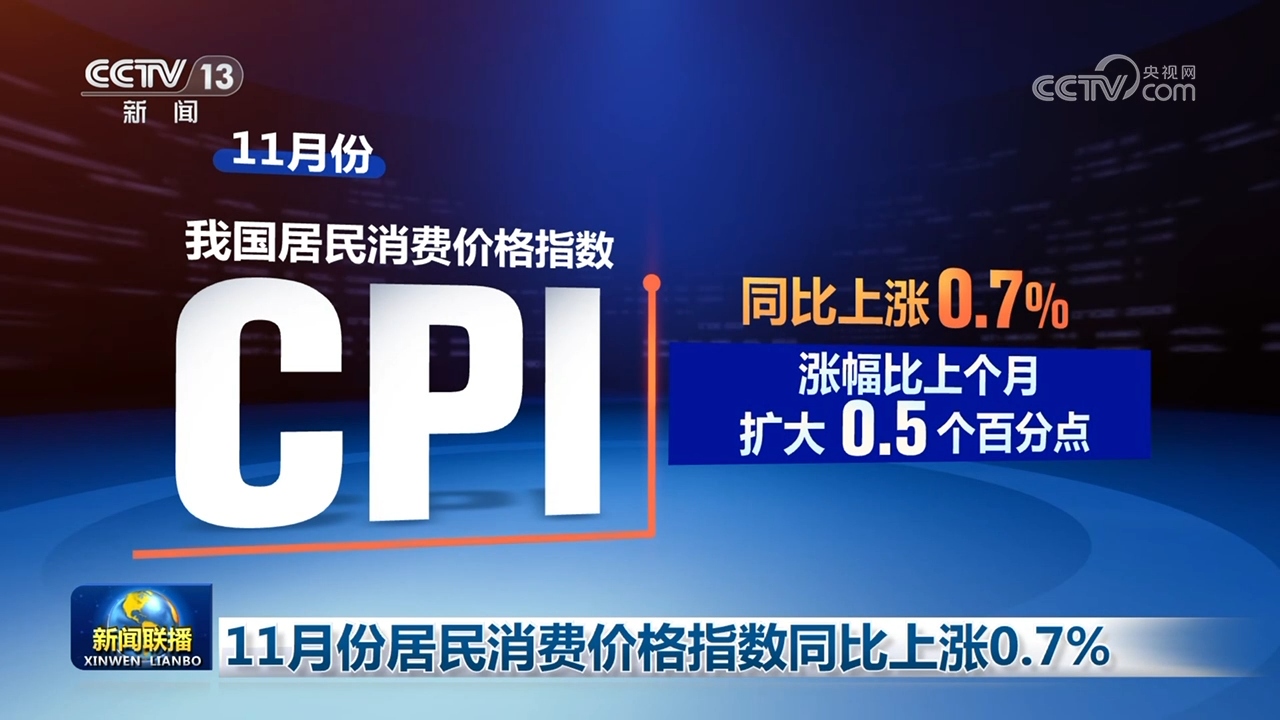
11月份居民消费价格指数同比上涨0.7%
Yang Shi Wang· 2025-12-10 12:12
Group 1 - The Consumer Price Index (CPI) in China increased by 0.7% year-on-year in November, with the growth rate expanding by 0.5 percentage points compared to the previous month [1] - The core CPI, excluding food and energy, rose by 1.2% year-on-year, maintaining a growth rate above 1% for three consecutive months [1] Group 2 - The Producer Price Index (PPI) for industrial producers increased by 0.1% month-on-month in November, marking the second consecutive month of growth [3] - The price declines in coal mining and washing, photovoltaic equipment and components manufacturing, and lithium-ion battery manufacturing have been narrowing for several months due to the effects of comprehensive rectification of "involution" competition [5]
CPI同比涨幅扩大 核心CPI继续上涨——透视11月物价数据
Xin Hua Wang· 2025-12-10 09:47
新华社北京12月10日电 题:CPI同比涨幅扩大 核心CPI继续上涨——透视11月物价数据 新华社记者王雨萧 国家统计局最新发布数据显示,11月份,全国居民消费价格指数(CPI)环比略降0.1%,同比上涨 0.7%,扣除食品和能源价格的核心CPI同比上涨1.2%,涨幅连续3个月保持在1%以上。 董莉娟分析,国内部分行业需求季节性增加带动价格上涨。各地"迎峰度冬"开始,煤炭、燃气需求季节 性增加,煤炭开采和洗选业价格环比上涨4.1%,煤炭加工价格上涨3.4%,燃气生产和供应业价格上涨 0.7%。入冬以来,防寒保暖产品进入消费旺季,毛织造加工价格上涨0.6%,羽绒制品加工价格上涨 0.2%。 "PPI同比下降2.2%,降幅比上月扩大0.1个百分点,主要受上年同期对比基数走高影响。"董莉娟说,随 着我国各项宏观政策不断显效,价格呈现积极变化。 综合整治"内卷式"竞争成效显现—— 重点行业产能治理持续推进,市场竞争秩序不断优化,煤炭开采和洗选业、光伏设备及元器件制造、锂 离子电池制造价格同比降幅均已连续多个月收窄;新能源车整车制造价格降幅比上月收窄0.6个百分 点。 新兴产业快速发展,带动相关行业价格同比上涨—— " ...
东海期货11月宏观数据观察:CPI同比超预期回升,PPI降幅有望收窄
Xin Lang Cai Jing· 2025-12-10 09:38
Group 1 - In November, China's CPI increased by 0.7% year-on-year, matching expectations, and up from 0.2% in the previous month [1][19] - The PPI decreased by 2.2% year-on-year, slightly worse than the expected decline of 2.0% and a previous decline of 2.1% [1][19] - The rise in CPI was driven by a significant rebound in food prices, while PPI's decline was influenced by high base comparisons from the previous year and ongoing supply-demand structural optimization in certain industries [20][21] Group 2 - The overall improvement in domestic supply-demand relationships is expected to lead to a gradual narrowing of PPI declines, supported by ongoing capacity governance in key industries [20][21] - International commodity prices have generally risen, while domestic demand remains weak, but some industries are experiencing price increases due to improved supply-demand fundamentals [20][21] - The core CPI maintained a high year-on-year growth rate of 1.2%, with non-food prices rising by 0.8%, indicating effective consumer demand policies [20][21] Group 3 - Food prices shifted from a decline of 2.9% last month to an increase of 0.2%, significantly impacting the CPI [20][21] - Energy prices fell by 3.4% year-on-year, contributing to the overall inflationary pressure [20][21] - The service sector saw price increases, with notable rises in household appliances and clothing prices, reflecting the effectiveness of domestic demand expansion policies [20][21]

中国PPI环比连续两个月上涨
Zhong Guo Xin Wen Wang· 2025-12-10 07:58
Group 1 - In November, China's Producer Price Index (PPI) increased by 0.1% month-on-month, marking the second consecutive month of growth [1] - Seasonal demand in certain domestic industries, particularly coal and gas, contributed to the price increase, with coal mining and washing prices rising by 4.1% and gas production and supply prices increasing by 0.7% [1] - The PPI year-on-year decreased by 2.2%, with the decline rate widening by 0.1 percentage points compared to the previous month, influenced by a high comparison base from the previous year [1] Group 2 - The reduction in year-on-year price declines for certain industries indicates the effectiveness of measures against "involution" competition, with coal mining and washing, photovoltaic equipment manufacturing, and lithium-ion battery manufacturing seeing narrowed declines [2] - Emerging industries are driving price increases, with external storage devices and components prices rising by 13.9% year-on-year, graphite and carbon product manufacturing prices increasing by 3.8%, and integrated circuit manufacturing prices up by 1.7% [2]
11月CPI同比涨幅扩大,食品价格是主因
Zheng Quan Shi Bao Wang· 2025-12-10 05:18
Group 1: Consumer Price Index (CPI) Trends - In November, the Consumer Price Index (CPI) increased by 0.7% year-on-year, with the growth rate expanding by 0.5 percentage points compared to the previous month, marking the highest increase since March 2024 [2] - The rise in CPI was primarily driven by food prices, which shifted from a decline to an increase, particularly fresh vegetable prices, which rose by 14.5% after a previous decline of 7.3% [2][3] - Core CPI, excluding food and energy, rose by 1.2% year-on-year, maintaining a growth rate above 1% for three consecutive months [4] Group 2: Producer Price Index (PPI) Trends - The Producer Price Index (PPI) decreased by 2.2% year-on-year in November, with the decline rate expanding by 0.1 percentage points compared to the previous month, ending a trend of narrowing declines [5] - The narrowing of price declines in certain industries, such as coal mining and washing, photovoltaic equipment manufacturing, and lithium-ion battery manufacturing, indicates the effectiveness of policies addressing "involution" competition [5][6] - Emerging industries are driving price increases in related sectors, with prices for external storage devices and components rising by 13.9% year-on-year [6]
