
军工

Search documents
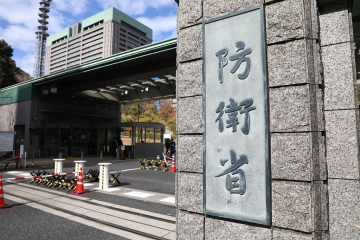
日本防卫开支达11万亿日元
财联社· 2025-11-30 01:52
Core Viewpoint - The Japanese government has approved a supplementary budget for the fiscal year 2025, aiming to achieve a defense spending target of 2% of GDP ahead of schedule [1] Group 1: Budget Overview - The overall defense-related expenses for Japan in the fiscal year 2025 will reach approximately 11 trillion yen (around 498.3 billion RMB), including an initial budget of over 9.9 trillion yen [1] - The supplementary budget allocates 847.2 billion yen specifically for the acquisition of destroyers, submarines, and surface-to-air missiles [1] - The total defense-related expenses, including other government expenditures, will exceed 1 trillion yen (approximately 45.3 billion RMB) in this supplementary budget [1]


警惕!日本防卫开支达11万亿日元
Yang Shi Xin Wen· 2025-11-30 00:36
Core Viewpoint - The Japanese government has approved a supplementary budget for the fiscal year 2025, enabling defense spending to reach 2% of GDP ahead of schedule, with total defense-related expenses estimated at approximately 11 trillion yen (around 498.3 billion RMB) [2] Group 1 - The supplementary budget includes an allocation of 847.2 billion yen for the purchase of destroyers, submarines, and surface-to-air missiles [2] - The overall defense-related expenses, including other government funding, will exceed 1 trillion yen (approximately 45.3 billion RMB) [2]
晚间重大,国常会出利好,4天缩量冲高回落,今天警惕一个关键信号
Sou Hu Cai Jing· 2025-11-29 06:01
Core Viewpoint - The A-share market experienced a "roller coaster" effect on November 27, 2025, with a slight increase in the Shanghai Composite Index but a decline in the Shenzhen Component and ChiNext indices, amidst decreasing trading volume over four consecutive days [1][3]. Market Trends - The market has shown a "shrinking rebound" trend for four days, with trading volume decreasing to 1.71 trillion yuan, raising concerns among investors about potential market stagnation or upcoming volatility [3][5]. - The market sentiment has cooled significantly, with the success rate of consecutive rising stocks dropping below 20%, indicating a cautious approach from active funds [3][5]. Technical Analysis - The shrinking trading volume reflects a decrease in capital participation and a strong sense of caution among investors, with the Shanghai Composite Index facing significant resistance at the 60-day moving average [5][7]. - Historical data suggests that the area above 3400 points on the Shanghai Composite Index has accumulated a considerable number of trapped positions, creating a strong resistance zone that requires substantial volume to break through [5][8]. Sector Performance - There is a noticeable shift in market focus from high-growth sectors to low-value stocks, with defensive sectors like banking, insurance, and liquor gaining traction as investors seek safety [8][10]. - The technology growth sectors, particularly semiconductors and AI, have faced significant pullbacks after substantial gains earlier in the year, leading to profit-taking behavior among investors [8][10]. Policy Impact - Recent government policies have positively influenced the pharmaceutical and medical device sectors, with expectations of continued active rebounds in certain stocks [10]. - Warnings from the Ministry of National Defense regarding Japan's stance on the Taiwan Strait have positively impacted the military industry and local stocks in Fujian [10]. Capital Flow - There is a noticeable slowdown in incremental capital, with northbound capital showing a cautious attitude and trading volumes declining [12]. - The overall market sentiment is cautious due to external uncertainties, with investors advised to maintain a 50% position and consider defensive sectors to hedge against risks [12].



每日投行/机构观点梳理(2025-11-28)
Jin Shi Shu Ju· 2025-11-28 13:43
Group 1 - Morgan Stanley is optimistic about the Chinese stock market, raising the A-share rating to "overweight" due to multiple positive incremental drivers expected next year, including broader AI applications and consumer stimulus measures [1] - Saxo Bank suggests that the stock market may trade sideways or see slight increases as the market responds positively to renewed expectations of a Federal Reserve rate cut, making a "Santa Rally" likely in December [1] Group 2 - ANZ analysts indicate that copper prices are supported by risk appetite and supply tightness, with Chilean producer Codelco pushing for a significant increase in annual premiums for 2026 contracts [2] Group 3 - Commonwealth Bank of Australia predicts that Brent crude oil prices could quickly drop to $60 per barrel if a ceasefire between Ukraine and Russia is achieved, which would alleviate supply risks from U.S. sanctions [3] Group 4 - Dutch Bank analysts believe the Bank of England is more likely to cut rates in December following the recent budget measures that could lower inflation [4] Group 5 - Pantheon Macroeconomics suggests that the Bank of Korea may maintain its interest rates longer than previously expected due to the weak won and rising housing prices [5] Group 6 - Kaiyuan Securities forecasts that the dividend style in the A-share market will outperform in 2026, with a focus on technology sectors and potential "high-low switch" opportunities [6] - CITIC Securities expresses optimism about AI-driven demand for computing power and applications, highlighting the need to focus on core model companies [6] - Galaxy Securities recommends focusing on the upstream military industry chain and military trade opportunities in 2026, anticipating a new round of procurement cycles [6] Group 7 - Zhongtai Securities asserts that there are no conditions for a major style switch in the market, suggesting a focus on low-crowding technology sectors and global resource pricing [7] Group 8 - Huatai Securities believes that the satellite industry chain will experience rapid growth due to advancements in reusable rockets and reduced launch costs [8] Group 9 - CITIC Securities indicates that the robotics technology route is continuously iterating, with a focus on three categories of investment opportunities [9] Group 10 - Huatai Securities expects a moderate recovery in essential consumption in 2026, driven by structural stabilization in real estate prices and potential policy stimuli [10] Group 11 - CITIC Securities reports that the domestic embodied intelligence sector has surpassed a total market value of 3 trillion yuan, with significant growth potential as commercialization progresses [11][12]
港股风向标|恒指反攻26000点受阻 机构聚焦下月降息节点
Sou Hu Cai Jing· 2025-11-28 13:31
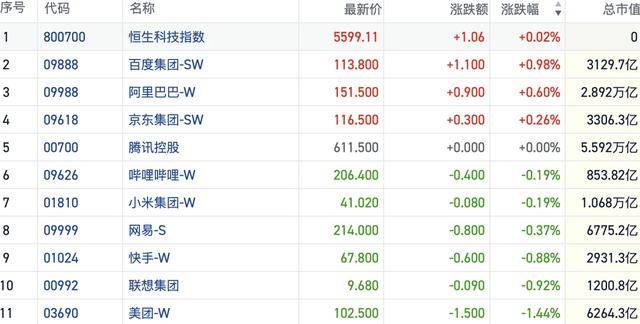
Market Overview - The Hong Kong stock market showed mixed results today, with the Hang Seng Index and the Hang Seng China Enterprises Index declining by 0.34% and 0.38% respectively, while the Hang Seng Tech Index saw a slight increase of 0.02% [1] - Major tech stocks displayed a divergent trend, with Meituan dropping by 1.44%, while Baidu, Alibaba, and JD.com experienced gains [2][3] Stock Performance - The Hang Seng Tech Index closed at 5599.11, up by 1.06 points or 0.02% [3] - Notable stock performances included: - Baidu Group: +1.1 (0.98%) with a market cap of 312.97 billion - Alibaba: +0.9 (0.60%) with a market cap of 2.892 trillion - JD.com: +0.3 (0.26%) with a market cap of 330.63 billion - Tencent: unchanged at 611.50 with a market cap of 5.592 trillion - Meituan: -1.5 (1.44%) with a market cap of 626.43 billion [3] Sector Trends - The market saw a resurgence in military stocks, while sectors such as wind power, gold, non-ferrous metals, gaming, lithium batteries, and construction materials experienced upward movement [3] - Conversely, financial and energy sectors showed weakness, with real estate stocks also underperforming [3] Trading Activity - The total trading volume for the day was 146.204 billion HKD, marking the first time in five months that daily trading volume fell below 200 billion HKD, indicating a tightening of liquidity as the year-end approaches [4] - Short selling amounted to 15.035 billion HKD, representing 10.28% of the total trading volume, with a decrease in short selling ratio to a five-day low [4][5] Market Sentiment - Despite the Hang Seng Index facing resistance at the 26,000 point level, there remains a cautious optimism regarding localized hot sectors, with a notable rotation of market interest [6] - Long-term outlook suggests that recent adjustments in the Hong Kong market may present attractive entry points for investors, as indicated by JPMorgan's upgrade of Chinese stocks to "overweight" [8] A-share Market - The A-share market also saw a rebound, with total trading volume decreasing by approximately 123.997 billion to 1.59 trillion [9] - The expectation of a potential interest rate cut by the Federal Reserve in December is anticipated to improve market sentiment and risk appetite [9]



德国失业率持稳于6.3% 但经济复苏步伐仍然疲软
智通财经网· 2025-11-28 11:28
Group 1 - The latest statistics from the German labor department indicate that the unemployment rate in Germany remains stagnant, with a slight increase of about 1,000 people in November, bringing the total to 2.973 million, which is lower than economists' expectations of a 5,000 increase [1] - The seasonally adjusted unemployment rate in Germany remained unchanged at 6.3%, aligning with expectations, highlighting the ongoing weakness in the labor market and insufficient economic growth momentum [1] - The German economy ministry has slightly revised its overall economic growth forecast for this year from stagnation (0% growth) to 0.2%, with a projected growth of 1.3% for the following year [1] Group 2 - Germany is pursuing a strategy of "large-scale infrastructure and defense investment" to support its economy, utilizing modified fiscal rules and special funds to create significant borrowing capacity [2] - A special infrastructure fund has been established with a scale of approximately €500 billion, aimed at public infrastructure projects over the next 10-12 years, focusing on transportation, utilities, energy transition, and climate projects to enhance competitiveness and stimulate medium to long-term growth [2] - The core budget for defense spending in the latest German government budget for 2026 is approximately €82.7 billion, with total defense spending exceeding €108 billion when including a special defense fund, indicating a clear intention to stimulate overall demand and support the military-industrial chain [2]
电商行业主导权易主?琉球部署导弹引连锁反应,军工股领涨A股
Sou Hu Cai Jing· 2025-11-28 11:16
Group 1: Global Market Dynamics - The U.S. stock market has recently experienced a decline of 7% in November, indicating sensitivity to market fluctuations [4] - The Federal Reserve's third-ranking official, Williams, mentioned increasing risks to employment and decreasing inflation risks, suggesting potential for further interest rate cuts [5] - The performance of global stock markets has been poor due to concerns over high valuations in tech stocks and the exhaustion of previous rate cut expectations [7] Group 2: Cryptocurrency Market - The cryptocurrency market has seen significant volatility, with reports of substantial losses in assets owned by the Trump family, including a 25% drop in the price of Trump meme coins [9] - Eric Trump remains optimistic about the future of cryptocurrencies, while notable investor Cathie Wood has increased her holdings in Bitcoin-related stocks [11] - U.S. Treasury Secretary Yellen's visit to a Bitcoin-themed bar is perceived as a supportive signal for the cryptocurrency industry [11] Group 3: A-Share Market and Geopolitical Factors - The A-share market has shown signs of recovery, particularly in the technology sector, with military stocks leading the charge due to geopolitical tensions [13] - Japan's defense minister's visit to the Ryukyu Islands and comments on missile deployment have heightened market concerns, leading to speculation about China's military response [15] - Both Chinese and Japanese stock markets have faced declines, with the Shanghai Composite Index down 4.78% and the Nikkei 225 Index down 7% from recent highs [17] Group 4: E-commerce Industry Trends - A significant number of internet celebrities are leaving Hangzhou, leading to a sharp decline in rental prices for office spaces [19] - The shift in the e-commerce landscape is characterized by the rise of "Taobao Flash Sale" and the integration of AI technology to enhance efficiency and reduce costs [21][23] - The competitive landscape is evolving, with brands increasingly taking control of sales through "store broadcasting" rather than relying solely on influencers [26] - Advances in AI digital human technology are improving operational efficiency in e-commerce, allowing for better consumer engagement [28]

陕西华达:公司目前收入结构中防务领域占比相对较高
Zheng Quan Ri Bao Wang· 2025-11-28 10:40
Core Viewpoint - The company, Shaanxi Huada (301517), has a significant revenue structure focused on the defense sector, primarily from the top five military industrial group clients [1] Group 1: Revenue Structure - The defense sector currently constitutes a relatively high proportion of the company's revenue [1] - Revenue from commercial satellites is gradually increasing year by year [1] - The company has a concentrated customer base in the commercial 6G sector, primarily with leading enterprises in civil communications [1] Group 2: Strategic Collaboration - The company collaborates closely with key clients to explore potential cooperation [1] - There is a continuous effort to expand the scope of cooperation [1] - The company aims to increase revenue from civilian products to enhance its ability to withstand industry cyclical fluctuations [1]
公司问答丨华强科技:公司2025年军贸订单已完成交付 后续订单正在积极对接中
Ge Long Hui A P P· 2025-11-28 09:38
Core Viewpoint - The company has completed its military trade orders for 2025 and is actively engaging in subsequent orders, aiming to enhance performance in the fourth quarter [1] Group 1 - The company has confirmed that its military trade business volume has not significantly increased recently [1] - The company is intensifying production arrangements in the fourth quarter to ensure timely delivery and improve performance [1] - The company is focused on providing better returns to shareholders through its operational efforts [1]

注意!A股缩量藏重大玄机,聪明钱已提前布局这一赛道,2026年行情或在此刻启动!
Sou Hu Cai Jing· 2025-11-28 07:47
配置上,建议采用"防御+景气"哑铃型策略:短期持有高股息、低估值的银行、电力等防御板块;同时 前瞻布局储能、军工、AI算力等景气领域,储能行业增速有望超40%,军工受益国防现代化需求,AI算 力在服务器出货翻倍驱动下需求刚性凸显。投资者需在震荡中保持耐心,灵活调整结构,为2026年机遇 蓄力。。 今天A股市场在窄幅震荡中收涨,但成交额降至1.6万亿元,接近四个月来的地量水平。这种量能萎缩, 往往意味着市场在寻找新方向前的蓄势。 具体看,上证指数微涨0.34%,收于3888.60点,深证成指和创业板指分别上涨0.85%和0.70%,科创50指 数以1.25%的涨幅领先,显示科技股仍是资金青睐的对象。月线层面,多数指数收跌,但今日超4000只 个股飘红,板块分化中透出结构性机会。 其他板块如锂矿和大消费,也受益于超跌反弹和事件驱动。锂矿股在盛新锂能等个股带动下反弹,大消 费则因海欣食品"地天板"而活跃。这些现象说明,资金正从高估值板块流向政策支持的硬科技和顺周期 领域。反观银行和医药的下跌,则反映了市场对基本面压力的担忧。 展望12月,A股市场预计延续震荡格局,多空因素博弈加剧。经济基本面企稳改善仍是核心关切,内 ...