
低空经济

Search documents
新华社“四中全会精神在基层”专栏:首篇关注广东高质量发展
2 1 Shi Ji Jing Ji Bao Dao· 2025-10-30 15:54
Group 1 - The 20th Central Committee of the Communist Party of China held its fourth plenary session, outlining the guiding principles and main goals for the 14th Five-Year Plan, emphasizing the continuation of China's modernization and economic development [4][5] - Guangdong, as a leading economic province, aims to solidify its position by planning for the 14th Five-Year Plan and striving to build a modernized economy [5][17] - The 138th Canton Fair has set a new record with 74,600 exhibition booths and over 32,000 participating companies, showcasing the vitality and confidence of the Chinese economy [8][9] Group 2 - Guangdong is focusing on high-level technological self-reliance and innovation, with companies like TCL emphasizing the importance of independent research and development [9][11] - The establishment of the first government-affiliated AI and robotics agency in Shenzhen aims to promote the development of the AI and robotics industry [11] - The low-altitude economy is a strategic emerging industry in Guangdong, with efforts to build 5G-A bases and create more application scenarios [13] Group 3 - The "Shenzhen-Hong Kong-Guangzhou" cluster ranks first in the Global Innovation Index, highlighting Guangdong's commitment to building a globally competitive modern industrial system [17] - The province is implementing reforms to bridge the development gap between urban and rural areas, with initiatives to enhance the quality of life for residents [19][26] - Guangdong is actively promoting the integration of the Guangdong-Hong Kong-Macao Greater Bay Area, enhancing connectivity and public services across the region [21][23][24] Group 4 - The province is focusing on improving public welfare and addressing citizens' needs, with initiatives to enhance healthcare access and quality in rural areas [29] - The government is committed to upgrading living conditions through urban renewal projects, transforming old buildings into modern facilities [28] - Guangdong's approach to governance emphasizes responsiveness to public concerns, as seen in the quick resolution of community issues [25][26]

新华全媒头条·四中全会精神在基层|锚定“排头兵” 坚决“挑大梁”——在改革开放前沿广东观察高质量发展新实践
Xin Hua She· 2025-10-30 15:01
Core Points - The article emphasizes Guangdong's role as a leader in China's economic development, particularly in the context of the recent Fourth Plenary Session of the 20th Central Committee, which outlines the goals for the 14th Five-Year Plan and the importance of high-quality development [2][3] Group 1: Economic Development and Innovation - Guangdong's economic output accounts for over 10% of the national total, positioning it as a key player in China's economic landscape [2] - The 138th China Import and Export Fair (Canton Fair) has set a new record with 74,600 booths and over 32,000 participating companies, showcasing the vitality and confidence of the Chinese economy [3] - TCL, a local enterprise, highlights its commitment to innovation with over 20,000 R&D personnel and more than 110,000 patents, aligning with the call for strengthening original innovation and key technology breakthroughs [4] Group 2: Technological Advancements - Guangdong is focusing on building a modern industrial system with global competitiveness, emphasizing high-level technological self-reliance [4][6] - The establishment of the first government-affiliated AI (robotics) agency in Longgang District, Shenzhen, aims to promote the planning and ecological development of the AI and robotics industry [5] - The "Shenzhen-Hong Kong-Guangzhou" cluster ranks first in the 2025 Global Innovation Index, reflecting the region's strong technological capabilities [6] Group 3: Regional Development and Integration - The "Hundred Counties, Thousand Towns, and Ten Thousand Villages" initiative aims to bridge the development gap between urban and rural areas in Guangdong [7][10] - The income ratio between urban and rural residents in Guangdong is projected to decrease from 2.55:1 in 2019 to 2.31:1 by 2024, indicating progress in income equality [10] - The Guangdong-Hong Kong-Macao Greater Bay Area is being developed to enhance connectivity and economic integration, with significant improvements in transportation reducing commute times [10][11] Group 4: Social Welfare and Public Services - The article discusses the importance of improving public services and addressing citizens' needs, as seen in the rapid response to community issues highlighted by the "Measuring Tape Brother" initiative [15][16] - Guangdong plans to enhance healthcare access by deploying 10,000 physicians to grassroots medical institutions over the next five years, aiming for comprehensive healthcare coverage [17] - The province is committed to improving living conditions and public facilities, as demonstrated by the renovation of outdated housing into modern living spaces [16][17]
四中全会精神在基层丨百米低空如何掀起万亿风口?来黄埔低空经济产业园解锁答案!
Xin Hua Wang· 2025-10-30 12:34
Core Insights - The article highlights the rapid development of the low-altitude economy, showcasing advancements in drone delivery, air taxis, and flying cars, indicating a complete industrial chain taking off [1] Group 1: Industry Overview - In Huangpu District, Guangzhou, leading manufacturers such as EHang, XPeng Heitech, and XAG have gathered, with over 50 low-altitude economy-related companies in the area, projecting a production value of approximately 14.8 billion yuan in 2024 [3] - The low-altitude economy is expected to create a market space worth trillions, with Guangdong housing over 15,000 related enterprises, accounting for 95% of the national consumer drone market, and leading in multiple indicators nationwide [5] Group 2: Policy and Strategic Importance - The inclusion of the low-altitude economy in the 2024 government work report and the "14th Five-Year Plan" emphasizes its growing significance, aiming to develop emerging pillar industries and accelerate the growth of strategic emerging industry clusters such as new energy, new materials, aerospace, and low-altitude economy [7] - Huangpu District is positioned as a "testbed" for institutional innovation and scenario implementation in the Guangdong-Hong Kong-Macao Greater Bay Area, aiming to reshape urban living paradigms with its "Sky City" blueprint [7]

在改革开放前沿广东观察高质量发展新实践
Xin Hua She· 2025-10-30 10:43
在接续推进中国式现代化建设的关键时期,党的二十届四中全会胜利召开,审议通过了《中共中 央关于制定国民经济和社会发展第十五个五年规划的建议》,系统谋划布局"十五五"经济社会发 展。 广东,中国经济的"排头兵",经济总量超全国十分之一的经济大省,在"十四五"即将收官和"十五 五"待启的重要节点,锚定"走在前列"总目标,深入谋划推进"十五五"发展,为建成一个现代化的 新广东打下坚实基础。 记者近日在广东多地调研看到,四中全会号角催征,广大干部群众主动担当、锐意进取,学习贯 彻落实全会精神的热潮澎湃,振奋人心。 向"新"而行,加快高水平科技自立自强 开栏的话 10月20日至23日,中国共产党第二十届中央委员会第四次全体会议在北京胜利召开。全会明确 了"十五五"时期经济社会发展的指导方针和主要目标,发出了乘势而上、接续推进中国式现代化 建设,续写经济快速发展和社会长期稳定两大奇迹新篇章的豪迈宣言。 学习好贯彻好全会精神,是当前和今后一个时期全党全国的重大政治任务。即日起,新华社开 设"四中全会精神在基层"专栏,记者深入田间地头、企业车间、科研院所等基层一线,以融合报 道的形式反映各地区各部门紧紧围绕习近平总书记在全会上 ...
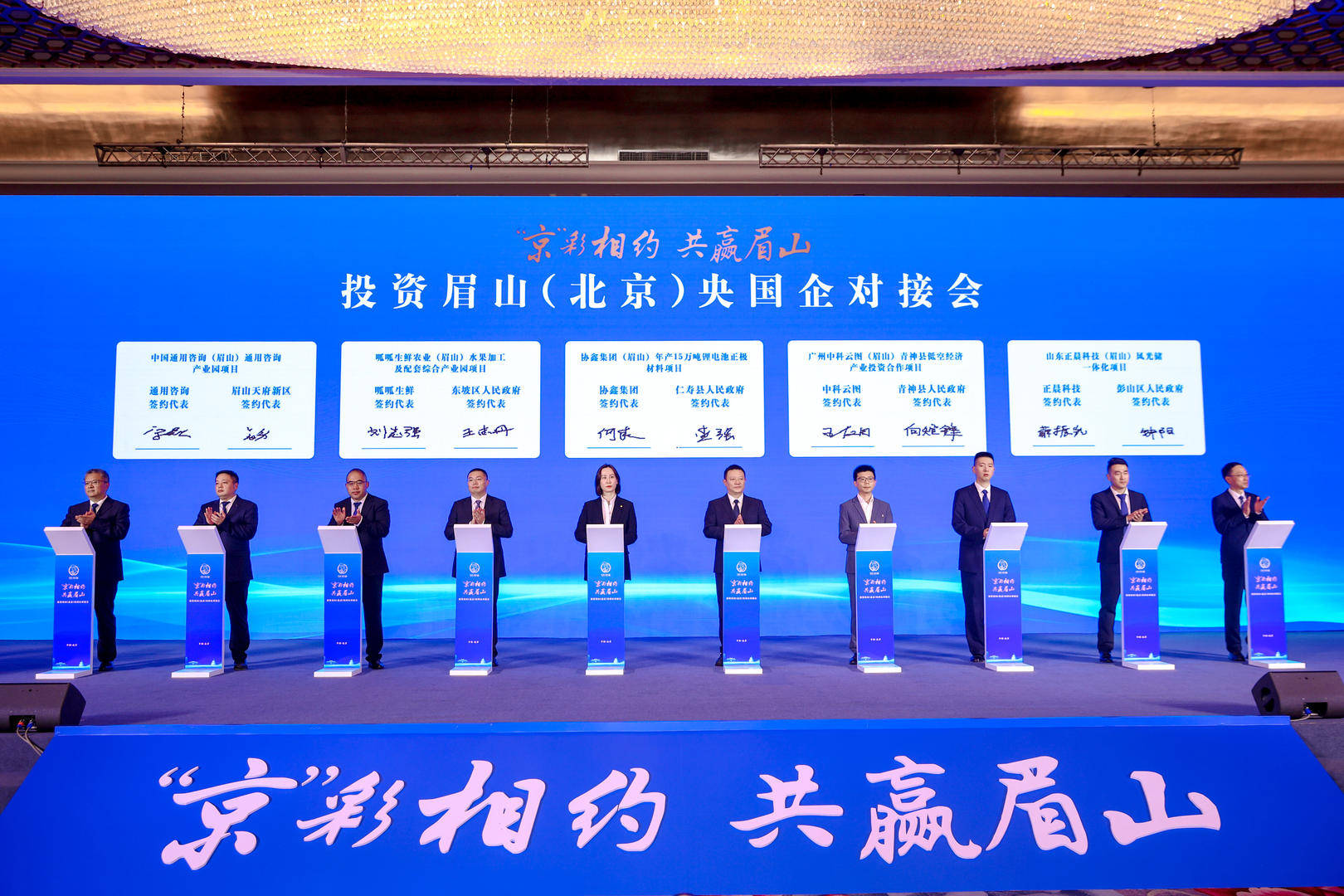
四川眉山在京签约43个项目,合同金额506.04亿元
Sou Hu Cai Jing· 2025-10-30 08:32
Group 1 - The investment conference themed "'Jing' Color Appointment, Win Together in Meishan" was held in Beijing, gathering over 90 key central and state-owned enterprises along with relevant departments and key companies from Sichuan Province and Meishan [1] - A total of 43 projects were signed during the event, with a contract amount of 506.04 billion yuan. Notably, 15 projects were signed on-site with companies such as China Railway Construction, General Consulting, and Xiexin Group, amounting to 341.81 billion yuan [3] - The "Investment Opportunity List of Meishan City" was released, covering 238 key industries and promising projects, representing a market opportunity exceeding 330 billion yuan, including sectors like new energy materials, electronic information, equipment manufacturing, and health care [3] Group 2 - Meishan City set three major goals for attracting investment this year: a contract amount of 100 billion yuan, 180 projects, and 25 major projects from Fortune 500 companies or investments of 2 billion yuan or more [3] - From January to September, Meishan City signed 187 new investment projects with a total contract amount of 989.08 billion yuan [3]
用好数亿新能源车电池储能 电力“调节潜力”惊人
Shen Zhen Shang Bao· 2025-10-30 05:26
Core Viewpoint - The forum emphasized the importance of building an efficient and safe low-altitude flight service guarantee system and promoting the deep integration of transportation and energy systems for the large-scale application of the low-altitude economy [1] Group 1: Low-altitude Economy - The forum on low-altitude economy infrastructure and zero-carbon scenario applications was held in Shenzhen [1] - Experts highlighted that the integration of transportation and energy systems is crucial for realizing the large-scale application of the low-altitude economy [1] Group 2: Energy System Perspective - Professor Wang Bo from Beijing Institute of Technology stressed the urgency and potential of the collaboration between transportation electrification and the power grid [1] - The high-power charging demands of new energy vehicles and electric aircraft pose challenges to grid stability, but effective incentives could enable interaction between millions of vehicle batteries and the grid, potentially matching the national electricity consumption [1] - The optimization of transportation and energy systems is considered core to supporting the "dual carbon" goals [1]
屈宏斌:如何迈向中等发达国家
Di Yi Cai Jing· 2025-10-30 03:05
Core Insights - The strategic direction is clear: internally "stimulating consumption" and externally "enhancing technology" to reach the peak of industry [1][8] Group 1: Economic Goals - The 20th Central Committee has reaffirmed the goal of achieving "per capita GDP at the level of moderately developed countries" by 2035 [1][2] - Current per capita GDP in China is approximately $14,000, ranking 70th globally, indicating a significant gap to close to reach the target [2][3] Group 2: Growth Engines - Future economic growth will rely on two core actions: "expanding domestic demand" and "enhancing new momentum" [3][4] - Expanding domestic demand focuses on encouraging young people to spend, particularly by improving the pension system for rural elderly [4][5] Group 3: New Momentum - "New quality productivity" is essential for climbing the GDP peak, with a clear future industrial structure [6] - Traditional industries will be empowered with AI and green technologies, while emerging industries like new energy vehicles and industrial metaverse will be prioritized [6][7] Group 4: Open Strategy - The strategy includes transitioning from merely attracting foreign investment to participating in and leading the establishment of global standards and regulations [7] - Emphasis on maintaining multilateral trade and expanding two-way investment, particularly in high-tech and green energy sectors [7][8]
“十五五”投资:“投资于人”成为主线,“投资于物”布局未来
2 1 Shi Ji Jing Ji Bao Dao· 2025-10-30 00:12
Group 1 - The core idea of the article emphasizes the importance of "investing in people" as a key focus in China's 14th Five-Year Plan, highlighting the need to combine investments in material and human capital to enhance people's livelihoods and promote consumption [1][3][4] - Fixed asset investment in China has reached 50 trillion yuan, with a shift from physical capital to human capital investment being deemed necessary due to declining returns on traditional investments [3][4] - The article outlines specific measures to enhance human capital, including improving population quality through education and healthcare investments, and implementing supportive policies for population growth [3][4][6] Group 2 - The article discusses the strategic emphasis on "investing in material" to layout future industries, with a focus on emerging sectors such as new energy, aerospace, and advanced manufacturing, which are expected to create trillion-yuan markets [5][6] - It highlights the role of technological innovation in driving new industries and enhancing productivity, with a call for deeper integration of technology and industry to support high-quality development [6][7] - The article notes that while fixed asset investment growth has slowed, there is a trend towards optimizing the industrial structure, with significant growth in high-tech sectors [7][8] Group 3 - Effective investment is defined as directing funds towards areas with positive returns and consumer willingness, with a focus on enhancing living standards and fostering new industries [8] - The relationship between central and local government investments is discussed, emphasizing the need for government investments to create a conducive environment for private sector participation and enhance overall investment effectiveness [8]
江苏省市联动进京“四对接”取得丰硕成果
Xin Hua Ri Bao· 2025-10-29 23:20
Core Insights - The "Four Connections" event in Jiangsu aims to attract high-level talent and quality projects, reflecting the province's strong commitment to talent acquisition and development [1][3][7] Group 1: Talent Acquisition Activities - The event included 148 activities, with 40 job fairs receiving over 29,000 resumes, of which nearly 70% were from candidates with master's degrees or higher [1] - Notable participation from top universities like Tsinghua University and Peking University, with over 8,000 attendees and 6,000 resumes collected by 186 companies [2][3] - Jiangsu's recruitment efforts featured 14,000 high-quality job positions across various sectors, including advanced manufacturing, AI, and renewable energy [3][10] Group 2: Engagement Strategies - The event emphasized direct engagement between company leaders and job seekers, facilitating in-depth discussions on career development and tailored training programs [3][5] - Jiangsu's promotional activities highlighted the province's rich culture and supportive policies, enhancing its appeal to potential recruits [4][5] Group 3: Project and Capital Integration - The event also focused on integrating high-quality projects with capital, featuring roadshows for talent and technology projects that attracted significant interest from over 70 investment institutions [10][11] - Collaborative initiatives were launched, such as partnerships between universities and local industries to enhance research and development capabilities [8][9]
“十五五”产业趋势三大关键定调:巩固传统优势 决胜新兴未来
2 1 Shi Ji Jing Ji Bao Dao· 2025-10-29 14:51
Core Viewpoint - The article emphasizes the importance of building a modern industrial system and strengthening the foundation of the real economy as a strategic task in China's 15th Five-Year Plan, highlighting four key tasks: optimizing traditional industries, nurturing emerging and future industries, promoting high-quality development of the service sector, and constructing a modern infrastructure system [1][2]. Group 1: Traditional Industries - The first key task is to optimize and enhance traditional industries, including mining, metallurgy, chemicals, light industry, textiles, machinery, shipbuilding, and construction, to strengthen their global competitiveness and position in the international division of labor [1][2][3]. - Traditional industries account for about 80% of the added value in China's manufacturing sector, serving as a fundamental support for the modern industrial system and contributing to stable growth, employment, and income [2][3]. - The focus is on upgrading traditional industries through technological transformation, green transition, and brand internationalization, shifting from a "cost advantage" to a "system advantage" in the global division of labor [3][4]. Group 2: Emerging and Future Industries - The plan aims to cultivate and expand emerging industries, with a focus on creating new pillar industries, particularly in areas such as new energy, new materials, aerospace, and the newly added low-altitude economy [5][6]. - The low-altitude economy is highlighted for its potential to activate a trillion-level market space, driven by advancements in technology and broad application scenarios [6][7]. - Future industries will include quantum technology, biomanufacturing, hydrogen and nuclear fusion energy, brain-computer interfaces, embodied intelligence, and sixth-generation mobile communications, which are expected to become new economic growth points [7][8]. Group 3: Service Sector Development - The article discusses the need to promote high-quality development in the service sector, emphasizing the expansion and enhancement of service capabilities, particularly in productive services [9][10]. - The productive service sector currently accounts for about 30% of China's GDP, indicating significant room for growth compared to developed economies [10]. - The plan includes constructing a modern infrastructure system, focusing on the development of new-type infrastructure and enhancing connectivity across regions to support economic growth [11][12].