
保险业

Search documents
2026年固收年度策略:低利率预期变化之时:溯因寻锚,换挡启程
GUOTAI HAITONG SECURITIES· 2025-10-31 06:00
Group 1 - The report highlights a significant increase in fiscal policy, with the budget deficit rate surpassing 4%, reaching a deficit scale of 5.66 trillion, an increase of 1.6 trillion from the previous year, and total government debt reaching 11.86 trillion, up by 2.9 trillion from last year [7][19][20] - The central bank has been optimizing its monetary policy framework since mid-2024, emphasizing the 7-day OMO rate as the main policy rate, with limited rate cuts throughout the year, indicating a cautious approach to monetary easing [11][12] - The report indicates a shift towards a more proactive fiscal policy, with measures such as child subsidies and free preschool education being introduced, alongside a focus on infrastructure projects [19][39] Group 2 - The report discusses the relationship between fiscal and monetary policies, suggesting that if fiscal policy remains restrained, monetary easing may struggle to counteract structural economic pressures [8][19] - It notes that the bond market's long-term interest rates may face upward pressure due to increased government leverage and the need for the central bank to buy government bonds to support the market [13][19] - The report emphasizes that the current economic recovery is weak, with fiscal expansion and liquidity supporting the equity market, while the bond market remains under pressure from risk assets [39][41] Group 3 - The report outlines a clear divergence in performance between new and traditional economic sectors, with technology and advanced manufacturing driving equity market gains, while traditional sectors lag behind [41][33] - It highlights that the bond market's pricing mechanism is increasingly influenced by fiscal policy rather than traditional monetary indicators, indicating a shift in how asset prices are determined [36][46] - The report suggests that the bond market's ability to price economic fundamentals is limited, with institutional behaviors playing a crucial role in determining interest rates [49][53]
平安证券(香港)港股晨报-20251031
Ping An Securities Hongkong· 2025-10-31 02:28
Market Overview - The Hong Kong stock market experienced a decline, with the Hang Seng Index closing at 23,831 points, down 145 points or 0.61% [1] - The US stock market also saw a drop, particularly in technology stocks, with the Nasdaq falling approximately 380 points [2] - The overall market turnover in Hong Kong decreased to 82.799 billion, while the southbound funds recorded a net inflow of 13.64 billion [1] Sector Performance - The metals sector continued to show strength, with China Nonferrous Mining rising by 7.4% and Zijin Mining increasing by 4.6% [1] - The software industry in China reported a revenue of 111,126 billion yuan in the first three quarters, reflecting a year-on-year growth of 13.0% [9] - The pharmaceutical sector has been underperforming, with the healthcare index dropping by 7.5% from August to October [3] Investment Recommendations - The report suggests focusing on sectors such as artificial intelligence, semiconductors, and industrial software for long-term growth opportunities [3] - It highlights the potential of state-owned enterprises with low valuations and high dividends, as well as upstream non-ferrous metals benefiting from anticipated interest rate cuts [3] - Companies like China Software International and Kingdee International are recommended for their stable growth in the software sector [9] Company Highlights - Tencent's cloud platform is set to charge for its "image understanding" plugin starting November 6 [12] - China National Offshore Oil Corporation reported a net profit of 101.971 billion yuan for the first nine months, a decrease of 12.59% [12] - Companies like Shandong Gold and Junsheng Electronics reported significant profit increases of 68.24% and 35.4% respectively in the third quarter [12]
人身险第四套生命表明年实施,如何影响你的保费
Guo Ji Jin Rong Bao· 2025-10-30 23:55
Core Insights - The release of the "2025 Experience Life Table" marks a significant milestone for the life insurance industry in China, transitioning from price competition to a focus on data accumulation, risk identification, and actuarial capabilities [1][2][3] Industry Overview - The new life table is based on nearly a decade of comprehensive policy data, making it the largest sample size in the global insurance market, and aims to reflect the current and future survival and mortality probabilities of the insured population [2][3] - The life table indicates a continuous increase in life expectancy, with an approximate rise of 10 years compared to the first life table, and shows significant improvements in child mortality rates and reductions in mortality rates in economically underdeveloped regions [3][4] Regulatory Framework - The Financial Regulatory Bureau has issued guidelines for the application of the new life table, emphasizing the need for insurance companies to scientifically and accurately set insurance liabilities and offer diverse, high-quality insurance products [4][5] Pricing Impact - The new life table introduces a dual-track pricing model that combines industry benchmarks with company-specific experience, allowing for differentiated and scientific management of insurance products [7][8] - The expected decrease in mortality rates for term life insurance products may lead to lower premiums, while products like annuities and pensions may see an increase in rates due to longer life expectancies [7][8] Risk Management Enhancements - The introduction of a "mortality deviation assessment mechanism" requires insurance companies to evaluate the potential deviations in mortality rates and implement a retrospective mechanism to optimize actuarial models [8][9] - This dynamic risk management process will necessitate increased investment in actuarial models, data systems, and professional talent to enhance decision-making capabilities [8][9]
2025金融街论坛|企业加速出海!多方共话京港资本市场合作新机遇
Sou Hu Cai Jing· 2025-10-30 15:32
Core Insights - The financial high-level opening and high-quality development of the real economy have become key themes, with Beijing and Hong Kong as core forces in promoting enterprises going global and capital connectivity [1] - The Hong Kong Securities and Futures Commission Chairman highlighted the significant market value and number of Beijing enterprises listed in Hong Kong, while the Hong Kong Stock Exchange Chairman noted an increasing number of tech companies preparing to list in Hong Kong [1][6] Group 1: Market Opportunities - There are over 200 companies from Beijing listed on the Hong Kong stock market, including major firms like Sany Heavy Industry and China Aluminum [4] - The "A+H" dual listing model is gaining traction, with 46 companies including Agricultural Bank of China and China Shenhua Energy listed in both markets [4] - The collaboration between the Beijing Stock Exchange and Hong Kong Stock Exchange aims to facilitate cross-border listings, enhancing market cooperation and promoting mutual prosperity [3][5] Group 2: Financial Performance - In the first three quarters of 2023, new listings in Hong Kong raised HKD 180 billion, a twofold increase year-on-year, while subsequent stock issuances raised HKD 260 billion, up 270% [6] - The average daily trading volume in the Hong Kong secondary market increased by over 90% compared to the previous year, with the market capitalization nearing HKD 50 trillion, ranking third in Asia [6] Group 3: Future Trends - The trend of A-share companies seeking to list in Hong Kong is expected to continue, driven by the desire to enhance international visibility and attract global capital [6][8] - The Chinese Securities Regulatory Commission has issued measures to support leading domestic enterprises in listing in Hong Kong, indicating a favorable policy environment for such initiatives [8]






“十五五”政策信号一文看懂
Guo Ji Jin Rong Bao· 2025-10-30 11:36
Core Viewpoint - The "15th Five-Year Plan" emphasizes high-quality development as the primary goal, shifting focus from rapid economic growth to enhancing the quality of economic development [2][3]. Economic Development Goals - The plan does not set specific GDP growth targets but aims for an average annual GDP growth rate of 4.5% to 5.0% during the "15th Five-Year Plan" period, ensuring a balance between growth, structural adjustment, and risk prevention [3]. - The plan highlights a significant increase in the resident consumption rate, indicating a shift from investment-driven growth to consumption-led growth [3][4]. Capital Market Development - The plan calls for a well-functioning capital market that supports innovation-driven development, emphasizing reforms in the Sci-Tech Innovation Board and the Growth Enterprise Market to provide better financing for "hard tech" companies [5][6]. - It aims to balance direct and indirect financing, enhancing the financing structure to better serve small and innovative enterprises [6][7]. Fiscal and Monetary Policy - The plan stresses the importance of active fiscal policy to enhance sustainability and support long-term investments while balancing efficiency and equity [9][10]. - Monetary policy will maintain a moderately loose stance, focusing on effective transmission mechanisms and structural tools to support key sectors [11][12]. Digital Economy and Innovation - The plan promotes the construction of a digital economy, emphasizing the development of data markets and the integration of artificial intelligence into various sectors [13][14]. - It aims to address challenges in data resource sharing, algorithm development, and privacy protection to enhance the value of data and accelerate AI development [14][15]. Social Security and Insurance - The plan proposes a multi-tiered pension system and emphasizes the role of commercial insurance in providing supplementary coverage [16][17]. - It introduces long-term care insurance to address the needs of the aging population, aiming to build a comprehensive care system [17].
股价新高之际,新华保险前三季净利同比增近60%
Hua Er Jie Jian Wen· 2025-10-30 11:16
Core Insights - Xinhua Insurance's stock reached an all-time high on October 30, coinciding with the release of its Q3 2025 financial report [1] - The company reported a Q3 revenue of 67.211 billion yuan, a year-on-year increase of 30.8%, and a net profit attributable to shareholders of 18.058 billion yuan, up 88.2% year-on-year [1] Financial Performance - For the first three quarters, Xinhua Insurance achieved a total revenue of 137.252 billion yuan, reflecting a year-on-year growth of 28.3%, with a net profit of 32.857 billion yuan, an increase of 58.9% [2][3] - The annualized total investment return rate as of September was 8.6%, while the annualized comprehensive investment return rate was 6.7%, with total assets exceeding 1.8 trillion yuan, an increase of 8.3% from the previous year [4] Premium Income Growth - The company reported original insurance premium income of 172.705 billion yuan for the first three quarters, a year-on-year increase of 18.6%, with first-year premium income from long-term insurance at 54.569 billion yuan, up 59.8% [5] - The first-year regular premium income for long-term insurance reached 34.9 billion yuan, a growth of 41.0%, while the first-year lump-sum premium income was 19.669 billion yuan, increasing by 109.2% [5] - The renewal premium income was 114.62 billion yuan, reflecting a growth of 5.9%, and the company’s new business value increased significantly by 50.8% [5] Distribution Channels - The bancassurance channel showed strong performance, generating first-year premium income of 35.938 billion yuan for long-term insurance, a year-on-year increase of 66.7% [6] - The group channel achieved premium income of 2.968 billion yuan, up 16.7%, with short-term insurance premium income at 2.603 billion yuan, a growth of 14.0% [7]
中国太保(02601.HK)前三季度净利457亿元 同比增长19.3%
Ge Long Hui· 2025-10-30 10:32
Core Viewpoint - China Pacific Insurance (02601.HK) reported a 3.6% year-on-year increase in insurance service revenue for the first three quarters of 2025, amounting to 216.894 billion yuan, with a significant net profit growth of 19.3% to 45.7 billion yuan [1] Group 1: Insurance Service Revenue - The insurance service revenue for China Pacific Insurance reached 216.894 billion yuan, reflecting a 3.6% increase compared to the previous year [1] - China Pacific Life Insurance generated 63.980 billion yuan in insurance service revenue, up 2.6% year-on-year [1] - China Pacific Property Insurance achieved 150.806 billion yuan in insurance service revenue, marking a 3.5% increase year-on-year [1] Group 2: Profit and Business Growth - The group reported a net profit of 45.7 billion yuan, which is a 19.3% increase from the previous year [1] - China Pacific Life Insurance's premium income reached 263.863 billion yuan, showing a 14.2% year-on-year growth [1] - The new business value for China Pacific Life Insurance was 15.351 billion yuan, with a year-on-year increase of 7.7%, and a comparable growth of 31.2% [1]

巨灾保险“出海”再提速,监管支持境内险企“侧挂车”
Nan Fang Du Shi Bao· 2025-10-30 10:30
Core Viewpoint - Catastrophe insurance is becoming increasingly important as extreme weather and natural disasters rise globally, with China facing significant challenges in its catastrophe insurance system despite recent policy advancements [2][4]. Group 1: Catastrophe Insurance Landscape in China - Over 70% of cities and more than 50% of the population in China are located in areas severely affected by natural disasters, highlighting the complex and concentrated nature of catastrophe risks [5]. - The catastrophe insurance system in China has been gradually improving, with significant developments such as the establishment of the earthquake catastrophe insurance community in 2016 and ongoing pilot programs in over 20 provinces [6]. - Despite a premium scale of 1.232 billion yuan and a compound annual growth rate exceeding 39% from 2014 to 2024, the insurance payout for natural disasters in China is only about 10% of the economic losses, compared to a global average of 50% [6]. Group 2: Regulatory Developments and Innovations - The Financial Regulatory Bureau has issued a notification allowing domestic insurance companies to issue "sidecar" insurance-linked securities in the Hong Kong market, which helps transfer risks to the capital market [3][4]. - "Sidecar" insurance-linked securities can provide additional protection for insurance companies, enhancing their financial stability and allowing them to share catastrophe risks with the capital market [4]. - The issuance of catastrophe bonds has been supported by recent regulatory changes, with the first catastrophe bond issued in Hong Kong in 2015 and subsequent issuances in 2021 and 2022 [9][10]. Group 3: Industry Trends and Future Outlook - The catastrophe bond market is expected to grow significantly, with predictions indicating a 20% increase in market size to approximately $60 billion by 2025 [10]. - The introduction of "sidecar" insurance-linked securities is anticipated to diversify capital markets and may lead to structural impacts on domestic stock markets, potentially attracting international capital back to mainland markets [11][12]. - The insurance industry is encouraged to adopt technology for risk management, shifting focus from post-disaster compensation to pre-disaster prevention, with companies like China Life and PICC developing advanced risk management platforms [7].


预定利率研究值降幅逐季收窄,业内预计人身险定价上限中短期难现调整窗口
Di Yi Cai Jing Zi Xun· 2025-10-30 10:12
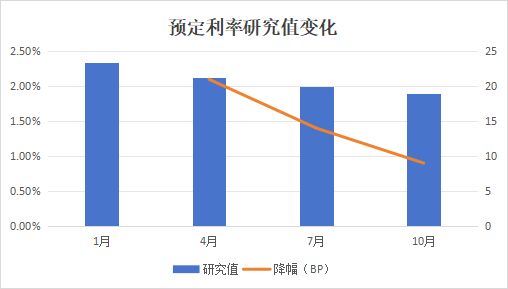
Core Viewpoint - The China Insurance Industry Association has lowered the research value for the maximum guaranteed interest rate for ordinary life insurance products to 1.9%, a decrease of 9 basis points from the previous quarter's 1.99% [1][2][4] Group 1: Research Value Trends - The decline in the research value has been narrowing over the past three quarters, with the initial value in January being 2.34%, followed by 2.13%, 1.99%, and now 1.9% [2][4] - The current research value is considered to be in line with expectations, as stated by analysts [2][4] Group 2: Regulatory Framework - According to the regulatory notice, if the maximum guaranteed interest rate for current ordinary life insurance products exceeds the research value by 25 basis points for two consecutive quarters, a downward adjustment must be made [2][6] - The current maximum guaranteed interest rate is 2%, which is still 15 basis points above the research value, indicating that a downward adjustment is not imminent [6] Group 3: Market Conditions and Predictions - Analysts suggest that the stability of long-term interest rates since early 2025 has contributed to the narrowing decline in the research value [4][7] - Predictions indicate that if current interest rates remain stable, the research value for the end of 2026 could be around 1.87%, which would not trigger the regulatory threshold for adjustment [7]
新华保险:前三季度净利润同比增长59% 投资收益增长
Mei Ri Jing Ji Xin Wen· 2025-10-30 09:41
Core Viewpoint - The company reported significant growth in both revenue and net profit for the third quarter and the first three quarters of 2025, driven by a recovery in the Chinese capital market [1] Financial Performance - In Q3 2025, the company achieved a revenue of 67.211 billion yuan, representing a year-on-year increase of 30.8% [1] - The net profit attributable to shareholders for Q3 2025 was 18.058 billion yuan, showing a year-on-year growth of 88.2% [1] - For the first three quarters of 2025, the company reported a total revenue of 137.252 billion yuan, which is a 28.3% increase compared to the same period last year [1] - The net profit attributable to shareholders for the first three quarters was 32.857 billion yuan, reflecting a year-on-year increase of 58.9% [1] Investment Performance - The performance improvement is primarily attributed to the favorable conditions in the Chinese capital market, which has stabilized and improved [1] - The investment income for Q3 2025 continued to grow significantly compared to the same period last year, building on the high growth from the previous year [1]