银行业

Search documents
2026年首月我国社融规模增量为7.22万亿元
Xin Hua Wang· 2026-02-13 09:15
【纠错】 【责任编辑:赵阳】 中国人民银行的数据显示,1月末,人民币贷款余额276.62万亿元,同比增长6.1%。1月份人民币贷款增 加4.71万亿元。分部门看,住户贷款增加4565亿元;企(事)业单位贷款增加4.45万亿元,其中中长期 贷款增加3.18万亿元。(记者吴雨、任军) 中国人民银行2月13日发布的金融统计数据报告显示,2026年1月份社会融资规模增量为7.22万亿元,比 上年同期多1662亿元,创历史同期新高。 ...
央行:1月份银行间人民币市场同业拆借月加权平均利率为1.4% 质押式债券回购月加权平均利率为1.43%
Di Yi Cai Jing· 2026-02-13 09:15
Core Viewpoint - The central bank released the financial statistics report for January 2026, highlighting significant growth in interbank RMB market transactions, with a total turnover of 211.96 trillion yuan and a daily average turnover of 10.09 trillion yuan, reflecting a year-on-year increase of 36.1% [1] Group 1: Market Transactions - In January, the interbank RMB market saw a total transaction volume of 211.96 trillion yuan, with a daily average of 10.09 trillion yuan [1] - The year-on-year growth in daily average transactions was 36.1%, with interbank lending showing a remarkable increase of 75.6% [1] - The daily average transaction volume for cash bonds increased by 9.2%, while the pledged repo daily average transaction volume rose by 40.7% [1] Group 2: Interest Rates - The weighted average interest rate for interbank lending in January was 1.4%, which is 0.04 percentage points higher than the previous month but 0.46 percentage points lower than the same period last year [1] - The weighted average interest rate for pledged repos was 1.43%, up by 0.03 percentage points from the previous month and down by 0.73 percentage points year-on-year [1]
央行:1月末广义货币(M2)余额347.19万亿元 同比增长9%
智通财经网· 2026-02-13 09:14
Group 1 - The total social financing stock at the end of January 2026 was 449.11 trillion yuan, with a year-on-year growth of 8.2% [2] - The increment of social financing in January 2026 was 7.22 trillion yuan, which is 166.2 billion yuan more than the same period last year [4] - The balance of broad money (M2) at the end of January was 347.19 trillion yuan, reflecting a year-on-year increase of 9% [5] Group 2 - The balance of RMB loans to the real economy was 273.3 trillion yuan, growing by 6.1% year-on-year [2] - The balance of foreign currency loans to the real economy, converted to RMB, was 1.09 trillion yuan, showing a year-on-year decline of 12.1% [2] - The balance of government bonds reached 95.9 trillion yuan, with a significant year-on-year increase of 17.3% [2] Group 3 - In January, RMB deposits increased by 8.09 trillion yuan, with household deposits rising by 2.13 trillion yuan [6] - The balance of foreign currency deposits was 1.1 trillion USD, marking a year-on-year growth of 23.7% [6] - The total balance of loans in both RMB and foreign currencies was 280.59 trillion yuan, with RMB loans increasing by 4.71 trillion yuan in January [7] Group 4 - The average weighted interest rate for interbank RMB market lending was 1.4%, which is 0.04 percentage points higher than the previous month [8] - The total transaction volume in the interbank RMB market reached 211.96 trillion yuan in January, with a daily average transaction of 10.09 trillion yuan, reflecting a year-on-year growth of 36.1% [8] - The cross-border RMB settlement amount under the current account was 1.49 trillion yuan in January [8]
央行:2026年1月末社会融资规模存量为449.11万亿元,同比增长8.2%
Xin Lang Cai Jing· 2026-02-13 09:12
Core Insights - The People's Bank of China reported that the total social financing scale reached 449.11 trillion yuan at the end of January 2026, marking an 8.2% year-on-year increase [1][2] Summary by Category Loans to the Real Economy - The balance of RMB loans issued to the real economy was 273.3 trillion yuan, reflecting a 6.1% year-on-year growth [1][2] - The balance of foreign currency loans to the real economy, converted to RMB, was 1.09 trillion yuan, showing a 12.1% year-on-year decline [1][2] Other Financing Instruments - The balance of entrusted loans was 11.3 trillion yuan, with a slight increase of 0.2% year-on-year [1][2] - The balance of trust loans reached 4.67 trillion yuan, representing a 7% year-on-year growth [1][2] - The balance of undiscussed bank acceptance bills was 2.78 trillion yuan, up by 6.7% year-on-year [1][2] Bonds and Stocks - The balance of corporate bonds was 34.69 trillion yuan, indicating a 6.1% year-on-year increase [1][2] - The balance of government bonds reached 95.9 trillion yuan, with a significant year-on-year growth of 17.3% [1][2] - The balance of domestic stocks held by non-financial enterprises was 12.23 trillion yuan, reflecting a 3.9% year-on-year increase [1][2]
央行:1月份人民币存款增加8.09万亿元,住户存款增加2.13万亿元
Xin Lang Cai Jing· 2026-02-13 09:12
Group 1 - The central bank reported that as of the end of January 2026, the total balance of domestic and foreign currency deposits reached 344.46 trillion yuan, reflecting a year-on-year growth of 10.1% [1][2] - The balance of RMB deposits at the end of January was 336.77 trillion yuan, with a year-on-year increase of 9.9% [1][2] - In January, RMB deposits increased by 8.09 trillion yuan, with household deposits rising by 2.13 trillion yuan, non-financial enterprise deposits increasing by 2.61 trillion yuan, fiscal deposits up by 1.55 trillion yuan, and deposits from non-bank financial institutions growing by 1.45 trillion yuan [1][2] Group 2 - The balance of foreign currency deposits at the end of January was 1.1 trillion USD, showing a year-on-year growth of 23.7% [3] - In January, foreign currency deposits increased by 438 billion USD [3]
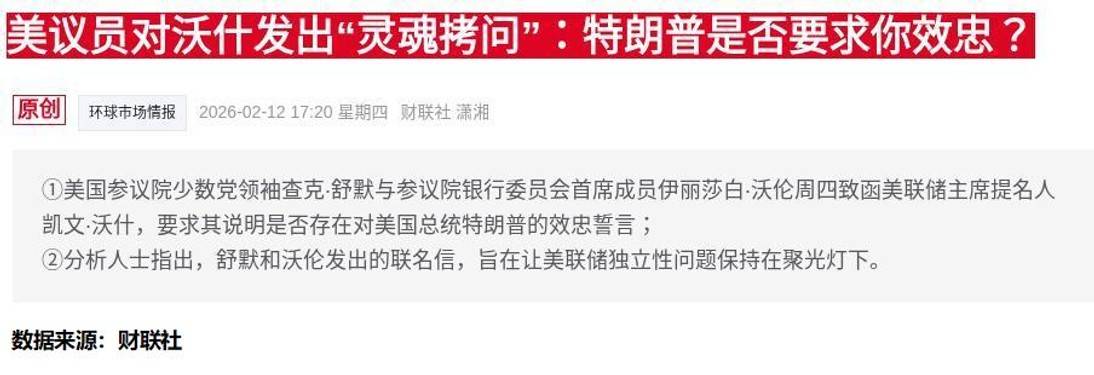
美联储迎来灵魂拷问,数据拆解涨跌逻辑
Sou Hu Cai Jing· 2026-02-13 09:05
Group 1 - The article discusses the emotional traps investors face when reacting to news, particularly regarding the Federal Reserve's nominations and the subsequent market reactions [1][3] - It highlights the tendency of investors to make impulsive decisions based on market fluctuations driven by news and emotions, often leading to buying high and selling low [1][3] - The piece emphasizes the importance of quantitative data in understanding market behavior, suggesting that it can help investors see beyond surface-level price movements to the underlying trading actions [5][9] Group 2 - Quantitative data can reveal the true nature of market movements, distinguishing between genuine market reactions and those artificially created to disrupt investor behavior [5][7] - The article illustrates how different stocks can appear to be reacting similarly to market events, but their underlying trading dynamics can be vastly different, affecting future performance [7][9] - It advocates for a shift from emotion-driven investment decisions to a data-driven approach, which can provide clearer insights into market trends and participant behaviors [11][12]

英国央行拟引入第三方机构 为私募市场压力测试数据收集“提速”
Xin Lang Cai Jing· 2026-02-13 09:02
格隆汇2月13日|知情人士称,部分私募市场巨头正与英国央行商讨引入第三方机构参与其开创性的行 业压力测试数据收集工作,以确保该项目能够满足严苛的时间表。此项测试旨在探究一场严重但可能发 生的全球衰退将如何影响数万亿美元的非上市资产——这些资产在全球金融生态系统中占据着迅速扩张 的版图。两位知情人士称,部分规模最大的机构对其他参与者能否快速提供高质量数据,以及这对汇总 结果可能产生的影响心存疑虑。其中一位人士表示,第三方机构可协助那些需要额外支持的公司收集数 据,并帮助项目按计划推进。另类投资管理公司需在3月16日前提交首批数据。 ...
TMGM外汇平台:意大利10年期国债收益率创近两月新低
Sou Hu Cai Jing· 2026-02-13 08:53
Core Viewpoint - The yield on Italy's 10-year BTP has decreased to 3.38%, marking the lowest level since November 12, driven by market expectations regarding global central bank monetary policies influenced by U.S. economic data and European Central Bank (ECB) signals [1][3]. Group 1: U.S. Economic Data Impact - The recent U.S. employment data exceeded market expectations, reducing investor anticipation for a Federal Reserve rate cut [3]. - A strong job market highlights the resilience of the U.S. economy, suggesting that a rate cut is unnecessary, which in turn affects global capital flows and Italian bond prices [3]. Group 2: European Central Bank Policy - Investors are assessing the ECB's stance on the recent appreciation of the euro, with the ECB showing confidence and not expressing significant concerns, stabilizing market expectations [3]. - ECB President Christine Lagarde stated that the inflation outlook for the Eurozone is in a "good state," further alleviating concerns about the euro's strength and reducing market uncertainty [3]. Group 3: Market Predictions - The probability of the ECB cutting rates before December is only 30%, with the market generally expecting the current policy stance to be maintained in the short term [4]. - The decline in Italy's 10-year BTP yield reflects a rational response to global central bank policy signals, with upcoming U.S. CPI data and ECB policy developments expected to continue influencing yield trends [4].

宏观经济周报:海外非农增长,国内通胀回升-20260213
BOHAI SECURITIES· 2026-02-13 08:51
Group 1: U.S. Economic Overview - U.S. retail sales unexpectedly stagnated in December 2025, with the control group retail sales showing a negative month-on-month growth, indicating high living costs suppressing consumption among low- and middle-income groups[1] - Non-farm employment rebounded unexpectedly, reversing the weak trend seen at the end of 2025, with private sector jobs supported mainly by education and healthcare, while financial and information sectors continued to decline due to AI substitution effects[1] - The unemployment rate decreased despite an increase in labor participation rate, with a slight rise in hourly wage growth, although the overall employment data may still be overestimated[1] Group 2: Domestic Economic Conditions - In January, the Consumer Price Index (CPI) month-on-month growth remained flat, with food prices slowing down but pork prices turning positive; core CPI continued to rise due to the upcoming Spring Festival[3] - Producer Price Index (PPI) showed an upward trend, with price changes in crude oil and non-ferrous metals causing a divergence in PPI growth across industries, while "anti-involution" policies positively impacted sectors like photovoltaics and lithium batteries[3] - Real estate transactions remained at a low point, with wholesale agricultural prices declining, and prices for steel and cement slightly decreasing, while upstream prices for coking coal and coking fell, and prices for non-ferrous metals and gold generally declined[3]
美国务卿:美元已不是全球储备货币,多国正寻找美元替代品
Sou Hu Cai Jing· 2026-02-13 08:49
Core Viewpoint - The U.S. Secretary of State Rubio revealed that nearly half of the countries no longer view the U.S. dollar as the global reserve currency, marking a significant acknowledgment from the U.S. government about the declining status of the dollar [1][3] Group 1: Dollar's Declining Status - A majority of countries have stopped holding dollar assets as reserve currencies, indicating a shift in global financial dynamics [3] - The total U.S. national debt has surpassed $38 trillion, with annual interest payments exceeding $1.3 trillion, raising concerns about the sustainability of the dollar [5] - The weaponization of the dollar and fluctuating U.S. policies have created unease among global central banks, complicating the dollar's role in international trade [5] Group 2: Shift in Asset Preferences - Central banks are increasingly diversifying their reserves to avoid reliance on U.S. debt, with countries like China strategically reducing their holdings of U.S. Treasury bonds [7] - If confidence in the dollar wanes, funds will seek new safe havens, with gold being one option, though its limitations prevent it from fully replacing the dollar [9] - The euro is seen as a potential successor to the dollar, but internal complexities within the Eurozone raise concerns among investors [9] Group 3: Future of Currency Dynamics - The current trend of de-dollarization is more about reserve diversification rather than a revolutionary shift away from the dollar [11] - The U.S. government is taking measures to stabilize the dollar's position by seeking control over key resources, such as oil in Venezuela and rare earth elements in Greenland [13] - China's efforts to internationalize the renminbi are progressing, particularly in cross-border transactions and commodity pricing, positioning it as a reliable alternative in specific trade areas [13]