公用事业

Search documents
【26日资金路线图】银行等行业实现净流入 龙虎榜机构抢筹多股
证券时报· 2025-09-26 12:54
Market Overview - The A-share market experienced an overall decline on September 26, with the Shanghai Composite Index closing at 3828.11 points, down 0.65%, the Shenzhen Component Index at 13209 points, down 1.76%, and the ChiNext Index at 3151.53 points, down 2.6% [1] - The total trading volume for both markets was 21,468.85 billion yuan, a decrease of 2,242.05 billion yuan compared to the previous trading day [1] Capital Flow - The net outflow of main funds from the Shanghai and Shenzhen markets exceeded 700 billion yuan, with an opening net outflow of 234.4 billion yuan and a closing net outflow of 113.03 billion yuan, totaling 701.87 billion yuan for the day [2] - In the last five trading days, the main funds showed a consistent trend of outflow, with the largest outflow recorded on September 23 at 761.67 billion yuan [3] Sector Performance - The ChiNext saw a significant net outflow of 326.76 billion yuan, while the CSI 300 index experienced a net outflow of 197.33 billion yuan [4] - Over the last five trading days, the electronic sector faced the largest net outflow of 279.58 billion yuan, followed by the computer sector with 245.82 billion yuan [5] Industry Insights - Certain industries, such as banking, real estate, and oil and petrochemicals, saw net inflows, with banking receiving 26.54 billion yuan and real estate 10.80 billion yuan [6] - Conversely, the electronic and computer sectors faced significant outflows, indicating a shift in investor sentiment [6] Institutional Activity - Institutions showed notable buying activity in specific stocks, with the highest net purchases recorded in Zhongdian Xindong at 97.06 million yuan and Huazi Technology at 80.89 million yuan [9] - The report also highlighted stocks that institutions are currently focusing on, with several companies receiving "buy" ratings from various securities firms [11]


公用事业行业资金流出榜:大众公用、露笑科技等净流出资金居前
Zheng Quan Shi Bao Wang· 2025-09-26 10:03
Market Overview - The Shanghai Composite Index fell by 0.65% on September 26, with 10 industries experiencing gains, led by the oil and petrochemical sector with a rise of 1.17% and the environmental sector up by 0.38% [1] - The utilities sector ranked third in terms of daily gains, while the computer and electronics sectors faced the largest declines, down 3.26% and 2.75% respectively [1] Capital Flow Analysis - The main capital outflow from the two markets totaled 83.579 billion yuan, with five industries seeing net inflows. The automotive sector led with a net inflow of 0.882 billion yuan despite a decline of 0.56% [1] - The banking sector also saw a slight increase of 0.08% with a net inflow of 0.0566 billion yuan [1] - A total of 26 industries experienced net capital outflows, with the electronics sector leading at a net outflow of 29.836 billion yuan, followed by the computer sector with a net outflow of 13.807 billion yuan [1] Utilities Sector Performance - The utilities sector rose by 0.35% with a net capital outflow of 0.317 billion yuan. Out of 131 stocks in this sector, 80 saw gains, including 2 hitting the daily limit, while 45 declined, with 2 hitting the lower limit [2] - Among the stocks with net capital inflows, Shanghai Electric led with a net inflow of 0.270 billion yuan, followed by Changjiang Electric and Shimao Energy with inflows of 84.043 million yuan and 38.960 million yuan respectively [2] - The stocks with the largest capital outflows included Dazhong Public Utilities with a decline of 9.97% and a net outflow of 173.835 million yuan, followed by Luxin Technology and Tianfu Energy with outflows of 98.760 million yuan and 65.848 million yuan respectively [3]




首提降碳目标,展现大国担当
HTSC· 2025-09-26 09:46
Investment Rating - The report maintains an "Overweight" rating for the Electric Equipment and New Energy sector and the Public Utilities sector [1][4]. Core Views - The report highlights China's new carbon reduction targets announced by President Xi Jinping, aiming for a 7%-10% reduction in greenhouse gas emissions by 2035, with non-fossil energy consumption exceeding 30% of total energy consumption [8][10]. - The transition from the "peak" phase to the "decline" phase in carbon emissions is emphasized, indicating a clear path towards carbon neutrality [8][10]. - The report identifies key beneficiaries in the energy transition, including leaders in the energy storage industry and companies like Sany Heavy Energy and Guodian NARI [8][11]. Summary by Sections Investment Recommendations - Sany Heavy Energy (688349 CH) is rated "Buy" with a target price of 38.01 CNY, reflecting a significant growth potential [4][15]. - Guodian NARI (600406 CH) is also rated "Buy" with a target price of 26.00 CNY, supported by its strong market position in secondary equipment [4][15]. Market Outlook - The report anticipates that by 2030, the cost parity of solar and storage will unlock new capacity for renewable energy installations, with a projected increase in installed capacity to 6,816 GW by 2035 [12][14]. - The need for a higher electrification rate and increased green energy proportion is highlighted to meet the carbon reduction targets without sacrificing energy consumption [11][12]. Company Performance - Sany Heavy Energy reported a revenue of 8.594 billion CNY for H1 2025, a year-on-year increase of 62.75%, with a significant improvement in profitability expected due to higher-margin product sales [16][17]. - Guodian NARI achieved a revenue of 15.348 billion CNY in Q2 2025, reflecting a year-on-year growth of 22.50%, indicating robust demand in the new power system construction [17][18].


美联储降息后最大受益者出现了!黄金股市疯涨,基金圈将彻底变天
Sou Hu Cai Jing· 2025-09-26 06:25
Market Overview - The recent market has seen significant gains, with gold rising over 35% and the stock market increasing by 14%, while the dollar index has dropped by 9.3% and crude oil has fallen by 11.4% [1] - The current market rally is attributed not only to the Federal Reserve's interest rate cuts but also to reductions in tariffs and taxes, indicating potential market bubbles [1] Historical Context - Historical data shows that since 1900, the average increase in stock market bubbles from low to peak is 244%, with current market conditions suggesting there may still be room for growth [3] - The "Seven Giants" have seen a 223% increase since March of the previous year, with a dynamic price-to-earnings ratio of 39 times, indicating that the current rally may not be over yet [3] Investment Strategies - Focus on core assets is recommended, as returns during bubble periods tend to be concentrated in specific sectors rather than widespread [6] - A "barbell strategy" is suggested, where investors hold both high-risk bubble assets for potential gains and undervalued value stocks for stability [7] - Global markets such as Brazil and the UK are highlighted for their attractive price-to-earnings ratios, suggesting opportunities beyond popular stocks [8] Bond Market Insights - Monitoring corporate bonds is crucial, as they often react more sensitively to underlying company fundamentals compared to stocks [9] - Historical patterns indicate that rising interest rates typically lead to falling bond prices, suggesting a strategy of shorting bonds in anticipation of rate hikes [10] Sector Focus - Industries that may be affected by inflation, such as large pharmaceuticals and energy companies, should be monitored closely for potential risks [12] - The depreciation of the dollar is seen as beneficial for international markets, with signs of a positive correlation between the yen and Japanese stocks, indicating potential investment opportunities [12]
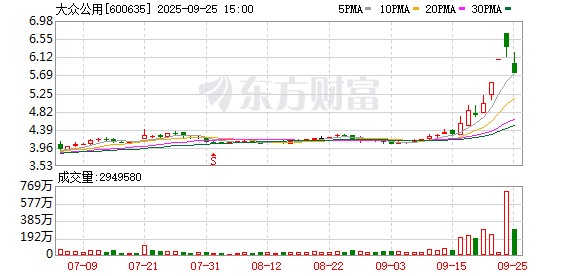
大众公用跌停,沪股通龙虎榜上净卖出2529.66万元
Zheng Quan Shi Bao Wang· 2025-09-25 10:26
具体来看,今日上榜的营业部中,沪股通为第四大卖出营业部,卖出金额为2529.66万元,合计净卖出 2529.66万元。 资金流向方面,今日该股主力资金净流出2.37亿元,其中,特大单净流出2.92亿元,大单资金净流入 5453.12万元。近5日主力资金净流出4.49亿元。 融资融券数据显示,该股最新(9月24日)两融余额为7.76亿元,其中,融资余额为7.72亿元,融券余额 为393.32万元。近5日融资余额合计增加2.13亿元,增幅为38.10%。融券余额合计增加116.58万元,增幅 42.13%。 大众公用(600635)今日跌停,全天换手率12.19%,成交额17.32亿元,振幅9.09%。龙虎榜数据显示,沪 股通净卖出2529.66万元,营业部席位合计净卖出69.58万元。 上交所公开信息显示,当日该股因日跌幅偏离值达-9.91%上榜,沪股通净卖出2529.66万元。 证券时报·数据宝统计显示,上榜的前五大买卖营业部合计成交3.34亿元,其中,买入成交额为1.54亿 元,卖出成交额为1.80亿元,合计净卖出2599.23万元。 8月30日公司发布的半年报数据显示,上半年公司共实现营业收入34.76亿 ...
创业板公司前三季业绩抢先看 5家预增
Zheng Quan Shi Bao Wang· 2025-09-25 02:08
Core Viewpoint - Five companies listed on the ChiNext board have announced their performance forecasts for the first three quarters, all indicating an increase in profits [1] Group 1: Company Performance Forecasts - Changchuan Technology (300604) expects a net profit increase of 138.39% with a latest closing price of 96.32 yuan and a year-to-date increase of 118.75% [1] - Zhongtai Co., Ltd. (300435) anticipates a net profit increase of 79.28%, with a latest closing price of 21.85 yuan and a year-to-date increase of 83.52% [1] - N United (301656) forecasts a net profit increase of 44.16% [1] - N Jianda (301584) projects a net profit increase of 35.00% [1] - Aifen Dazhi (301575) expects a net profit increase of 14.72%, with a latest closing price of 55.40 yuan and a year-to-date decrease of 25.91% [1] Group 2: Industry Insights - The companies span various industries, including electronics, public utilities, automotive, pharmaceuticals, and light manufacturing [1]



Vistra Corp. (VST)’s CEO James A. Burke Discloses Stock Sales Worth $9.1 Million
Yahoo Finance· 2025-09-25 00:39
Group 1 - Vistra Corp. is recognized as one of the 11 Best Nuclear Energy Stocks to invest in, highlighting its significant upside potential [1] - CEO James A. Burke disclosed stock sales worth $9.1 million on September 16-17, 2025, coinciding with the exercise of 48,000 stock options at prices of $14.03 and $19.68 per share [2] - The average transaction price for the stock sales was between $212.56 and $213.78 per share, slightly below the 52-week high of $217.90, while Burke retains over 227,000 shares directly and has substantial indirect holdings [2] Group 2 - Vistra Corp. operates approximately 41,000 megawatts of capacity across various energy sources, including nuclear, gas, coal, solar, and battery storage, serving around 5 million customers in the US [3] - The company's diverse portfolio and strong performance contribute to its status as a top contender among nuclear energy stocks and as one of the Best Utility Stocks [3]

大众公用换手率29.54%,沪股通净卖出7869.12万元
Zheng Quan Shi Bao Wang· 2025-09-24 13:50
Group 1 - The stock of Dazhong Public Utilities (600635) increased by 4.79% with a turnover rate of 29.54% and a trading volume of 4.682 billion yuan, showing a fluctuation of 8.99% [1] - The stock was listed on the Shanghai Stock Exchange due to its turnover rate reaching 29.54%, with a net sell of 78.6912 million yuan from the Shanghai-Hong Kong Stock Connect [1] - The top five trading departments accounted for a total transaction of 565 million yuan, with a net sell of 58.4606 million yuan [1] Group 2 - The stock experienced a net outflow of 720 million yuan from major funds, including a net outflow of 443 million yuan from large orders [2] - The latest margin trading balance as of September 23 was 589 million yuan, with a financing balance of 585 million yuan and a securities lending balance of 4.1269 million yuan [2] - The company reported a revenue of 3.476 billion yuan for the first half of the year, a year-on-year decrease of 5.80%, while net profit increased by 172.62% to 333 million yuan [2]
大众公用换手率29.54%,沪股通净卖出7869.12万元
Zheng Quan Shi Bao· 2025-09-24 13:47
大众公用(600635)今日上涨4.79%,全天换手率29.54%,成交额46.82亿元,振幅8.99%。龙虎榜数据显 示,沪股通净卖出7869.12万元,营业部席位合计净买入2023.06万元。 上交所公开信息显示,当日该股因日换手率达29.54%上榜,沪股通净卖出7869.12万元。 买四 天风证券股份有限公司杭州教工路证券营业部 4993.29 资金流向方面,今日该股主力资金净流出7.20亿元,其中,特大单净流出4.43亿元,大单资金净流出 2.77亿元。近5日主力资金净流出2.04亿元。 融资融券数据显示,该股最新(9月23日)两融余额为5.89亿元,其中,融资余额为5.85亿元,融券余额为 412.69万元。近5日融资余额合计增加4652.70万元,增幅为8.64%。融券余额合计增加140.51万元,增幅 51.62%。 8月30日公司发布的半年报数据显示,上半年公司共实现营业收入34.76亿元,同比下降5.80%,实现净 利润3.33亿元,同比增长172.62%。 大众公用9月24日交易公开信息 买/卖会员营业部名称买入金额(万元)卖出金额(万元) 买一 平安证券股份有限公司深圳分公司 5491. ...
【24日资金路线图】沪深300主力资金净流入超80亿元 电子等多个行业实现净流入
证券时报· 2025-09-24 12:50
Market Overview - The market experienced a rebound on September 24, with the Shanghai Composite Index rising by 0.83%, the Shenzhen Component Index increasing by 1.8%, the ChiNext Index up by 2.28%, and the STAR Market 50 Index gaining 3.49%. The total trading volume in A-shares was 2.35 trillion yuan, down from 2.52 trillion yuan the previous day [1]. Capital Flow - The net outflow of main funds in the Shanghai and Shenzhen markets was nearly 300 million yuan, with an opening net outflow of 134.19 billion yuan and a closing net inflow of 56.63 billion yuan, resulting in a total net outflow of 2.79 billion yuan for the day [2][3]. - The CSI 300 index saw a net inflow of 80.87 billion yuan, while the ChiNext experienced a net inflow of 44.33 billion yuan [4][5]. Sector Performance - The electronics sector led with a net inflow of 267.72 billion yuan and a growth of 2.74%, followed by the computer sector with a net inflow of 207.10 billion yuan and a growth of 2.35%. Other notable sectors included power equipment and pharmaceuticals [6]. Institutional Activity - The top stocks with significant institutional buying included Huicheng Co. with a 15.84% increase and a net buying amount of 15,173.86 million yuan, followed by Northern Huachuang with a 10.00% increase and a net buying amount of 14,288.91 million yuan [8]. - Institutions have recently focused on stocks such as Baili Tianheng, Yifeng Pharmacy, and Dongcai Technology, with target price increases ranging from 15.83% to 51.19% [10].