脑机接口

Search documents
七大未来产业吸金近700亿,筑基“十五五”新增长极
Huan Qiu Wang· 2025-12-29 08:59
Group 1 - The global technology competition is intensifying, with disruptive technologies at the core of the "future industries" becoming a prominent part of China's economic landscape, as highlighted in the "14th Five-Year Plan" [1][2] - The total financing in related fields has approached 70 billion yuan this year, with specific sectors like nuclear fusion and 6G seeing index increases of over 80% [1][4] - The future industries are transitioning from "concept validation" to "commercialization," becoming a leading force in driving economic and social transformation [1] Group 2 - The "14th Five-Year Plan" outlines a clear blueprint for future industries, focusing on seven key areas including quantum technology, biomanufacturing, hydrogen energy, nuclear fusion, brain-computer interfaces, embodied intelligence, and 6G [2] - Local governments are actively responding with supportive policies, such as Beijing's "Create the Future" initiative, which has supported 83 potential enterprises and facilitated over 2 billion yuan in financing [2] - Various cities like Shenzhen and Shanghai are implementing financial measures to support high-quality development in future industries, establishing a solid foundation for growth [2] Group 3 - The capital market's enthusiasm for future industries is evident, with IPOs and refinancing processes accelerating significantly, totaling nearly 70 billion yuan as of December 26, 2025 [4] - Notable fundraising includes 14 billion yuan from China Nuclear Power in the nuclear fusion sector and over 8 billion yuan from companies in the embodied intelligence sector [4] - The overall profitability of future industries is expected to improve, with a median net profit forecast of over 650 billion yuan for 381 companies in 2025, reflecting a year-on-year increase of over 20% [5] Group 4 - Market funds are actively seeking undervalued potential stocks, with over 40 companies showing a decrease in shareholder numbers, indicating a concentration of shares [6] - Companies like Fuzhijun Technology and Zhongyuan Neipei have seen significant reductions in shareholder numbers, suggesting increased market attention [6] - Some companies, despite underperforming in the market, are positioned in sectors like embodied intelligence and quantum technology, presenting potential investment opportunities [6]




A股收评 | 年内新纪录!沪指走出九连阳 商业航天概念热度不减
智通财经网· 2025-12-29 07:26
Market Overview - The Shanghai Composite Index closed up 0.04% at 3965.28 points, marking a nine-day winning streak, a new record for the year [1] - The market saw a total turnover of 2.1 trillion yuan, with over 3300 stocks declining [1] - Gold prices fell below 4500 yuan, and silver and palladium also saw significant declines, impacting related stocks [1] Sector Performance - The commercial aerospace sector remained strong, with stocks like Shenjian Co. and China Satellite achieving consecutive gains [1] - The oil and gas sector showed robust performance, with stocks such as Intercontinental Oil and Heshun Petroleum hitting the daily limit [1] - The battery, photovoltaic equipment, and industrial metals sectors attracted significant capital inflow, with leading stocks including Sunshine Power and BYD [2] Policy and Economic Developments - The People's Bank of China announced a digital yuan action plan, set to officially launch on January 1, 2026 [3] - The Ministry of Agriculture emphasized the need to cultivate leading agricultural technology enterprises to enhance innovation capabilities [4] Monetary Policy - The People's Bank of China conducted a 7-day reverse repurchase operation of 482.3 billion yuan, resulting in a net injection of 415 billion yuan [5] - Analysts from CITIC Securities predict that the market's year-end rally has begun, driven by optimistic institutional investor sentiment and favorable policy expectations [5] Market Sentiment and Predictions - Guosheng Securities suggests that the market is still in a phase of adjustment, with several indices showing signs of potential declines [6] - Huatai Securities indicates that while the overseas environment has improved, the A-share market may continue to experience volatility in the short term, with a focus on sectors like batteries and chemicals for potential gains [8]
A股收评:沪指微涨0.04%录得九连阳、创业板指跌0.49%,机器人及商业航天概念股走高,锂矿、医药商业板块表现疲软
Jin Rong Jie· 2025-12-29 07:11
Market Overview - The A-share market experienced fluctuations, with the Shanghai Composite Index closing up 0.04% at 3965.28 points, marking a nine-day rise, while the Shenzhen Component Index fell 0.49% to 13537.1 points, and the ChiNext Index dropped 0.66% to 3222.61 points. The total trading volume in both markets reached 2.14 trillion yuan, with over 3300 stocks declining [1] Hot Sectors - The commercial aerospace sector continued to show strength, with over ten stocks hitting the daily limit, including Shenjian Co. with eight consecutive limit-ups. The recent announcement from the Shanghai Stock Exchange regarding new listing rules for commercial rockets is expected to drive demand in related industries such as satellite manufacturing and ground equipment [2] - The brain-computer interface sector saw significant gains, with stocks like Haige Communication and Xilinmen hitting the daily limit. This surge followed the opening of the Fifth Frontier Brain Science and Industry Conference, which launched the "Guangdong-Hong Kong-Macao Greater Bay Area Brain Science and Central Nervous System Disease AI Innovation Alliance" [3] - The carbon fiber sector experienced a rally, with stocks like Heshun Technology and Jilin Chemical Fiber hitting the daily limit. This was influenced by Toray's announcement of a price increase for its carbon fiber products, expected to improve market conditions [4] - The robotics sector remained active, with stocks such as Awat New Materials and Buke Co. hitting the daily limit and reaching historical highs. The establishment of a humanoid robot standardization committee is anticipated to drive growth in specialized robotics [5] Institutional Insights - CITIC Securities noted that a year-end market rally has begun, driven by optimistic expectations among institutional investors, improved overseas liquidity, and a series of policy announcements. Key sectors to watch include non-ferrous metals and AI computing power, with commercial aerospace remaining the primary focus [6] - Guosheng Securities suggested that the market is likely to confirm its direction before the holiday, despite ongoing adjustments. They highlighted the potential for a mid-term reversal in various sectors [8] - Huatai Securities indicated that while the overseas environment has improved, the A-share market may still experience volatility in the short term due to a lack of cohesive funding and ongoing policy uncertainties. They recommend focusing on sectors with improving fundamentals, such as batteries and certain chemicals [9]



收评:沪指微涨0.04%录得九连阳,商业航天板块持续爆发
Xin Lang Cai Jing· 2025-12-29 07:04
A股三大指数今日涨跌不一,截至收盘,沪指涨0.04%,深成指跌0.49%,创业板指跌0.66%,北证50指 数跌0.45%,沪深京三市成交额21577亿元,较上日缩量234亿元。三市超3300只个股下跌。板块题材 上,碳纤维、脑机接口、多元金融、商业航天、人形机器人、光伏设备板块涨幅居前;医药商业、能源 金属、电池、食品饮料、化工板块跌幅居前。盘面上,商业航天产业链延续强势,神剑股份8连板,大 业股份4连板,泰尔股份3连板,苏州高新、中超控股、航天发展2连板。脑机接口板块表现活跃,三博 脑科、翔宇医疗、创新医疗涨幅居前。跨境支付、数字货币概念股同样表现积极,拉卡拉大涨10%。翠 微股份、四方精创领涨。此外,人形机器人、碳纤维、光伏设备等多个板块盘中轮动。另一方面,能源 金属板块午后下挫,盛新锂能、天齐锂业、赣锋锂业纷纷下跌。食品饮料板块集体走弱,妙可蓝多盘中 跌停,皇氏集团、南侨食品、西部牧业跟跌。 ...
【申万宏源策略】周度研究成果(12.22-12.28)
申万宏源研究· 2025-12-29 07:03
Key Points - The article emphasizes the importance of systematic and practical strategies in investment analysis [2] - It discusses the favorable conditions for the spring market rally, including liquidity support and upcoming events that may influence market sentiment [8] - The article provides a detailed valuation comparison of various A-share indices, highlighting their current price-to-earnings (PE) and price-to-book (PB) ratios relative to historical percentiles [11][13] - It identifies specific industry sectors with high valuations, such as real estate and electronics, which are above the 85th percentile historically [11] - The article outlines investment themes for the upcoming year, including quantum technology, hydrogen energy, and brain-machine interfaces, indicating potential growth areas [16][18] - A strategic outlook for gold in 2026 is presented, focusing on the implications of the U.S. fiscal deficit and the trend of de-dollarization on gold prices [19]

医药行业周报(25/12/22-25/12/26):2026年行业催化密集,重点关注脑机接口机会-20251229
Hua Yuan Zheng Quan· 2025-12-29 06:00
Investment Rating - The investment rating for the pharmaceutical industry is "Positive" (maintained) [4] Core Insights - The report emphasizes the potential of brain-computer interface (BCI) technology and AI medical applications, predicting significant developments in 2026. It suggests focusing on innovative drug stocks and medical technology themes, particularly in the context of an aging population and the recovery of consumer spending in healthcare [3][5][42]. Summary by Sections 1. Policy Catalysts and BCI Application Potential - The brain-computer interface (BCI) technology is highlighted as a key area of growth, with the market expected to reach approximately $2.62 billion by 2024 and grow to $12.4 billion by 2034, reflecting a compound annual growth rate (CAGR) of 17.4% from 2025 to 2034 [12][18]. - The medical sector is projected to account for about 46% of the BCI application market in 2024, focusing on areas such as neurological rehabilitation and sensory diagnostics [13][18]. 2. Industry Perspective: Innovation and Global Expansion - The pharmaceutical index has shown a decline of 0.18% from December 22 to December 26, 2025, with a year-to-date increase of 14.29%. The report notes a significant number of stocks experiencing both gains and losses during this period [25][30]. - The report identifies key stocks to watch, including innovative drug companies and those involved in the BCI and AI medical sectors, suggesting a focus on companies like Heng Rui Medicine, Zai Lab, and others [42][45]. 3. Investment Opportunities - The report suggests that the pharmaceutical industry has completed a transition from old to new growth drivers, with innovative drugs leading the way. It highlights the increasing global competitiveness of Chinese pharmaceutical companies and their growing capabilities in international markets [41][42]. - Specific recommendations include focusing on innovative drugs, medical devices, and companies involved in the BCI sector, with a particular emphasis on those with strong fundamentals and potential for recovery in 2026 [42][44].





【掘金板块牛熊】机器人再迎利好 背后受益板块浮出水面!
第一财经· 2025-12-29 05:25
Group 1 - The article highlights the strong performance of PEEK material concept stocks, with Hengbo Co., Ltd. hitting the daily limit up, and other companies like Chaojie Co., Ltd., Guangwei Composite Materials, Nanjing Julong, Huami New Materials, Shuangyi Technology, and Fuheng New Materials also experiencing gains [1] - The brain-computer interface concept is showing a strong upward trend, with Xiangyu Medical rising over 10%, and other companies such as Beiyikang, Innovation Medical, Sanbo Brain Science, Meihao Medical, and Botuo Biology following suit, indicating a potential for significant growth in this sector [1] - The lithium battery sector is experiencing a downturn, with lithium mines and electrolyte directions leading the decline, as companies like Xinwangda and Hongyuan Pharmaceutical fell over 10%, while Duofluo, Tianhua New Energy, Dazhong Mining, Haike New Source, and Qingshuiyuan all dropped over 7% [1]
今天,A股有望破纪录!
天天基金网· 2025-12-29 05:23
Core Viewpoint - The A-share market is experiencing two significant trends: the strong performance of the commercial aerospace sector and the continuous rise of the Shanghai Composite Index, which is on track to break its previous record of consecutive daily gains [2][3]. Group 1: Commercial Aerospace Sector - The commercial aerospace sector is driving market enthusiasm, leading to a ripple effect across various sectors such as diversified finance, carbon fiber, gas, and wind power equipment [2][3]. - The Shanghai Stock Exchange has introduced guidelines to support high-quality commercial rocket companies in meeting the listing standards of the Sci-Tech Innovation Board, which is expected to accelerate the development of the commercial aerospace industry [5]. - The rapid growth of the commercial aerospace industry is projected to create significant market opportunities for carbon fiber composite materials, which can account for 70%-90% of the structural weight in spacecraft [6]. Group 2: Market Performance - As of December 26, the Shanghai Composite Index rose by 0.31% to 3975.92, marking a potential ninth consecutive day of gains, surpassing the previous record of eight consecutive days [3]. - The Shenzhen Component Index and the ChiNext Index showed mixed performance, with the former up by 0.03% and the latter down by 0.32% [3]. - Various sectors, including diversified finance and carbon fiber, saw significant gains, with specific stocks like Lushin Investment and Guangwei Composite Materials experiencing notable increases [4][5][6]. Group 3: Brain-Computer Interface Sector - The brain-computer interface sector is witnessing substantial growth, with stocks like Macland and Sanbo Brain Science showing significant increases [10]. - The National Medical Products Administration has released a list of high-end medical devices for priority approval, which includes implantable brain-computer interface medical devices, indicating a supportive regulatory environment for this sector [11]. - The global brain-computer interface market is projected to exceed $10 billion by 2030, with significant growth expected in the medical application sector [12].

首次实现公开赛事“意念落子” 脑电大模型助力人机交互新突破
Xin Hua Cai Jing· 2025-12-29 04:57
新华财经上海12月29日电(王骋)12月29日,在海南举行的"天天象棋杯"中国象棋协会年度总决赛现 场,一场特殊的对弈吸引了全场目光。重庆脑瘫棋手韩彬彬佩戴着轻巧的头部设备,凝视棋盘,仅 凭"意念"驱动,与他的偶像、象棋特级大师孟辰展开对局,成功运用非侵入式脑机接口技术竞技对战。 "鼻尖"到"意念",一位棋手的圆梦时刻 在赛事现场,仅靠一套普通的非侵入式脑机接口,大脑视觉皮层产生的微弱电信号经由算法精准实时解 码,最终实现棋子操控。 赛事主办方"天天象棋"制作人黄世兴表示,"从帮助色弱群体的'色彩增强模式',到服务全盲人士的'无 障碍版',再到今天助力行动不便者'意念下棋',赛事将继续探索科技普惠实践。" 从赛场到大众日常,脑机接口普惠未来 赛场之外,该脑电大模型目前已在多个领域展现出潜力:在医疗辅助场景,该模型在28项非侵入脑电疾 病筛查实验中表现优于传统算法;在交互娱乐领域,已实现97%的操作精度、低于60毫秒刷新率及超过 10个自由度的脑控体验,可流畅操控3A游戏;在辅助生活方面,远程精细脑控机械狗等技术为行动不 便者提供了新的可能性;在智能家居领域,非侵入式脑机也能成为房间的万能钥匙…… 韩彬彬是一位 ...
午评:港股恒指涨0.26% 科指涨1.6% 科网股普涨 汽车股走强 蔚来涨超6%
Xin Lang Cai Jing· 2025-12-29 04:03
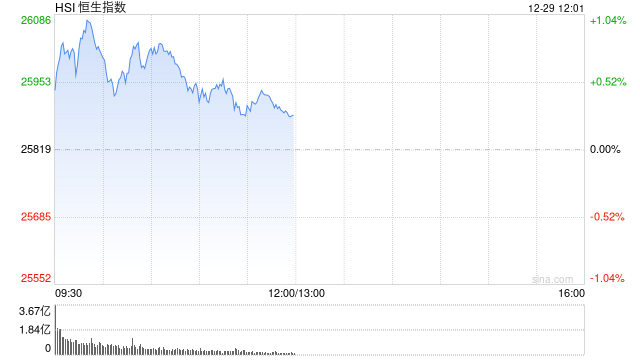
12月29日消息,港股三大指数集体上涨。截至午间收盘,恒生指数涨0.26%,报25886.75点,恒生科技 指数涨1.60%,国企指数涨0.77%。盘面上,科网股普涨,网易、美团涨超2%,百度、联想、快手、哔 哩哔哩涨超1%;汽车股走强,蔚来涨超6%;脑机接口概念普涨,心玮医疗涨超10%;纸业股涨幅居 前,玖龙纸业涨超4%。 | 名称 | | 最新价 | 涨跌幅 √ | | --- | --- | --- | --- | | 但生科技指数 | NY | 5587.24 | +1.60% | | 800700 | | | | | 国企指数 | ี | 8983.59 | +0.77% | | 800100 | | | | | 恒生指数 | 200 | 25886.75 | +0.26% | | 800000 | | | | 汽车股走强,蔚来涨超6%。方正证券发布研报称,中央经济工作会议及财政部明确优化"两新"政策, 多地遴选以旧换新平台企业。据媒体披露,2026年国补将延续,单车最高补3万元,聚焦淘汰老旧高排 放车辆,同时提升新能源补贴与混动车型纯电续航门槛。 脑机接口概念普涨,心玮医疗涨超10%。光大证券发布 ...