保险

Search documents
7家险企抱团参与股权投资,新公司注册资本86.01亿元
Mei Ri Jing Ji Xin Wen· 2026-02-26 12:06
Group 1 - The core viewpoint of the articles highlights the increasing involvement of insurance companies in private equity funds, driven by long-term capital investment policies and the need for asset allocation [1][4] - Tianjin Lanqin, a newly established private equity partnership, has a registered capital of 8.601 billion yuan and includes several major insurance firms as partners, indicating a strong collaborative effort in the private equity space [2][3] - The trend of insurance capital participating in private equity is not new, with previous collaborations such as the establishment of Beijing Baoshichengyuan Equity Investment Partnership, which raised 13 billion yuan, showcasing the benefits of risk sharing and increased investment capacity [3] Group 2 - The push for insurance capital to engage in private equity is supported by recent policy changes that encourage investment in equity assets, aiming to enhance the role of insurance funds in supporting the real economy [4] - Insurance funds are characterized as long-term institutional investors, and their collaboration with private equity funds can leverage professional investment capabilities while enhancing returns on insurance capital [4][5] - Future strategies for insurance capital in private equity will evolve to include secondary market transactions, cross-border investments, and ESG integration, aiming for a balance between high returns, risk diversification, and liquidity [5]



险资权益配置创新高,超六成险企今年要加仓
Di Yi Cai Jing· 2026-02-26 11:50
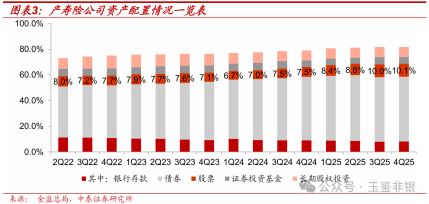
Core Viewpoint - The insurance capital is experiencing a significant increase in equity allocation, with a projected additional investment of approximately 713.3 billion yuan in 2026, driven by rising market valuations and a shift in asset allocation strategies [1][12]. Group 1: Insurance Capital Allocation - As of the end of 2025, the total investment balance of the insurance industry reached 38.5 trillion yuan, a year-on-year increase of 15.7%, marking the highest growth rate since 2021 [2]. - The allocation of core equity assets (stocks + securities investment funds) by insurance capital increased significantly by 1.6 trillion yuan to 5.7 trillion yuan, with stocks contributing 1.31 trillion yuan and funds 290 billion yuan [1][6]. - The proportion of equity allocation remains at a historical high, with over 60% of insurance institutions expressing intentions to moderately or slightly increase stock investments in 2026 [1][9]. Group 2: Investment Trends - The proportion of bank deposits in insurance capital allocation has decreased from nearly 12% in 2020 to 8.2% in 2025, while bond allocations have stabilized around 50.4% [3]. - The stock allocation ratio has increased for six consecutive quarters, indicating a strong upward trend in equity investments [5]. - By the end of 2025, the stock balance of insurance capital reached 3.7 trillion yuan, a year-on-year increase of 53.81%, with a stock allocation ratio of 10.1% [8]. Group 3: Future Outlook - A survey indicated that over 60% of insurance institutions plan to increase their stock allocations in 2026, with 40.54% of asset management institutions and 36.26% of insurance companies intending to slightly increase their stock investments [9]. - The insurance sector is optimistic about the A-share market, particularly in industries such as electronics, non-ferrous metals, and pharmaceuticals, with a focus on themes like semiconductor chips and AI capabilities [10]. - In terms of overseas investments, Hong Kong stocks are viewed as the most favorable option for 2026, with half of the asset management institutions planning to slightly increase their allocations [11].

哑铃策略还有效吗?香港大盘30ETF(520560)下探新低,最新解读来了
Xin Lang Cai Jing· 2026-02-26 11:44
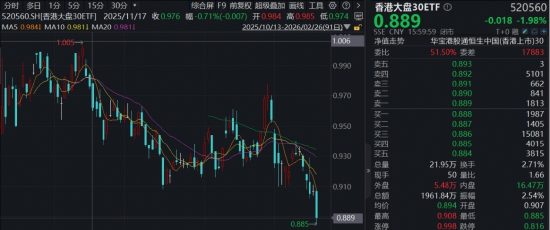
Market Overview - The Hong Kong stock market continued its recent downward trend, with the Hang Seng Index and Hang Seng Tech Index dropping by 1.44% and 2.87% respectively [1][9] - Major internet companies experienced significant declines, with Alibaba-W falling over 3%, Tencent Holdings and Meituan-W dropping over 2%, and Xiaomi Group-W decreasing by more than 1% [1][9] ETF Performance - The Hong Kong Large Cap 30 ETF (520560) closed down 1.98%, reaching a new low since its listing [1][10] - The ETF's underlying index, the Hang Seng China (Hong Kong Listed) 30 Index, has shown relative resilience, with a cumulative decline of 6.81%, which is less than the declines of the Hang Seng Tech Index (-10.65%) and the CSI Hong Kong Internet Index (-13.18%) during the same period [3][13] Investment Trends - Southbound capital has significantly increased its buying power since February, with net purchases exceeding 80 billion HKD, surpassing the total for January 2026 [3][12] - Notable increases in holdings were observed for Tencent Holdings and Alibaba-W, each gaining over 30 million shares, while Xiaomi Group-W and Meituan-W also saw substantial increases [3][12] Future Outlook - The long-term investment value in the technology and internet sectors is becoming more apparent following significant adjustments, supported by dividend assets [4][13] - According to Guangfa Securities, the ongoing decline in the Hong Kong market has released considerable emotional pressure, suggesting potential for recovery and capital inflow if positive catalysts emerge [4][13]
许正宇:将透过“促改革、增容量”等四大措施赋能 巩固香港国际金融中心优势
智通财经网· 2026-02-26 11:22
Core Viewpoint - The Hong Kong government aims to enhance its status as an international financial center through four main themes: "Promote Reform," "Expand Infrastructure," "Increase Capacity," and "Build Connectivity," aligning with the national "14th Five-Year Plan" to drive economic development [1]. Group 1: Promote Reform - The Hong Kong Stock Exchange (HKEX) has implemented measures to ensure market liquidity, generating approximately HKD 2.5 billion in stamp duty revenue during adverse weather conditions [2]. - HKEX plans to consult on revising listing requirements for companies with dual-class shares and facilitate secondary listings for overseas issuers [2]. - The Securities and Futures Commission (SFC) and HKEX will introduce a paperless securities market system and optimize the regulatory framework for listed companies [2]. Group 2: Expand Infrastructure - The Hong Kong Monetary Authority (HKMA) and HKEX are researching a one-stop multi-asset trading post-trade infrastructure to enhance collateral interoperability [4]. - The Central Moneymarkets Unit (CMU) aims to establish a digital asset platform by the end of the year to support the issuance and settlement of digital bonds [4]. - HKEX's comprehensive fund platform will expand its functionalities to include payment and settlement processes, improving market efficiency [4]. Group 3: Increase Capacity - The government has doubled the total quota for RMB business funding arrangements to RMB 200 billion [5]. - A third issuance of tokenized bonds amounting to HKD 10 billion has been completed, with plans for regular issuance and encouragement of more digital bond offerings [5]. - The asset and wealth management sector will benefit from optimized tax incentives, including the inclusion of digital assets and specific commodities as eligible investments for tax relief [5]. Group 4: Build Connectivity - The government supports the Asian Infrastructure Investment Bank (AIIB) in establishing an office in Hong Kong and will host the Asia-Pacific Economic Cooperation (APEC) Finance Ministers' Meeting [7]. - Hong Kong has signed 55 comprehensive double taxation agreements and will continue to expand its network of agreements [8].
长江养老、阳光人寿高管分工调整
Xin Lang Cai Jing· 2026-02-26 11:13
Group 1: Leadership Changes at Changjiang Pension and Sunshine Life - Changjiang Pension's General Manager Wang Haifeng has taken on the additional role of Chief Financial Officer, overseeing both operational and financial management [1][7] - Vice General Manager Chen Chen will no longer serve as CFO and will focus on core business areas [1][7] - Assistant General Manager Yan Tao has been removed from the executive team but will continue to lead the Alternative Investment Management Center [1][7] Group 2: Profiles of Key Executives - Wang Haifeng, born in March 1973, holds a doctoral degree and has previously worked at the People's Bank of China and the China Securities Regulatory Commission [1][7] - Chen Chen, born in January 1973, has a master's degree and has held various positions in financial institutions before joining Changjiang Pension [1][7] - Yan Tao, born in June 1975, has extensive experience in the financial sector and has held multiple roles within Changjiang Pension [2][7] Group 3: Overview of Changjiang Pension - Changjiang Pension is a subsidiary of China Pacific Insurance Group, established in May 2007, focusing on pension financial services [2][8] - The company manages over 1 trillion yuan in assets as of the end of 2023, positioning itself among the industry leaders [2][8] Group 4: Leadership Changes at Sunshine Life - Sunshine Life's General Manager Li Suoyi has also taken on the role of Chief Compliance Officer, while former compliance head Sun Yi is no longer part of the executive team [3][9] - Li Suoyi, born in 1969, has a background in industrial management and has held various managerial positions within the insurance sector [3][10] Group 5: Compliance Issues and Financial Performance at Sunshine Life - Sunshine Life has faced significant compliance challenges, receiving over 70 fines in 2025, totaling 6.843 million yuan, a 478% increase from 2024 [5][11] - For the first three quarters of 2025, Sunshine Life reported insurance revenue of approximately 92.127 billion yuan, a year-on-year increase of about 29.9%, while net profit decreased by 8.84% [5][11] - As of the end of Q3 2025, Sunshine Life's core solvency ratio was 133.52%, and the comprehensive solvency ratio was 193.99% [5][11]
蚂蚁保、腾讯微保等多款互联网保险宣布3月1日上调保费
Jing Ji Guan Cha Wang· 2026-02-26 10:57
Core Insights - Multiple popular term life insurance products from internet insurance platforms such as Ant Group and Tencent will be discontinued on February 28, with new products set to launch on March 1 at increased premiums [1] Pricing Changes - Ant Group's Sunshine Life's "National Insurance" term life insurance and Tongfang Global's "Zhenai" term life insurance will see a price increase of approximately 7.2% [1] - Tencent's WeSure will also stop offering the "Tongfang Global Hushenfu" term life insurance (Goose Community version), with no new products currently available [1] Factors Influencing Changes - The price adjustments are driven by three main factors: a decline in the predetermined interest rate, the implementation of a new life table, and tighter regulations on value-added tax policies [1] - The industry's pricing logic is shifting from price competition to a focus on protection and risk pricing [1] Consumer Guidance - Industry experts advise consumers to configure their insurance needs wisely and to rationally grasp the insurance application window, avoiding blind speculation on "炒停售" (speculative buying of discontinued products) [1]
5家险企,偿付能力不达标
Xin Lang Cai Jing· 2026-02-26 10:50
Core Insights - The solvency of insurance companies is crucial for their ability to fulfill compensation and payment responsibilities, regarded as the "lifeline" for stable operations [1][6] - In the fourth quarter of 2025, five insurance companies failed to meet regulatory solvency standards, despite the majority of the 57 life insurance and 77 property insurance companies reporting sufficient solvency [6][8] Group 1: Solvency Status - Five insurance companies are identified as having unsatisfactory solvency, including Qianhai Property Insurance, Asia-Pacific Property Insurance, Anhua Agricultural Insurance, Huahui Life, and Changsheng Life [8] - The solvency standards require a core solvency adequacy ratio of at least 50%, a comprehensive solvency adequacy ratio of at least 100%, and a risk comprehensive rating of B or above [8] - Changsheng Life is noted as the only company failing due to a comprehensive solvency adequacy ratio below 100%, specifically at 79.7% [8] Group 2: Reasons for Non-Compliance - The five companies cited issues such as deficiencies in corporate governance, poor operational conditions, and changes in key personnel as reasons for their non-compliance [2][8] - Huahui Life indicated that its risk rating was downgraded from B to C due to incomplete governance-related rectifications since Q1 2022 [2][8] - Changsheng Life attributed its solvency ratio decline to the prolonged decrease in interest rates, necessitating increased solvency reserves [2][8] Group 3: Improvement Plans - All five companies have disclosed plans to improve their solvency status through a combination of "blood transfusion" (capital injection) and "blood production" (internal reforms) [3][9] - Qianhai Property Insurance plans to enhance capital management and risk management in the upcoming quarters [10] - Anhua Agricultural Insurance aims to strengthen solvency risk management in Q1 of the current year [11] - Changsheng Life intends to adjust asset allocations to long-term interest rate bonds and encourage new business sales to increase the proportion of protection-type products [11] - Huahui Life will focus on controlling existing risks and enhancing its risk management system [11]
从头部险企健康险理赔“结构”,看实际保障力度被低估
Xin Lang Cai Jing· 2026-02-26 10:27
Core Insights - The article discusses the current state and challenges of commercial health insurance in China, highlighting the impact of policy and technology on the industry's growth and the perception of its value [1][2]. Group 1: Business Growth and Challenges - In 2025, the total premium for commercial health insurance reached 997.3 billion yuan, with a year-on-year growth of 2.04%, falling short of the expected trillion-yuan mark [2][13]. - The decline in health insurance premiums from life insurance companies, which saw a 5.9% drop in December 2025, has contributed to the overall negative growth in the sector [2][14]. - Life insurance companies reported a slight decrease in health insurance premiums for the entire year of 2025, totaling 769.9 billion yuan, down 0.41% from the previous year [2][14]. Group 2: Claims and Payouts - Despite the challenges faced by life insurance companies, the value of health insurance claims remains significant, with "medical + critical illness" claims accounting for about 80% of total payouts among leading insurers [5][16]. - For instance, China Life reported over 788 billion yuan in health insurance claims, representing 78.5% of its total claims in 2025 [6][17]. - The trend shows that medical insurance continues to have the highest number of claims, while critical illness insurance has the highest payout amounts [7][18]. Group 3: Underestimated Actual Payout Rates - There is a prevailing belief that the payout rate for commercial health insurance in China is low, around 40%, which is significantly below the 70%-85% range seen in developed countries [8][19]. - Recent analyses suggest that this perception is misleading, as the payout rate for medical insurance, excluding critical illness insurance, is approximately 75% [8][19]. - The actual payout rates for long-term medical insurance range from 55% to 80%, while short-term health insurance shows a payout rate of 50% to 70% for individual policies and 100% to 120% for group policies [8][19]. Group 4: Strategies for Growth and Risk Management - The industry needs to address the dual challenge of scaling growth while managing risks effectively to unlock the full value of health insurance [9][20]. - Expanding coverage for individuals with pre-existing conditions and chronic diseases is seen as a viable strategy to tap into new market segments [9][20]. - Insurers are encouraged to innovate products tailored to specific demographics, such as high-end consumers and the elderly, to better meet diverse needs [10][21].

观察丨一张保单20亿人民币!新加坡香港神仙打架,内地保险在失去什么?
Xin Lang Cai Jing· 2026-02-26 10:21
Group 1 - Manulife issued a life insurance policy with a coverage of $300 million in Singapore, setting a new regional record, surpassing the previous record of $250 million held by HSBC in Hong Kong [1][20] - In the past 12 months, Manulife has issued 25 individual life insurance policies with coverage exceeding $50 million, indicating a growing trend in high-value insurance products [1][20] - Singapore saw an increase of 3,500 high-net-worth individuals in 2023, with ultra-high-net-worth population growing by 6.9%, highlighting the region's wealth accumulation [3][22] Group 2 - The insurance market in Asia-Pacific is shifting towards Singapore, which poses a challenge for mainland Chinese insurance companies and Hong Kong, as legal frameworks play a crucial role in insurance product offerings [4][23] - The lack of a unified standard for high-net-worth clients in mainland China leads to a disparity in services offered compared to those available in Singapore [5][25] - The insurance products in mainland China have primarily been traditional whole life policies, which may not meet the evolving needs of high-net-worth clients in a changing interest rate environment [6][26] Group 3 - The index universal life insurance (IUL) product offered by Manulife allows policyholders to allocate premiums into fixed income and market index-linked accounts, providing a balance of risk and return [6][26] - High-net-worth clients require more than just insurance products; they need comprehensive wealth management solutions that include legal and tax support, which are better provided in jurisdictions like Singapore [8][27] - Singapore's tax agreements and family office exemptions enhance the attractiveness of its insurance products for high-net-worth individuals, facilitating asset management and intergenerational wealth transfer [9][28] Group 4 - The outflow of high-end business scenarios to Singapore and Hong Kong indicates a loss of complex wealth management opportunities for mainland insurance companies [10][30] - The development of top-tier wealth management capabilities requires extensive real-world experience, which is hindered when high-value cases move abroad [11][32] - The competitive advantage of mainland insurance companies in the high-end market is weak, and they may need to pivot towards healthcare and aging services to attract high-net-worth clients [14][36] Group 5 - The trend of mainland intermediaries seeking opportunities in Hong Kong and Southeast Asia reflects the pressure on domestic insurance firms and the need for adaptation [15][37] - The expansion of the middle class in Southeast Asia and the potential for high-income status in Malaysia by 2026 may benefit offshore financial centers like Singapore and Hong Kong [16][38] - The insurance market's evolution presents both challenges and opportunities for intermediaries, requiring a deep understanding of wealth management to navigate effectively [17][38]

平安产险重庆分公司入选“2025重庆ESG先锋企业”
Xin Lang Cai Jing· 2026-02-26 10:21
Core Viewpoint - The company, Ping An Property & Casualty Insurance Chongqing Branch, has been recognized as a "2025 Chongqing ESG Pioneer Enterprise," highlighting its achievements in green finance and providing a model for local financial institutions to deepen their ESG transformation [1][2][4] Group 1: ESG Practices - The company integrates ESG principles throughout its business operations, empowering local sustainable development with professional insurance capabilities [3] - In ecological protection, the company has implemented the "Financial + Ecology" model, providing a total of 6.6 million yuan in exclusive protection for ancient trees in Chongqing's Tongliang District under the "Ping An Ancient Tree Protection Action" [3] - In rural revitalization, the company has expanded agricultural insurance coverage through innovative products and services, achieving a premium scale of approximately 172 million yuan by 2025, providing risk protection of up to 9.12 billion yuan for 185,000 farming households [3] Group 2: Technological Innovation - The company has established a groundbreaking partnership with AITO Wenjie Automobile under Seres, launching the "Ping An-Seres Intelligent Driving Liability Insurance," which will provide 36.8 billion yuan in intelligent driving risk protection by 2025, benefiting around 450,000 car owners [2][3] - The total premium collected for this innovative insurance product has exceeded 6.5 million yuan, with 3,928 claims completed [2][3] Group 3: Future Plans - Following the recognition as an ESG pioneer, the company plans to further deepen its ESG strategic layout, focusing on key areas such as green industries, technological innovation, and rural revitalization, while actively launching innovative products and services [4]