
不动产

Search documents
迪拜的“安全神话”破灭
日经中文网· 2026-03-24 08:00
Core Viewpoint - The "safety myth" surrounding Dubai is collapsing due to geopolitical tensions, particularly the threat from Iran, which is impacting its status as a global business and tourism hub [2][3]. Group 1: Impact on Tourism and Travel - Dubai International Airport is projected to reach a record 95 million passengers by 2025, maintaining its position as the world's busiest international airport since surpassing London Heathrow in 2014 [5]. - Recent attacks from Iran have led to damage at airport facilities and nearby fuel tanks, causing frequent flight cancellations and delays, resulting in a stark decrease in passenger presence at the airport [7]. - The number of flights to Dubai has decreased significantly, with many departing flights fully booked due to evacuations, while incoming flights are nearly empty [7]. Group 2: Real Estate and Economic Impact - Real estate transactions in Dubai dropped by 37% in the first two weeks of March compared to the same period last year, as reported by Goldman Sachs [7]. - The stock price of Emaar Properties, a government-linked real estate company, fell by over 25% following the escalation of the US-Iran conflict [7]. Group 3: Regional Competition and Strategic Shifts - Other Gulf nations, including Saudi Arabia and Qatar, are closely observing Dubai's model, aiming to develop their own tourism, sports, and cultural sectors, as well as becoming hubs for data centers and AI technology [9]. - The recent fire and power outage at a data center in the UAE raised concerns about the region's safety, potentially deterring investment and talent [9]. Group 4: Government Response and Public Perception - The UAE government is taking measures to maintain its image as a safe destination, allowing travelers stranded due to conflict to remain in the country beyond their visa limits [10]. - There are reports of increased government scrutiny on social media posts related to attacks, indicating a push to control the narrative surrounding safety in the region [10].


2026年政府工作报告:不动产行业发展四维解读|聚焦两会
清华金融评论· 2026-03-09 10:25
Group 1: Macro Policy - The government work report indicates a shift from planning to the implementation of a new model for real estate development, emphasizing the need for systemic coordination among various policies to stabilize employment, enterprises, and market expectations [6][7]. - The report highlights the importance of advancing foundational systems and supporting policies in real estate, focusing on reforms in land and fiscal systems [6]. - The emphasis on proactive macro policies aims to enhance the effectiveness of economic governance and ensure that various economic and non-economic policies work in concert [6][7]. Group 2: Housing Market - The policy focus has shifted towards "de-stocking" and "optimizing supply," with a systematic approach to asset operation and long-term service in the housing market [9]. - The report includes housing security measures for newly married and multi-child families, indicating a structural and precise approach to housing policy aligned with national birth encouragement strategies [9]. - The construction standards for "good houses" now include quality improvement projects and enhanced property service quality, reflecting a shift towards long-term community operation and high-quality comprehensive services [9]. Group 3: Urban Renewal - Urban renewal is identified as a key strategy for revitalizing existing assets, with a focus on transforming old neighborhoods and underutilized properties [11][12]. - The report outlines the need for effective investment growth driven by market forces, with a proposed central budget investment of 755 billion and 800 billion in special long-term bonds for infrastructure projects [11]. - Long-term mechanisms for government guidance in urban renewal projects are emphasized, including debt management and new policy financial tools to attract social capital [12]. Group 4: Commercial Real Estate - The commercial real estate sector is undergoing significant transformation, driven by new urbanization and high-level financial openness, with a focus on broadening financing channels and embracing new business models [13][14]. - The report stresses the importance of deepening capital market reforms to enhance equity financing and improve the exit channels for private equity and venture capital [13]. - The development of diverse new spatial formats, such as industrial and business communities, is encouraged, reflecting a shift towards integrated and interactive mixed-use developments [14].

沪市债券新语 | 首批商业不动产REITs项目获受理 市场高质量发展再迈步
Zhong Guo Jin Rong Xin Xi Wang· 2026-01-30 13:32
Core Insights - The first batch of commercial real estate REITs projects has been officially submitted and accepted by the China Securities Regulatory Commission and exchanges, marking the expansion of China's REITs market into the commercial real estate sector [2][3] - This initiative is seen as a significant step towards promoting the healthy development of the REITs market and implementing the new "National Nine Articles" to support the real economy [2][3] Group 1: Project Participants and Assets - The initial projects involve participants such as Poly Developments, Jin Jiang International Group, Shanghai Real Estate, Lujiazui Group, CapitaLand, Vipshop, Sandaohua, and Intime Retail, representing a mix of state-owned enterprises, leading local companies, quality private enterprises, and foreign firms [2][3] - The underlying assets include commercial complexes, retail, office spaces, and hotels located in core areas of cities like Shanghai, Guangzhou, Shenzhen, Wuhan, Hefei, Xi'an, and Zhengzhou [2][3] - The projects are characterized by mature operations and stable cash flows, with Poly Developments focusing on assets in the Guangzhou and Foshan regions, and other key state-owned enterprises in Shanghai submitting diverse asset types [2][3] Group 2: Market Significance and Future Outlook - The acceptance of the first commercial real estate REITs is seen as a landmark event, indicating a new phase in the development of China's REITs market, enhancing the depth and breadth of capital market services for the real economy [3][4] - New products will provide market-based exit channels for companies holding quality commercial real estate, promoting a shift towards a "strong operation, strong return" model [3][4] - The introduction of commercial real estate REITs is expected to enrich the REITs market product supply, offering investors new tools to share in commercial development dividends [3][4] Group 3: Regulatory and Market Development - Industry experts note a high level of participation from market players, including original rights holders and intermediaries, in the asset selection and application process, reflecting strong industry consensus and positive expectations for commercial real estate REITs [4][5] - Regulatory bodies and local governments are actively enhancing policy communication and collaboration to stimulate market participation and build an efficient, risk-controlled, and healthy REITs market ecosystem [4][5] - A transparent regulatory framework has been established to ensure the smooth progress of the pilot program, with a focus on asset quality and timely disclosure of review processes [4][5]

发票促合规 ▏关于特定业务发票开具,这些“特定信息”不要忘了填!
蓝色柳林财税室· 2026-01-28 15:08
Group 1 - The article discusses the requirements for individual income tax settlement for business income in 2025, which starts on January 1, 2026 [9][12]. - Entities required to handle the settlement include individual industrial and commercial households, sole proprietorships, partners in partnerships, and individuals engaged in production and business activities [9][12]. - The deadline for filing the tax settlement is March 31 of the year following the income generation, specifically from January 1, 2026, to March 31, 2026, for the 2025 tax year [19]. Group 2 - The article outlines the specific scenarios in which individuals must report business income, including income from production and business activities, educational services, medical services, consulting, and other paid services [14][16][18]. - The process for filing includes logging into the electronic tax bureau, collecting personnel information, and submitting the necessary details for tax reporting [20][22][27]. - After completing the filing, individuals can check the status of their submission and proceed with payment if the declaration is successful [27].

2026中国不动产金融论坛举行:今年房地产市场主要指标跌势有望收敛
Xin Lang Cai Jing· 2026-01-24 10:00
Core Viewpoint - The Chinese real estate market is undergoing structural adjustments and paradigm shifts, transitioning from incremental expansion to stock optimization and moving from rapid growth to high-quality development [1][2][3] Group 1: Market Trends - The real estate market is expected to see a narrowing of declines by 2025, although issues such as high inventory and weak demand persist [3] - By 2026, policy support such as optimizing purchase restrictions in major cities and enhancing financing coordination mechanisms may help stabilize key market indicators [3] Group 2: REITs Impact - The launch of commercial real estate REITs marks a new phase for China's REITs market, offering significant development opportunities [2][3] - REITs can assist real estate companies in reducing debt and mitigating risks, fostering a virtuous cycle and promoting a shift towards "light asset operations" [2][3] - In a low-interest-rate environment, REITs can facilitate the revaluation of quality assets and provide new investment channels for investors [2][3] - Future efforts should focus on improving product structures and enhancing market development to promote high-quality growth in the REITs market [2]
2026年中国保险投资官调查显示:投资前景预期偏乐观 权益资产继续受青睐
Zheng Quan Shi Bao· 2026-01-13 19:17
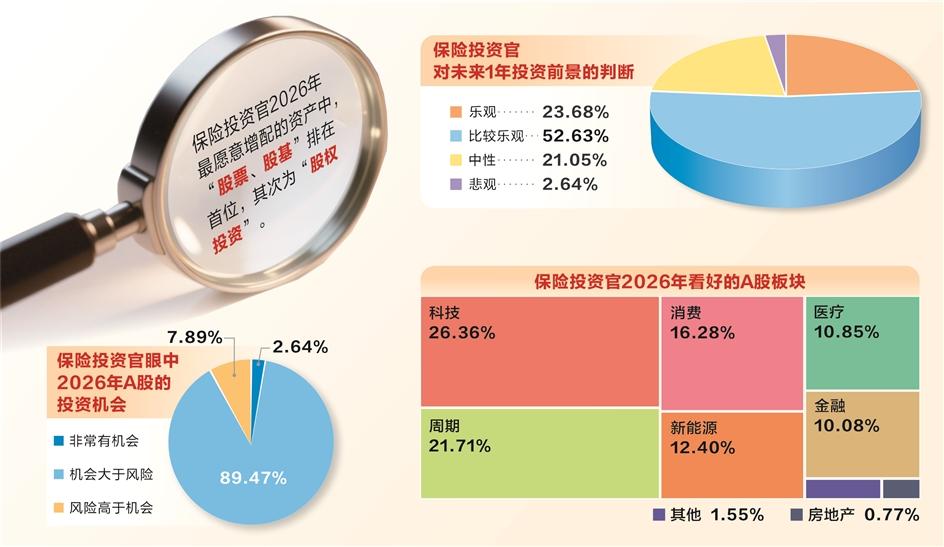
Core Viewpoint - The insurance investment officers are optimistic about the investment outlook for 2026, with over 70% expressing a "optimistic" or "relatively optimistic" sentiment, indicating a significant improvement compared to early 2025 [5][7]. Investment Preferences - The most favored asset class for increased allocation in 2026 is "stocks and equity funds," followed by "equity investments" [6][19]. - A significant majority of insurance investment officers (over 70%) plan to increase their allocation to equity assets, with 68.42% expecting a "slight increase" and 2.63% anticipating a "significant increase" [22][23]. Sector Outlook - The sectors viewed as having the most potential in A-shares for 2026 include technology (26.36%), cyclical (21.71%), and consumer sectors (16.28%) [26]. - Nearly 70% of insurance investment officers still see value in dividend-paying assets, driven by a low-interest-rate environment [26]. Market Sentiment - 89.47% of investment officers believe that the opportunities in the A-share market outweigh the risks, citing factors such as corporate profit improvement and structural opportunities [10]. - The overall sentiment towards the investment environment for 2026 is mixed, with 36.84% of officers believing it will weaken compared to 2025, while 23.68% expect it to improve [9]. Geopolitical Concerns - Geopolitical issues are identified as the primary uncertainty for 2026, with around 40% of investment officers highlighting this as a major concern [15]. - Concerns about the international market environment and domestic economic conditions also rank high among investment officers [15][16]. Risk Factors - The primary risk identified by investment officers is stock market volatility, with over 50% expressing concern about this issue [17]. - Credit risk remains a significant concern, particularly in light of potential defaults and liquidity issues [17]. Investment Strategy - Investment officers are increasingly diversifying their asset allocation, with a notable interest in alternative investments such as real estate investment trusts (REITs) [21]. - The focus on maintaining a balanced approach to equity investments is emphasized, with a need to optimize the investment structure while keeping the overall proportion stable [23][24].
第九届新驱动力峰会举行
Zhong Zheng Wang· 2026-01-09 10:56
Core Insights - The integration of AI into the real estate industry is becoming an inevitable trend, impacting various aspects such as planning, design, construction, marketing, and operations [1] - The ninth New Driving Force Summit emphasized the importance of high-quality development in industrial parks and commercial buildings [1] Group 1: Industry Development - The real estate sector is expected to embrace AI across its entire value chain, enhancing efficiency and innovation [1] - Zhang Guobin from Zhongguancun Development Group highlighted three strategies for leveraging the 14th Five-Year Plan: strengthening manufacturing foundations, stimulating innovation, and promoting collaborative openness [1] Group 2: Industrial Parks - Zhongguancun has established 64 characteristic industrial parks housing over 6,600 technology innovation companies, generating more than 1.2 trillion yuan in revenue, positioning itself as a key player in the integration of technology and industry [1] - Gai Shuai, Secretary-General of the Zhongguancun High-Precision Industry Space Supply and Demand Service Alliance, stated that industrial parks are crucial for economic development, industrial upgrading, and innovation [2] Group 3: Scene Innovation - Zhu Zhihua from Great Wall Strategic Consulting proposed five recommendations for creating innovative scenes, including designing projects based on local characteristics and developing benchmark projects [2] - The demand for diversified services in industrial parks is increasing, focusing on cost reduction, efficiency improvement, and digital development, which aligns with the core applications of AI technology [2]

白皮书:不动产行业迎五大变局,核心使命从空间供给转向价值创造
Zhong Guo Jing Ying Bao· 2026-01-09 06:00
Core Insights - The core viewpoint of the white paper is that the real estate industry in China is transitioning from incremental development to stock operation, emphasizing value creation over traditional spatial supply [1][2] Group 1: Industry Trends - The industry is undergoing a fundamental transformation in its core mission, shifting towards full lifecycle operations to unlock stock potential and navigate economic cycles [1] - Five major trends reshaping the industry are identified, including differentiated strategies among real estate companies, self-use enterprises, and financial investment institutions [1] - The financing model is rapidly evolving from development loans to operational financing and direct financing, with the total market value of public REITs in China projected to reach 220.6 billion yuan by October 2025 [1] Group 2: Product and Service Upgrades - The importance of customized design and professional operations is highlighted, with new energy and building technologies reshaping asset value [1] - A comprehensive solution covering the entire lifecycle of investment, financing, construction, management, and exit is necessary for sectors such as office, retail, hotels, and long-term rentals [1] Group 3: Management Innovation - The trend towards intelligent management is notable, with over 90% of companies prioritizing AI-related real estate management in their budgets according to global research [1] - Future asset management will evolve from mere value preservation to value co-creation, with asset forms transitioning from physical entities to digital twin management [2]

深圳审计查出市属国企采购不规范、制度不健全及1.83亿资金闲置等问题
Sou Hu Cai Jing· 2026-01-04 09:21
Core Insights - The Shenzhen Municipal Audit Bureau presented the 2025 Performance Audit Work Report, evaluating the progress of reforms in key sectors such as technology, education, finance, culture, and livelihood, while analyzing issues and providing audit recommendations [1] Group 1: Asset Securitization Achievements - Shenzhen state-owned enterprises (SOEs) have made significant progress in asset securitization, with experiences being promoted nationwide [2] - By the end of 2024, five public REITs products in the real estate sector have been issued, driving new project investments of 96.724 billion yuan, including the first clean energy REIT in the country [2] - In the intellectual property sector, 95 securitized products have been issued, totaling 21.427 billion yuan, revitalizing 2,758 intellectual properties, with a "characteristic brand of intellectual property securitization" being promoted as a typical experience for comprehensive reform [2] Group 2: Issues Identified - There are issues related to idle funds and non-compliance in procurement processes, with one SOE's wholly-owned subsidiary having 183 million yuan in idle funds [3] - The audit identified three main problems: idle funds due to insufficient project feasibility studies, non-compliance in procurement processes including backdated contracts, and lack of established management systems for intellectual property pledge financing [3][4] - The internal control systems of some SOEs are flawed, leading to inadequate planning for the use of raised funds, resulting in idle capital and failure to maximize fund efficiency [4] Group 3: Recommendations for Improvement - The audit recommends that relevant SOEs establish and improve management systems for intellectual property pledge financing and securitization, as well as risk control systems [4] - It is advised to enhance the screening and feasibility analysis of proposed projects to improve fund efficiency and establish a closed-loop management mechanism for funds [4] - The procurement process for intermediary institutions should be standardized to ensure effective risk isolation [4]
迎接数智红利 不动产行业步入精益运营深水区
Zhong Guo Jing Ying Bao· 2025-12-19 15:02
Core Insights - The Chinese real estate and construction industry is undergoing a profound transformation, shifting from scale expansion to enhancing operational quality and sustainability, driven by the "Digital China" strategy and the new productivity concept [1] - Artificial intelligence (AI) is identified as the core driving force of this transformation, although the integration of AI with business scenarios and the sustainable path for value creation remain areas for exploration [1][3] - The KPMG report highlights a dual perspective of a "clear future" and a "blurred present," indicating a consensus on the direction of smart technology, while the pace of technological breakthroughs outstrips the evolution of organizational and data foundations [2][3] Industry Transformation - The past five years have represented a microcosm of the real estate industry's shift from development to operation, from backend to frontend, and from self-research to ecosystem collaboration [2] - The importance of asset lean operation has increased as the market transitions from growth to stock, with technology departments becoming key links in addressing various demands through digital intelligence [2] - The 2025 KPMG "New Intelligence Practice" case selection exemplifies the embodiment of "new productivity" in AI-enabled high-quality industry development [2] Challenges and Opportunities - The industry faces a paradox of "clear future" trends and "blurred" realities, with a pressing need for AI to support future operations amid increasing competition and the challenges of transitioning from traditional models to AI-driven forms [3] - Many companies are still in the early stages of AI application, primarily focused on data collection and information integration, with decision-making heavily reliant on experienced teams [3] - The shift from "information advantage" to "model advantage" in asset management presents a challenge in balancing short-term returns with long-term capability building [3] New Competitive Landscape - Companies are adjusting strategies to navigate revenue pressures during industry downturns, including serving state-owned enterprises and expanding into new infrastructure sectors [4] - The new core competitive advantages are identified as data assets, algorithm capabilities, and organizational agility, applicable to both tech companies and traditional developers [4] - Ecosystem collaboration and co-creation have become mainstream, with tech firms that provide leading solutions and can customize standardized products being favored by partners [4] Path Forward - Key breakthroughs are seen in internal organizational awareness and strategic alignment, with a clear roadmap for encouraging innovation and developing AI product managers [5] - The focus of digitalization is shifting from construction processes to ongoing data operations of completed assets, necessitating timely and accurate operational information for risk management and business decisions [5][6] - The development of the REITs market requires a better understanding of financial tools and lifecycle value management in asset management transformation [6] Talent Development and Global Expansion - The scarcity of talent that combines business acumen with technical expertise is recognized as a bottleneck, with companies increasingly using project-based practices to stimulate internal talent development [7] - The global competitiveness of domestic solutions is improving, with more companies actively expanding overseas, although challenges related to local regulations and industry practices remain [7] - The narrative of AI empowering real estate emphasizes the need for strategic patience and systematic self-reconstruction through iterative practices [7][8]