
算力设施

Search documents
国泰海通·策略前瞻丨中国股市有望出现重要底部与击球点
国泰海通证券研究· 2026-03-22 15:44
Core Viewpoint - The micro trading impact is expected to be short-lived, and it is not advisable to blindly sell off at the current position. The Chinese stock market is likely to see an important bottom and rebound zone, supported by a loose monetary stance and diversified reserves [2]. Investment Highlights - The Chinese stock market is expected to find an important bottom and rebound point, with stability as the base and confidence as the key. The Shanghai Composite Index has broken key levels, with the average adjustment of the entire A-share market close to 9% and the CSI 1000 down by 10%. Recent market adjustments are attributed to inflation risks and financial tightening expectations, as well as loosening micro trading structures. Despite external conflicts not directly impacting China, the unclear situation has reduced market risk appetite. The simultaneous adjustment of stocks and bonds has created investment constraints for institutions with high leverage and positions since the beginning of the year. The impact of micro trading shocks is expected to be short-lived, and the current position should not be blindly sold off. While inflation risks are still to peak, it is important to recognize that Chinese assets have improved productivity and a relatively stable security situation, making them scarce even globally [4][9]. Pricing of Energy Shock and Financial Tightening Risks - The pricing of energy shocks and financial tightening risks can be divided into three stages: expectation shock, reality shock, and return to growth logic. Historical references indicate that the U.S. stock market showed resilience and rebound despite the challenges posed by the Russia-Ukraine conflict and multiple Fed rate hikes in 2022. The first stage involves expectation shocks, where oil prices surged and the U.S. stock market fell. The second stage is the reality shock, where the intensity of the conflict did not escalate further, leading to a decline in oil prices and a stabilization of risk pricing. The third stage is the return to growth logic, marked by advancements in the U.S. AI industry and increased capital expenditure. Key insights include that risk pricing ends not with the cessation of risks but when their intensity no longer rises, and the market's growth capability becomes crucial post-risk pricing [5][14]. Industry Comparison - Financial and stable sectors remain preferred, with Chinese technology manufacturing and stable domestic demand being key to breaking the narrative of stagflation. The financial and stability sectors are seen as important stabilizers with high dividend yields, recommending investments in banks, electricity, highways, and coal. The technology manufacturing and energy transition sectors, particularly companies with global competitiveness and cost advantages, are expected to benefit from energy shocks and transitions, recommending investments in power equipment, new energy vehicles, and engineering machinery. The AI sector is anticipated to grow significantly, with increased technology investment expected to drive domestic production growth by 2026, recommending investments in semiconductors, communication equipment, and machinery. Domestic demand is expected to be bolstered by stable investment policies and rising inflation, recommending investments in construction materials, real estate, hotels, and consumer goods [6][15]. Thematic Recommendations - 1. Energy Transition: Focus on new energy infrastructure and advanced energy equipment benefiting from clean energy transitions, with investment opportunities in power grids, new energy storage, and nuclear fusion energy. 2. Computing Power Collaboration: Emphasizing the integration of computing power, electricity, and energy storage, with investment opportunities in computing facilities, digital power grids, and green power operators. 3. Token Globalization: Chinese models are increasingly called upon globally, with investment opportunities in leading model companies and domestic computing power. 4. Commercial Aerospace: The acceleration of low-orbit satellite internet networks and new technology breakthroughs, with investment opportunities in medium and large rocket manufacturing and launch services [22][23][24][26][28].

新华解码丨发展绿色生产力 零碳工厂怎么建?
Xin Hua She· 2026-01-26 11:46
Core Viewpoint - The article discusses the development of zero-carbon factories in China, emphasizing the need for technological innovation and systematic measures to reduce carbon emissions, as outlined in the recent guidelines issued by multiple government departments [1][3]. Group 1: Zero-Carbon Factory Construction - The "14th Five-Year Plan" suggests the construction of zero-carbon factories and parks to promote green transformation in the manufacturing sector [1]. - Zero-carbon factories focus on minimizing carbon emissions through technology, structural adjustments, and management optimization rather than achieving absolute zero emissions [1]. - The construction of zero-carbon factories is seen as a new development model that drives the green transformation and enhances efficiency in the manufacturing industry [1]. Group 2: Guidelines and Implementation - The guidelines include overall requirements, main objectives, construction paths, and work requirements, outlining a roadmap for zero-carbon factory construction [3]. - From 2026, a selection of zero-carbon factories will be initiated, with specific industries targeted for development by 2027 and further expansion by 2030 [3]. - The guidelines prioritize industries with urgent decarbonization needs and lower difficulty in achieving carbon reduction, allowing for a phased approach to implementation [3]. Group 3: Key Challenges and Solutions - There are significant differences in understanding zero-carbon factories, with challenges such as inconsistent evaluation requirements and weak carbon emission accounting foundations [2]. - The guidelines emphasize the need for a robust carbon emission accounting management system to provide accurate data for emission reduction strategies [4]. - Collaborative carbon reduction across the entire supply chain is crucial, with a focus on analyzing carbon footprints and managing zero-carbon supply chains [4]. Group 4: Standards and Support - The construction of zero-carbon factories requires a solid foundation of standards and regulations, with efforts to develop general requirements and industry-specific guidelines [5]. - The China Electronic Technology Standardization Institute is working on establishing national standards for zero-carbon factories, including carbon footprint monitoring [5]. - Strengthening standard compliance and guiding enterprises to meet these standards will support the cultivation of benchmark zero-carbon factories [5].
工信部、生态环境部等五部委联合下发零碳工厂建设指导意见!
Xin Lang Cai Jing· 2026-01-26 11:10
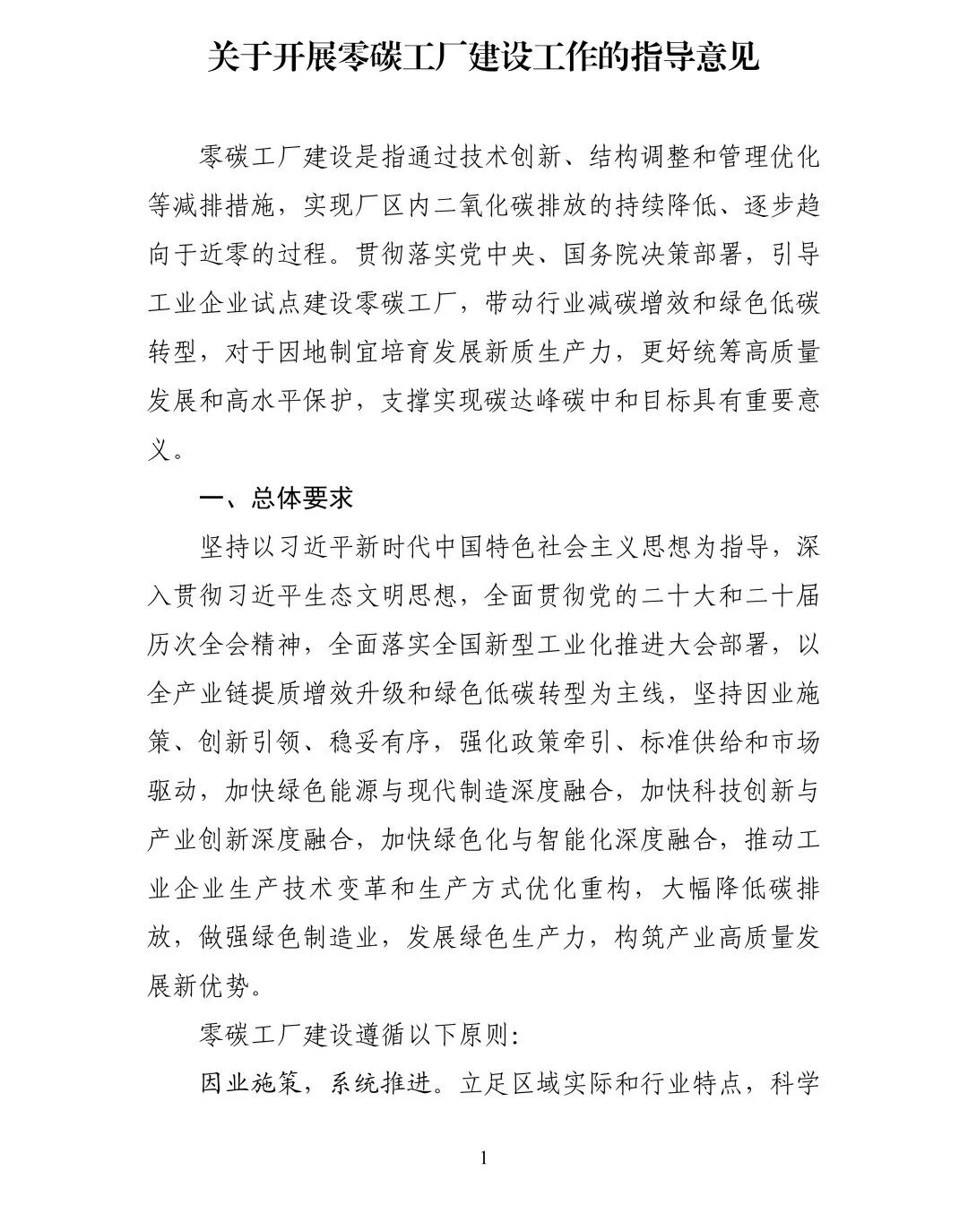
Core Viewpoint - The document outlines the guidelines for the construction of zero-carbon factories in China, emphasizing the importance of reducing carbon emissions through technological innovation, structural adjustments, and management optimization, aiming for near-zero emissions in industrial operations [1][5][21]. Group 1: Overall Requirements - The initiative is guided by Xi Jinping's thoughts on ecological civilization and aims to integrate green energy with modern manufacturing, promoting technological and industrial innovation to significantly reduce carbon emissions [6][22]. - The construction of zero-carbon factories will follow principles such as tailored strategies based on industry characteristics, innovation-driven approaches, and a focus on transparency and standardization in carbon accounting [7][23]. Group 2: Main Goals - The plan includes a phased approach, prioritizing industries with urgent decarbonization needs and lower difficulty levels, with a target to select a batch of zero-carbon factories by 2026 [8][24]. - By 2027, the initiative aims to establish zero-carbon factories in sectors like automotive, lithium batteries, photovoltaic, electronics, light industry, machinery, and computing facilities, creating an ecosystem that supports energy supply, technology research, and financial backing [9][25]. Group 3: Construction Pathways - A carbon emission accounting management system will be established to provide accurate data for zero-carbon factory construction, including direct and indirect emissions from production activities [10][26]. - The initiative encourages the development of green energy sources such as distributed solar, wind, and biomass power, promoting the use of integrated energy systems and green hydrogen applications [11][27]. - There will be a focus on enhancing energy efficiency and optimizing production processes to achieve significant reductions in carbon emissions, with a push for advanced energy-saving technologies and practices [12][28]. Group 4: Collaborative Efforts - The document promotes zero-carbon supply chain management, encouraging the procurement of green products and the adoption of low-carbon logistics to enhance collaborative decarbonization across the industry [13][29]. - The use of digital technologies such as IoT and big data will be emphasized to create smart carbon management systems, enabling precise measurement and control of energy consumption and emissions [14][30]. Group 5: Implementation Requirements - Local industrial and information departments are tasked with developing specific implementation plans for zero-carbon factory construction, fostering collaboration among government, enterprises, and markets [15][31]. - A comprehensive standard system will be established to guide the management and evaluation of zero-carbon factories, ensuring alignment with international standards and promoting transparency in carbon emissions reporting [16][32].
零碳工厂建设进入快车道,2030年将纳入钢铁、有色金属等行业
Xin Lang Cai Jing· 2026-01-23 13:45
Core Insights - The Chinese government is actively promoting the construction of zero-carbon factories and parks, with a goal to select a batch of zero-carbon factories starting in 2026 and expand to various industries by 2030 [2][4]. Policy Development - The concept of zero-carbon parks was first introduced in the 2024 Central Economic Work Conference, with subsequent government reports and guidelines reinforcing the initiative [3]. - The first batch of national-level zero-carbon parks was announced on December 26, 2025, with 52 parks officially recognized [4]. Implementation Strategies - The construction of zero-carbon factories involves reducing carbon emissions through technological innovation, structural adjustments, and management optimization [4]. - Key strategies for building zero-carbon factories include establishing a carbon emission accounting system, transitioning to green energy sources, improving energy efficiency, analyzing carbon footprints, enhancing digital management, and implementing carbon offsetting measures [4]. Regional Distribution - The first batch of zero-carbon parks is distributed across various provinces, achieving nationwide coverage, with a focus on key regions [5]. - The construction of zero-carbon parks is seen as a strategic move to accelerate green transformation in the industry [5]. Industry Impact - Zero-carbon parks are expected to drive deep decarbonization in high-emission industries such as steel, construction materials, and chemicals, while also fostering the growth of new energy and smart manufacturing sectors [6]. - The construction of zero-carbon parks is viewed as a means to enhance the competitiveness of China's green industrial chain on a global scale [6]. Challenges and Lessons - Challenges in the construction of zero-carbon parks include weak carbon management capabilities, significant funding pressures, and the need for improved data monitoring and accounting systems [6]. - European examples, such as Berlin's EUREF-Campus and Denmark's Kalundborg eco-industrial park, provide valuable insights into effective energy system planning and digital management for zero-carbon initiatives [6][7].

零碳工厂迎来“顶层设计”
Xin Jing Bao· 2026-01-23 09:52
Core Viewpoint - The construction of zero-carbon factories in China is being guided by a new policy framework aimed at promoting green transformation in the manufacturing sector, with specific targets set for 2027 and 2030 [1][2]. Group 1: Policy and Guidelines - The "Guiding Opinions" issued by multiple government bodies aim to cultivate a number of zero-carbon factories in key industries by 2027, expanding to additional sectors by 2030 [1][2]. - The transition from energy-saving to green factories and then to zero-carbon factories reflects a progressive evolution in China's manufacturing green transformation [2][3]. Group 2: Importance of Zero-Carbon Factories - Zero-carbon factories are essential for reducing carbon emissions in the industrial sector, which accounts for nearly 70% of China's total carbon emissions [2]. - The construction of zero-carbon factories is recognized as a critical step towards deep decarbonization in the industrial field [2][3]. Group 3: Implementation Challenges - The construction of zero-carbon factories involves complex and systemic challenges, including energy structure, technology, funding, and management, with varying implementation paths across different regions and industries [3][4]. - There are existing issues such as inconsistent evaluation requirements and a lack of robust carbon emission accounting frameworks that need to be addressed [3][4]. Group 4: Regional Initiatives and Standards - Several regions in China, including Tianjin, Shanghai, and Jiangsu, have initiated pilot projects for near-zero carbon factories, establishing a foundation for broader zero-carbon factory construction [4]. - Industry associations have developed over 30 technical standards to guide the construction and evaluation of zero-carbon factories based on international benchmarks [4]. Group 5: Opportunities in Digitalization and Green Energy - The push for zero-carbon factories is expected to create significant opportunities in digital technologies, particularly in areas like digital twin modeling and simulation for manufacturing processes [7]. - The "Guiding Opinions" encourage the development of integrated projects for green hydrogen and ammonia, aiming to establish a sustainable supply chain for clean energy [7].
零碳工厂建设目标出台 激发工业企业节能降碳动力
Zheng Quan Ri Bao· 2026-01-20 16:25
Core Viewpoint - The joint release of the "Guiding Opinions on the Construction of Zero Carbon Factories" aims to drive carbon reduction and green transformation in key industrial sectors, injecting strong momentum into energy conservation and carbon reduction in China's industrial field [1][2]. Group 1: Zero Carbon Factory Development - The "Guiding Opinions" propose a phased approach to cultivate zero carbon factories, prioritizing industries with urgent decarbonization needs and primarily electric energy consumption [1][2]. - By 2026, a selection of zero carbon factories will be established as benchmarks, with a focus on sectors such as automotive, lithium batteries, photovoltaics, electronics, light industry, machinery, and computing facilities [2]. - By 2030, the initiative will expand to include high-energy industries like steel, non-ferrous metals, petrochemicals, building materials, and textiles, exploring new decarbonization pathways [2]. Group 2: Technological and Operational Implications - The construction of zero carbon factories is a comprehensive and systematic project that involves energy structure, process technology, funding, and management services, with varying implementation paths across regions and industries [2][3]. - The initiative is expected to stimulate industrial enterprises to increase investment in energy-saving and emission-reduction technology research and application, promoting production technology transformation [3]. - Zero carbon factory construction will encourage the optimization of production methods, leading to intelligent, green, and integrated development, enhancing energy resource output efficiency and reducing production costs [3]. Group 3: Digital Technology Integration - The demand for digital technology in zero carbon factory construction presents unprecedented business growth opportunities for the digital industry [4]. - Digital industry companies can leverage their expertise in 3D modeling and simulation analysis to create high-precision digital twin models for manufacturing enterprises, optimizing factory layout and energy consumption [4]. - The complexity and high standards of zero carbon factory construction will drive innovation in digital technologies, fostering deep integration and collaborative development between the digital industry and manufacturing sectors [4].
中国明确三个阶段梯度培养零碳工厂
Chang Jiang Shang Bao· 2026-01-20 06:47
Core Viewpoint - The construction of zero-carbon factories is receiving policy support, aimed at enhancing energy efficiency and promoting green low-carbon transformation in key industries [1][2]. Group 1: Policy Guidance - The Ministry of Industry and Information Technology and four other departments issued the "Guiding Opinions on Zero-Carbon Factory Construction," focusing on energy-saving and carbon reduction potential in the industrial sector [1]. - The guidance outlines a three-phase approach to cultivate zero-carbon factories, prioritizing industries with urgent decarbonization needs and lower difficulty in achieving carbon reduction [2]. Group 2: Goals and Timeline - By 2026, a selection of zero-carbon factories will be established as benchmarks, with a focus on sectors such as automotive, lithium batteries, photovoltaics, electronics, light industry, machinery, and computing facilities [2]. - By 2030, the initiative will expand to include high-energy-consuming industries like steel, non-ferrous metals, petrochemicals, building materials, and textiles, exploring new decarbonization pathways [2]. Group 3: Construction Pathways - The construction of zero-carbon factories involves improving carbon emission accounting, transitioning to green energy structures, enhancing energy efficiency, analyzing carbon footprints, and increasing digital intelligence for carbon control [3]. - The Ministry emphasizes that building zero-carbon factories is a complex and systematic project, requiring unified evaluation standards and verification of key technologies [3]. Group 4: Implementation Support - The Ministry will coordinate with relevant departments to implement the guiding opinions, ensuring high-quality advancement of zero-carbon factory construction and supporting industrial green low-carbon transformation [3].
“双万亿”第三城,新目标定了
Mei Ri Jing Ji Xin Wen· 2026-01-20 01:40
Group 1: Core Insights - Guangzhou has become the third city in China to achieve a "double trillion" status in consumption and foreign trade during the 14th Five-Year Plan period, following Beijing and Shanghai [1][2] - By 2025, Guangzhou's airport is expected to handle over 83 million passengers, ranking among the top ten globally, while its port is projected to handle nearly 700 million tons of cargo, placing it in the top six worldwide [1] - The city aims to establish six advanced manufacturing clusters with outputs exceeding 100 billion yuan and ten service sectors with added value surpassing 100 billion yuan during the same period [1] Group 2: Economic Indicators - As of 2024, only seven cities in China have reached a consumption level of over one trillion yuan, including Guangzhou, which highlights the significance of its economic status [2] - The report indicates that Guangzhou's foreign trade volume also exceeds one trillion yuan, making it one of only seven cities to achieve this milestone [2] Group 3: Strategic Development - Guangzhou's government has outlined plans to enhance its role as a global supply chain innovation center, aiming to strengthen its core urban functions [3][4] - The city is leveraging its geographical advantages, including proximity to the Pearl River Delta manufacturing hub and its status as a major transportation and trade center, to transition from a trade hub to a supply chain management center [4] Group 4: Future Goals - The city has set ambitious goals for the 15th Five-Year Plan, focusing on increasing its visibility and resource allocation capabilities within the global resource network [3] - The government has previously articulated a vision to develop Guangzhou into a world-class city with both historical charm and modern vitality, as outlined in its urban planning documents [3]
五部门:2026年起将遴选一批标杆零碳工厂
Zhong Guo Zheng Quan Bao· 2026-01-19 23:57
Core Viewpoint - The Chinese government has issued guidelines for the construction of zero-carbon factories, aiming to enhance energy efficiency and promote green transformation in key industries by selecting and establishing benchmark zero-carbon factories starting in 2026 [1][2]. Group 1: Objectives and Implementation - The main goal is to implement a phased approach to cultivate zero-carbon factories, prioritizing industries with urgent decarbonization needs and lower difficulty in achieving carbon reduction [1]. - By 2027, a batch of zero-carbon factories will be established in sectors such as automotive, lithium batteries, photovoltaics, electronics, light industry, machinery, and computing facilities [1]. - The initiative will expand to include traditional high-energy industries like steel, non-ferrous metals, petrochemicals, building materials, and textiles by 2030, exploring new decarbonization pathways [1]. Group 2: Construction Pathways - Zero-carbon factory construction involves continuous reduction of CO2 emissions through technological innovation, structural adjustments, and management optimization [2]. - Key construction pathways include establishing a carbon emission accounting management system, enhancing the green and low-carbon transformation of energy structures, and improving energy efficiency through technological upgrades [2][3]. - The guidelines emphasize the importance of digitalization and intelligent management for precise measurement and control of energy consumption and carbon emissions [2]. Group 3: Energy Structure Transformation - The guidelines encourage factories to achieve zero-carbon energy supplies, including electricity, heat, hydrogen, and fuels, while promoting the use of distributed renewable energy sources [3]. - Development of industrial green microgrids and integrated projects utilizing solar, wind, and energy recovery technologies is encouraged to enhance energy efficiency [3]. - The initiative also supports the advancement of clean low-carbon hydrogen applications through industrial by-product hydrogen and renewable energy hydrogen production [3].
今年起将遴选一批标杆零碳工厂
Xin Lang Cai Jing· 2026-01-19 22:18
Core Viewpoint - The Ministry of Industry and Information Technology, along with four other departments, has issued guidelines for the construction of zero-carbon factories, aiming to enhance energy efficiency and carbon reduction in key industrial sectors, with a target to select a batch of zero-carbon factories starting in 2026 [1] Group 1: Zero-Carbon Factory Construction - Zero-carbon factory construction involves reducing carbon dioxide emissions through technological innovation, structural adjustments, and management optimization, aiming for near-zero emissions within factory premises [1] - The guidelines emphasize the importance of pilot zero-carbon factories in fostering new productive forces and balancing high-quality development with environmental protection, supporting carbon peak and carbon neutrality goals [1] Group 2: Implementation Timeline and Industry Focus - By 2027, the initiative aims to cultivate zero-carbon factories in sectors such as automotive, lithium batteries, photovoltaics, electronics, light industry, machinery, and computing facilities [1] - By 2030, the construction of zero-carbon factories will expand to include traditional high-energy-consuming industries like steel, non-ferrous metals, petrochemicals, building materials, and textiles, exploring new decarbonization pathways [1] Group 3: Construction Pathways - The guidelines outline pathways for zero-carbon factory construction, including establishing a carbon emission accounting system to identify and quantify emissions and removals [2] - Factories are encouraged to build industrial green microgrids and enhance the application of new-generation information technology [2] - Carbon emissions reductions can be offset through mechanisms such as cross-border carbon trading [2]