计算机及电子产品

Search documents
美国就业警报拉响!降息大局已定?
Di Yi Cai Jing Zi Xun· 2025-12-01 23:52
Core Insights - The overall manufacturing sentiment in the U.S. has declined for the ninth consecutive month, with the ISM manufacturing PMI dropping from 48.7 in October to 48.2 in November, indicating a contraction in the sector [2][3] - The trade war initiated by the Trump administration has led to increased costs and reduced demand, with 67% of surveyed participants indicating that workforce management is focused on controlling numbers rather than hiring new employees [3][4] - The Federal Reserve is expected to consider another interest rate cut as economic indicators show weakness, with predictions of a 25 basis point reduction in December [6][7] Manufacturing Sector Performance - The new orders index fell to 47.4, reflecting a decrease in demand due to tariffs raising prices on certain goods [3] - Manufacturing employment has contracted for ten consecutive months, with only four industries, including computers and electronics, showing growth, while others like wood products and transportation equipment are shrinking [3][4] - Manufacturers in the transportation equipment sector are beginning to implement permanent adjustments, including layoffs, due to the current tariff environment [3] Economic Indicators and Federal Reserve Actions - The upcoming economic data, including the ISM services index and ADP private employment report, will be closely monitored as indicators of future monetary policy [6] - Recent data shows that initial jobless claims have risen to 1.96 million, the highest level since the pandemic, indicating increased difficulty in job searching [6] - Market expectations for a rate cut have shifted significantly, with most major brokerage firms anticipating a 25 basis point reduction in the upcoming Federal Reserve meeting [7]


就业警报拉响!ISM制造业指数“九连缩” 降息大局已定?
Di Yi Cai Jing· 2025-12-01 23:45
Group 1: Manufacturing Sector Overview - The overall manufacturing sentiment in the U.S. has declined for the ninth consecutive month, with the ISM manufacturing PMI dropping from 48.7 in October to 48.2 in November, indicating continued contraction [1][2] - The new orders index fell to 47.4, reflecting reduced demand due to tariffs increasing prices of certain goods [2] - Manufacturing employment has contracted for ten consecutive months, with 67% of survey participants indicating that managing personnel numbers is the norm rather than hiring new employees [2] Group 2: Impact of Tariffs and Economic Conditions - Tariffs have led to increased production costs, with the prices index rising from 58.0 in October to 58.5 in November, further suppressing demand [2] - Some manufacturers are linking layoffs to the broad tariff policies implemented by President Trump, indicating a shift towards permanent adjustments in response to the current tariff environment [2][3] - The chemical products sector has reported that tariffs and economic uncertainty are suppressing demand for adhesives and sealants, which are primarily used in construction [3] Group 3: Federal Reserve's Monetary Policy Outlook - As the Federal Reserve approaches its year-end meeting, there is speculation about potential interest rate cuts, with expectations for a 25 basis point reduction in December [4][5] - Recent data shows that initial jobless claims have risen to 1.96 million, the highest level since the pandemic, indicating significant challenges in the job market [4] - Economic analysts predict that further rate cuts may occur in 2026, with the terminal rate expected to fall to the range of 3.00%-3.25% [5]
美国就业警报拉响!降息大局已定?
第一财经· 2025-12-01 23:41
Core Viewpoint - The overall manufacturing sentiment in the U.S. continues to decline, marking the ninth consecutive month below the threshold, primarily due to the impacts of the trade war initiated by the Trump administration, which has led to decreased orders, job demand pressure, and increased production costs [3][4]. Manufacturing Sector Pressure - The ISM reported that the manufacturing Purchasing Managers' Index (PMI) fell from 48.7 in October to 48.2 in November, with the new orders sub-index dropping to 47.4, indicating weakened demand due to tariffs raising prices [5][6]. - Manufacturing employment indicators have contracted for ten consecutive months, with 67% of survey participants indicating that managing personnel numbers is the norm rather than hiring new employees [5][6]. - The manufacturing sector accounts for 10.1% of the U.S. economy, with only four industries, including computers and electronics, showing growth, while sectors like wood products and transportation equipment are experiencing contraction [6][7]. Impact of Tariffs and Economic Uncertainty - Manufacturers in the transportation equipment sector are linking layoffs to the extensive tariff policies of President Trump, indicating a shift towards permanent adjustments, including layoffs and new overseas production initiatives [6][7]. - Chemical product manufacturers report that tariffs and economic uncertainty are suppressing demand for adhesives and sealants, which are primarily used in construction [6][7]. - The chaotic trade environment has led to complaints from electrical equipment and appliance manufacturers regarding increasing difficulties in exporting to the U.S. [6][7]. Federal Reserve's Policy Considerations - As the Federal Reserve approaches its year-end meeting, market attention is focused on economic data, including the ISM services index and the ADP private employment report, which are critical for assessing future policy directions [8][9]. - Recent data shows that the number of Americans filing for unemployment benefits rose to 1.96 million, the highest level since the pandemic, indicating significant challenges in the job market [9][10]. - The Federal Reserve has already cut rates twice since September and may consider another cut in the coming weeks, with expectations for a 25 basis point reduction at the December meeting [9][10].

越南计算机及电子产品出口取得突破
Shang Wu Bu Wang Zhan· 2025-08-27 10:24
Core Insights - Vietnam's total export value reached $282.61 billion as of August 15, 2025, representing a year-on-year growth of over 15% [1] - The export value of computers, electronic products, and components amounted to $61.32 billion, marking a 42.6% increase compared to the same period last year, which translates to an increase of approximately $18.3 billion [1] - The share of computers and electronic products in Vietnam's total export value is 21.7%, up by 4.2 percentage points from the same period last year [1]
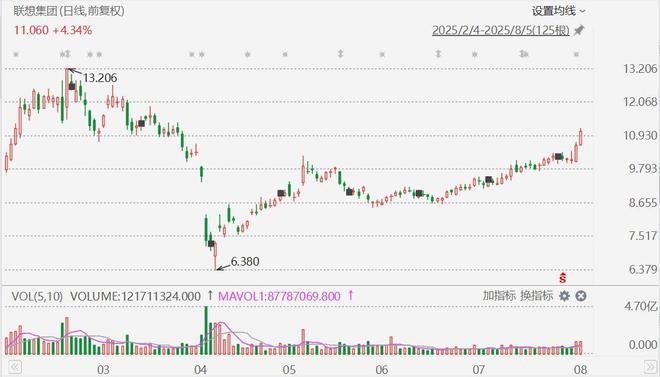
港股异动丨联想集团涨超5%,2连升,股价创3月27日以来新高
Ge Long Hui· 2025-08-05 07:27
Core Viewpoint - Lenovo Group (0992.HK) shares rose over 5%, reaching HKD 11.15, marking the second consecutive day of gains and the highest price since March 27, 2023 [1] Group 1: Financial Performance - JPMorgan's report anticipates Lenovo's Q1 performance for the fiscal year ending June 2026 will exceed market expectations, primarily due to strong performance in the PC business [1] - The resilience in PC business profitability is attributed to an increase in market share and flexible supply chain management [1] - The company's server (ISG) business has recently secured multiple new orders, contributing to growth [1] Group 2: Market Outlook - The entry into the AI server market may present a re-rating opportunity for Lenovo's stock in the medium to long term [1] - JPMorgan has raised its earnings forecasts for fiscal years 2026 and 2027 by 2% to 3%, maintaining an "Overweight" rating with a target price of HKD 13 [1] Group 3: Industry Trends - Canalys reported that global tablet shipments reached 39 million units in Q2 2025, reflecting a year-on-year growth of 9% and a quarter-on-quarter growth of 5% [1] - Apple remains the market leader with Q2 shipments of 14.1 million units, a 2% increase year-on-year [1] - Samsung follows with shipments of 6.7 million units, while Huawei, Lenovo, and Xiaomi achieved strong annual growth, ranking third to fifth respectively [1]

关税战下的美国库存“倒计时”
一瑜中的· 2025-05-12 10:52
Core Viewpoint - The article discusses the potential impact of tariffs on U.S. inventory levels and how long these inventories can buffer against rising import costs and consumer prices [1]. Group 1: U.S. Inventory Analysis - As of February, the overall inventory-to-sales ratio in the U.S. manufacturing and trade sectors is approximately 1.5 months, with manufacturers at 1.9 months, wholesalers at 1.3 months, and retailers at 1.4 months, all at relatively low percentiles since the pandemic [4][8]. - If assuming that inventories from manufacturers, wholesalers, and retailers are solely for domestic retail sales, the overall inventory could cover about 4.2 months of sales [5][9]. - The low inventory-to-sales ratios suggest limited buffering capacity against supply-demand imbalances, which could lead to upward pressure on inflation [5][9]. Group 2: Industry-Specific Inventory Insights - In the retail sector, categories such as furniture, appliances, and consumer electronics have a notably low inventory-to-sales ratio of just 1 month, placing them in the 6.5% percentile since the pandemic [13]. - Conversely, the automotive and building materials sectors have higher ratios, exceeding 2 months, indicating a more stable inventory position [13]. - In the manufacturing and wholesale sectors, categories like machinery and textiles show higher inventory-to-sales ratios, while electrical equipment remains low at around 1 month [6][14]. Group 3: PMI and Inventory Trends - The ISM manufacturing PMI inventory index fell to 50.8% in April from 53.4% in March, indicating a decrease in inventory accumulation as companies reduce stockpiling ahead of tariff implementations [17]. - The customer inventory index remains low at 46.2%, suggesting concerns about the sustainability of overall manufacturing inventory levels [17][18]. - Among 18 manufacturing sectors, 5 reported increased inventory levels in April, while 8 sectors, including textiles and transportation equipment, saw declines, reflecting a mixed inventory landscape [18].