合成生物学

Search documents
CEO思考问题的宏观、中观和微观
3 6 Ke· 2026-01-19 09:58
Group 1: Macro Perspective - The macro perspective emphasizes the need for companies to look outward at global trends, economic cycles, and technological advancements to form unique insights [3][4] - Companies should identify long-term trends over the next decade to find certainty amid uncertainty, guiding their business strategies [8] - Understanding the political, economic, social, and technological (PEST) signals is crucial for companies to derive insights that directly impact their strategic decisions [4][5] Group 2: Economic and Financial Trends - Companies must focus on long-term growth drivers while filtering out short-term fluctuations, such as those caused by the pandemic or inflation cycles [5][6] - It is essential to monitor systemic risks, including debt cycles and asset bubbles, to prepare for potential economic downturns [6][7] - Companies should analyze changes in consumer behavior and investment patterns to capture long-term shifts in demand and supply [6][7] Group 3: Social and Technological Impact - Companies need to track demographic changes and shifts in societal values to understand evolving consumer needs [7][8] - The distinction between sustaining and disruptive technologies is vital for assessing how innovations can reshape industry dynamics [8][9] - Companies should be aware of the ethical implications of technological advancements to avoid potential backlash from society [9][10] Group 4: Industry Perspective - The industry perspective requires companies to understand the underlying logic of their sector, including key drivers and competitive dynamics [17][18] - Companies should analyze their position within the industry value chain to assess bargaining power and identify potential profit traps [18][19] - Recognizing cyclical patterns in the industry can help companies anticipate market conditions and adjust their strategies accordingly [19][20] Group 5: Competitive Landscape - Companies must monitor the strategic moves of leading competitors to understand resource allocation and potential shifts in industry rules [19][20] - The threat of new entrants and substitute products should be evaluated to prepare for potential disruptions in the market [20][21] - Identifying unmet consumer needs can reveal opportunities for innovation and value creation within the industry [20][21] Group 6: Organizational Perspective - Companies should assess their core capabilities to ensure they are resilient and adaptable to market changes [22][23] - Improving organizational efficiency and collaboration is essential for reducing internal friction and enhancing overall performance [23][24] - Talent management and cultural alignment are critical for executing strategies effectively and maintaining a motivated workforce [24][25] Group 7: Strategic Alignment - Companies should establish mechanisms for long-term trend observation to avoid losing sight of strategic goals amid daily operations [10][11] - Regular stress testing of core assumptions can help companies adjust their strategies in response to changing market conditions [10][11] - Aligning organizational culture with strategic objectives is necessary to ensure that employees are engaged and motivated to achieve company goals [25][26] Group 8: Conclusion - The integration of macro, industry, and organizational perspectives creates a comprehensive framework for companies to navigate complex environments and achieve sustainable growth [27][28] - This approach enables companies to define their strategic direction, competitive positioning, and execution capabilities effectively [28][29]


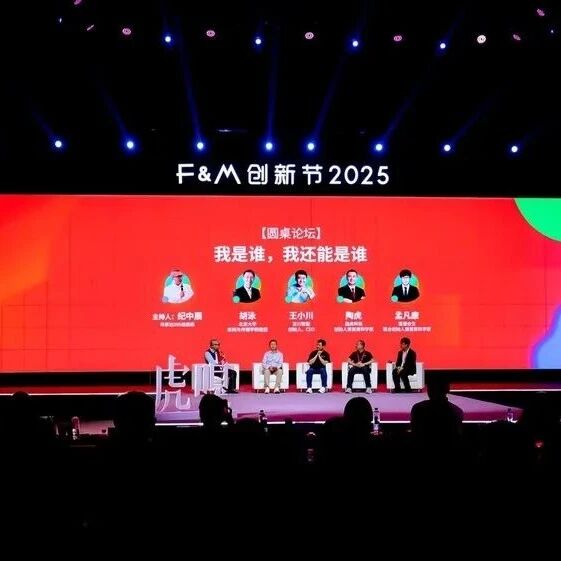
要不要重新设计“我”:三个科技“天才”与一个人文学者的思想对抗
虎嗅APP· 2025-11-29 03:06
Core Viewpoints - The discussion revolves around the implications of AI and technology on human identity and existence, questioning whether humans can maintain their essence in the face of advanced AI and biotechnology [2][3][4]. Group 1: AI and Human Identity - The panelists explore how AI and technology redefine human existence, with a focus on AI in healthcare, brain-computer interfaces, and synthetic biology [4][5]. - Wang Xiaochuan views AI as an integral part of human civilization, suggesting that future human history will be co-written with AI [4][5]. - Tao Hu emphasizes the brain's central role in defining humanity, arguing that enhancing human capabilities through technology is essential for survival in an intelligent competition [4][8]. Group 2: Ethical and Philosophical Considerations - The conversation raises ethical questions about the implications of consciousness transfer and the potential loss of individuality if consciousness can be digitized [11][12]. - Meng Fankang discusses synthetic biology's potential to redefine what it means to be human, suggesting that it could lead to healthier lives but also risks altering human identity [12][13]. - Hu Yong warns that the rapid advancement of AI could lead to a loss of human control, drawing parallels to historical technological developments that had unforeseen consequences [23][24]. Group 3: The Future of Human-AI Interaction - The panelists express concerns about the increasing decision-making power of AI, with Wang Xiaochuan noting that humans may become mere executors of AI decisions [21][22]. - Tao Hu highlights the importance of improving communication between humans and AI to enhance societal progress [18][19]. - Meng Fankang presents a vision where AI aids in human evolution and adaptation, potentially expanding human capabilities [29]. Group 4: The Role of Ethics in Technological Advancement - The discussion emphasizes the need for ethical frameworks to guide the development of technologies like synthetic biology and AI, ensuring that advancements do not compromise human values [26][27]. - The panelists agree that while technology can enhance human life, it must be approached with caution to avoid ethical pitfalls [13][26]. - Hu Yong suggests that the concept of "responsible life design" is paradoxical, as once life is engineered, the notion of responsibility may become irrelevant [25].
中央定调六大未来产业,这些城市已抢先布局
第一财经· 2025-10-26 02:45
Core Viewpoint - The article emphasizes the importance of emerging industries such as quantum technology, biomanufacturing, hydrogen energy, nuclear fusion energy, brain-computer interfaces, and embodied intelligence as new economic growth points in China's future development strategy [3][4]. Quantum Technology - Quantum technology is identified as a core area of the new technological revolution, with Hefei, Beijing, and Shanghai forming the "first tier" in terms of enterprise and patent applications [6][7]. - Hefei leads the domestic quantum industry, ranking second globally after San Francisco, with 93 quantum enterprises and over 2000 related patents [7]. - Beijing focuses on foundational technology breakthroughs, leveraging its dense research resources, and aims to build a trillion-yuan industry cluster by 2030 [7][8]. - Shanghai is concentrating on neutral atom quantum computing and has established key laboratories to drive innovation [8]. Biomanufacturing - Shanghai, Beijing, Shenzhen, and Tianjin are the top four cities in biomanufacturing competitiveness, with Shanghai's industry scale expected to exceed 1 trillion yuan by 2025 [10][11]. - Shenzhen has established a national biomanufacturing innovation center and is a hub for new enterprises in synthetic biology [11]. - Tianjin is leveraging its chemical industry base to develop biomanufacturing projects, attracting multinational companies [11]. Hydrogen and Nuclear Fusion Energy - Hydrogen and nuclear fusion energy are highlighted as clean energy "dual engines," with Beijing and Shanghai leading in technology and infrastructure development [12][13]. - Beijing plans to have 1,200 hydrogen fuel cell buses and 35 hydrogen stations by 2025, while Shanghai aims for its hydrogen industry to reach international leading levels by 2035 [13]. - Hefei is making significant advancements in nuclear fusion technology, participating in key international projects [14]. Brain-Computer Interfaces - The brain-computer interface (BCI) market in China is projected to grow from 3.2 billion yuan in 2024 to 5.58 billion yuan by 2027, with Shanghai, Beijing, and Shenzhen as the leading cities [15][16]. - Shanghai is developing a comprehensive BCI ecosystem and has launched the first BCI industrial cluster [16]. - Beijing is focusing on non-invasive BCI technologies, while Shenzhen is applying BCI in various fields, including education and gaming [17]. Embodied Intelligence - Embodied intelligence, represented by humanoid robots, sees Beijing, Shenzhen, Shanghai, and Hangzhou as the leading cities in technology and industry [18][19]. - Beijing aims to achieve significant technological breakthroughs and establish a robust industrial cluster by 2027 [19]. - Shenzhen is the manufacturing hub for humanoid robots, with a goal to support over 1,200 related enterprises by 2027 [19][20]. - Shanghai is working on a complete ecosystem for robotics, targeting a core industry scale of over 50 billion yuan by 2027 [20]. 6G Technology - 6G technology is being developed with Beijing as a core hub for standard-setting and innovation, aiming to create a testing environment by 2026 [21][22]. - Shenzhen is integrating 6G with AI and plans to establish a low-altitude economy demonstration zone [21][22]. - Nanjing is focusing on terahertz communication breakthroughs and aims for a 300 billion yuan industry value within five years [22][23].

新材料50ETF(159761)涨超3.8%,行业需求与技术突破或驱动景气周期
Mei Ri Jing Ji Xin Wen· 2025-09-28 09:19
Group 1 - The core viewpoint is that the new materials sector is a crucial direction for the future development of the chemical industry, currently experiencing rapid downstream demand growth, supported by policy and technological breakthroughs [1] - The new materials industry is foundational, supporting the development of key fields such as electronic information, new energy, biotechnology, and environmental protection [1] - In the electronic information sector, focus areas include display materials and 5G materials; in aerospace, attention is on PI films, precision ceramics, and carbon fibers; in new energy, the focus is on photovoltaics, lithium-ion batteries, proton exchange membranes, and hydrogen storage materials; in biotechnology, the emphasis is on synthetic biology and scientific services; and in environmental protection, key materials include adsorption resins, membrane materials, and biodegradable plastics [1] Group 2 - The New Materials 50 ETF (159761) tracks the New Materials Index (H30597), which primarily covers listed companies engaged in the research and production of advanced foundational materials, key strategic materials, and cutting-edge new materials [1] - The index constituents are characterized by high technological content and high added value, widely distributed across the chemical, non-ferrous metals, and electronics industries, reflecting the overall performance of listed companies in the new materials sector [1] - Investors without stock accounts can consider the Guotai Zhongzheng New Materials Theme ETF Initiated Link A (014908) and Guotai Zhongzheng New Materials Theme ETF Initiated Link C (014909) [1]
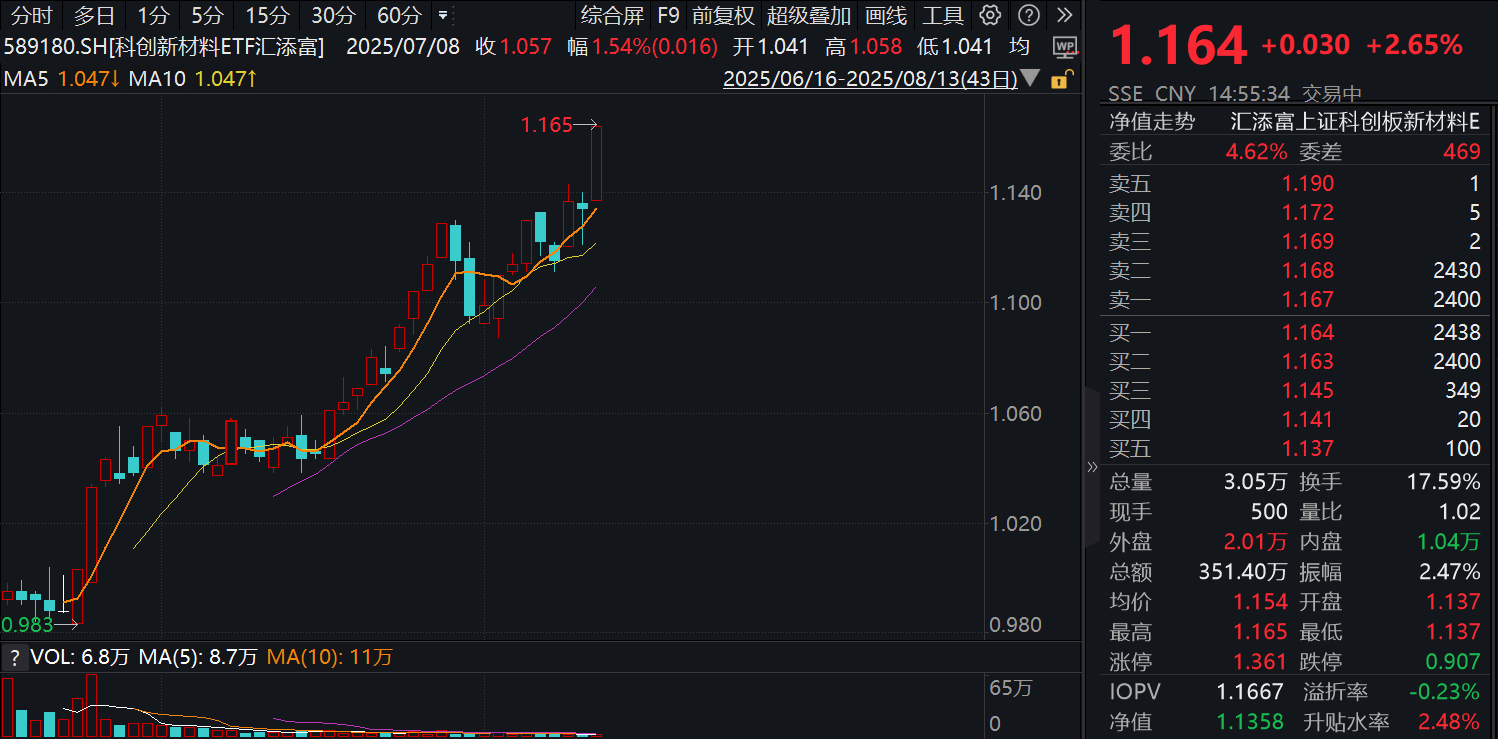
中船特气20CM涨停,国内新材料正迎加速成长期!科创新材料ETF汇添富(589180)大涨2.65%!
Xin Lang Cai Jing· 2025-08-13 07:22
Market Performance - The A-share market is experiencing a significant rise, with the Kexin New Materials ETF (589180) increasing by 2.65% [1] - Notable stocks include China Shipbuilding Gas, which hit the daily limit with a 20% increase, and Guanggang Gas, which rose over 13% [1] New Materials Industry Outlook - The new materials sector is identified as a crucial direction for the chemical industry, currently witnessing rapid downstream demand growth [3] - With policy support and technological breakthroughs, the domestic new materials industry is expected to enter an accelerated growth phase [3] Sector Focus Areas 1. **Electronic Information Sector** - Key areas of focus include semiconductor materials, display materials, and 5G materials [4] - In Q2 2025, global silicon wafer shipments reached 3,327 million square inches, a 9.6% increase year-over-year [4] 2. **Aerospace Sector** - Focus on PI films, precision ceramics, and carbon fibers [5] - The successful launch of the "Forged Star 1" satellite marks a significant milestone in space manufacturing technology [5] 3. **New Energy Sector** - Key areas include photovoltaics, lithium-ion batteries, proton exchange membranes, and hydrogen storage materials [6] 4. **Biotechnology Sector** - Focus on synthetic biology and scientific services [7] - Hainan Province is enhancing cooperation in biomedicine and high-end consumer goods manufacturing [7] 5. **Energy Conservation and Environmental Protection Sector** - Focus on adsorbent resins, membrane materials, and biodegradable plastics [8] - A new action plan for heavy metal pollution prevention has been issued, aiming for significant improvements by 2030 [8]



化工龙头ETF(516220)涨超2.0%,行业多元化趋势获市场关注
Mei Ri Jing Ji Xin Wen· 2025-08-11 06:42
Group 1 - The basic chemical and chemical products industry is experiencing a trend of diversification, with synthetic biology entering a pivotal moment and fossil-based materials facing disruptive challenges [1] - The demand for bio-based materials is expected to surge due to cost reductions and breakthroughs in "non-food" raw materials [1] - Electronic specialty gases, as a core component of the electronics industry, have significant domestic substitution potential driven by the demand from semiconductors, panels, and photovoltaics [1] - The third-generation refrigerants are entering a high prosperity cycle, with a continuous reduction in supply and stable demand growth leading to an expanding supply-demand gap and rising prices [1] - Light hydrocarbon chemicals are becoming a global trend, with raw material lightening driving changes in the olefin industry, aligning with carbon neutrality goals [1] - The industrialization of COC polymers is accelerating, with domestic breakthroughs expected, and optical performance advantages driving applications in consumer electronics and new energy vehicles [1] - The MDI industry is seeing an improved supply structure, characterized by high technical barriers and oligopolistic features, making it a resilient chemical product [1] - Potash fertilizer prices have bottomed out, with international giants reducing production and an increase in grain planting intentions improving supply-demand relationships and driving industry recovery [1] Group 2 - The chemical leader ETF (516220) tracks the sub-sector chemical index (000813), which selects listed companies involved in the manufacturing of chemical products and fibers to reflect the overall performance of representative enterprises in the chemical industry [1] - The index employs a balanced industry distribution strategy aimed at accurately capturing market dynamics and industrial upgrade trends in the chemical field [1]
新材料50ETF(159761)涨超1.3%,供需格局改善或支撑细分领域景气
Mei Ri Jing Ji Xin Wen· 2025-07-18 03:27
Group 1 - The new materials industry is experiencing stable demand with global supply dominance, focusing on segments such as sucralose, pesticides, MDI, and amino acids [1] - Domestic demand is expected to mitigate tariff impacts in sub-industries like refrigerants, fertilizers, civil explosives, and dyes [1] - Sub-industries with earlier capacity releases, such as organic silicon and spandex, are likely to recover first, with organic silicon seeing a weekly increase of 1.9% and significant growth in pre-sale orders, reducing inventory pressure [1] Group 2 - Emerging fields like OLED materials, catalytic materials, and synthetic biology are also worth attention [1] - The basic chemical sector has shown strong recent performance, with organic silicon, synthetic resins, and civil explosive products leading in growth [1] - The potassium chloride market is supported by low inventory and tight spot prices, while DMF prices continue to rise due to favorable supply and demand [1] Group 3 - The New Materials 50 ETF tracks a new materials index compiled by China Securities Index Co., selecting listed companies from the Shanghai and Shenzhen markets involved in advanced steel, non-ferrous metals, and chemical materials [1] - This index focuses on high-tech and high-value-added new materials, prioritizing companies in new materials research and application fields to reflect the overall performance of related listed securities [1] - Investors without stock accounts can consider the Guotai CSI New Materials Theme ETF Initiated Link A (014908) and Guotai CSI New Materials Theme ETF Initiated Link C (014909) [1]
江苏无锡生物医药产业专项母基金招GP
FOFWEEKLY· 2025-06-17 10:06
Core Viewpoint - The Jiangsu Wuxi Biopharmaceutical Industry Special Fund aims to promote the development of strategic emerging industries in Jiangsu Province, with a total scale of 4 billion yuan [1]. Group 1: Fund Structure and Investment Strategy - The fund is established in collaboration with Wuxi City to support the integration and development of strategic emerging industry clusters [1]. - Investment methods include setting up sub-funds or direct project investments, with direct investments generally not exceeding 30% of the actual investment amount of the special fund [1]. - The special fund's contribution to sub-funds will not exceed 30% of the sub-fund's total size, and investments in individual direct projects will not exceed 20% of the total paid-in capital of the special fund [1]. Group 2: Investment Focus Areas - The fund primarily invests in pharmaceuticals (including innovative drugs, high-end raw materials, traditional Chinese medicine, cell gene therapy, synthetic biology, etc.), medical devices (including in vitro diagnostic reagents and supporting instruments), and supportive medical industries (including research instruments, synthetic biology, CXO, new medical infrastructure, MAH platform companies, etc.) [2]. - Additional focus areas include consumer healthcare and improving national health quality (including health management, medical aesthetics, special medical foods, and functional foods), as well as AI in pharmaceuticals [2].