
小型无人机

Search documents
爸爸妈妈别塞了,这些真不让带!
Xin Lang Cai Jing· 2026-02-23 12:30
Group 1 - The article provides guidelines on items that can and cannot be carried on trains, emphasizing the importance of proper packaging and handling to avoid contamination and safety issues [1][3][4] - Specific food items such as meat, poultry, and eggs are allowed if properly sealed and stored, while certain alcoholic beverages are permitted under specific conditions, including a maximum alcohol content of 70% and a total volume not exceeding 3000 milliliters [3][4] - Personal care items like perfumes and sprays are allowed in limited quantities, with restrictions on container sizes for flammable products [6][7] Group 2 - Items such as knives with blades longer than 60mm are prohibited for carry-on but can be checked in, while smaller knives are allowed [7][11] - Certain recreational items like folding strollers and wheelchairs are permitted, with specific guidelines for electric wheelchairs [8][9] - Prohibited items include flammable liquids, certain tools, and weapons, which cannot be carried on or checked in [14][15] Group 3 - Smoking is strictly prohibited on high-speed trains and in designated areas of regular trains, with fines imposed for violations [18] - Passengers are allowed to carry a limited number of electronic cigarettes and lighters, but usage is restricted [18] - Guidelines for transporting small animals, such as guide dogs and pets, are provided, including weight limits and health requirements [19] Group 4 - The article outlines procedures for reporting lost items, including using the railway's official app and contacting customer service for assistance [20][21][22][23]


春节回家行李怎么打包?哪些东西不能带?一份攻略说明白
Yang Shi Xin Wen· 2026-02-06 05:16
Group 1 - The article discusses the regulations regarding what items can be brought on trains during the Spring Festival travel season, including specific allowances for items like cigarettes and fishing rods [1][2][4] - Passengers are allowed to carry up to 50 cigarettes and two lighters, while fishing rods must not exceed 130 cm for high-speed trains and 200 cm for regular trains [1][2] - Various food items, such as edible oils and seafood, are permitted as long as they are properly sealed and packaged, while flammable substances like gasoline and paint are prohibited [5][7][9] Group 2 - Tips for packing efficiently for travel are provided, emphasizing the use of space in luggage and techniques for rolling clothes to maximize capacity [10][12][14] - Specific packing methods for bulky items like winter coats are outlined, including folding techniques to save space [20][22] - Guidelines for carrying oversized or special items, such as wheelchairs and strollers, are mentioned, indicating that these do not count towards standard luggage limits [24][26] Group 3 - Regulations on carrying sharp objects are specified, with a maximum blade length of 6 cm for knives, while larger tools should be checked in [28][29] - The article highlights the importance of adhering to battery regulations for power banks, which must be under 100Wh and clearly labeled [32] - It is advised to seal strongly scented foods to prevent odors during travel, with restrictions on carrying such items on planes [33]

大摩:机器人迎来寒武纪大爆发,中国领先优势明显
Hua Er Jie Jian Wen· 2025-12-15 08:53
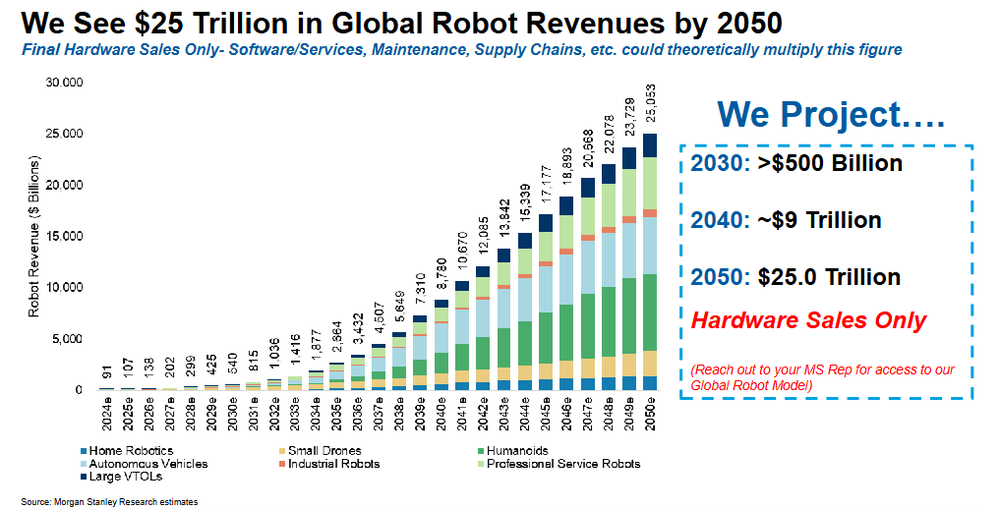
Core Insights - The article discusses a fundamental shift in artificial intelligence from the digital realm to the physical world, predicting a global robotics hardware market worth $25 trillion by 2050 due to this transition [1][4]. Group 1: Market Growth Projections - Morgan Stanley's global robotics model forecasts that global robotics hardware sales will surge from approximately $100 billion in 2025 to $500 billion by 2030, reaching $9 trillion by 2040 and $25 trillion by 2050 [1][5]. - By 2050, it is estimated that 1.4 billion robots will be sold globally, with a total of 6.5 billion operational robots [5]. Group 2: Diverse Robot Types and Applications - The types of robots will be highly diverse, including industrial robots, service robots, drones, autonomous vehicles, humanoid robots, and household robots, covering various applications from manufacturing to healthcare, agriculture, transportation, defense, and space exploration [8]. Group 3: Component Demand Surge - The explosive growth in the robotics industry will create significant opportunities for upstream component suppliers, with projections indicating the need for 5.7 billion cameras, 27 billion motors, 41 billion bearings, and 1.25 million ExaFLOPS of edge computing capacity by 2050 [9]. - The demand for rare earth magnets and battery capacity will also see substantial increases, with projections of 170 million tons of rare earth magnets and 26 terawatt-hours of battery capacity required [9]. Group 4: Investment Opportunities - The demand surge will present major business opportunities for suppliers of motors, bearings, rare earth materials, cameras, sensors, AI chips, and batteries [11]. - Small drones and low-altitude robotic systems are identified as the most promising investment areas, driven by ease of navigation, lessons learned from the Russia-Ukraine conflict, and the maturation of regulatory frameworks [11]. Group 5: China's Competitive Advantage - China demonstrates a clear competitive advantage in manufacturing capabilities, control over rare earth materials, and policy support, with expectations that its leading position will continue to expand over the next decade [4][16]. - By 2025, investments in robotics and drone sectors in China are expected to exceed $30 billion, with AI-related financing reaching $260 billion, highlighting the significant role of Chinese companies in these markets [15]. - China is projected to account for approximately 26% of global robot sales by 2050, with even higher shares in industrial robots and drones [16].

全球首款无人机母舰测试成功,一次释放200多架无人机实施超饱和攻击
Xin Lang Cai Jing· 2025-12-13 12:23
Core Viewpoint - The world's first drone mothership has successfully tested its capability to launch over 200 drones for a saturation attack, demonstrating a significant advancement in drone warfare technology [1] Group 1 - The drone mothership is capable of releasing more than 200 small drones or loitering munitions in a single operation, showcasing its potential for overwhelming enemy defenses [1] - The successful test highlights the effectiveness of the "Fire Phoenix" plan, indicating a strategic shift in military operations towards drone-based warfare [1]

法国巴黎银行看好美国航空航天与国防板块,雷神(RTX.US)、TransDigm(TDG.US)、AeroVironment(AVAV.US)获力挺
智通财经网· 2025-11-20 07:20
Core Viewpoint - BNP Paribas Exane initiates coverage on 12 U.S. aerospace and defense companies, suggesting selective investment due to pressures in commercial aviation and anticipated growth in defense spending by 2026 [1] Commercial Aviation - The firm prefers parts and subsystem suppliers over large OEMs, favoring companies like Raytheon (RTX.US), TransDigm (TDG.US), and AeroVironment (AVAV.US) with positive ratings, while giving a negative outlook on Boeing (BA.US) and GE Aerospace (GE.US) [1][3][4][5] Defense Sector - Exane expects U.S. budget decisions in 2026 to drive demand, listing Lockheed Martin (LMT.US), Northrop Grumman (NOC.US), and AeroVironment (AVAV.US) as preferred picks [1] Company Ratings - **AeroVironment (AVAV.US)**: Outperform, positioned at the core of U.S. defense priorities with expected double-digit growth in its AxS segment [1] - **TransDigm (TDG.US)**: Outperform, with anticipated profit margin improvements in 2026 and 2027, and a projected special dividend of $100 next year [2][3] - **Raytheon (RTX.US)**: Outperform, expecting improved output from Collins Aerospace and growth in Pratt & Whitney [4] - **GE Aerospace (GE.US)**: Underperform, with concerns over declining aftermarket revenue and increasing losses in the GE9X project [5] - **L3Harris Technologies (LHX.US)**: Neutral, with limited room for valuation expansion despite benefits from missile defense projects [6] - **Boeing (BA.US)**: Underperform, with overly optimistic expectations on aircraft production and cash flow [7] - **Lockheed Martin (LMT.US)**: Outperform, driven by missile projects and international demand [8] - **Kratos Defense (KTOS.US)**: Neutral, with high valuation concerns despite broad defense technology coverage [9] - **General Dynamics (GD.US)**: Outperform, with expected improvements in various sectors including Gulfstream jets and shipbuilding [10] - **Northrop Grumman (NOC.US)**: Outperform, with anticipated growth in multiple projects as they transition to procurement phases [11] - **Howmet Aerospace (HWM.US)**: Outperform, with strong performance in pricing and market share [12] - **Heico (HEI.US)**: Neutral, with cautious outlook due to high valuation and potential slowdown in acquisitions [13]



跨企业技术合作,易邮快递超市以技术合力驱动服务升级
Sou Hu Cai Jing· 2025-10-17 04:56
Core Viewpoint - In the digital economy era, technological innovation is the core driving force for the development of the logistics and e-commerce industries. Easy Post Express Supermarket integrates resources from major e-commerce platforms and courier companies, promoting deep technological cooperation across enterprises to break down technical barriers and enhance service capabilities through collaborative innovation [1][9]. Group 1: System Interoperability - The disconnection between e-commerce platforms and courier companies has long restricted logistics efficiency, leading to issues such as delayed order reviews and untimely logistics updates. Easy Post promotes "system interoperability" to achieve real-time data flow from order placement to package delivery [2][3]. - Data synchronization time has been reduced from an average of 30 minutes to under 10 seconds, improving order processing efficiency by over 95%. The time taken to trace abnormal orders has decreased from 4 hours to 30 minutes, resulting in a 40% reduction in user complaints [3]. Group 2: Intelligent Technology Development - Easy Post has formed a "cross-enterprise intelligent technology research alliance" to tackle core technologies such as intelligent forecasting, unmanned delivery, and green logistics technology. This collaboration aims to innovate and address industry pain points [4][5]. - The logistics demand forecasting model developed by Easy Post has an accuracy rate exceeding 85%, helping courier companies reduce capacity waste by 15% and improve order fulfillment rates to 98% [5]. - Unmanned delivery vehicles and drones have been developed to address last-mile delivery challenges, with pilot operations in 500 communities across 20 cities, significantly alleviating delivery pressure [5][6]. Group 3: Service Standard Co-construction - The lack of unified service standards in the e-commerce and courier industries leads to inconsistent service quality. Easy Post promotes the establishment of unified service standards and technical specifications to enhance overall service levels [7][8]. - A standardized after-sales processing system has been created, improving user satisfaction with after-sales complaint handling from 75% to 92% [8]. - A technical service assessment standard has been established, linking assessment results to resource allocation, thereby incentivizing companies to improve service quality [8]. Group 4: Future Directions - Easy Post's cross-enterprise technological cooperation model provides a replicable example for the collaborative development of technology in the logistics and e-commerce industries. Future expansions may include the introduction of AI customer service and blockchain traceability technologies [10].

“美国发现自己落后了”,美媒:美国面临无人机制造困境
Huan Qiu Wang· 2025-09-16 15:00
Core Insights - The U.S. military is struggling to keep pace with drone manufacturing capabilities compared to countries like China, despite efforts to accelerate production [1][3] - The ongoing Russia-Ukraine conflict has highlighted the rapid evolution in drone warfare, revealing that the U.S. is lagging behind in this area [3][4] Group 1: Manufacturing Challenges - The U.S. excels in producing large, expensive weapons like fighter jets and tanks but is unprepared for the rapid mass production of smaller, cheaper drones [3] - A significant challenge for the U.S. is the inability to use Chinese-made components in weapons due to security concerns, while domestic alternatives are significantly more expensive [3] Group 2: Market Position - Chinese companies dominate the consumer drone market, while U.S. manufacturers of first-person view (FPV) drones rely heavily on contracts from the Department of Defense, which currently do not include large-scale procurement [3] - The U.S. Department of Defense's "Replicator" initiative aims to produce 3,000 drones within two years, but this is a small fraction compared to China's production of tens of millions of small drones annually [3] Group 3: Policy and Implementation - The Pentagon announced a major policy shift on July 10 to accelerate the deployment of small drones across the military, aiming to equip thousands of drones to the forces [4] - Despite these initiatives, the U.S. military's implementation of drone policies and the resulting impacts remain uncertain, with a noticeable gap between current drone application and global trends [4]
解放军演练登陆作战,画面披露
财联社· 2025-08-04 02:34
Core Viewpoint - The article emphasizes the importance of joint operations among land, sea, and air forces, showcasing advancements in military tactics and technology to enhance combat effectiveness [1][8]. Group 1: Joint Operations - The military is pioneering new strategies and tactics, focusing on complex combat scenarios that require diverse equipment and professional expertise [1][8]. - A recent exercise demonstrated the collaboration between army and navy forces, highlighting the challenges faced during night operations and the importance of situational awareness [3][11]. Group 2: Technological Advancements - New technologies are driving the development of innovative combat methods, such as the integration of small drones with tanks for coordinated operations [9]. - The military is continuously refining new tactics to overcome obstacles in landing operations, indicating a shift towards more sophisticated warfare techniques [9][13]. Group 3: Realistic Training - The article describes a realistic training scenario where soldiers experienced near-combat conditions, enhancing their readiness and morale [11]. - The transition from training to combat readiness was emphasized, with specific missions outlined to achieve tactical objectives during landing operations [13].

本轮泰柬冲突,可以回答“隐身战斗机与小型无人机”之问了
Hu Xiu· 2025-07-28 02:40
Group 1 - The recent military conflict between Cambodia and Thailand has resulted in dozens of deaths and the evacuation of 130,000 people from the war zone [1] - The conflict is similar to previous disputes over the Preah Vihear Temple, characterized by cross-border gunfire [2] - The historical context of the Preah Vihear Temple dates back to the Khmer Empire, with territorial disputes influenced by colonial history and international court rulings [3][4][5] Group 2 - The current conflict is centered around the Mota Antong Temple, located approximately 200 kilometers from Preah Vihear Temple, with initial exchanges of gunfire [13] - Political dynamics in Thailand and Cambodia have influenced the conflict, with leaders attempting to mediate while facing internal pressures [12][14] - The military capabilities of Thailand are significantly stronger than those of Cambodia, particularly in air power, which has played a crucial role in the current conflict [16][19] Group 3 - Cambodia has recently acquired advanced artillery from China, which may enhance its military response compared to previous conflicts [17][23] - The ongoing arms race in Southeast Asia reflects the regional powers' efforts to bolster their military capabilities amid territorial disputes [22] - The conflict illustrates the complex interplay of military strength and political maneuvering in Southeast Asia, where both nations have their own strategic interests [20][21]

防线“迅速崩溃”?美国断供弹药 乌军先进武器恐成废铁
Zhong Guo Xin Wen Wang· 2025-07-04 11:28
Group 1 - The U.S. has paused the delivery of certain weapons to Ukraine, which the White House claims aligns with U.S. interests, while Russia welcomes this decision as a means to expedite the end of the conflict, and Ukraine finds it "painful" [1] - The Trump administration has withheld hundreds of PAC-3 missiles, Stinger missiles, Sparrow missiles, Hellfire missiles, precision-guided rockets, and thousands of 155mm artillery shells, citing concerns that U.S. military weapon stocks could drop to dangerous levels [1] - Analysts suggest that the halt in ammunition supply could render a significant amount of U.S.-made weaponry in Ukraine obsolete, impacting the overall military capability of the Ukrainian forces [1] Group 2 - Since 2021, Russian defense industry production capacity has increased tenfold, capable of supporting battlefield consumption for 500,000 troops, while the U.S. military faces challenges in maintaining its weapon stock due to commitments in Ukraine, Israel, and other regions [2] - Ukrainian officials emphasize their heavy reliance on U.S. weapon supplies, stating that without U.S. ammunition, they would face significant difficulties despite European efforts [2] - Estimates suggest that the Western weapons available to Ukrainian forces may only last until the end of summer 2023, prompting Ukraine to ramp up the production of small drones, with an expected annual output exceeding 4 million units [2] Group 3 - The Ukrainian Defense Minister acknowledged that a recent large-scale airstrike by Russia aimed to deplete Ukraine's air defense capabilities [3] Group 4 - The ongoing conflict has displaced approximately 10.6 million people, representing about a quarter of Ukraine's population, with many others suffering from frequent airstrikes and shortages [4] - A recent poll indicates that 56% of Ukrainians support ending the war through negotiations, reflecting a growing sentiment that military victory may not be achievable [4]