
工银蒙能清洁能源REIT

Search documents
商业不动产REITs申报项目增至12单,首单数据中心REITs拟扩募
Mei Ri Jing Ji Xin Wen· 2026-02-24 12:14
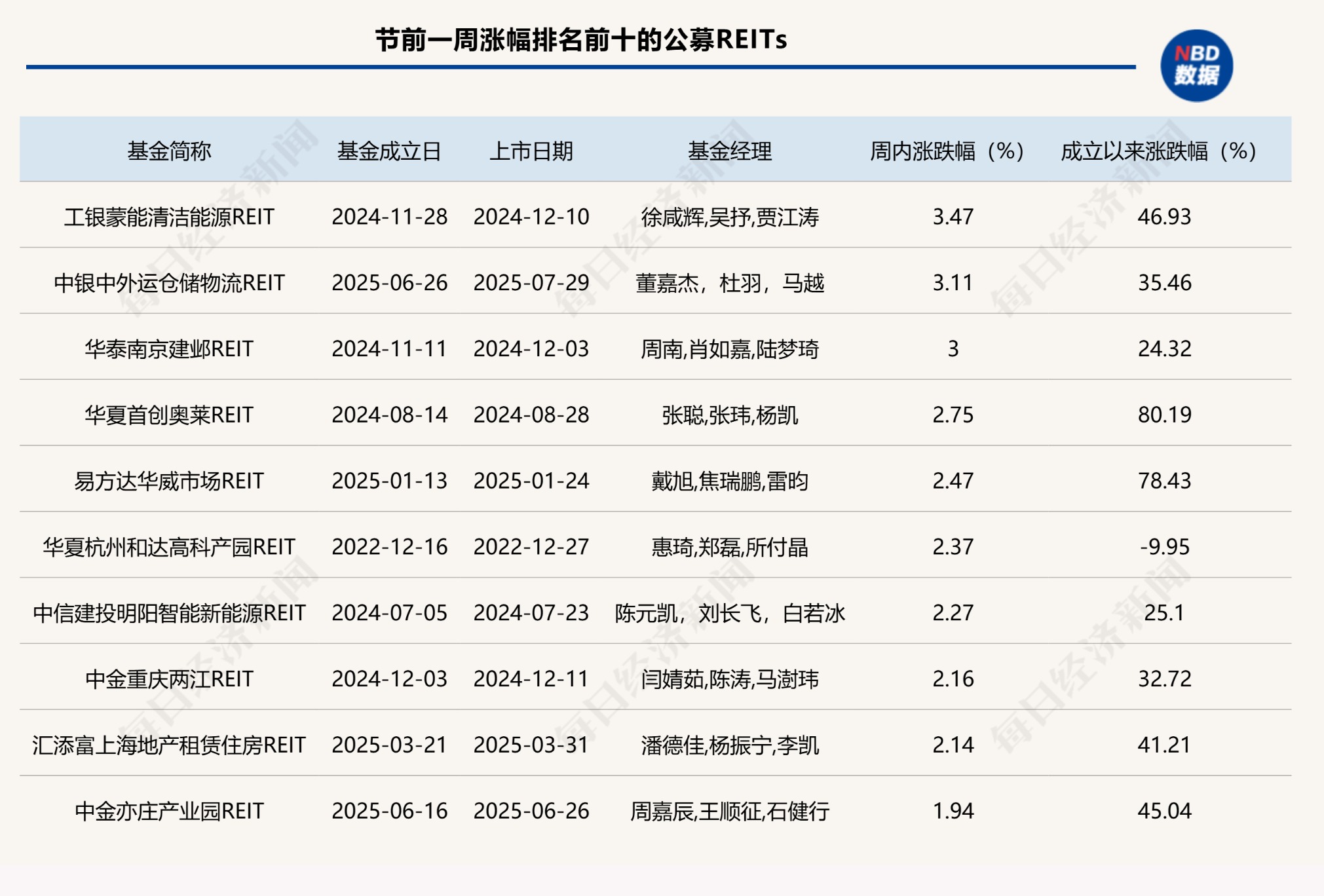
Group 1 - The public REITs market showed signs of recovery in the week before the Spring Festival, with significant increases in sectors such as data centers, consumption, and energy [1][2] - Among the 79 listed public REITs, 60 experienced a rise, with the top three performers being ICBC Mengneng Clean Energy REIT, Bank of China China Foreign Trade Warehousing Logistics REIT, and Huatai Nanjing Jianye REIT, which rose by 3.47%, 3.11%, and 3% respectively [1][2] - The overall trading activity of public REITs decreased, with a total transaction amount of 411 million yuan, down 29.5% from the previous week [4] Group 2 - There has been a continuous push for commercial real estate REITs, with the number of newly reported projects increasing to 12, including two new projects on the Shanghai Stock Exchange [6] - The first IDC public REIT, Southern Runze Data Center REIT, plans to expand its fundraising, with underlying assets comparable to its initial offering [9] - Two new commercial real estate REITs have been reported, with expected fundraising of 12.6 billion yuan and 27.5 billion yuan, respectively, indicating new opportunities for real estate companies undergoing transformation [8]

公募REITs二级市场震荡上行 首批商业不动产REITs集中申报
Mei Ri Jing Ji Xin Wen· 2026-02-02 16:23
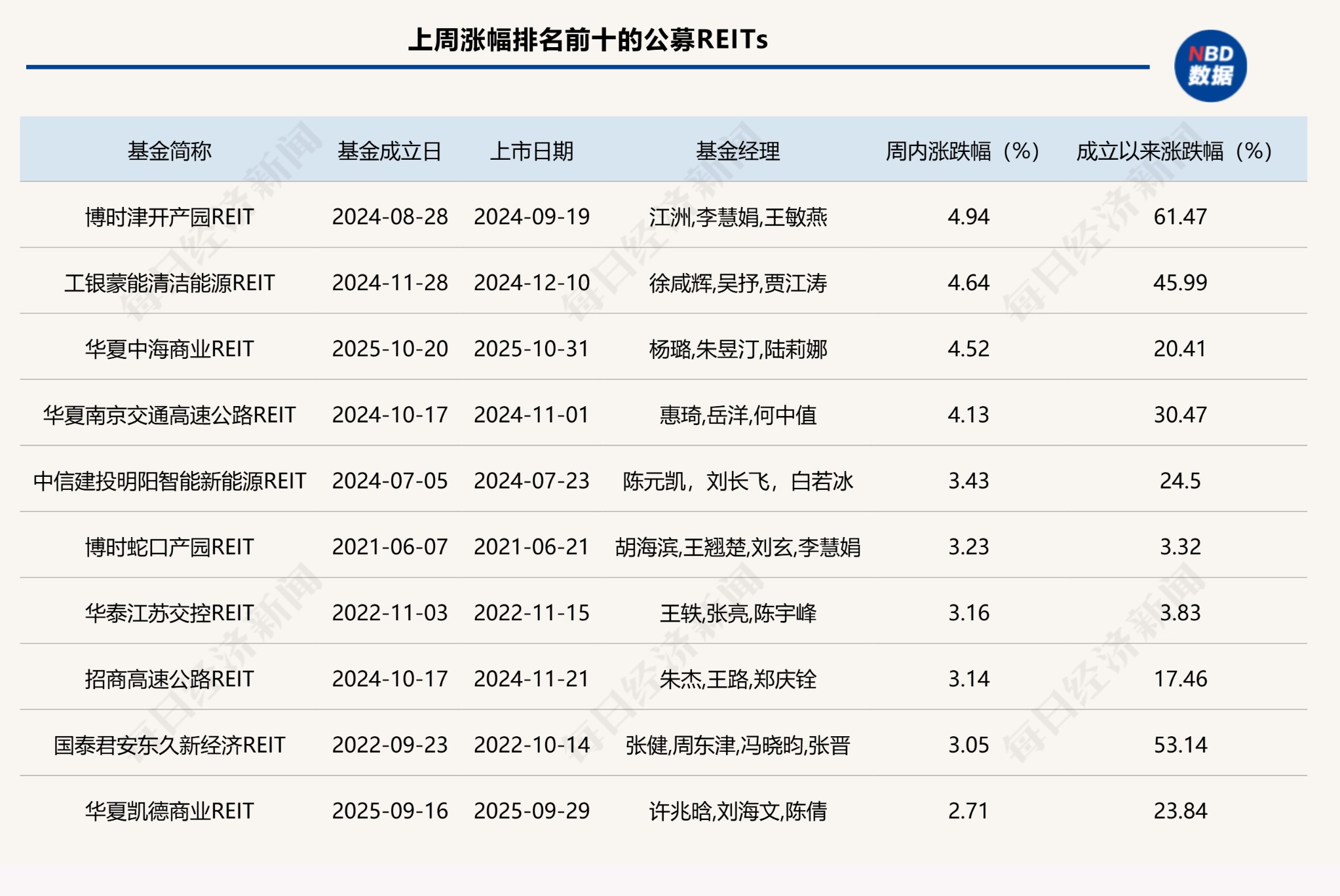
Core Viewpoint - The public REITs market experienced a fluctuating upward trend last week, with significant movements in various sectors, particularly in commercial real estate REITs, which have garnered attention due to new listings and market dynamics [1][3][9]. Market Performance - As of January 30, the CSI REITs index closed at 809.56 points, reflecting a week-on-week increase of 0.35%, while the CSI REITs total return index reached 1052.42 points, up by 0.47% [1][3]. - Among the 78 listed public REITs, 41 saw an increase in value, with the top three performers being Bosera Jinkai Industrial Park REIT (+4.94%), ICBC Mengneng Clean Energy REIT (+4.64%), and Huaxia Zhonghai Commercial REIT (+4.52%) [2][4]. Sector Analysis - The energy and municipal environmental REITs sectors showed the highest gains last week, indicating a positive trend in these areas [4]. - Conversely, 36 products experienced declines, with the largest drops recorded by E Fund Guangkai Industrial Park REIT (-5.03%), Huaxia Hefei High-tech REIT (-3.39%), and Bank of China China Foreign Storage Logistics REIT (-2.68%) [2][4]. New Listings and Industry Developments - The first batch of eight commercial real estate REITs was submitted for approval, marking a significant expansion in the market. These REITs focus on office buildings, shopping centers, and hotels, diversifying the asset types available [9][10]. - The total fundraising target for these new REITs is approximately 31.475 billion yuan, with a mix of private, foreign, and state-owned enterprises involved [10][12]. Investor Sentiment and Market Dynamics - The enthusiasm for commercial real estate REITs is evident, with additional companies like Maoye Commercial and Everbright Jiabao planning to submit their own REITs [12]. - Long-term, this influx of new products is expected to optimize the investor structure within the REITs market and enhance liquidity, although it may also create short-term pressures on market sentiment [12].
公募REITs周报(第52期):指数震荡上行,首批商业不动产REITs已申报-20260201
Guoxin Securities· 2026-02-01 12:50
Report Industry Investment Rating - Not provided in the given content Core Viewpoints of the Report - This week, REITs fluctuated upwards, outperforming major stock and bond indices. The CSI REIT Index rose 0.8% this week, with water conservancy, energy, and transportation REITs leading the gains, while data center REITs, which had significant increases earlier, adjusted significantly. The order of weekly returns of major indices was: CSI REIT > CSI 300 > CSI Aggregate Bond > CSI Convertible Bond. As of January 30, 2026, the dividend yield of equity REITs was 60 basis points lower than the average dividend yield of CSI Dividend stocks, and the spread between the average internal rate of return of concession - type REITs and the 10 - year Treasury yield was 326 basis points. The submission and acceptance of the first 8 commercial real - estate REITs by the Shanghai Stock Exchange signify a key expansion of China's public REITs market from the infrastructure sector to the commercial real - estate sector [1] Summary by Relevant Catalogs Secondary Market Trends - **Index Performance**: As of January 30, 2026, the closing price of the CSI REIT (Closing) Index was 809.56 points, with a weekly return of 0.8% from January 24 - 30, 2026, outperforming the CSI Convertible Bond Index (-2.6%), the CSI Aggregate Bond Index (0.0%), and the CSI 300 Index (0.1%). Year - to - date, the order of returns of major indices was: CSI Convertible Bond (+5.8%) > CSI REIT (+4.4%) > CSI 300 (+1.7%) > CSI Aggregate Bond (+0.4%). In the past year, the return of the CSI REIT Index was -2.8%, with a volatility of 7.5%. Its return was lower than that of the CSI Convertible Bond Index, the CSI 300 Index, and the CSI Aggregate Bond Index; its volatility was lower than that of the CSI 300 Index and the CSI Convertible Bond Index, but higher than that of the CSI Aggregate Bond Index [1][2][6] - **Market Size and Turnover**: The total market capitalization of REITs on January 30 was 228.7 billion yuan, an increase of 700 million yuan from the previous week. The average daily turnover rate for the whole week was 0.60%, a decrease of 0.16 percentage points from the previous week [2][8] - **Sector - Specific Performance**: As of January 23, 2026, the average weekly returns of equity REITs and concession - type REITs were 0.3% and 0.8% respectively. Among different project - type REITs, water conservancy, energy, and transportation REITs led the gains. The top three REITs in terms of weekly returns were Bosera Tianjin Binhai New Area Industrial Park REIT (+4.94%), ICBC Mongolia Energy Clean Energy REIT (+4.64%), and China Asset Management CNOOC Commercial REIT (+4.52%) [1][3][15] - **Trading Activity and Fund Flow**: Among different project - type REITs, new infrastructure REITs had the highest average daily turnover rate in the period, at 1.065%. Park infrastructure REITs had the highest proportion of trading volume this week, accounting for 20.251% of the total REIT trading volume. The top three REITs in terms of net inflow of main funds this week were China Asset Management China Resources Commercial REIT (38.6 million yuan), CICC Yizhuang Industrial Park REIT (15.9 million yuan), and CICC InCity Mall REIT (14.46 million yuan) [3][22][23] Primary Market Issuance - From January 1 to January 30, 2026, there were 3 REIT products in the in - inquiry stage, 3 in the feedback stage, 8 in the submitted stage on the exchange, and 8 commercial real - estate REITs were officially submitted [25] Valuation Tracking - **Valuation Metrics**: REITs have both bond - like and stock - like characteristics. As of January 30, the average annualized cash distribution rate of public REITs was 6.11%. From the stock - like perspective, relative net value premium rate, IRR, and P/FFO were used to evaluate REITs' valuations. The relative net value premium rate reflects the relationship between the market value and fair value of the fund, similar to the PB indicator of stocks. IRR is the internal rate of return calculated using the discounted cash - flow method, and P/FFO is the current price divided by the operating cash flow [27] - **Sector - Specific Valuation**: Different project - type REITs had different valuation levels. For example, the relative net value premium rate of affordable rental housing REITs was 42.40%, with a P/FFO of 38.43, an IRR of 3.50%, and an annualized dividend rate of 2.76% [28] - **Comparison of Equity and Concession - type REITs**: As of January 30, 2026, the dividend yield of equity REITs was 60 basis points lower than the average dividend yield of CSI Dividend stocks, and the spread between the average internal rate of return of concession - type REITs and the 10 - year Treasury yield was 316 basis points [1][30] Industry News - The first 8 commercial real - estate REITs' applications were accepted by the Shanghai Stock Exchange. On January 29, 2026, Hua'an Jinjiang Closed - end Commercial Real - Estate REIT, Huitianfu Shanghai Real - Estate Closed - end Commercial Real - Estate REIT, and CICC Vipshop Closed - end Commercial Real - Estate REIT were submitted and accepted. On January 30, another 5 commercial real - estate REITs were submitted, marking a key expansion of China's public REITs market from the infrastructure sector to the commercial real - estate sector [1][4][32]
公募REITs周报(第52期):数震荡上行,首批商业不动产REITs已申报-20260201
Guoxin Securities· 2026-02-01 11:15
1. Report Industry Investment Rating No relevant content provided. 2. Core Viewpoints - This week, REITs fluctuated upwards, outperforming major stock and bond indices. The China Securities REITs Index rose 0.8% this week, with water conservancy, energy, and transportation REITs leading the gains, while data center REITs, which had significant previous gains, adjusted significantly. The order of weekly price changes of major indices was: China Securities REITs > CSI 300 > China Securities All - Bond > China Securities Convertible Bonds [1]. - As of January 30, 2026, the dividend yield of equity - type REITs was 60BP lower than the average dividend yield of CSI Dividend stocks, and the spread between the average internal rate of return of concession - type REITs and the 10 - year Treasury bond yield was 326BP [1]. - The first 8 commercial real - estate REITs applications were accepted by the Shanghai Stock Exchange, indicating a key expansion of China's public REITs market from the infrastructure sector to the commercial real - estate sector [1]. 3. Summary by Directory 3.1 Secondary Market Trends - **Index Performance**: As of January 30, 2026, the closing price of the China Securities REITs (closing) Index was 809.56 points, with a weekly change of 0.8%, outperforming the China Securities Convertible Bonds Index (-2.6%), the China Securities All - Bond Index (0.0%), and the CSI 300 Index (0.1%). Year - to - date, the order of price changes of major indices was: China Securities Convertible Bonds (+5.8%) > China Securities REITs (+4.4%) > CSI 300 (+1.7%) > China Securities All - Bond (+0.4%). In the past year, the return rate of the China Securities REITs Index was -2.8%, with a volatility of 7.5%. Its return rate was lower than that of the China Securities Convertible Bonds Index, the CSI 300 Index, and the China Securities All - Bond Index; its volatility was lower than that of the CSI 300 Index and the China Securities Convertible Bonds Index, but higher than that of the China Securities All - Bond Index [2][6][8]. - **Market Capitalization and Turnover**: The total market capitalization of REITs on January 30 was 228.7 billion yuan, an increase of 700 million yuan from the previous week. The average daily turnover rate for the whole week was 0.60%, a decrease of 0.16 percentage points from the previous week [2][8]. - **REITs Performance by Type**: As of January 23, 2026, the average weekly price changes of equity - type REITs and concession - type REITs were 0.3% and 0.8% respectively. Among different project - type REITs, water conservancy, energy, and transportation REITs led the gains. The top three REITs in terms of weekly price increase were Boshi Jinkai Industrial Park REIT (+4.94%), ICBC Inner Mongolia Energy Clean Energy REIT (+4.64%), and Huaxia China Overseas Commercial REIT (+4.52%) [3][15][19]. - **Trading Activity**: In terms of different project types, new infrastructure REITs had the highest daily turnover rate during the period, with an average daily turnover rate of 1.065%; park infrastructure REITs had the highest trading volume share this week, accounting for 20.251% of the total REITs trading volume. The top three REITs in terms of net inflow of main funds this week were Huaxia China Resources Commercial REIT (38.6 million yuan), CICC Yizhuang Industrial Park REIT (15.9 million yuan), and CICC Yinli Consumption REIT (14.46 million yuan) [3][22][23]. 3.2 Primary Market Issuance - From January 1 to January 30, 2026, there were 3 REITs products in the in - inquiry stage, 3 in the feedback stage, and 8 in the application stage on the exchange. Among them, 8 commercial real - estate REITs were officially applied [25]. 3.3 Valuation Tracking - **Valuation Indicators**: REITs have both bond and equity characteristics. From the bond perspective, the annualized cash distribution rate is concerned. As of January 30, the average annualized cash distribution rate of public REITs was 6.11%. From the equity perspective, the relative net value premium rate, IRR, and P/FFO are used to judge the valuation of REITs. The relative net value premium rate reflects the relationship between the market value and the fair value of the fund, similar to the PB indicator of stocks; IRR is the internal rate of return calculated by the cash - flow discount method; P/FFO is the current price divided by the cash flow generated from operations [27]. - **Valuation by Project Type**: Different project - type REITs have different valuation levels. For example, the relative net value premium rate of affordable rental housing REITs was 42.40%, with a P/FFO of 38.43, an IRR of 3.50%, and an annualized dividend rate of 2.76% [28]. - **Comparison with Benchmarks**: Equity - type REITs' dividend yield was 60BP lower than the average dividend yield of CSI Dividend stocks, and the spread between the average internal rate of return of concession - type REITs and the 10 - year Treasury bond yield was 316BP as of January 30, 2026 [30]. 3.4 Industry News - The first 8 commercial real - estate REITs applications were accepted by the Shanghai Stock Exchange. On January 29, 3 commercial real - estate REITs were applied and accepted; on January 30, 5 more were applied. This marks a key expansion of China's public REITs market from the infrastructure sector to the commercial real - estate sector [4][32].
REITs 周度观察(20260126-20260130):二级市场价格波动上涨,首批商业不动产 REITs 已申报-20260131
EBSCN· 2026-01-31 09:55
1. Report Industry Investment Rating - Not mentioned in the report 2. Core Viewpoints of the Report - From January 26 to January 30, 2026, the secondary - market prices of listed public REITs in China showed a fluctuating upward trend. The returns of REITs ranked third among major asset classes, behind only crude oil and ahead of other assets such as pure bonds, US stocks, A - shares, gold, and convertible bonds. Different types of REITs also showed varying performance in terms of price, trading volume, and net inflow of funds [1][11]. - In the primary market, no new REITs were listed this week, but the project status of 10 REITs was updated, and 8 commercial real - estate REITs were declared [4][41]. 3. Summary According to the Directory Secondary Market Price Trends - **At the major asset level**: The secondary - market prices of listed public REITs in China showed a fluctuating upward trend. The China Securities REITs (closing) and the China Securities REITs Total Return Index closed at 809.56 and 1052.42 respectively, with weekly returns of 0.35% and 0.47%. The weighted REITs index had a weekly return of 0.42%. Compared with other major asset classes, the return ranking from high to low was: crude oil > REITs > pure bonds > US stocks > A - shares > gold > convertible bonds [11]. - **At the underlying asset level**: Both equity - type and franchise - type REITs saw price increases. The return of equity - type REITs was 0.27%, and that of franchise - type REITs was 0.68%. Among different underlying asset types, water conservancy facilities REITs had the largest increase, with the top three return - ranking underlying asset types being water conservancy facilities, energy, and transportation infrastructure, with returns of 2.04%, 1.55%, and 0.44% respectively [16][19]. - **At the single - REIT level**: Among the REITs, 41 rose, 1 remained flat, and 36 fell. The top three in terms of increase were Bosera Jinkai Industrial Park REIT, ICBC Mengneng Clean Energy REIT, and China Asset Management China Overseas Commercial REIT, with increases of 4.94%, 4.64%, and 4.52% respectively. The top three in terms of decline were E Fund Guangkai Industrial Park REIT, China Asset Management Hefei High - tech REIT, and BOC Sinotrans Warehouse Logistics REIT, with declines of 5.03%, 3.39%, and 2.68% respectively [22]. Trading Volume and Turnover Rate - **At the underlying asset level**: The trading volume of public REITs this week was 3.18 billion yuan. The new - type infrastructure REITs led in the average daily turnover rate during the period. The total trading volume of the 78 listed REITs was 3.18 billion yuan, and the average daily turnover rate during the period was 0.68%. In terms of trading volume, the top three REIT asset types were park infrastructure, consumer infrastructure, and transportation infrastructure, with trading volumes of 644 million yuan, 561 million yuan, and 541 million yuan respectively. In terms of turnover rate, the top three were new - type infrastructure, ecological and environmental protection, and municipal facilities, with average daily turnover rates of 1.06%, 0.80%, and 0.77% respectively [24]. - **At the single - REIT level**: The trading volume and turnover rate of single REITs continued to show differentiation. In terms of trading volume, the top three were China Asset Management Hefei High - tech REIT, Bosera Shekou Industrial Park REIT, and Harvest JD Warehouse Infrastructure REIT, with trading volumes of 410 million shares, 360 million shares, and 300 million shares respectively. In terms of trading value, the top three were China Asset Management China Resources Commercial REIT, Southern Runze Technology Data Center REIT, and Harvest JD Warehouse Infrastructure REIT, with trading values of 128 million yuan, 109 million yuan, and 109 million yuan respectively. In terms of turnover rate, the top three were CICC Yizhuang Industrial Park REIT, Harvest JD Warehouse Infrastructure REIT, and CITIC Construction Shenyang International Software Park REIT, with turnover rates of 12.23%, 8.97%, and 8.71% respectively [27]. Net Inflow of Main Funds and Block Trading - **Net inflow of main funds**: The total net inflow of main funds this week was 149.1 million yuan, and the market trading enthusiasm decreased compared with last week. At the level of different underlying asset REITs, the top three in terms of net inflow during the period were consumer infrastructure, park infrastructure, and energy infrastructure, with net inflows of 72.01 million yuan, 29.45 million yuan, and 19.13 million yuan respectively. At the single - REIT level, the top three in terms of net inflow were China Asset Management China Resources Commercial REIT, CICC Yizhuang Industrial Park REIT, and CICC Yinli Consumer REIT, with net inflows of 38.6 million yuan, 15.9 million yuan, and 14.47 million yuan respectively [30]. - **Block trading**: The total block - trading volume this week reached 366 million yuan, a decrease compared with last week. There were block - trading transactions on 5 trading days, with a total block - trading volume of 366 million yuan. The block - trading volume on Wednesday (January 28, 2026) was the highest during the period, reaching 108.06 million yuan. At the single - REIT level, the top three in terms of block - trading volume were Ping An Ningbo Jiaotou REIT, Huatai Baowan Logistics REIT, and Harvest JD Warehouse Infrastructure REIT, with trading volumes of 180.62 million yuan, 45.8 million yuan, and 42.87 million yuan respectively, and corresponding average discount - premium rates of - 1.66%, - 2.11%, and - 0.01% respectively [33]. Primary Market Listed Projects - As of January 30, 2026, there were 78 public REIT products in China, with a total issuance scale of 201.749 billion yuan. Among them, transportation infrastructure had the largest issuance scale, reaching 68.771 billion yuan, followed by park infrastructure REITs, with an issuance scale of 32.933 billion yuan. No new REIT products were listed this week [37]. Projects to be Listed - According to the project announcements of the Shanghai and Shenzhen Stock Exchanges, there were 22 REITs in the to - be - listed state, including 20 initial - offering REITs and 2 REITs to be expanded. This week, the project status of AVIC Beijing Changbao Rental Housing Closed - end Infrastructure Securities Investment Fund (initial offering) and CICC Xiamen Torch Industrial Park Closed - end Infrastructure Securities Investment Fund (initial offering) was updated to "inquired". In addition, 8 commercial real - estate REITs were declared [41].
又有5只商业不动产REITs,上报并获受理
Zhong Guo Ji Jin Bao· 2026-01-30 13:47
Market Performance - The public REITs secondary market experienced an overall upward trend this week, with a slight decrease in trading activity compared to the previous week [1] - The CSI REITs total return index increased by 0.47% this week, while the CSI REITs index rose by 0.35%, outperforming the CSI 300 index [1][2] - As of January 30, the CSI REITs total return index closed at 1052.42 points, marking a positive weekly growth for two consecutive weeks [2] Individual REITs Performance - Among the 78 listed public REITs, 41 saw an increase in their prices this week, with the top performers being focused on sectors such as parks, energy, consumption, and transportation [2] - The best-performing REIT this week was Bosera Jinkai Industrial Park REIT, which had a weekly increase of 4.94% [3] - Other notable gainers included ICBC Mengneng Clean Energy REIT and Huaxia Zhonghai Commercial REIT, with weekly increases of 4.64% and 4.52%, respectively [3] New Listings and Applications - Huaxia Zhongke Clean Energy REIT is set to be listed on the Shanghai Stock Exchange on February 2, becoming the 79th public REIT in the market [5] - Five commercial real estate REITs have been reported and accepted for review, with the first three submitted on January 29 [6][7] - The submitted commercial REITs include products from Huaxia Fund, Huitianfu Fund, and CICC Fund, expanding the total number of reported commercial REITs to eight [9]

初心向远 步履不停工银瑞信以高质量发展开启“十五五”新征程
Xin Lang Cai Jing· 2026-01-04 21:06
Core Viewpoint - The article emphasizes the commitment of the company, ICBC Credit Suisse Asset Management, to high-quality development in the public fund industry, aligning with national financial strategies and focusing on creating long-term value for investors [1][8]. Group 1: Financial Contributions and Strategies - As of November 2025, the company has invested over 1 trillion yuan in equity and debt assets for real enterprises, supporting over 400 companies on the Sci-Tech Innovation Board with IPO financing [2]. - The company has developed two flagship technology ETFs, each exceeding 10 billion yuan, facilitating investor participation in technological innovation [2]. - In response to the national "dual carbon" strategy, the company has issued 17 ESG-themed products, with total investments in green finance nearing 3000 billion yuan [2]. Group 2: Pension and Retirement Services - The company has established a comprehensive service system for pension finance, managing over 370 billion yuan in corporate annuities as of Q3 2025, with notable returns of 10.94% and 18.37% for fixed-income and equity-inclusive portfolios, respectively [2]. - A complete product line for personal pension products has been developed, with 13 fund products catering to various risk-return profiles and retirement ages [2]. Group 3: Investment Education and Engagement - The company has created a comprehensive investment education ecosystem, enhancing its "Investment Knowledge" brand with innovative initiatives like the "Anti-Money Laundering Maze" exhibition and the "Investment Knowledge 2.0" tea-themed event [3]. Group 4: Research and Investment Capabilities - The company has built a robust investment research capability, focusing on a multi-strategy approach and a high-quality professional team, achieving top rankings in absolute and excess returns among large equity fund companies over various time frames [4]. - The fixed income team employs a strategy aimed at low volatility and stable returns, with nine bond funds receiving a three-year five-star rating as of September 30, 2025 [4]. Group 5: Index and REITs Development - The company has established a diverse range of index investment products, covering broad-based, thematic, and enhanced index strategies, facilitating comprehensive asset allocation [5]. - In the public REITs sector, the company has successfully launched several innovative products, contributing to asset revitalization and infrastructure development [5]. Group 6: Digital Transformation and Risk Management - The company is actively pursuing digital transformation, integrating data, technology, and business operations, and has received awards for its advancements in financial technology [7]. - A comprehensive risk management system has been established, incorporating a "9+X" core risk indicator framework to enhance risk identification and control [7]. Group 7: Future Outlook - Looking ahead, the company aims to align with national financial strategies, enhance investor satisfaction, and contribute to building a resilient and vibrant modern financial system in China [8].
以专业锚定价值,探秘公募大厂的REITs实践
Zhong Guo Ji Jin Bao· 2025-12-19 08:13
Core Insights - Public REITs have emerged as a new growth point for the public fund industry, with a total market value exceeding 200 billion yuan in just four years since their launch in 2021, serving as a vital link between capital markets and infrastructure construction [1][2] Group 1: Public REITs Overview - Public REITs, or publicly offered infrastructure securities investment funds, allow ordinary investors to participate in infrastructure investments by breaking down large projects like highways and wind farms into smaller shares, thus enabling low-threshold investment opportunities [2] - The value of public REITs lies in their ability to "activate" dormant infrastructure assets and connect capital with new projects, creating a virtuous cycle of investment, operation, exit, and reinvestment [2] Group 2: Operational Structure - Public REITs utilize a dual-layer structure of "public fund + asset-backed securities," focusing on underlying infrastructure assets, with returns derived from stable cash flows and potential appreciation in the secondary market [3] - The management of public REITs involves a clear division of responsibilities, with fund managers overseeing the overall strategy while external operators manage daily operations, ensuring asset quality and stable returns for investors [3] Group 3: Investment Strategy - High-quality underlying assets are fundamental to the success of public REITs, with ICBC Credit Suisse's REITs focusing on core values in transportation infrastructure and green energy [4] - The G18 Rongwu Expressway, part of the national highway network, serves as a key asset for the Hebei Expressway REIT, projected to achieve a cash distribution rate of 9.48% in 2024, indicating strong revenue potential [4] - The ICBC Mongolian Clean Energy REIT targets green investments through an inland wind power project, contributing to ecological protection while providing returns to investors [4] - The company is also diversifying its REIT product matrix by actively reserving various asset types such as parking lots, affordable rental housing, and industrial parks to meet different investor needs [4]
以专业锚定价值,探秘公募大厂的REITs实践
中国基金报· 2025-12-19 08:12
Core Viewpoint - The public REITs market has surpassed a total market value of 200 billion yuan within four years since the first products were launched in 2021, providing a new growth point for the public fund industry and serving as a crucial link between capital markets and infrastructure construction [2]. Group 1: Public REITs Overview - Public REITs, or publicly offered infrastructure securities investment funds, allow ordinary investors to participate in infrastructure investments by breaking down large projects like highways and wind farms into smaller shares, enabling low-threshold investment opportunities [4]. - The value of public REITs is reflected in two dimensions: revitalizing dormant infrastructure assets to fund new projects and providing a new investment channel that balances safety, profitability, and liquidity [4]. Group 2: Macro Perspective - From a macro perspective, public REITs are an important tool for implementing financial strategies and expanding effective investments [5]. Group 3: Operational Structure - Public REITs utilize a dual-layer structure combining public funds and asset-backed securities, focusing on underlying infrastructure assets, with returns derived from stable cash flows and potential appreciation in the secondary market [7]. - The management of public REITs features a clear division of responsibilities, with fund managers overseeing the overall strategy while external operational management entities handle day-to-day operations, ensuring stable performance for investors [7]. Group 4: Investment Strategy - High-quality underlying assets are fundamental to public REITs. ICBC Credit Suisse's REITs focus on core transportation infrastructure and align with the green energy trend [9]. - The G18 Rongwu Expressway, part of the national highway network, serves significant logistical functions and is projected to achieve a cash distribution rate of 9.48% in 2024, indicating strong revenue potential [9]. - The ICBC Mongolian Clean Energy REIT targets green investments through an inland wind power project, contributing to ecological protection while generating returns for investors [9]. - The company is also diversifying its REIT product matrix by actively reserving various asset types such as parking lots, rental housing, and industrial parks to meet different investor needs [9].

廿载初心映征程,REITs聚力赋实体——工银瑞信以绿色金融与基建投资书写战略答卷
Jin Rong Jie· 2025-12-19 06:21
Core Insights - Public REITs are becoming a key financial tool to support the real economy by revitalizing existing assets and facilitating investment and financing cycles [1][2] - The market for public REITs in China has entered a new phase of "normalization and scaling" after five years of exploration, with the total market value exceeding 220 billion yuan by the end of Q3 2025 [2][14] - ICBC Credit Suisse Asset Management has made significant strides in the public REITs market, launching notable products like the ICBC Galaxy North Expressway REIT and the ICBC Mengneng Clean Energy REIT, which have set records in investor subscriptions [2][8][13] Industry Development - The pilot program for public REITs in China was officially launched in April 2020, and the scope has since expanded to include commercial real estate, creating a dual-driven development model of "infrastructure + commercial real estate" [1][2] - As of Q3 2025, 13 transportation infrastructure REITs have been listed with a total issuance scale exceeding 68 billion yuan, highlighting the significant cluster effect in this sector [4] - The ICBC Galaxy North Expressway REIT has demonstrated strong operational resilience, achieving an annualized cash distribution rate of 9.30% as of Q3 2025 [4][6] Financial Performance - The ICBC Mengneng Clean Energy REIT, launched on December 10, 2024, achieved a subscription multiple of 357 times, setting a record for public REITs on the Shenzhen Stock Exchange [2][8] - The clean energy REIT is backed by wind power assets capable of generating 400 million kilowatt-hours of green electricity annually, contributing to significant carbon reduction efforts [8][10] - The financial indicators for the ICBC Galaxy North Expressway REIT show a revenue of 158 million yuan and a cash flow from operating activities of 134 million yuan for the reporting period [6] Strategic Initiatives - ICBC Credit Suisse Asset Management has established a three-tier collaborative system leveraging the comprehensive financial resources of its parent company, ICBC, to enhance project management and operational efficiency [11][12] - The company is focused on a diversified asset portfolio that includes transportation, clean energy, municipal infrastructure, and elder care services, aligning with national strategic directions [12] - The successful launch of these REITs reflects the company's commitment to revitalizing existing assets and facilitating economic circulation, contributing to the broader goal of a financial strong nation [13][14]
